
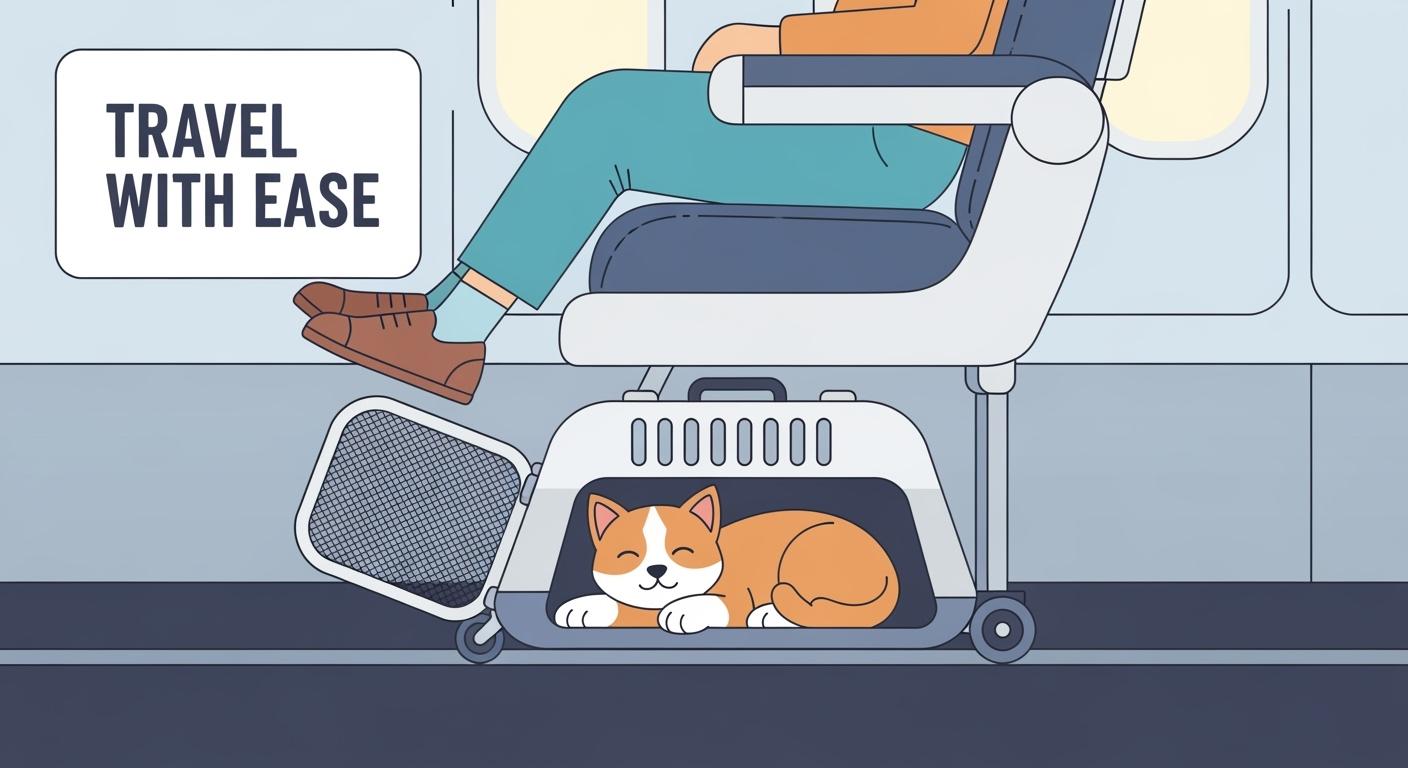
A pet carrier with wheels under the seat looks practical on the product page. The exterior dimensions suggest room to spare. Slide it under an airline seat, though, and the math changes. The wheel base and internal frame occupy volume that exterior measurements do not account for — and that volume comes directly out of the space a pet can actually use to sit, turn, or lie down.
The core trade-off is straightforward: wheels add rolling convenience in the terminal but subtract interior height and floor area where the pet spends the flight. A soft-sided carrier with a flat, frameless base avoids that subtraction. The design question is not whether wheels are useful — they are, before boarding — but whether the space they cost under the seat is worth the convenience they provide in the concourse.
Why a Wheel Base Shrinks Interior Space in an Under-Seat Carrier

Outside Dimensions vs. Usable Interior — the Numbers Gap
The label on a wheeled pet carrier lists exterior length, width, and height that can look identical to a soft-sided model. The difference is what sits inside those boundaries. A wheeled carrier dedicates a portion of its total envelope to a rigid sub-floor, axle housing, and telescoping handle channel — none of which the pet can occupy. A soft-sided carrier with no wheel assembly puts nearly the full exterior footprint to work as interior floor space.
| Carrier Type | Dimensions (L x W x H) |
|---|---|
| Soft-sided | 17″ x 11″ x 9.5″ |
| Soft-sided | 18″ x 11″ x 11″ |
| Soft-sided | 18.5″ x 8.5″ x 13.5″ |
| Soft-sided | 21.5″ x 15.5″ x 9″ |
| Soft-sided | 21.5″ x 15.5″ x 10.5″ |
These soft-sided dimensions represent what the pet actually gets. In a wheeled carrier with the same exterior numbers, the raised floor platform can consume 1.5 to 2.5 inches of vertical clearance before the pet ever steps inside. A carrier listed at 11 inches tall may deliver only 8.5 inches of standing room. That difference determines whether a cat can sit upright or must crouch for the entire flight.
How the Wheel Assembly Transfers Seat Pressure Into the Pet Compartment
The mechanism is physical, not subjective. A wheel assembly requires a rigid sub-floor to anchor the axle — the wheels cannot spin freely if the floor flexes under load. That sub-floor sits above the carrier’s true bottom panel, creating a raised platform. When the seat above presses down — as it does on every occupied airline seat — the rigid frame cannot distribute that downward force across the carrier’s footprint. Instead, the load concentrates at the frame edges, where the hard corners of the sub-floor meet the soft side walls. The side walls buckle inward at those points. The ceiling sags between frame members. The pet ends up in a compartment whose effective volume is smaller than the carrier’s own structure dictates — compression amplifies the space loss beyond what the wheel hardware alone accounts for.
A soft-sided carrier without a rigid sub-floor responds differently. The flat fabric base sits directly on the cabin floor. When seat pressure arrives from above, the flexible walls transfer that load to the floor across the entire perimeter, not through isolated frame points. The ceiling may dip slightly, but the walls do not collapse inward because no hard internal frame is creating leverage against them. The interior volume shrinks less under load — and in some cases not at all if the carrier is sized with a small margin of extra height.
Where Rigid Frames Fail in Actual Under-Seat Conditions
Rigid Base, Sliding, and Zipper Access Under Load
A hard plastic or metal base does not grip carpet. Slide a wheeled carrier under the seat and the smooth bottom panel can drift during taxi, takeoff, or turbulence. The carrier may rotate or migrate forward until it contacts the seat support bar — at which point the rigid base has no give, so the entire carrier tilts. A tilted carrier shifts the pet’s footing and can pin one side of the carrier against the seat structure, blocking a ventilation panel.
Zipper access also changes when the carrier is loaded and compressed. A rigid frame holds its shape at rest but does not guarantee that shape under seat pressure. If the ceiling bows down between frame rails, the zipper track can bind — making it harder to open the carrier partway to check on the pet mid-flight without fully extracting the carrier from under the seat.
Note: To test this at home, load the carrier with a weighted bag approximating your pet’s weight, slide it under a chair with roughly 10 inches of clearance, then try to unzip the top opening halfway. If the zipper resists or the slider catches, the frame is distorting under load.
Headroom Loss and Ventilation Collapse
The raised wheel-base floor does two things at once: it lifts the pet closer to the ceiling and reduces the ceiling’s ability to stay up. With less vertical clearance to begin with, even modest compression from the seat above can push the top panel onto the pet’s head or back. A cat that could sit upright in an unloaded carrier may spend the flight in a forced crouch.
Ventilation panels take the same hit. Mesh side windows rely on distance between the carrier wall and the pet’s body to allow air to move. When the rigid frame buckles inward and the walls collapse, that gap closes. The mesh can end up pressed flat against the pet’s fur, which blocks airflow at exactly the points where it is needed most. On a long flight, a carrier with collapsed side vents can trap heat and humidity inside — the pet arrives stressed and overheated even if the cabin temperature was comfortable.
An observable check: after a flight, open the carrier immediately and feel the mesh panels. If they are warm and damp to the touch on the inside surface, ventilation was inadequate. If they are dry and roughly cabin-temperature, airflow held up. This check works regardless of carrier brand or price point.
What Carrier Design Keeps Interior Space Intact Under the Seat
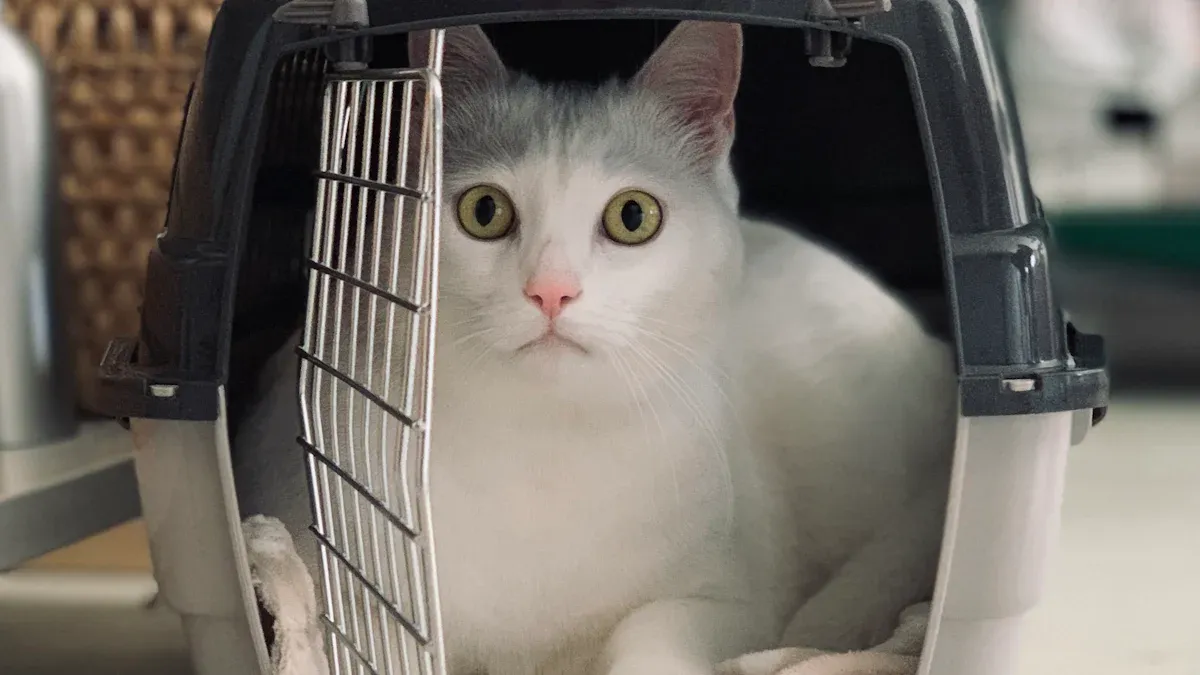
Flat-Base Soft-Sided Construction — Why the Floor Design Matters
The design feature that most directly determines usable space is the absence of a raised sub-floor. A soft-sided carrier with a flat fabric base places the pet at floor level — the same level the exterior height measurement assumes. Every inch of listed interior height is available to the pet. There is no wheel housing, no axle channel, no handle track running beneath the floor panel. The base is typically a single layer of durable fabric with a thin removable pad, which compresses only a fraction of an inch under weight.
This matters most for carriers used on flights where under-seat clearance varies by aircraft. A carrier with a flat base and no rigid floor can adapt to a seat support bar that protrudes downward by letting the fabric floor contour around it, rather than perching on top of it and tilting.
| Design Difference | Why It Matters |
|---|---|
| Flat fabric base (no wheel sub-floor) | Preserves interior height; pet stands at floor level, not on a raised platform |
| Flexible frame | Absorbs seat pressure without buckling side walls inward |
| Perimeter mesh ventilation | Keeps airflow open even when carrier sides contact seat structure |
| Foldable structure | Stores flat; no rigid hardware to deform in luggage |
Flexible Corners and Mesh Placement — Adapting to Variable Seat Clearance
Airlines publish carrier size limits, but the actual under-seat cavity is not a perfect box. Seat support bars, life-vest housings, and in-flight entertainment boxes create irregular obstructions. A rigid carrier must fit into the largest open rectangle within that cavity — a shape that is often smaller than the published dimensions suggest. A soft-sided carrier bends at the corners. If the cavity narrows toward the rear, the carrier’s rear corners compress inward. If a support bar hangs lower on one side, the carrier’s top panel dips locally rather than being blocked entirely.
Preparing a soft-sided carrier for airport travel involves fewer clearance surprises because the structure gives before it jams. This flexibility also keeps mesh panels functional: a soft carrier placed off-center under the seat can shift to keep at least two ventilation panels clear, even if one side contacts an obstruction. A rigid carrier with fixed mesh windows has no such option — the blocked window stays blocked.
Tip: Before travel, load the carrier and slide it under a desk or chair with similar clearance to your flight’s under-seat dimensions. Reach inside and measure the distance from floor to ceiling at three points — front, center, and rear. A difference greater than one inch between any two points signals uneven structural compression that will worsen under a full seat load.
Material choice also plays a role in how a soft carrier behaves under sustained load. Fabrics with a tight weave and light interior padding — common in airline-approved soft-sided carriers — resist sag because the weave distributes tension across the panel rather than concentrating it at stitch lines. In production terms, a carrier built with edge-bound seams and reinforced corner stitching holds its envelope shape better over repeated compression cycles than one with simple turned-and-stitched seams, which can develop slack at the corners after a few trips.
When a Soft-Sided Carrier Is the Wrong Tool
A soft-sided carrier is not the universal answer. The same flexibility that helps it fit under a seat makes it a poor choice for checked baggage or cargo-hold travel, where a hard-sided crate provides crush protection that no fabric carrier can match. Soft carriers also offer less protection if the carrier is handled roughly during gate-checking — a scenario where wheels and a rigid frame would actually earn their space penalty.
For pets that chew or claw at enclosure walls, a soft-sided carrier’s fabric panels are a vulnerability. A determined dog can open a mesh window in under a minute. In that scenario, a hard-sided carrier — wheeled or not — is the safer choice regardless of interior space efficiency.
For car travel, where under-seat compression is not a factor, the interior-space advantage of a soft-sided carrier largely disappears. A wheeled carrier’s rolling convenience may then outweigh its space cost, especially for heavier pets or longer terminal walks.
Disclaimer: This comparison assumes standard mainline-aircraft under-seat dimensions. Regional jets and some budget carriers use narrower seat configurations where even a soft-sided carrier may need to be oriented sideways, reducing usable length. If the dog has a long body relative to its standing height — Dachshunds and Corgis are common examples — a carrier that clears the height limit may still be too short for the dog to lie with legs extended. Measure the dog in both a standing and a fully stretched lying position, and verify your specific aircraft’s under-seat clearance, before committing to any carrier type.
FAQ
Can a pet carrier with wheels fit under an airplane seat at all?
It can, if the exterior dimensions match the airline’s published limits. The real question is not whether it fits but how much interior space survives the fit. A wheeled carrier that slides under the seat may still leave the pet with significantly less headroom and floor area than a soft-sided carrier of the same listed size — because the wheel assembly and rigid frame occupy interior volume that exterior dimensions do not capture.
What carrier dimensions work for most mainline airline under-seat spaces?
Carriers around 17 to 18 inches long, 11 inches wide, and 10 to 11 inches tall tend to fit under most mainline economy seats. Soft-sided models in this range have an edge because their flexible corners can conform to seat support bars and life-vest housings that would block a rigid carrier of the same footprint. Checking both the exterior and effective interior dimensions before flying avoids the most common sizing surprise: a carrier that fits the published limit at home but not the actual cavity on the aircraft.
Is a soft-sided carrier less durable than a wheeled one?
Different failure modes, not necessarily less durability. A wheeled carrier’s rigid base and frame can crack at the axle mounts or handle channel under repeated loading. A soft-sided carrier’s wear concentrates at seam lines and zipper tracks. For in-cabin use — where the carrier is not thrown, stacked, or exposed to cargo-hold conditions — a well-constructed soft-sided carrier with reinforced corner stitching and edge-bound seams typically lasts through years of regular travel.
| Design Difference | Main Limitation |
|---|---|
| Flat, flexible base | No crush protection if gate-checked; fabric floor can abrade on rough surfaces |
| Lightweight soft frame | May not hold shape if pet leans hard against one side for extended periods |
| Mesh ventilation panels | Vulnerable to chewing or clawing; a determined dog can tear through in under a minute |
| Foldable, no wheels | Heavier pets require carrying through the terminal; no rolling option for long concourses |






