
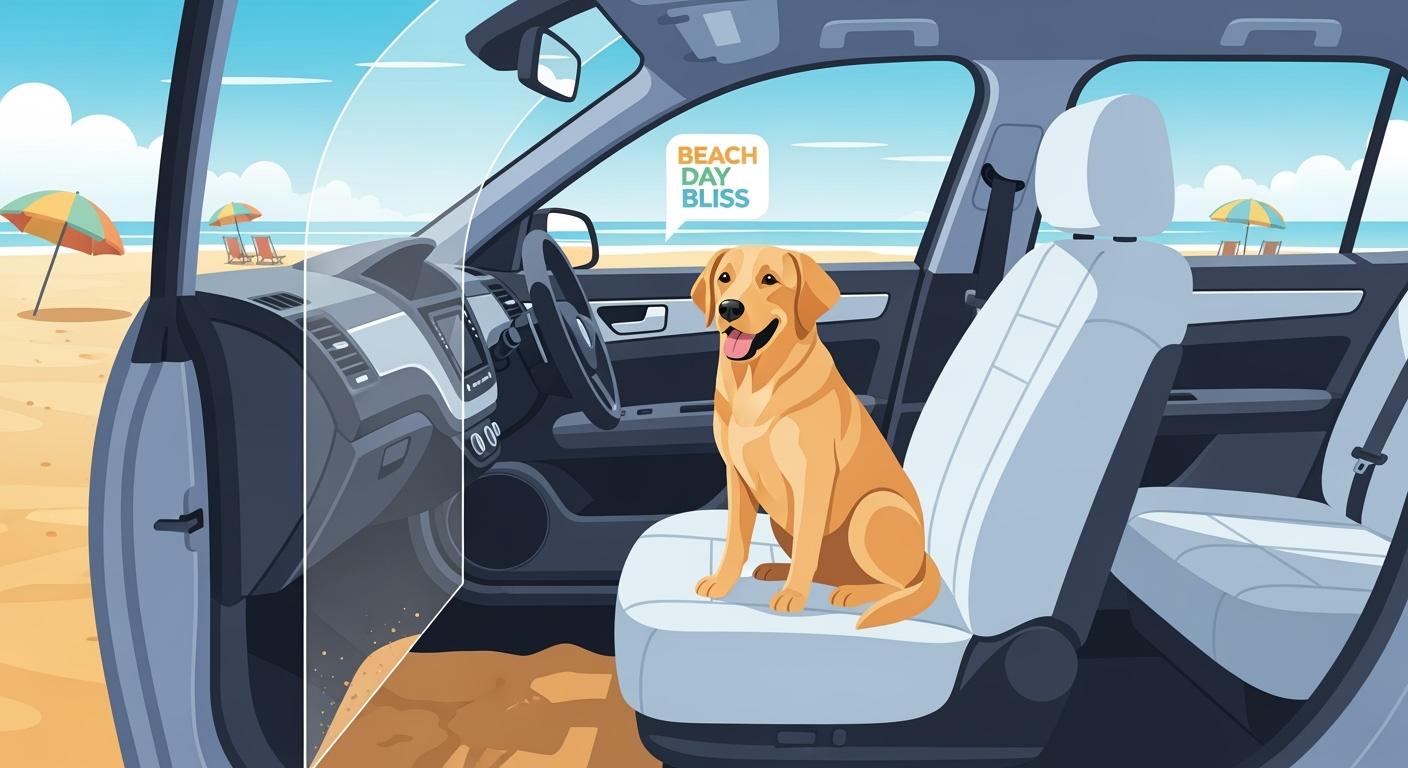
A beach trip with a dog ends the same way every time. Wet fur. Sandy paws. A car seat cover that was supposed to protect the upholstery now holding a layer of grit you cannot shake out. The difference between a cover that cleans up in seconds and one that traps sand for weeks comes down to two design decisions: what the top surface does when sand hits it, and whether the cover leaves gaps for sand to slip through. Get both wrong and beach sand wins every time. Get the surface right and sand has no place to grip.
Why Surface Design Decides Whether Sand Sticks or Releases
What Happens When Wet Sand Meets Fabric Texture
Sand particles are tiny, irregular crystalline fragments — sharp-edged under a microscope. When they land on a textured or looped fabric surface, those edges catch on fiber loops and mechanically interlock. The sand grain finds an anchor point. Your dog shifts position, presses down, and the grain gets driven deeper into the weave.
Wet sand compounds the problem. Water creates surface tension that acts as a weak adhesive between particle and fiber, and wet grains clump together, presenting a larger combined surface area for fabric to grip. A smooth, non-porous top layer — typically a TPU-coated or heavy polyester with a sealed finish — changes the physics entirely. No fiber loops means no anchor points. Surface tension still exists, but without mechanical interlock, a firm shake breaks the bond. The sand slides off.
This is the same principle behind sand-free beach towels: a tight, flat weave with no raised loops leaves sand nowhere to hide. Applied to in-car protection from sand and moisture, the same physics holds — smooth surfaces release, textured surfaces retain.
Why Seams Become Sand Reservoirs
Every stitched seam on a cover is a linear trap. When a dog moves or shakes off, the motion presses loose sand sideways across the surface. On a smooth panel, sand keeps sliding. Hit a seam and it drops into the channel. Quilted or diamond-stitched patterns multiply the problem — each stitch line becomes a collection trench that holds sand long after the surrounding surface is clean.
A cover with fewer seams in high-contact zones — the center panel where the dog sits, the areas under the shoulder and hip — gives sand fewer places to settle. The seams that remain should be positioned away from weight-bearing areas or heat-taped on the underside so the channel is sealed from below. This is not about eliminating seams entirely. It is about not putting them where sand and pressure intersect. A waterproof cover designed for real-world cleaning treats every seam as a potential failure point, not a decorative feature.
In practice: After a beach trip, shake the cover out over a patch of dry pavement. Count how many shakes it takes before no more sand falls. On a smooth TPU-coated surface, most dry sand releases within two firm shakes. On a quilted cover, sand keeps trickling out of the channels four or five shakes later — trapped grit that a surface-level wipe never reaches.
| Failure after a beach trip | Why it happens | What a better cover design does differently |
|---|---|---|
| Sand packed into seams and stitched channels | Wet sand pressed into channels by paw pressure and body weight; each seam acts as a linear collection trench | Fewer seams in high-contact zones; seams positioned away from weight-bearing areas; heat-taped underside seals the channel |
| Moisture soaking through to seat upholstery | No waterproof membrane between top layer and seat; water migrates through fabric under pressure | Waterproof or water-resistant backing layer blocks vertical moisture migration |
| Sand falling onto seat edges | Gaps between cover perimeter and seat bolster; no vertical barrier at sides | Raised side panels create a vertical catch surface that redirects sliding sand inward |
| Hard-to-clean surface after every trip | Textured or quilted fabric gives sand anchor points; grit hides in weave irregularities | Smooth, quick-clean top layer with minimal texture releases sand with a shake |
Where Sand Finds a Way Through — Gaps, Bunching, and Side Edges
A waterproof surface stops sand from embedding, but it does not stop sand from traveling. Sand on a cover is loose particulate — it moves with vibration, slope, and air currents inside the car. If the cover does not create a continuous barrier, sand finds the exit routes before you ever get a chance to clean.
Side Gaps That Let Sand Reach the Seat
The most overlooked failure point on a car seat cover is the side edge. A dog stepping in or out brushes against the side bolster. Sand on the fur transfers to the gap between cover and seat edge. If the cover sits flat with no raised lip or side flap, that sand drops straight onto the seat upholstery.
Raised side panels create a vertical barrier that catches sand before it clears the cover perimeter. The panel does not need to be tall — even an inch of vertical rise redirects sliding sand back toward the center of the cover. What matters is that the panel stays upright under pressure. A flimsy side flap that collapses when the dog leans against it is cosmetic, not functional. Side flaps and gap control on rear-seat covers only work when the panel construction includes stiffening that holds shape under lateral load.
Observable check: After a beach drive, run your hand along the seat edge where the cover meets the door-side bolster. Grit on the seat itself — not on top of the cover — means the side seal is failing and sand is escaping the containment zone.
What Happens When a Cover Bunches Under Movement
A cover that slides or bunches creates folds. Each fold is a sand pocket. Worse, the bunching motion itself works sand deeper into whatever fabric texture exists — like a hand rubbing grit into a carpet. When you finally shake the cover out, sand hides in creases you cannot see.
A non-slip backing addresses the root cause. Silicone-dotted or rubberized backing material increases the coefficient of friction between cover and seat surface. When the dog shifts weight, the cover stays put while the dog moves relative to it — sand stays on the surface instead of being ground in. Secure anchors — headrest straps, seat-crevice push-in anchors — keep the cover tensioned so there is no loose fabric to bunch in the first place. A back-seat cover with these anchoring features maintains a flat work surface that releases sand instead of trapping it in shifting folds.
A hammock-style cover adds another layer of containment: by suspending the cover between front and rear headrests, it eliminates the footwell gap entirely. Sand that slides forward hits a vertical wall of fabric instead of dropping onto the floor. Bench-style covers work if they are wide enough to tuck into the seat crevice on all sides, creating a mechanical seal rather than a draped edge. Stability and non-slip grip on back-seat covers determine whether that seal holds over the duration of a drive.
| Problem | What secure anchors change | Why it matters for sand cleanup |
|---|---|---|
| Cover bunches into folds | Anchors keep the cover tensioned flat across the seat surface | No folds means no sand pockets; sand stays on the surface where it can be shaken off |
| Sand collects where fabric shifts under the dog | Non-slip backing prevents the cover from sliding when the dog repositions | The dog moves relative to the cover; sand is not ground into the surface by shifting fabric |
| Cover slides off the seat edge | Headrest straps and seat-crevice push-in anchors lock the cover position | Perimeter seal stays intact; sand cannot escape through reopened side gaps |
Dark Surfaces Hide Sand Until It Is Too Late
Dark or heavily textured surfaces camouflage sand. You do not see the grit, so you do not clean it. Later — when someone sits in the back seat or you fold the cover for storage — the trapped sand reappears. A lighter, smooth surface makes sand immediately visible. You see the problem, you shake it out, you move on. This is a small design detail with an outsized effect on long-term seat condition.
A car seat cover built to handle beach sand earns its keep under specific conditions: frequent trips to sand beaches, dogs that go into the water, multi-dog households where the volume of wet sand multiplies fast. In these scenarios, the combination of a slick waterproof surface, minimal seams, raised sides, and non-slip anchoring directly reduces both the time spent cleaning and the amount of sand that reaches the upholstery over months of use.
The same design is overbuilt for a dog that rides in the car for dry park trips on grass or pavement. A simpler cover with a basic waterproof backing handles those conditions without the premium features. The beach-specific design does not make the cover worse for everyday use — a smooth surface still wipes clean — but the value proposition shifts. You are paying for sand-specific engineering that dry-use dogs do not need. Choosing car travel gear by real-world use conditions instead of feature lists keeps the decision grounded in what actually happens in your vehicle.
Disclaimer: The shake-out and wipe-down checks described here assume short-coated or smooth-coated dogs. Double-coated breeds — Huskies, Malamutes, German Shepherds — shed undercoat fibers that mix with sand and create a bonded mat that resists shaking regardless of surface smoothness. For these coats, hand-check by running fingers over the cover surface after shaking; if you feel grit embedded in the undercoat-sand mat, a vacuum pass clears what shaking cannot.
FAQ
How do you get wet sand off a dog car seat cover?
Let wet sand dry before attempting removal. Wet sand clumps and adheres through surface tension. Once dry, the water bonds break and the sand reverts to loose particulate — a quick shake or brush removes most of it. Wipe the remaining dust with a damp microfiber cloth. Rubbing wet sand while it is still wet presses it deeper into seams and surface texture, turning a quick cleanup into a scrubbing job.
Can a waterproof car seat cover go in the washing machine?
Most can, but machine washing gradually degrades the waterproof coating through mechanical agitation and detergent exposure. A faster and gentler approach: shake out loose debris, wipe the surface with a damp cloth and mild soap, and air dry. Reserve machine washing for deep cleaning every few months, using cold water and no fabric softener — softeners leave a residue that reduces surface slickness and makes sand more likely to stick on the next trip.
What is the difference between a hammock and a bench cover for sand containment?
A hammock suspends fabric between the front and rear headrests, creating a continuous basin with no gap at the footwell. Sand that slides forward hits fabric instead of carpet. A bench cover lays flat over the rear seat only and relies on tucked edges and raised sides to contain sand. Hammocks provide more complete containment for dogs that move around during drives. Bench covers work well for dogs that stay in one spot and for vehicles where front-seat access matters.
Do raised side panels actually stop sand?
They reduce sand escape, but effectiveness depends on panel stiffness. A side panel that holds its shape when the dog leans against it redirects sliding sand inward. One that folds flat on contact provides no barrier. Check panel construction: sewn-in stiffening inserts hold shape better than unreinforced fabric flaps that collapse under lateral pressure.






