
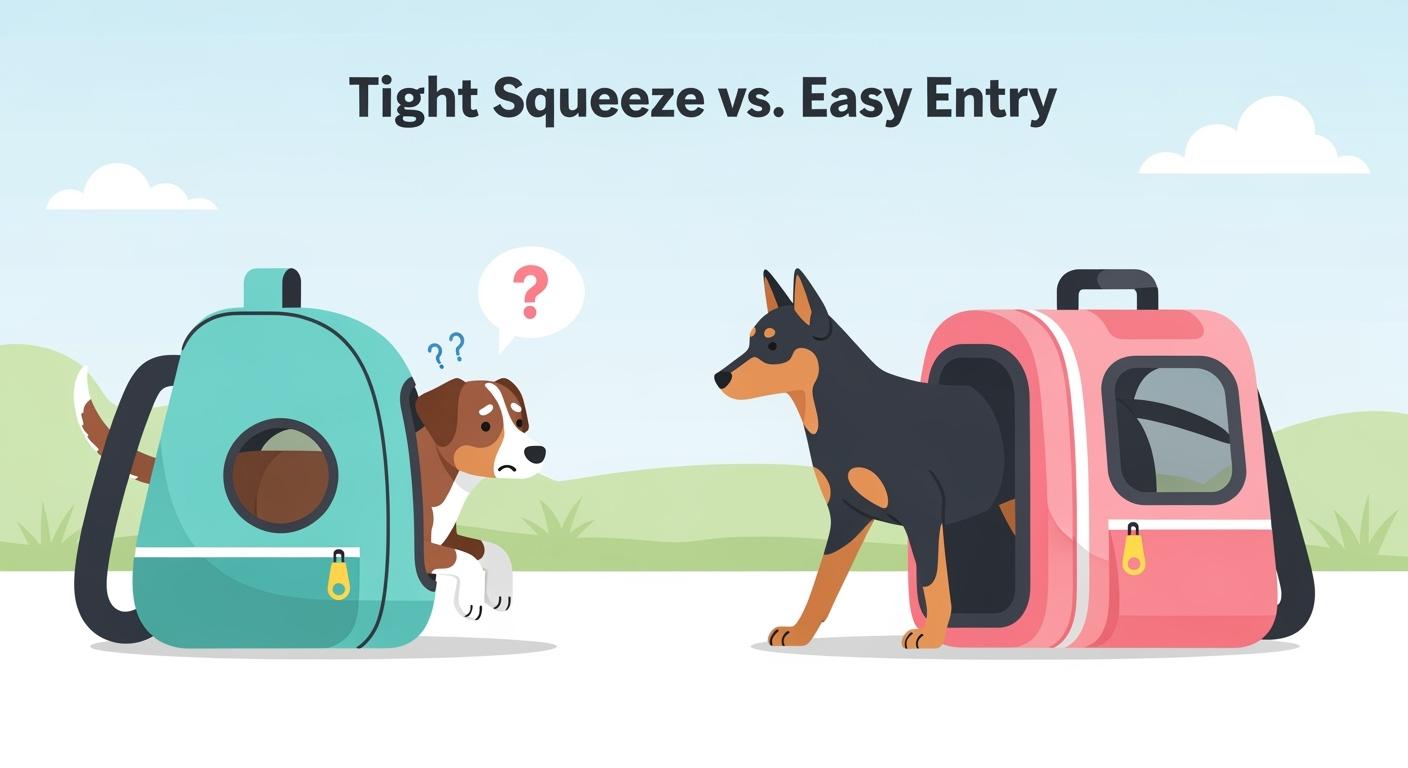
A dog that freezes at the backpack opening is not being stubborn. The entry surface is feeding them information — and when that surface deforms, narrows, or shifts under the first paw, the signal reads as unstable ground. The dog backs away because their proprioceptive system just flagged a surface that cannot be trusted. This is an engineering problem, not a temperament problem. A backpacking carrier lives or dies by what happens at its threshold in the first half-second of entry.
Why Collapsing Openings Turn Entry Into a Fight
The physics at the entry edge is punishing on soft-sided designs. When a dog places a paw on the opening, the force vector runs downward and slightly forward — roughly 30 to 40 percent of the dog’s body weight concentrated through a paw pad no larger than a few square inches. On a backpack without a rigid frame, that pressure deforms the fabric inward immediately. The edge rolls under. The opening narrows. The dog’s proprioceptive feedback registers a surface that gives way under load.
That signal is primal. It triggers the same caution response as stepping onto loose scree or a surface that might collapse — the dog hesitates, withdraws the paw, or backs away entirely. Once a dog has experienced this twice, they begin to anticipate it. They slow down on approach. They brace. The entry becomes a negotiation, not a step.
A rigid entry frame changes the mechanical equation completely. The downward force meets a static structure that does not deform, so the opening profile stays constant through each paw placement. The dog receives predictable tactile feedback — firm, stable, unchanging — and the proprioceptive alarm never fires. This is not about the frame being sturdy. It is about the frame refusing to participate in the deformation that soft fabric invites. Entry ease is rarely about the dog’s mood. It is about what the dog’s paws report back from the threshold.
You can verify this yourself. After a week of regular use, open the backpack fully and inspect the fabric panel adjacent to the zipper path. Diagonal crease lines radiating outward from the zipper teeth are the stress record of repeated inward collapse — each line marks a moment when the opening deformed under entry load. No creases means the frame held its geometry.
Entry Geometry — Frame, Lip, Edge Binding, and the Zipper Path

Four design details at the entry determine whether a dog steps in or walks away. Each one operates on a different part of the entry sequence, and a failure at any single point can unravel the whole process.
The frame. A rigid frame keeps the opening geometry constant under load. Semi-rigid frames — typically a plastic stiffener sewn into a fabric sleeve — resist moderate pressure but can still flex inward when a dog leans weight on the edge. Soft frames offer no structural resistance. The difference is most visible not when the backpack sits empty on the floor but in the half-second when the dog’s chest passes through the opening: a soft frame pinches inward; a rigid frame stays put.
The front lip. Every inch of lip height is an inch the dog must step over. For small breeds — particularly those under 15 pounds with proportionally shorter legs — a lip higher than roughly 3 inches becomes a barrier rather than a threshold. The dog must lift a paw higher than their natural stride, shift weight awkwardly, and commit to an unstable single-leg stance while the other three paws remain outside. That momentary imbalance is enough to trigger a retreat. A low, beveled lip turns the entry into a walk-through rather than a climb-over.
The edge binding. This is the contact surface — the strip of material wrapping the raw edge where the dog’s paws, legs, and chest make first contact. Hard binding creates a sharp tactile event at the exact moment the dog is deciding whether to continue. Soft binding, particularly a padded microfiber or neoprene wrap, removes that negative signal. Material choices at contact points matter more than most buyers realize — the binding is the handshake, and a bad handshake ends the introduction.
The zipper path. A zipper that catches, snags, or requires two-handed operation introduces unpredictability at the worst possible moment. A smooth, single-pull zipper path that glides without resistance lets the opening behave the same way every time. Predictability builds confidence. A zipper that binds at the curve point — where most backpack openings transition from horizontal to vertical — can suddenly narrow the opening mid-entry, triggering the same retreat response as a collapsing frame.
Run your hand along the entry edge after the dog has gone in and out three times. If the binding has shifted, rolled, or feels perceptibly softer on one side than the other, it is absorbing entry force unevenly. That asymmetry will eventually create a pressure point the dog learns to anticipate — and once a dog anticipates discomfort at the threshold, entry refusal becomes a trained behavior.
| Visible entry failure | Likely design cause | Better design direction |
|---|---|---|
| Dog backs away or freezes at threshold | Narrow opening, collapsing fabric, unstable frame | Rigid frame, wide opening, constant geometry under load |
| Dog paws at the edge without entering | Soft binding catching on fur, high front lip | Low beveled lip, padded edge wrap, firm shape retention |
| Dog requires lifting over the lip | Stiff corners, excessive lip height for leg length | Walk-through opening height, smooth corner radii |
Interior Space — What the Dog Sees From the Threshold Shapes the Decision
Horizontal carriers give the dog a visible settling zone: a flat surface they can see from outside, where they can turn, curl, or lie in a natural four-paw-down position. That visible destination reduces the uncertainty that feeds hesitation. Upright carriers — where the dog sits in a semi-crouched position — offer no visible rest posture from the threshold. The dog sees a narrow column of space and must commit to being lowered into it without knowing whether they will fit comfortably. That gamble is one many dogs refuse to take.
Interior dimensions also interact with the opening itself. A carrier wide enough for the dog to turn around inside means the entry can be proportionally wider — the opening is not a choke point but a natural extension of the interior volume. When the interior is narrow and the opening is equally tight, the dog experiences the entire sequence as constriction. Fit checks that account for interior turn radius, not just standing height, produce a carrier the dog enters without negotiation.
Well-designed backpack carriers treat the entry and the interior as one continuous experience — the opening is not a separate feature but the first few inches of the interior space the dog will occupy. When that continuity exists, the dog steps through the opening and into the settling zone in one fluid motion. When it does not, the dog pauses at the boundary — and that pause is where refusal begins.
When These Design Advantages Do Not Hold
No entry design solves every dog. The conditions under which a rigid frame and low lip work best are also the conditions that define where they stop helping.
Barrel-chested breeds. Bulldogs, Boxers, and similar breeds carry their chest width low and forward. A wide, rigid opening helps — but if the interior depth does not accommodate the chest profile, the dog’s sternum will contact the carrier floor before the hind legs clear the lip. The result is a half-in, half-out stall that a rigid frame alone cannot prevent.
Prior negative experiences. A dog that has been forced into a collapsing carrier — or dropped while inside one — may have generalized the backpack itself as aversive. A better entry design removes the physical trigger but does not automatically erase the learned response. Matching a carrier to the dog’s size and activity level is a starting point, not a fix for conditioned fear.
Ventilation-structure tradeoffs. Mesh panels that improve airflow reduce the structural integrity of the entry surround. In hot weather, a carrier prioritizing ventilation may sacrifice frame rigidity — the opening stays cooler but becomes more prone to deformation. The tradeoff is real and no single design optimizes for both extremes simultaneously.
Disclaimer: The entry-fit checks described here assume a dog with healthy limb function and typical body proportions for their breed. Dogs with arthritis, hip dysplasia, or recent surgery may show hesitation that is orthopedic in origin rather than design-related — a rigid opening will not resolve pain-driven entry refusal. For dogs with thick double coats, the edge-binding contact test described above may produce subtler results; visual inspection of fur compression patterns at the shoulder and chest after entry provides a more reliable indicator of binding pressure than tactile hand checks alone.
FAQ
Why does a dog back away from an opening that looks wide enough?
Width alone is not enough. If the opening collapses inward under the first paw — even slightly — the dog’s weight deforms the edge, and that deformation signals instability. A wide but soft opening is still a soft opening. The dog reacts to what the surface does under load, not to how it looks when empty.
What separates a rigid frame from a stiffened fabric edge?
A rigid frame — typically an aluminum or reinforced polymer loop — resists deformation across its entire circumference. Load applied at any point distributes through the frame structure. A stiffened fabric edge uses an internal plastic strip or dense foam insert sewn into a fabric channel. Under concentrated paw pressure, the stiffener bends locally; under sustained chest pressure, it can fold inward gradually. The difference shows up at the curve points of the opening, where stiffened edges tend to pinch and rigid frames hold their arc.
Does a horizontal carrier position affect whether a dog enters willingly?
It often does. From the threshold, a dog can see a flat settling surface inside a horizontal carrier — a destination they understand. Upright carriers conceal the final body position from view, which forces the dog to commit to an unknown posture. The visual availability of the landing zone reduces the information gap that feeds hesitation.
Can a better entry design help a dog with prior bad carrier experiences?
It removes the physical trigger — the collapsing edge, the sharp lip, the catching zipper — but it does not automatically undo the learned fear response. A rigid, stable entry prevents the carrier from confirming the dog’s existing expectation that entry will be uncomfortable. That alone can shift behavior over time, particularly when combined with entry practice sessions where the dog controls the pace and is never forced past the threshold.
| Design variable | How it affects entry | Where it falls short |
|---|---|---|
| Rigid frame vs. soft opening | Constant geometry under paw pressure; no deformation signal | Adds weight; limits packability for storage |
| Low beveled lip vs. high squared edge | Walk-through motion; no high-step imbalance | Reduces weather sealing at the threshold |
| Horizontal vs. upright interior | Visible settling zone reduces commitment anxiety | Larger footprint; less practical for crowded transit |






