
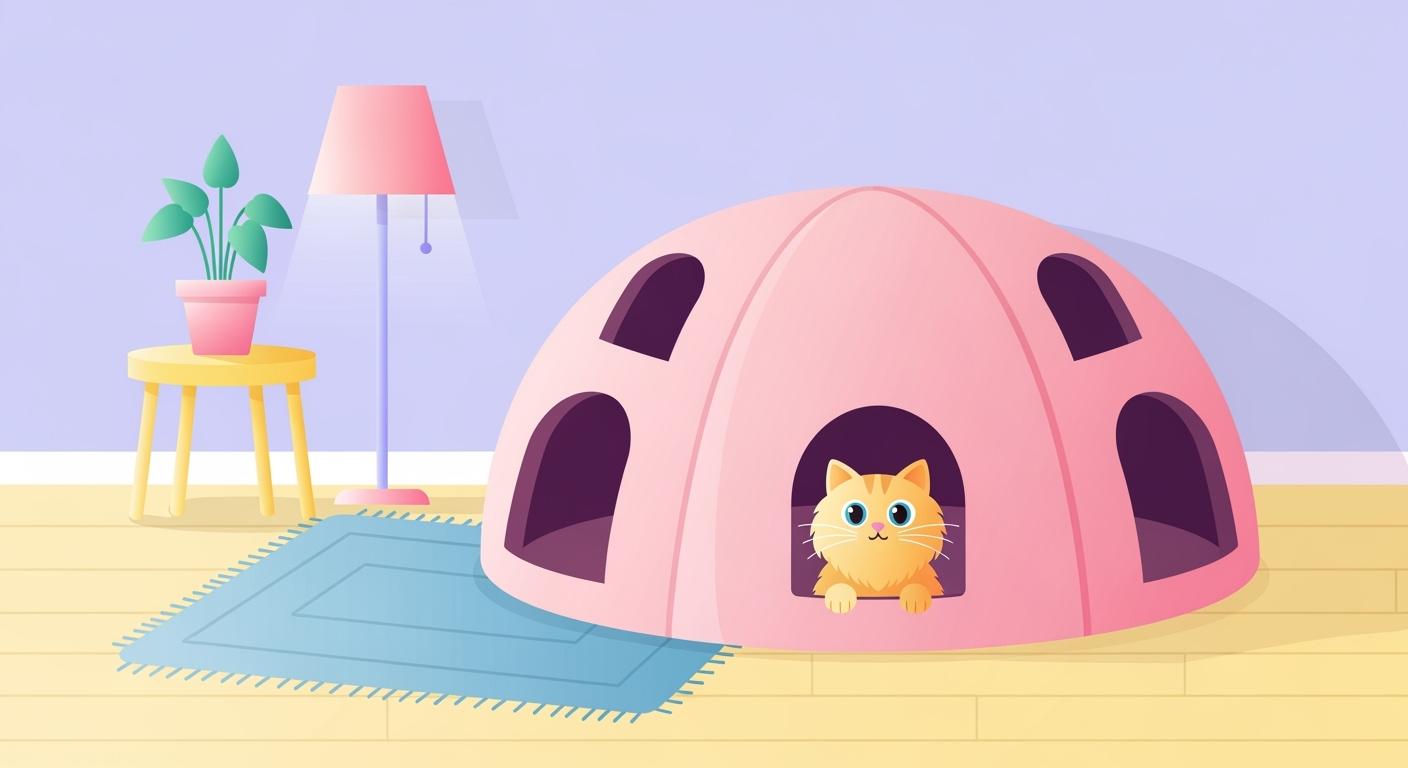
A cat approaching a bed runs a quick mental checklist: Can I see out? Is there another way to leave? What happens if something changes while I am inside? A cat tunnel bed with four openings answers all three questions before the cat even steps in. A single-opening cave bed answers none of them — and that is often where the trouble starts.
The difference is not about whether the bed looks cozy. It is about whether the cat can verify, from any resting position, that no threat is approaching from a blind angle. Four exits make that verification possible without the cat having to turn around or reposition. One exit does not.
Why a Single Opening Works Against a Cat’s Instincts
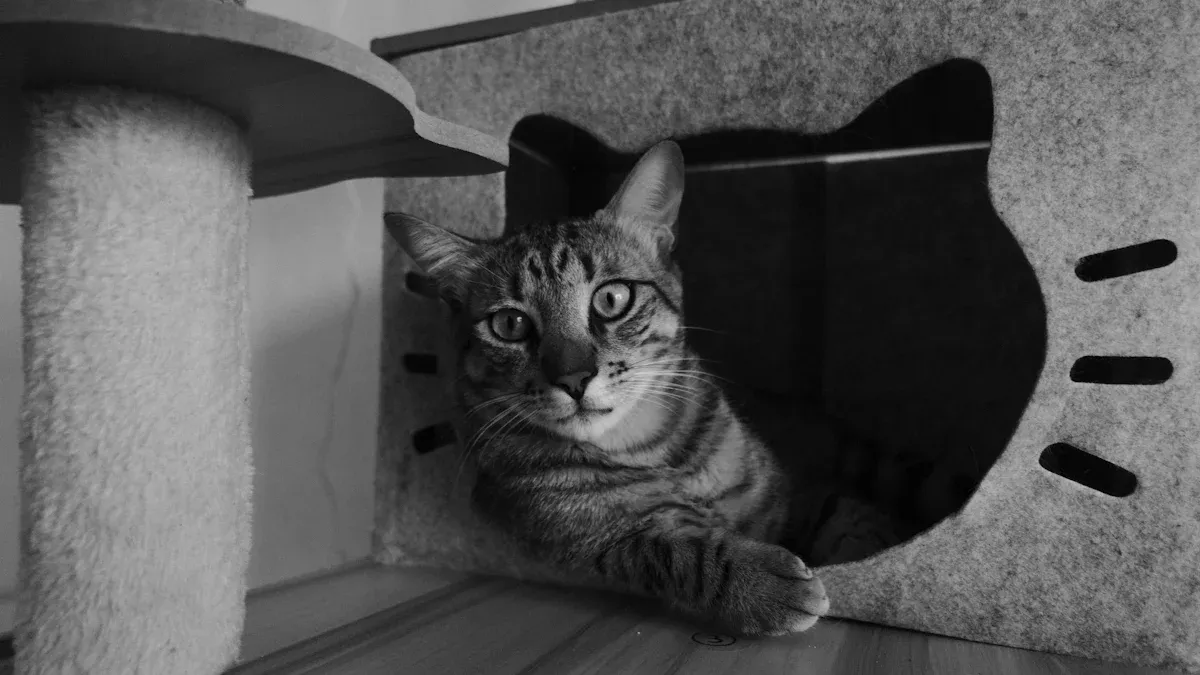
The Dead-End Problem
A cat entering a single-opening cave bed faces the room with its back to the only exit. Its ears and whiskers point into an enclosed shell. The cat cannot monitor what approaches from behind without turning around inside a confined space. That is not a rest posture — it is a surveillance gap.
The behavioral chain runs like this: the cat approaches, sees one dark opening, cannot scan the far side of the room through the structure, hesitates at the threshold. If it does enter, it orients toward the single exit. Any noise or movement triggers a head-turn. The cat never fully transitions from “assess” to “settle.” After a few minutes it leaves, or it backs out without ever lying down.
This is not a personality quirk. It is a spatial assessment pattern. A cat evaluating a resting spot weighs two variables above most others: how many sightlines are available, and how many exit paths exist. A single-opening design fails both checks. The enclosed cave versus open bed decision hinges on exactly this trade-off — cover is valuable, but not when it blinds the cat.
What Backing Out Tells You
Watch a cat enter a single-exit cave bed. If it backs out — rear-first, hesitant, head scanning — the space has failed the safety check. The cat is not rejecting comfort. It is rejecting a blind corner.
Observable test: place the bed in the cat’s usual resting zone for three days. Count how many times the cat enters fully, turns around inside, and settles with its head toward the opening versus how many times it enters partway and reverses out. A cat that backs out more often than it settles is telling you the exit math does not work for it. The fit and layout of a tunnel bed directly changes these entry-to-settle ratios.
What Four Openings Change in the Behavioral Equation
A four-opening layout changes the entry calculation entirely. The cat can see through the bed. Light passes from one opening to another. The cat’s peripheral vision picks up movement through at least two exits regardless of which direction it faces. No position inside the tunnel is a true blind spot.
That through-line visibility is what turns a hiding cave into a usable resting spot. The cat does not need to remember where the exit is — it can see an exit at all times. The sympathetic nervous system stays closer to baseline. The cat’s posture softens: ears relax, eyes half-close, breathing slows. These are the markers of a cat that trusts the space enough to actually rest in it.
The mechanical reason this works is straightforward: four openings mean the cat’s head-neck axis does not need to rotate more than roughly 45 degrees to bring an exit into view, compared to the near-180-degree turn required in a single-opening cave. That difference in required rotation is what separates a space that feels surveillable from one that feels like a dead end.
Tunnel Play and Tunnel Rest — One Structure, Two Modes
The same four-opening tunnel that works as a hiding spot also works as a play structure. A cat can dart in one opening and burst out another, loop around, and re-enter from a third side. That is not a side benefit — it is the same design feature expressed differently. The multiple openings that reduce vigilance during rest also create unpredictable exit paths during play.
But the structure does not force either mode. A cat that wants to curl up and ignore the world can settle in the center of the tunnel, facing whichever opening feels safest. A cat that wants to ambush a toy can use the openings as entry and exit chutes. The bed does not have to switch modes; the cat does. That is the difference between a piece of furniture shaped like a cave and a design that accommodates feline behavioral range.
In practice: Place the bed so at least two openings face into the room rather than toward walls. A cat that can see activity through one exit while having a second exit available as a backup tends to settle faster than a cat whose only visible exit also faces a blank wall.
| Design Difference | Why It Matters | Main Limitation |
|---|---|---|
| Four openings vs. one | Cat can see an exit from any resting position; no full turn required to spot a departure path | Openings reduce total enclosed wall area, so the bed provides less visual shielding from above |
| Tunnel shape with open center mat | Cat can stretch, turn, or change positions without contacting a wall; supports both curled and sprawled postures | A cat that prefers full-body contact with enclosing walls may find the open center less reassuring |
| Non-slip base on felt structure | Bed stays put during entry lunges and exit bursts; no slide = no startle on dismount | On very thick carpet, the grip differential between base and floor may be reduced |
Material and Structure — What Keeps the Cave Usable Over Time
Why Felt Works for Cat Caves
Felt is not chosen because it looks soft. It is chosen because it performs three jobs simultaneously: it holds its shape under repeated entry and exit traffic, it resists the kind of surface abrasion that cat claws produce during kneading, and its density provides enough thermal insulation to feel warm without trapping heat the way a foam-lined cave does.
From a manufacturing standpoint, felt panels can be cut and stitched as flat pieces that gain structure when assembled — the four-opening tunnel shape is produced from joined panels whose seams run along the edges, not across weight-bearing surfaces. That means the seams themselves are not subjected to direct pressure when a cat lies in the center. Less seam stress translates to a longer interval before the structure begins to sag or gap.
Observable check: after a week of regular use, run your hand along the interior felt where the cat most often rests. If the surface feels matted, rough, or visibly thinner, the felt density is too low for the cat’s weight and clawing habits. A cat bed that fits the cat’s size and sleep style should show minimal surface change over the first month of use.
Base Stability and the Startle Factor
A bed that slides when a cat jumps out creates a specific problem: the cat learns to associate the bed with instability. After one or two slide events, the cat begins to approach with more tension, enter more slowly, and leave earlier. The bed did not change. The cat’s trust in the surface did.
A non-slip base prevents that feedback loop from forming. The cat can launch out of any of the four openings without the bed skidding across hardwood or tile. Each clean exit reinforces that the bed is a reliable platform, not a trap that shifts underfoot.
Observable test: set the bed on the floor surface your cat uses most. Push sideways with moderate hand pressure roughly where the cat’s body weight would land during a quick exit. If the bed shifts more than an inch, the base grip is insufficient for confident entry and exit on that surface.
| Use Problem | Likely Product Cause | Better Design Direction |
|---|---|---|
| Cat avoids bed | Only one tight opening; cat cannot see through to the other side | Four openings for through-line visibility; cat verifies safety before entering |
| Cat hesitates at entrance | Narrow tunnel with poor airflow; interior feels stuffy or confined | Tunnel layout with open resting surface and cross-ventilation between openings |
| Bed slides or tips during use | Unstable base or lightweight structure shifts under entry force | Non-slip base paired with structured felt that resists deformation |
| Bed collects odor or fur | Material traps debris in fiber loops or absorbs moisture | Dense felt surface that releases fur with a shake and does not hold ambient humidity |
When Four Exits Is Not the Answer
A four-opening tunnel bed makes sense when a cat wants concealment plus awareness. But that combination is not what every cat needs in every environment.
Cats in cold, drafty rooms may prefer a more enclosed bed that traps body heat. The same cross-opening airflow that prevents stuffiness in a warm room becomes a cooling draft in a chilly one. A cat that routinely seeks out the warmest corner of the house — behind a radiator, under a blanket, pressed against a sunny window — may choose a closed cave over a tunnel bed on thermal grounds alone.
Some cats with high baseline anxiety do not want visibility. For these cats, seeing movement through multiple openings keeps arousal elevated rather than reducing it. A fully enclosed bed with a single small entrance, placed against a wall, may provide the sensory reduction these cats need to finally power down. The four-opening design helps cats that want to monitor their surroundings while resting. It does not help cats that need to shut out the surroundings entirely.
A quiet, stable setup matters as much as the bed design itself — placement near high-traffic paths or directly under a busy shelf can override even the best exit layout.
Disclaimer: These observations assume a typically proportioned domestic shorthair cat without mobility limitations. Cats with arthritis, recovering from surgery, or weighing over 18 pounds may struggle to turn comfortably even inside a four-opening tunnel — a flat, open sleeping surface may serve them better. In multi-cat households, the exit-preference patterns described here are most visible; a single cat in a quiet, stable home may show less dramatic avoidance of single-opening designs simply because fewer surprises occur in its environment.
FAQ
How do you clean a felt cat cave bed with four exits?
Unfold or flatten the bed and shake out loose fur and debris. A stiff-bristled brush removes embedded hair from the felt surface. For deeper cleaning, spot-clean with a damp cloth and mild soap, then air-dry completely before returning it to use. Felt resists odor better than fleece or sherpa liners because its dense fiber structure leaves fewer gaps for bacteria to colonize.
Will a four-exit tunnel bed fit in a small apartment?
Most four-opening tunnel beds occupy a footprint comparable to a standard cat bed — roughly 18 to 22 inches across. The tunnel shape compresses slightly when not in use. Measure the intended spot and leave at least 6 inches of clearance on at least two sides so the cat can approach and enter from more than one direction.
Why does a cat prefer four openings when it sleeps curled up anyway?
The cat does not use all four exits during a single nap. It uses the visibility they provide before deciding to nap. A curled cat can still lift its head, scan through the nearest opening, and confirm the room state without uncurling. That check takes roughly one second in a four-opening bed. In a single-opening bed it requires turning around — and turning around wakes the cat up.
Does the tunnel shape with a center mat work for cats that like to hide completely?
It depends on what the cat is hiding from. If the cat wants to avoid being seen by other pets or people, the tunnel walls provide partial concealment from side angles while the openings maintain situational awareness. If the cat wants total sensory isolation — no light, no sound, no visual input — a fully enclosed cave bed or covered box will serve that need better. The tunnel bed splits the difference: concealment from some angles, visibility through others.






