
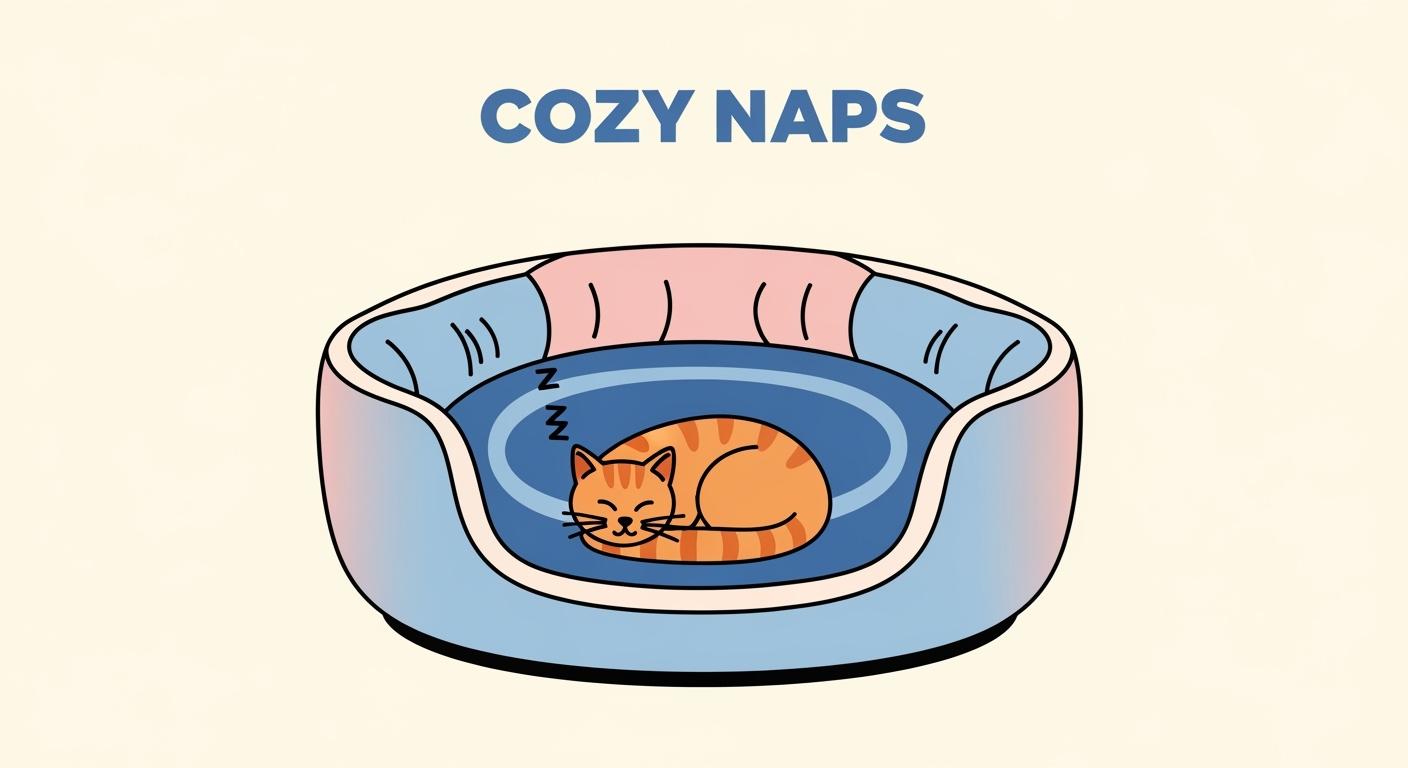
A round cat bed with tunnel looks sturdy on a product page, but a cat mid-zoom can flatten it in seconds. That collapse is not random. It traces back to three design decisions: whether the tunnel ring acts as a structural frame or just folded fabric, how the seam binding transfers force, and what the fill does under compression.
The tunnel matters because cats use it in ways that test structure. They launch at speed, slam a shoulder against the inner wall mid-turn, or brace against the entrance ring while swatting at a toy outside. Each motion applies force at an angle the structure either absorbs or collapses under.
When the Tunnel Collapses During Play
A tunnel bed gives a cat two things a flat mat cannot: a concealed through-path for ambush play and a semi-enclosed cavity for deep rest. Both depend on the tunnel holding its shape under load. When a cat bolts through, the forward push loads the entrance ring in a direction most fabric tunnels are not built to handle — inward and sideways, not just downward. If the ring lacks a rigid core or reinforced binding, that lateral force folds the entrance inward. The tunnel mouth narrows. A passage becomes an obstacle.
A cat’s body weight at play speed generates more force than static pressure from a resting cat. When that force hits an unsupported fabric wall, the wall moves. If the seams connecting the tunnel to the bed base have slack, the movement propagates — the tunnel leans, the roof dips. A round opening becomes a slit the cat has to push through. Most cats stop using it at that point.
You can verify this directly: after a 10-minute play session, check whether the tunnel entrance is visibly narrower than when your cat started. A well-built tunnel returns to its original diameter. One with a weak ring does not.
The Structural Points That Fail First
Three structural elements fail in a predictable order. Each one, when it goes, accelerates the failure of the others.
Circular Seams and How Force Travels Through Them
The circular seam joining the tunnel to the donut base is the highest-stress connection in the bed. When a cat launches into the tunnel, impact force concentrates at the contact point and then travels along the stitch line toward the opposite side. With a single stitch line and wide spacing, that force path has no redundancy — one broken stitch unzips the seam for several inches.
Here is the causal chain: forward momentum → impact on tunnel wall → force travels circumferentially along the seam → low stitch density means stitch failure at the impact point cascades → tunnel wall separates from base → structure collapses. Double stitching creates a second load path. The force spreads across more thread contact points, so no single stitch takes the full impulse.
Material Density and Edge Binding
Thin felt drapes. It has no inherent resistance to bending, so the tunnel wall relies entirely on the ring and seams for shape. Dense felt or structured fabric has enough internal stiffness to help the ring do its job — the material resists folding even before the ring engages. When a cat leans against a wall made of dense material, the wall pushes back in a way thin panels cannot.
Edge binding wraps the raw fabric at the tunnel entrance. Without it, that edge frays under repeated clawing and shoulder bumps. Frayed edges lose tension, and a tensionless edge cannot hold the tunnel’s circular geometry. The opening distorts from circle to oval to a deflated shape that no longer functions.
| Material Type | Structural Behavior Under Load | Main Limitation |
|---|---|---|
| Dense Felt | Resists bending; holds wall shape independently | Heavier; harder to machine-wash without care |
| Heavy Canvas | High tensile strength; edge binding adheres well | Stiffer under-paw feel some cats avoid |
| Thin Synthetic Panels | Drapes under body weight; folds at contact point | No structural contribution — shape depends entirely on ring |
A simple check: push the tunnel roof down with your palm for five seconds and release. If the fabric stays dimpled instead of springing back, the fill density or fabric resilience is too low to survive repeated use. Adequate material rebounds within a second.
Center Mats and the Stability They Add or Subtract
A mat that slides around does more than annoy the cat. It shifts pressure against the inner tunnel wall, working the seams loose from the inside. Each time the mat bunches or migrates, the wall gets an asymmetric push it was not designed to handle. Over weeks, that off-axis force fatigues the stitching and distorts the ring geometry.
A tunnel bed with a secured center mat removes a variable source of internal stress that weakens the seams over time. The cat’s weight presses down on the mat, and that force transfers into the bed base rather than into the tunnel walls. The ring stays circular because the cavity floor is stable.
What Keeps a Tunnel Open Under Load
Three design features work together to prevent flattening. None works well alone.
A Ring That Acts as a Frame
A reinforced ring is not just thicker fabric folded into a circle. It is a separate structural element — a rigid or semi-rigid hoop sewn into the tunnel entrance that resists compression in all directions. When a cat pushes sideways against the interior, a proper ring transfers that force around its circumference instead of letting it fold the wall inward. A complete hoop under compression distributes load evenly. An unsupported fabric circle buckles at the first point of contact.
This is the single strongest predictor of whether a tunnel bed survives active play. If the ring has no rigid core, the tunnel collapses the first time a cat hits it at speed. If the ring includes a stiffened core or dense foam hoop, the opening stays round through repeated impacts.
Firm Edge Binding and Double Stitching
Edge binding serves two functions. It prevents fraying at the highest-wear zone — the entrance lip where claws catch during entry. And it adds circumferential tension to the ring, helping it resist deformation.
Double stitching along the tunnel-to-base seam is not just about redundancy. The two stitch lines create a narrow band of fabric between them that acts as a mini structural beam. Forces that would tear a single stitch spread across this entire band, giving the seam enough load distribution to survive the sharp impacts of play.
In practice: A tunnel bed with single-stitch seams may hold up through light napping but tends to fail within weeks of active play. The failure starts small — a gap near the bottom of the ring — and grows wider each session until the wall detaches enough for the tunnel to lose shape.
Scratch-Resistant Materials That Hold Tension
Dense felt matters for more than durability. Its scratch resistance means the fabric stays dimensionally stable after repeated clawing. Fabrics that pill or develop thin spots lose surface tension, and a tensionless wall cannot contribute to structural integrity. When a cat digs claws into dense felt, the fibers resist pulling out. The wall stays taut, so the ring does not do all the structural work alone.
When a Reinforced Tunnel Still Is Not Enough
A well-built tunnel bed resists flattening under normal use, but no design handles every scenario. Large cats — Maine Coons, Ragdolls, or any cat above about 15 pounds — generate forces that can overwhelm a single-ring design even when properly reinforced. The ring compresses because the load exceeds what a hoop of that diameter and material can redistribute.
Multi-cat households create a different failure mode. Two cats playing simultaneously produce unpredictable, multi-directional forces. One pushes outward while the other pushes inward — the ring gets torsional stress it was never designed to handle.
For cats that prefer fully enclosed spaces, a tunnel bed may be the wrong product. The choice between a covered cave and an open donut bed depends on whether the cat seeks concealment or just a defined edge to curl against. A tunnel bed offers a through-path and a rim — not full enclosure.
Disclaimer: The press test and diameter checks described here assume a smooth-coated cat of average size. Double-coated or very large breeds may produce subtler deformation that requires hand-checking the ring tension rather than relying on visual inspection alone. If your cat’s weight exceeds the typical range for the bed’s listed size, the ring may not hold its shape even with reinforced construction — choose a bed rated for a higher weight class or expect a shorter usable lifespan.
A tunnel bed’s lifespan comes down to three interdependent features: a ring with a rigid core, seams with redundant stitching, and materials dense enough to hold tension under clawing. When any one is missing, the other two compensate temporarily — and then fail faster.
| Design Feature | What It Prevents | Where It Falls Short |
|---|---|---|
| Reinforced ring with rigid core | Entrance collapse under lateral force | Can still compress under cats above the listed weight range |
| Double-stitched circular seams | Seam unzipping from impact force | Does not protect against chewing — sharp teeth cut thread regardless of stitch count |
| Firm edge binding | Fraying and tension loss at the entrance lip | Adds stiffness some cats find less inviting on first approach |
| Non-slip or secured center mat | Internal pressure shifting that fatigues seams | Secured mats complicate machine washing and mat replacement |
| Scratch-resistant dense felt | Surface tension loss from repeated clawing | Heavier and slower to air-dry than synthetic alternatives |
FAQ
What causes a round cat bed tunnel to flatten?
Flattening starts when the tunnel ring lacks a rigid core, the circular seams use single stitching with wide spacing, or the wall material has no inherent resistance to folding. In combination, the tunnel flattens within days of active use. The ring compresses, the entrance narrows, and the cat stops using it.
How do I check if a tunnel bed’s ring will hold up?
Press the tunnel entrance between your hands from opposite sides. A ring with a rigid core resists compression and returns to shape immediately. A ring made only of folded fabric collapses with light pressure and stays deformed. If you can flatten the entrance with one hand, the ring lacks structural reinforcement.
Can I wash a cat tunnel bed with a reinforced ring?
Most tunnel beds with rigid rings cannot go in a washing machine — agitation can break the ring core or warp the hoop. Spot-clean the tunnel walls with a damp cloth. Removable center mats not attached to the ring can typically be machine-washed. Aggressive washing of a reinforced ring bed tends to shorten its structural life.
Why does my cat avoid a flattened tunnel bed?
Cats assess enclosed spaces by visual entry clearance. When the tunnel entrance narrows from a circle to a slit, the cat perceives it as too small or too risky to enter. The same cat that used the tunnel daily may abandon it once the opening collapses — even if the interior is still accessible.
Does a thicker center mat prevent tunnel collapse?
No. The center mat contributes stability by reducing internal pressure shifts, but it does not resist the lateral forces that flatten the tunnel. A thick mat without a reinforced ring is like a better mattress in a tent with broken poles — the comfort improves, but the structure still fails.
For cats that need a secure, semi-enclosed space, a cozy cat bed setup with multiple retreat options works better than relying on a single bed type. An elevated cat bed offers a different kind of security — height instead of concealment — which suits cats that prefer observing from above rather than hiding inside a cavity.






