
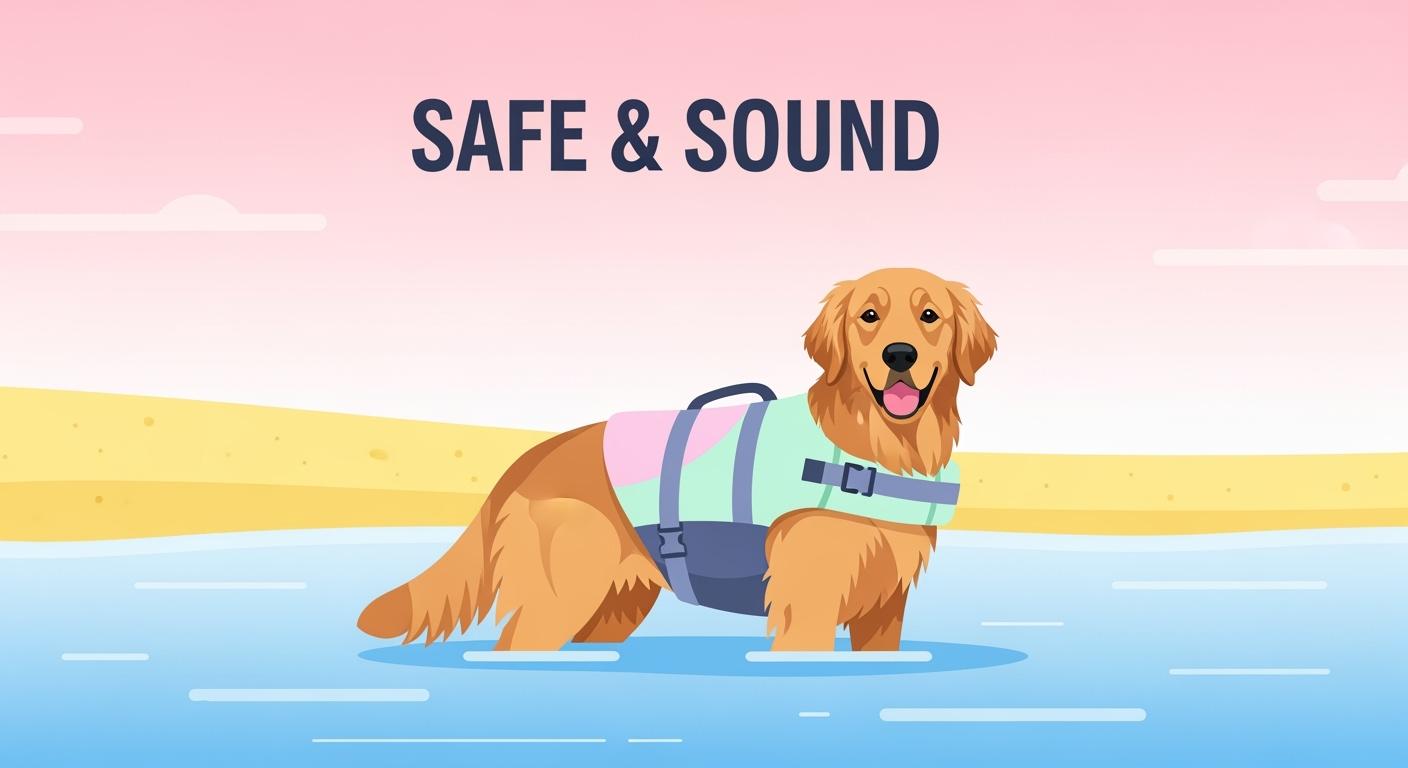
A dog life jacket that rides up mid-swim is not a sizing failure. It is a design failure. The jacket climbs toward the neck because the forces acting on it — buoyant lift from below, water drag from the front, and the dog’s paddling motion — are not being countered by the strap system. When a jacket stays put, it is because the straps, panels, and materials work together as a restraint system that resists these forces without restricting the dog’s natural stroke. Understanding which design choices make that possible is the difference between a jacket that floats and one that actually keeps a dog safe.
Why a Life Jacket Rides Up Once It Gets Wet
A jacket that fits well on dry land can become a different piece of gear the moment the dog hits the water. The mechanism is straightforward: water enters the fabric, saturates fibers, and adds weight. That weight pulls the jacket downward. Simultaneously, the foam panels generate upward buoyant force. The mismatch between these two vectors — wet, heavy fabric pulling down while foam pushes up — creates a rotational moment. The jacket tries to resolve this by sliding upward along the path of least resistance: toward the neck.
Material choice determines how large that mismatch becomes. Neoprene’s closed-cell structure traps gas in discrete pockets that water cannot penetrate. The fabric may feel wet on the surface, but the internal cell walls stay dry, and the jacket retains nearly all of its buoyancy after hours in the water. Nylon is different. Its woven fibers absorb water into the strand structure itself. As the fibers swell and gain mass, the fabric becomes heavier, and the foam panels must work harder to compensate. The result is a growing force imbalance that a loose strap system cannot resist.
| Design Difference | Why It Matters | Where It Falls Short |
|---|---|---|
| Closed-cell neoprene shell | Water cannot enter cell walls; buoyancy stays consistent even after extended submersion | Less ventilation on hot days; a dog may run warmer out of the water than in a mesh-only vest |
| Woven nylon shell with foam insert | Lighter on land, dries faster in air | Fibers absorb water into the strand, adding mass that the foam must lift; buoyancy fades as soak time increases |
This is why material selection shapes everything downstream — from how the jacket behaves after ten minutes in the water to whether the straps can hold position at all.
Swimming Motion and the Lift Problem
Even if the fabric stays light, the dog’s own movement introduces a second set of forces. Each paddle stroke pushes water backward and slightly downward. That flow runs along the dog’s sides and belly. If the chest or belly straps sit loose, the moving water gets between the jacket and the body, generating lift — the same principle that makes an airplane wing work. The panel catches the flow, pressure builds underneath, and the jacket climbs.
Bulky or uneven foam magnifies the problem. A panel that is thicker on one side creates asymmetric drag, tilting the dog and forcing them to compensate with harder strokes on the opposite side. This is not a comfort issue. It is a stability issue. A dog that cannot hold a level position in the water fatigues faster.
Tip: Watch the dog swim away from you for 30 seconds, then call them back. If the handle has drifted off-center by more than an inch or the chest straps have ridden up past the breastbone, the strap system is not resisting water pressure.
Reading the Signs Mid-Swim
Three observations during a swim tell you whether the jacket’s design is holding up:
- The chest straps slide upward, exposing belly skin that was covered when the dog entered the water.
- Flotation panels rotate to one side, making the dog list and paddle harder on the opposite side to compensate.
- The top handle shifts off the spine’s midline, which means the entire jacket has twisted — lifting the dog by that handle would now apply uneven pressure.
Any one of these signals that the anchoring system is not strong enough for the conditions. A jacket built around multi-point restraint rather than simple strap-and-clip closure resists all three.
Where Strap and Panel Designs Usually Fail
Chest Straps That Loosen Under Load
A chest strap that stays tight on land can loosen in water for a reason that has nothing to do with the buckle. When the foam panels press upward and the soaked fabric pulls downward, the strap experiences a shear force perpendicular to its tension axis. If the strap runs through a simple slider rather than a locking cam, that shear incrementally works the webbing loose. After a few minutes of paddling, the chest opening widens, and water flow gets between the jacket and the dog’s body.
The design fix is not a tighter strap. It is hardware that resists creep under cyclic load: a double-lock slider or a cam buckle that requires deliberate release. These add a few grams of hardware weight and roughly double the number of production steps in assembly, but they eliminate the dominant failure mode for chest fit in moving water.
Belly Panels That Leave the Underside Unsupported
A belly strap that attaches only at the sides, with no structural panel crossing underneath, leaves a gap that water exploits. When the dog kicks, the rear legs generate forward thrust and a downward component. That downward pulse pushes water against the belly, and any unsupported fabric gets pushed away from the body. The back panel then rotates forward to compensate, and the jacket rides up.
A continuous belly panel — one that runs from the ribcage back toward the hind legs and anchors to both side straps — closes that gap. The water pulse hits the panel and deflects around the body instead of between the body and the jacket. This is the same principle that makes a stable buoyancy platform possible: the flotation surfaces need continuous backing to resist displacement.
Foam That Concentrates Instead of Wrapping
Some jackets place all their flotation in two thick blocks — one on each side of the spine. This is cheaper to cut and sew. But it concentrates the buoyant force along a narrow ridge on the back. When the dog rolls slightly, that ridge acts as a pivot point, and the jacket rotates around it. A wrap-around distribution — foam panels that extend down the sides and under the chest — spreads the buoyant force across a wider contact area, lowering the center of buoyancy and making the jacket self-righting rather than pivot-prone.
In practice: After a 10-minute swim, run your hand under the chest panel while the dog is still in the water. If you can fit more than two fingers between the panel and the dog’s sternum, the foam distribution is not holding against water pressure.
What Keeps a Life Jacket in Place When Water Tries to Move It
Multi-Point Anchoring and Load Distribution
A jacket that stays put uses at least four anchor points: the top ridge along the spine, both sides of the chest, and under the belly. These create a geometry that resists movement in all three axes — up, sideways, and rotational. When the dog is lifted by the handle, the load transfers to all four anchors simultaneously rather than concentrating at the neck or shoulders.
From a manufacturing standpoint, the difference between a two-strap jacket and a four-point restraint system is not just the number of buckles. It requires seam reinforcement at each anchor point, bar-tacking that holds under wet-dry cycling, and strap routing that does not shift when the nylon webbing swells slightly in water. These are production decisions that are invisible to the consumer but determinative in the water — the jacket either holds or it does not.
The strap geometry matters in a specific way: straps that meet across a continuous belly panel, rather than terminating at side seams, transfer load across the panel’s entire surface area instead of concentrating it at two stitch points. This is the difference between the jacket acting as a single unified restraint and acting as two separate halves that can shift independently.
| Design Difference | Why It Matters | Main Limitation |
|---|---|---|
| Four-point anchor system with continuous belly panel | Load distributes across the full panel surface; jacket resists lift, twist, and side-shift as a single unit | More adjustment points mean more setup time before each swim |
| Side-only strap attachment with no belly panel | Faster to put on and remove | Water pressure between strap gaps pushes the jacket upward; each side can shift independently |
| Dual-density foam — firmer outer shell, softer inner layer | Outer layer deflects water flow; inner layer conforms to body contour, reducing gap formation | Adds material cost and lamination steps in production; slightly thicker profile |
Centered Handle with Reinforced Load Path
The top handle is not an accessory. It is a structural element. When a dog needs to be lifted out of the water — onto a dock, into a boat, away from a current — the handle transfers the dog’s full body weight through the jacket. If the stitching runs only through the outer shell, the fabric can tear at the attachment point. A handle backed by a load-spreading panel — one that extends several inches forward and aft of the grip — distributes that force across the jacket’s dorsal surface instead of concentrating it at two stitch lines.
The handle’s position matters for a second reason. If it sits too far forward, lifting tilts the dog head-down. If it sits too far back, the dog’s hindquarters drop. A centered handle, aligned with the dog’s center of mass roughly behind the shoulder blades, lifts the dog level. Check this in shallow water before trusting it in deep water: lift the dog a few inches and watch whether the jacket rotates. If it does, the handle placement does not match the dog’s weight distribution, and handle position may need to vary by body type.
Adjustability That Survives Wet Conditions
Straps adjusted on dry land can fit differently after the dog has been swimming. Nylon webbing swells slightly when wet, which can cause slider-based adjustments to bind — making it difficult to tighten or loosen mid-swim. Straps routed through smooth-edged hardware with enough clearance for wet webbing to slide freely let you adjust fit after the dog is already in the water, which is when you actually discover whether the fit works.
The test is simple. Put the jacket on the dog, adjust the straps, let the dog swim for five minutes, then try to slide a strap tighter by one notch. If the hardware binds and will not move without unbuckling, the clearance tolerance is too tight for wet use. If it slides smoothly, the design accounts for the fact that fit checks on land do not predict fit in water.
When the Design Works — and When It Does Not
A multi-point jacket with wrap-around flotation performs best on dogs with a defined chest and moderate body depth — the geometry the anchor points were patterned for. The design advantage narrows in two specific cases.
Dogs with a barrel chest and deep keel — think Bulldogs, some Boxers, broad-built Pit Bulls — have a ribcage that tapers sharply behind the shoulders. The chest strap can hold at the widest point but may slide rearward as the dog paddles, because the taper offers no mechanical stop. In these cases, the belly panel and rear strap routing do more of the work, and a jacket with extra rearward strap adjustment becomes more important than chest tightness alone.
Dogs with very short legs and a long body — Dachshunds, Corgis, Bassets — present a different challenge. The distance between the chest strap and the belly strap is compressed, which reduces the lever arm that resists rotation. A shorter lever arm means the same water force generates a larger rotational moment. These body types benefit from a jacket that extends further along the back, adding a third strap position behind the ribcage to restore the lever-arm length.
Disclaimer: The fit checks described here assume a smooth-coated dog with visible strap and panel positioning. Double-coated breeds — Huskies, Golden Retrievers, any dog with a dense undercoat — may show subtler shift patterns because fur cushions and conceals strap movement. On these dogs, check for ride-up by feeling for strap position relative to the breastbone rather than relying on visual alignment alone. If the dog’s chest shape falls outside the breed norms this jacket style was patterned for, the observable checks described here may not catch every pressure point.
FAQ
How can I tell if a life jacket fits correctly without putting the dog in the water?
You cannot — not reliably. Dry-land fit checks catch gross sizing errors but cannot replicate the forces that act on the jacket during swimming. The minimum valid test is a shallow-water swim where you watch for the three ride-up signals described above. If the jacket passes after 10 minutes of active paddling, the fit and strap system are working.
What should I do if the jacket rides up during a swim?
Tighten the chest and belly straps while the dog is still in the water. If the straps will not hold tension or the jacket continues to climb after re-tightening, the strap hardware is likely the problem — a simple slider that creeps under cyclic load. Switching to a jacket with locking cam buckles or double-lock sliders tends to resolve this. If the straps hold but the jacket still shifts, the panel geometry may not match the dog’s body shape.
Does material choice affect anything besides buoyancy?
Yes. Neoprene’s closed-cell structure also provides thermal insulation, which matters in cold water but can cause overheating on hot days out of the water. Nylon dries faster in air and ventilates better but loses buoyancy as soak time increases. The tradeoff is between consistent flotation over long swims and cooler wear during breaks between swims.
Can one life jacket work for all water activities?
A jacket designed for steady swimming in calm water may not hold position during the sudden directional changes of paddleboarding or the continuous spray of boating. The strap system and panel distribution that work for one set of water forces may be inadequate for another. If the activity involves frequent entry and exit — dock jumping, boat boarding — a reinforced handle with a load-spreading panel becomes more important than it is for continuous swimming.






