
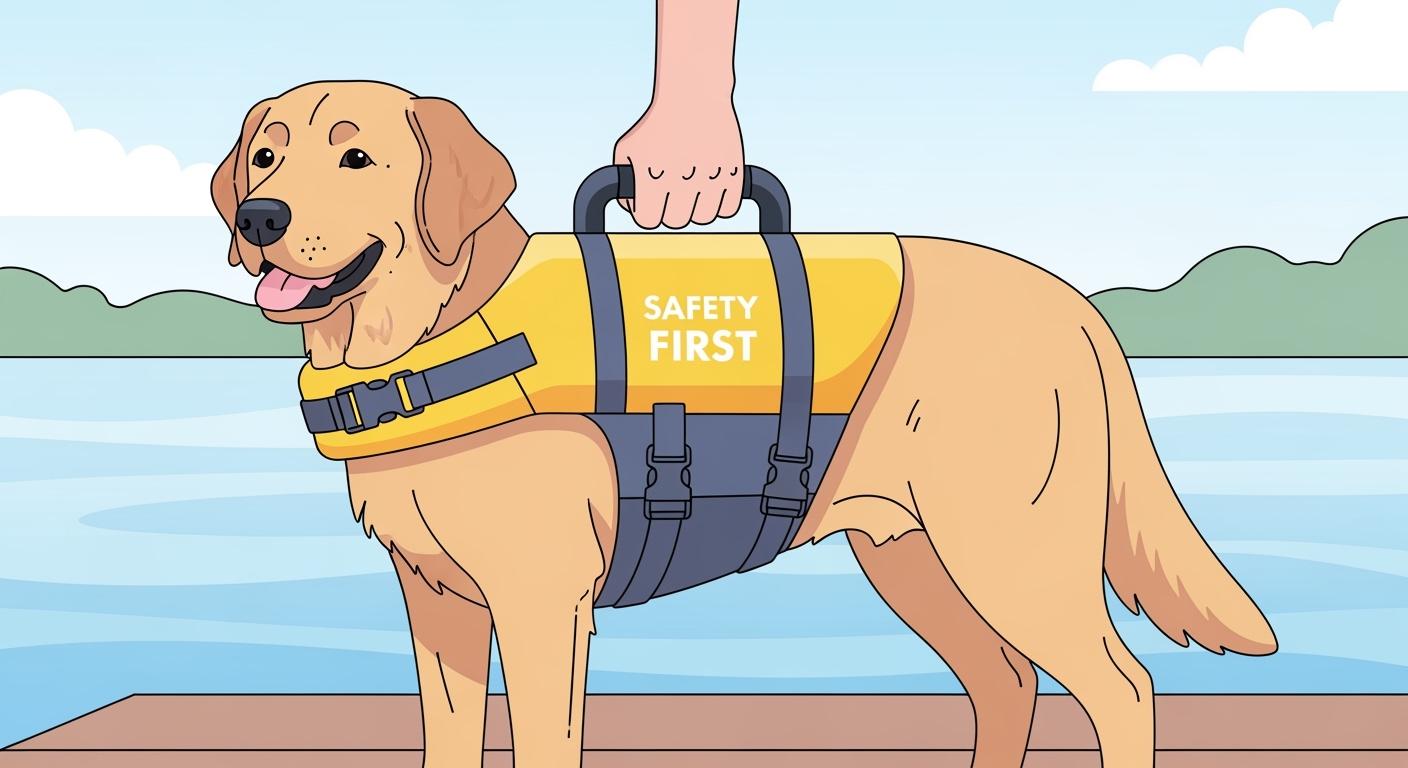
The moment that decides a life jacket for a large dog is rarely the swim itself. It is the second you reach down to lift a soaked, tired 70-pound retriever back onto a dock or into a kayak and the handle has to do exactly what the picture promised. A jacket that looks supportive on land can twist sideways in your hand once it is wet, and more flotation does not always translate into a safer lift if it crowds the neck or floats the dog at a tilt.
Note: A life jacket supports flotation and gives you a way to lift, but it does not replace supervision. Treat the handle, the fit, and your own attention as three parts of the same safety system.
Key Takeaways
Match the jacket to how you actually use it, not to how thick the foam looks. A trustworthy lift handle usually matters more than extra buoyancy for large breeds, and the right fit is the one that still passes a wet handle-lift test after the jacket has been soaked. For the broader picture of types and sizing, see the dog life jacket types and sizing guide.
How to Think About the Handle Before You Compare
Before judging any specific jacket, picture the lift you actually need to perform. A dog stepping off a low dock, a dog being hauled into a kayak, and a dog being lifted out of surf are three different jobs, and they each ask different things of the handle and the fit.
| Where You Use It | What the Handle Has to Do | Why It Matters |
|---|---|---|
| Calm lake, low dock | Short, balanced lift onto a flat surface | A centered handle keeps the dog level |
| Kayak or paddleboard | Sustained pull while you stay balanced | Stitching and webbing must hold under angle |
| Boat with high freeboard | Full vertical lift of the wet dog’s weight | Handle position controls how the dog hangs |
| River or surf | Quick grab during current or chop | Handle must be findable without looking |
For most large-dog owners, the lift you do most often should drive the choice. A jacket that handles a low-dock lift beautifully can feel undersized when the same dog has to come up over a kayak rail.
Handle Strength: What Actually Makes One Trustworthy
Handle strength matters because the dog’s wet weight loads it suddenly, not gently. A handle that feels firm in the store can flex once the webbing is soaked and the foam underneath compresses. The features worth looking at are the ones that survive that wet, loaded moment.
| Construction Detail | Why It Matters |
|---|---|
| Webbing that wraps the body, not just stitched on top | Load travels through the jacket instead of pulling at the seams |
| Reinforced stitching at handle anchor points | Anchor points are where wet jackets usually fail first |
| Centered handle position | A centered lift keeps the dog level instead of tipping head down |
| Handle that stays open shape when wet | You can grab it without fishing for it |
The honest test is not how a handle looks dry. Soak the jacket, fit it on the dog, and lift on land before you ever need it in real water. If the jacket twists, stretches, or pulls the dog’s head down on a calm lift, it will do worse on a frantic one.
Front Float Bulk and Shoulder Freedom
Front flotation keeps the chest and chin up, which matters most for tired or older dogs. The tradeoff is that every extra inch of foam at the front is an inch the shoulders have to work around. A jacket that overcorrects on buoyancy can make a strong swimmer feel awkward and a nervous swimmer feel trapped.
| Design Choice | Why It Helps |
|---|---|
| Low-profile chest panel | Keeps the shoulders free for a natural swim stroke |
| Buoyancy split across the body, not stacked at the chest | Floats the dog level instead of nose-up |
| Adjustable belly and neck straps | Lets you tune fit to chest depth and coat thickness |
| Chin support or front lift panel | Helps tired or older dogs keep the face clear of water |
For most strong-swimming large dogs, low-profile front bulk usually wins. For older or less confident swimmers, a fuller front panel with chin support usually fits better, even at the cost of some shoulder freedom.
Side-by-Side: Handle-First vs. Float-First Designs
Use this comparison as a starting point for matching your dog’s swims, not as a verdict on which style is best in general.
| Feature | Handle-First Design | Float-First Design | What to Watch |
|---|---|---|---|
| Lift Strength | Built around a centered, reinforced handle | Handle present but secondary | Soaked weight is the real test |
| Buoyancy Distribution | Balanced across body, lower bulk | Stronger front and chin support | Front-heavy floats can tip nose-up |
| Shoulder Freedom | Generally more open | Slightly limited by front bulk | Watch for stiff stride after fitting |
| Best Use Case | Active swimmers, kayak and boat lifts | Older or less confident swimmers | Wrong match looks like a tired or twisted dog |
| Main Limitation | Less front lift for tired dogs | Can crowd shoulders and reduce stride | No design replaces supervision |
For confident large swimmers around docks and boats, a handle-first design usually fits better. For older dogs, recovery dogs, or first-time swimmers, a float-first design with chin support usually fits better. The right answer is rarely the one with the most foam.
Matching the Jacket to Dog and Activity
| Situation | Style That Usually Fits | Why It Helps |
|---|---|---|
| Strong swimmer, kayak trips | Handle-first, low-profile front | Lift over the rail is the real risk, not buoyancy |
| Older or recovering dog | Float-first with chin support | Fatigue is the real risk, not stride |
| First-time swimmer, calm lake | Float-first, balanced handle | Confidence comes from being held level |
| Surf or moving water | Handle-first, secure straps | Quick grab matters more than extra foam |
For a deeper look at how fit, build, and activity tie together, the swimming and kayaking confidence solution walks through how to match a jacket to the kind of water you actually paddle in.
Common Mistakes That Make a Good Jacket Feel Wrong
- Judging the handle dry and skipping a wet, loaded lift on land.
- Choosing more foam by default and ending up with a dog that swims nose-up.
- Tightening straps once and never rechecking after the coat thickness changes.
- Buying by breed name instead of measuring chest girth and length.
- Treating the lift handle as a leash attachment for daily walks, which wears the stitching where it matters most.
Tip: The most common mistake is trusting the dry fit. A jacket that sits perfectly in the living room can shift, twist, or stretch within seconds of being soaked, and the wet handle-lift on land is the only test that catches it before real water does.
Pre-Water Pass / Fail Check
| Check | Pass Signal | Fail Signal | Improvement Plan |
|---|---|---|---|
| Two-finger room under each strap | Snug but not pinching | Too tight or sliding loose | Re-adjust, recheck after the dog moves |
| No twisting when the dog walks | Jacket stays centered | Front panel rotates to one side | Tighten belly straps or try a different cut |
| Shoulders move freely | Natural stride | Short, choppy steps | Move to a lower-profile chest panel |
| Wet handle-lift on land | Dog comes up level, jacket stays put | Dog tips, jacket twists or stretches | Replace before any real swim |
| Visible from a distance | Bright color, reflective trim | Dark or muted in glare | Choose a higher-visibility option |
Troubleshooting Poor Fit and Awkward Lifts
| Symptom | Likely Cause | Fast Check | Fix |
|---|---|---|---|
| Jacket twists while swimming | Belly straps loose or off-center | Watch the front panel from above | Re-center and tighten, then retest |
| Dog tips nose-up in the water | Front float bulk too high | Look at the waterline at the chin | Move to a more balanced flotation layout |
| Handle stretches under load | Anchor stitching weakening when wet | Lift gently on land after soaking | Stop using and replace the jacket |
| Dog refuses to move with the jacket on | Neck crowding or shoulder restriction | Watch the first few steps after fitting | Loosen the neck strap or change cut |
Disclaimer: Stop and reassess if the dog shows panic, coughing, fatigue, or any sign of distress in the water. Persistent issues call for a veterinarian, not a strap adjustment.
Record Before You Decide
Record for 5 swims before settling on a jacket: how the dog enters the water, posture once afloat, behavior of the handle when lifted wet, and stride freedom after the jacket dries.
FAQ
How is a large-dog life jacket fit checked?
The fit is checked by sliding two fingers under each strap, watching for twisting on the move, and lifting the dog gently on land after the jacket is soaked.
Is more flotation always safer?
Not usually, because excess front bulk can crowd the shoulders and tip the dog nose-up instead of holding them level.
Can a daily walking handle replace a lift handle?
No, because daily walking loads wear the stitching where the lift handle anchors and weaken the part that has to hold the dog’s wet weight.
How often should the fit be rechecked?
The fit should be rechecked whenever the dog’s weight or coat thickness shifts noticeably, and at the start of every new swim season.
Note: This FAQ is about jacket fit and handle behavior. It does not replace veterinary guidance when fatigue, joint pain, or breathing trouble shows up around water.
Bringing It Together
For most large dogs, a trustworthy lift handle and a level wet posture matter more than maximum buoyancy. For older or less confident swimmers, a float-first design with chin support earns its place. Whichever style fits the dog, the wet handle-lift on land is the test that decides whether the jacket is ready for real water. Browse the dog life jacket and swim vest options with this match-to-need lens rather than a “more foam is better” one.
| Dog Type | Recommended Setup | Key Consideration |
|---|---|---|
| Strong swimmer, active in boats | Handle-first, low-profile front | Confirm wet handle-lift behavior |
| Older or recovering dog | Float-first with chin support | Watch for stride restriction on land |
| First-time or nervous swimmer | Balanced flotation, centered handle | Build confidence in shallow water first |
Disclaimer: A life jacket supports flotation and lifting, not active rescue. Always supervise the dog in the water and consult a veterinarian if swims trigger ongoing fatigue, coughing, or anxiety.






