
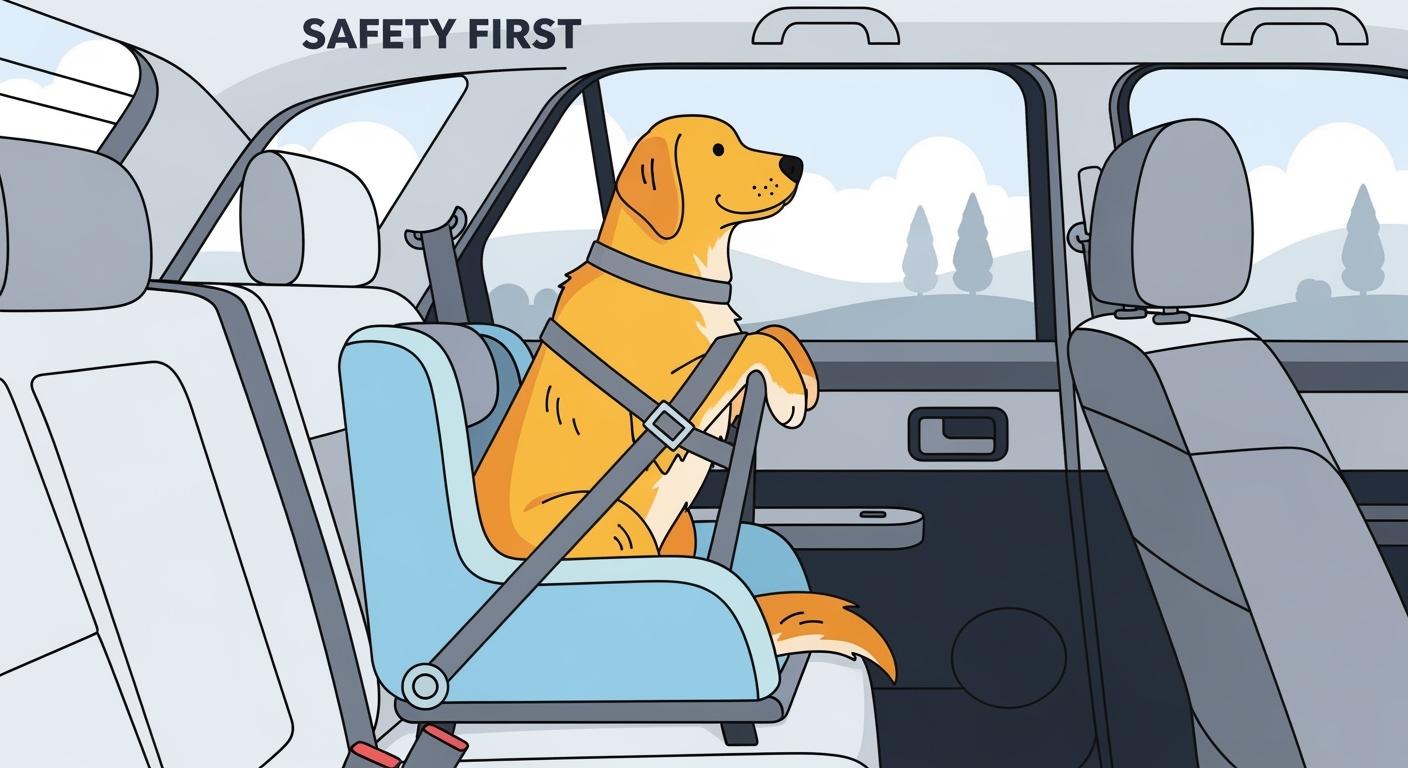
A raised booster seat gives a medium dog a window view. It also gives every turn, bump, and brake a longer lever to work with. When a 35-pound dog sits six to eight inches above the rear seat cushion, the same lateral force that barely registers at cushion level becomes a tipping moment. The seat shifts. The dog braces. What looks like a nervous dog is often just physics — and a base that was never wide enough to resist it.
The difference between a booster that stays put and one that slides across the rear bench during a moderate turn is not about weight ratings or padding thickness. It comes down to base footprint, floor rigidity, and how far the dog’s center of gravity sits from the seat surface. A booster seat built around those three dimensions resists movement with far less dependence on strap tension alone.
The Lever Problem — Why Raising a Dog Even Six Inches Multiplies Instability
A dog sitting directly on a rear seat cushion has its center of gravity roughly two inches above the contact surface. During a left turn at 15 mph, lateral force pushes the dog’s body toward the right. The force acts through that center of gravity, but with only a two-inch lever arm relative to the cushion, the tipping moment is small — the dog shifts slightly and the seat foam compresses under the load.
Raise that same dog six inches on a booster, and the lever arm effectively triples. The same turn now produces roughly three times the tipping moment. Instead of compressing cushion foam, the dog’s weight rotates the entire booster around its base edge. If the booster’s footprint is narrower than the rear seat cushion’s contact patch, nothing counteracts that rotation beyond the dog’s own bracing against the side walls.
This puts medium dogs — typically 25 to 45 pounds — in an uncomfortable middle zone. They are heavy enough to generate real leverage from a raised platform, but often too light to stabilize the booster through body weight alone the way a larger dog might. The booster becomes the pivot. The dog becomes an unwilling counterweight.
Soft rear seat cushions make the math worse. A base that sits flat on a hard floor can sink unevenly into a plush cushion, tilting the entire platform before the car moves. That initial tilt reduces the lateral force needed to start rotation — the booster is already leaning before the first turn.
In practice: Place the empty booster on the rear seat and push sideways at the height where the dog’s shoulder would sit. If the far edge lifts before the base slides more than half an inch, the booster’s footprint is too narrow for its height. It will tip before it slips during actual driving.
Three Design Details That Determine Whether a Booster Stays Put
A Base Floor That Does Not Fold Under Load
Many booster seats use a fabric floor stretched between foam walls. Under a medium dog’s weight, that floor bows downward. The dog sinks into a hammock-like pocket instead of sitting on a flat surface. The problem is not comfort. It is geometry. A bowed floor shortens the effective base width where the dog’s weight meets the seat. The contact patch shrinks. The same dog now has a narrower stance, and the booster becomes easier to tip.
A rigid or semi-rigid floor panel keeps the base geometry intact under load. The dog’s weight distributes across the full footprint instead of funneling into a narrow center channel. In a medium-dog car seat with a supported base floor, the outer edges carry their share of the load — widening the effective stance and raising the force needed to start a tip.
Check this yourself: after a 15-minute drive, unbuckle the booster and look at the impression it left on the rear seat cushion. A uniform depression across the full base area means the floor stayed flat under load. A deeper center depression with lighter outer marks means the floor bowed — and the dog was effectively sitting on a narrower platform than the booster’s outside dimensions suggest.
Footprint Width That Matches the Dog’s Sitting Width
A medium dog sitting naturally occupies roughly 12 to 16 inches of seat width at the hip. If the booster’s internal width is narrower than the dog’s sitting width, the dog cannot center its weight. One hip presses against a side wall. The other hangs near the opposite edge. The weight distribution is off-center before the car moves.
An off-center load on a raised platform does two things. First, it pre-loads one side of the base into the cushion while lifting the other — the starting condition for rotation. Second, it forces the dog to brace continuously with one set of paws against the side wall. That bracing can look like anxiety, but it is often just a dog compensating for a base that is too narrow to let it settle in a neutral position.
Road test: after the drive, check whether the booster has shifted more than one inch from its starting position. Mark the seat with a piece of tape before the trip to create a reference. Then examine where the dog’s hip dents sit in the booster padding. If the deepest impression is consistently against one wall rather than centered, the internal width is mismatched to the dog’s hip width.
Front Entry Height and Side Walls — Two Levers That Pull Against Each Other
A high front wall keeps a dog from stepping forward into the front seat area during sudden braking. But it also forces the dog to climb over it during entry. A medium dog climbing over a tall front edge puts body weight briefly on the very front lip of the booster — the worst possible place for tipping leverage. The higher the wall, the more forward the dog’s weight shifts on entry. Why would a design that improves braking safety make entry less stable?
This is the tradeoff booster design has to solve: enough front height to act as a barrier during braking, but low enough that entry does not create its own instability. Some designs handle this with a moderate front wall paired with a tether system that limits forward travel — the tether does the restraining, so the front wall can stay lower without sacrificing safety.
Side walls create a parallel tension. Walls tall enough to support during turns can crowd a broad-chested dog’s ribcage. Walls too low let the dog slide sideways under lateral force. The functional sweet spot for most medium dogs is walls that reach roughly to elbow height — high enough to provide a lateral stop, low enough that the shoulder and ribcage move freely above them.
When the Dog’s Build Fights the Booster’s Shape
Not every medium dog fits a raised booster, and the mismatch is rarely about weight. It is about body geometry — leg length, chest width, and resting posture.
Long-legged dogs like adolescent Golden Retrievers or standard Poodles often find a booster’s floor area too short. The dog’s hind legs extend past the booster’s front edge, shifting weight forward and pulling the center of gravity toward the tipping point. The same dog may settle comfortably in a car bed with a longer floor pan, where the legs can extend without loading the front edge.
Broad-chested breeds — Bulldogs, Boxers, Pit Bull types — press into side walls that were patterned for narrower dogs. The chest compresses against the walls. The dog cannot settle into a neutral sitting position because the walls constrain ribcage expansion. A harness-based restraint system that attaches directly to the seat belt removes the wall-crowding problem entirely by letting the dog sit on the seat cushion itself.
Active dogs that stand, turn, and reposition throughout the drive also work against the booster’s design. A raised platform assumes the dog settles in one orientation. If the dog is constantly rotating, the weight distribution keeps shifting — and each shift is a new tipping event. These dogs often do better with a lower-profile setup where the consequences of movement are smaller. A higher seat is not automatically better if the dog never uses it as intended.
Disclaimer: The stability checks described here assume a dog that sits or lies in a centered position for most of the drive. A dog that paces, stands continuously, or paws at the walls will show instability even in a well-designed booster — no base geometry can eliminate movement if the dog never settles. For dogs with thick double coats, rub-mark checks against the side walls after the first few drives may need to be done by hand rather than visually, since dense fur can hide pressure points that only become apparent when the coat is parted.
The table below maps restraint types to the body profiles and behaviors they tend to match best:
| Restraint Type | Works Best For | Main Limitation |
|---|---|---|
| Raised Booster with Rigid Base | Medium dogs under 40 lb with moderate leg length; dogs that settle quickly and stay in one position | Base width must match hip width; a soft rear seat cushion reduces the rigid floor’s advantage |
| Low-Profile Car Bed | Long-legged dogs; dogs that prefer to lie flat rather than sit upright during drives | No raised view; dog sits at cushion level and may not see out the window |
| Harness-First Restraint | Broad-chested breeds; active dogs that reposition frequently; dogs over 40 lb | Requires correct harness sizing and seat belt routing; no containment — the dog occupies the full seat |
| Enclosed Carrier | Dogs under 25 lb that prefer a den-like space; dogs that startle easily during drives | Limited ventilation at the rear; interior width constrains turn-around space for medium dogs |
Frequently Asked Questions
How do I tell if a booster’s base is wide enough for my dog?
Measure the dog’s sitting hip width — the distance between the outer edges of the hindquarters when sitting naturally on a hard floor. The booster’s internal floor width should exceed that measurement by at least two inches. Less than that, and the dog will be forced to sit against one wall, creating the off-center loading that primes rotation during turns.
Why does a non-slip bottom matter more on soft seats than on firm ones?
A non-slip base creates friction between two surfaces. On a firm seat, that friction is predictable — the bottom coating grips the upholstery, and the booster resists sliding. On a soft, plush seat, the cushion material compresses unevenly under the booster, creating micro-gaps where the non-slip coating loses contact. A rigid base floor helps by distributing weight evenly across the cushion, keeping more of the non-slip surface engaged.
Can a medium dog use a booster seat in the front passenger seat?
Front-seat placement introduces airbag risk and driver distraction that rear-seat placement avoids. Beyond safety concerns, front passenger seats are typically more contoured than rear bench seats — the bolsters create an uneven starting surface that amplifies the tipping lever problem discussed above. A booster that sits stable on a flat rear bench may tilt noticeably on a sculpted front bucket seat.
What should I check before the first drive with a new booster?
With the booster installed but the dog not yet in it, push down on the front edge with about 30 pounds of force — roughly the weight of a medium dog’s front half during braking. The front edge should compress the seat cushion without folding forward or lifting the rear of the booster. Then place the dog in the booster and watch from outside the car while a second person turns the steering wheel side to side with the car stationary. If the dog braces with paws against the walls before the car moves, the internal width is likely too narrow.






