
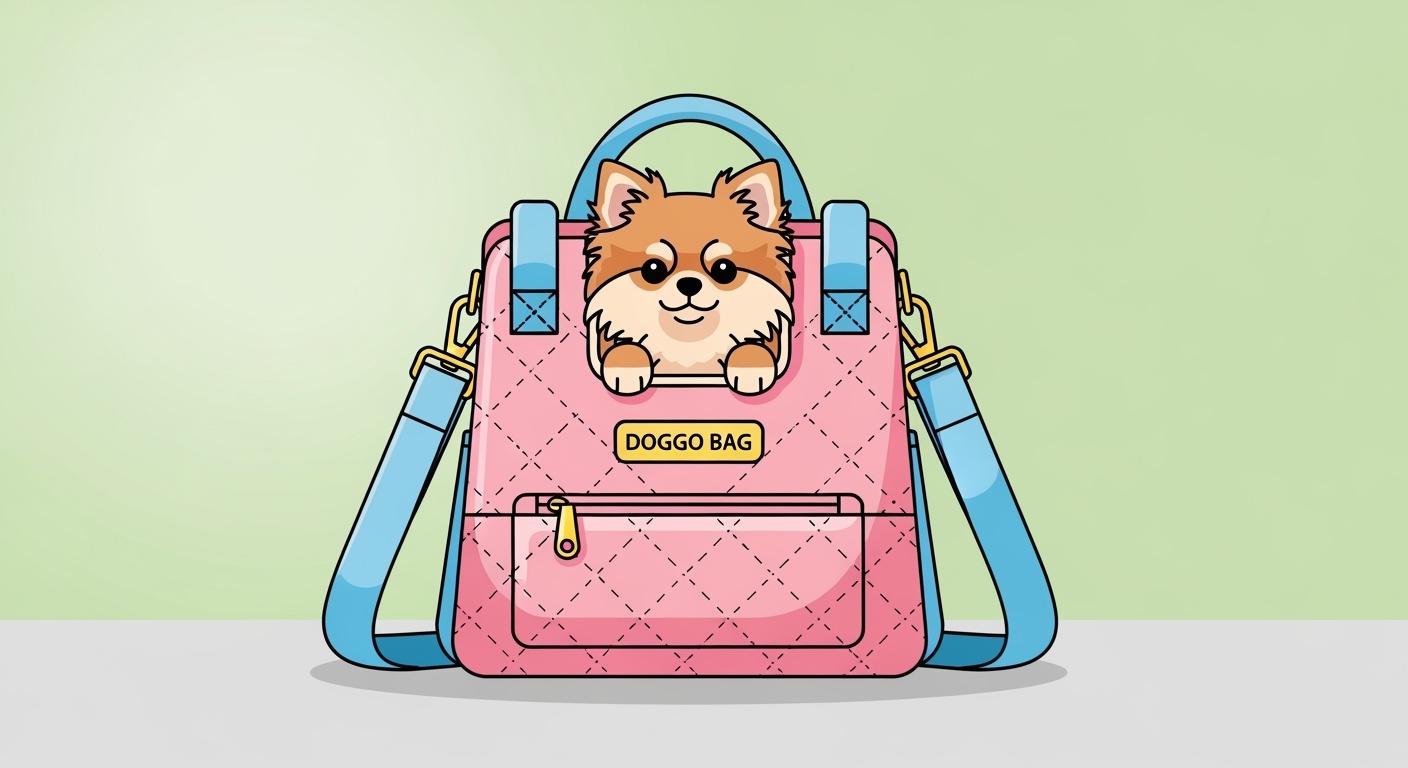
You pick up the purse carrier, your dog shifts, and the whole thing leans. You adjust your grip. The dog moves again. Now the opening is collapsing inward and the base is sagging. Three design details determine whether this cycle repeats or stops: the bottom panel, the sidewalls, and where the handles attach.
A carrier that stays upright is not about padding or price. It is about whether the structure resists deformation when weight moves. That distinction — between a bag that holds shape under load and one that does not — separates a usable small dog carrier purse from one that fights you on every trip.
Why Soft Purse Carriers Tip During Quick Trips
The base bends when the dog shifts weight
Most soft-sided purse carriers use a fabric-only bottom. Fabric under tension stretches. When your dog stands, shifts to one side, or turns around, that movement concentrates weight onto a smaller area of the base. The fabric there deforms. Deformation deepens the sag, which pulls more of the dog’s weight into the low point, which deepens the sag further. It is a positive feedback loop: sag invites more weight, more weight creates more sag.
This is not a vague comfort issue. A sagging base forces the dog’s spine into a curved position — hindquarters lower than shoulders — which small breeds with longer backs tolerate poorly. The dog feels the instability and compensates by bracing or shifting again, which feeds the same loop from a different angle.
Check this yourself: place the empty carrier on a table and press down on the center of the base with your palm using moderate pressure. If the bottom panel deflects more than half an inch, it will deflect significantly more under a live dog shifting weight during a walk from the car to the vet’s office.
Tall soft sides can fold instead of supporting the shape
The sidewalls face a different problem. When the dog leans against a soft fabric side, that side has no bending resistance in the lateral direction. The fabric buckles inward. Once it buckles, the opening narrows. A narrowed opening makes it harder to place the dog inside and restricts the dog’s head movement once inside — which can make an already nervous dog more agitated.
Folded sides also trap heat. Mesh panels that are supposed to provide airflow stop working when the fabric around them collapses, because the mesh itself loses tension and lies flat against the dog’s body instead of standing off it. The ventilation path closes.
What Keeps a Small Dog Carrier Purse More Stable
A firmer bottom panel interrupts the sag loop
The fix is not thicker fabric. It is a rigid insert — typically a thin plastic or composite panel sewn into or slid beneath the base padding. A rigid panel works by distributing the dog’s weight across its full surface area before that weight reaches the fabric shell. The fabric still carries the load, but it does so evenly, with no single point taking enough force to initiate deformation.
This changes the failure mode. Instead of a sag cascade that starts the moment the dog moves, the base stays flat until the panel itself reaches its flexural limit — which, for a small dog under 15 pounds on a properly spec’d insert, does not happen during normal use.
In production terms, the difference between a rigid-insert base and a fabric-only base comes down to one additional cutting and insertion step. It adds minimal material cost. But it changes the structural behavior from “fabric in tension” to “composite sandwich” — the rigid core takes bending loads, the fabric shell handles abrasion and provides the attachment surface. This is the same structural logic used in backpack frames and hiking daypacks, just scaled down.
A handbag-style carrier with a hard-shell base panel prevents the bottom from drooping even when the dog stands up and repositions. A removable comfort pad on top of the rigid base adds cushion without compromising the structure underneath — and it comes out for washing, which matters after a muddy-pawed pickup at the park.
| Design Difference | Why It Matters | Main Limitation |
|---|---|---|
| Rigid insert base panel | Distributes weight across a flat plane; prevents sag cascade that curves the dog’s spine | Adds weight; non-removable inserts make washing the shell harder |
| Fabric-only bottom | Lighter and machine-washable as a single piece | Deforms under point loads; positive feedback loop between sag and weight shift |
Shape-holding sidewalls and balanced handles reduce tilt
Sidewalls stay upright when they have either a rigid frame sewn into the perimeter or dense foam panels that resist buckling. The frame approach — a thin wire or plastic hoop following the top opening — works like a tent pole: it holds the fabric in tension so the mesh windows stay open and the dog has a defined space. The foam-panel approach uses the panel’s own compressive stiffness to resist folding. Both work. Which one matters less than whether one is present at all.
Handle placement is the other half of stability. If the handles attach only to the sides of a soft carrier, lifting pulls the sides inward — the same buckling force the dog applies from inside. When the dog’s weight and the lifting force both pull the sidewalls toward the center, the carrier collapses from two directions at once.
Handles anchored to a rigid top frame or to structural points that tie into the base panel transmit lifting force around the dog instead of into the dog’s space. This keeps the carrier level in your hand — the dog stays horizontal, not tilted forward or back with every step you take. After a 10-minute errand, check whether the sidewalls have crept inward. A carrier whose opening measures visibly narrower than when you started lacks adequate sidewall reinforcement.
The same principle shows up in other carrier styles. A tote-style carrier with weak side structure lets the dog lean outward against the opening, creating the same instability from a different direction. A purse carrier and a tote carrier fail differently but for the same underlying reason: the structure cannot resist lateral load without deforming.
When a Small Dog Carrier Purse Works Best
Better for calm small dogs and short door-to-door movement
These carriers are built for short, predictable trips. Vet waiting rooms. The walk from the car to the coffee shop. A pickup line. The design constraints — compact footprint, handheld carry, soft-sided visibility — match these scenarios well because the dog is stationary most of the time and the carrier only needs to hold shape for a few minutes at a stretch.
Calm small breeds fit this profile naturally. Dachshunds, Yorkies, Miniature Pinschers, Pomeranians, and Norfolk Terriers tend to settle quickly in an enclosed space once they recognize it as a rest spot rather than a threat. The carrier works with that tendency: it creates a defined, den-like space that rewards stillness. The design priorities for urban pet carrying center on exactly this — short-duration stability, easy pickup and set-down, and enough structure to keep the dog horizontal when you are moving through doorways or stepping off curbs.
For sizing, the dog needs enough interior length to lie down without curling and enough width to turn around once. If the dog cannot shift position at all, the carrier is too small — even if the weight rating says otherwise. Weight ratings on soft carriers can be misleading because they account for static load, not for a dog that needs room to reposition.
Not ideal for long walking, anxious dogs, or dogs that push upward
A purse carrier’s stability depends on the dog being a passive load. An anxious dog that paws at the sides, pushes upward against the top opening, or tries to climb out turns the carrier into an active-load scenario. The sidewalls — even reinforced ones — are not designed for repeated upward force concentrated at the rim. A dog that hooks its front paws over the edge and pulls creates a lever arm that can fold even a stiff sidewall inward.
Long walks introduce a different problem: fatigue. Even a calm dog will eventually shift, stretch, and reposition during a 30-minute carry. Each shift is a small stability test. Over enough repetitions, a carrier that passed the 5-minute errand test may start to lean. This is not a design failure — it is the design working within its intended envelope and being pushed past it.
Disclaimer: Fit and stability checks described here assume a smooth-coated small breed with a standard rectangular body profile. Dogs with a barrel chest, very deep keel, or heavy bone for their height may create pressure points that the base panel was not patterned to relieve. Double-coated breeds may show subtler rub marks on the chest or underarm area that need hand-checking rather than visual inspection after use. If the dog’s body shape falls significantly outside breed norms for the size class this carrier targets, a sling carrier with an adjustable body wrap or a backpack-style carrier with a more structured interior compartment may distribute weight more evenly across a non-standard torso.
A small dog carrier purse works inside a narrow but well-defined window: calm dog, short duration, flat path. Within that window, the right structural features — rigid base, reinforced sides, frame-anchored handles — keep the carrier upright and the dog level. Outside that window, the same carrier becomes the wrong tool. Sling carriers handle short-errand duty with a different weight distribution path that can work better for dogs that refuse to settle flat, but they trade the purse carrier’s den-like enclosure for a more open carry that some anxious dogs find less calming. The choice is not about which carrier is better. It is about which structural approach matches the dog’s behavior and your actual trip length.
FAQ
How do you clean a small dog carrier purse?
Remove the rigid base insert if it is removable, then wipe the shell with a damp cloth and mild detergent. Most comfort pads unzip and machine-wash cold. Air dry everything — heat can warp the base panel and shrink foam sidewall inserts. Do not submerge a carrier with a sewn-in rigid base unless the care label explicitly permits it.
Can a purse carrier replace a car seat for small dogs?
No. A purse carrier lacks any form of crash-rated restraint. In a sudden stop, an unsecured carrier — with dog inside — becomes a projectile. Use a car-specific restraint system for vehicle travel. A purse carrier works for carrying the dog to and from the car, not inside it while moving.
What size dog fits best in a purse carrier?
Measure your dog’s length from shoulder to base of tail and height from floor to top of shoulder while standing. The carrier interior should exceed both measurements by at least 2 inches in length and 1 inch in height. Weight ratings alone do not guarantee fit — a 12-pound dog with a long body may be too cramped in a carrier rated for 15 pounds if the interior length is inadequate.






