
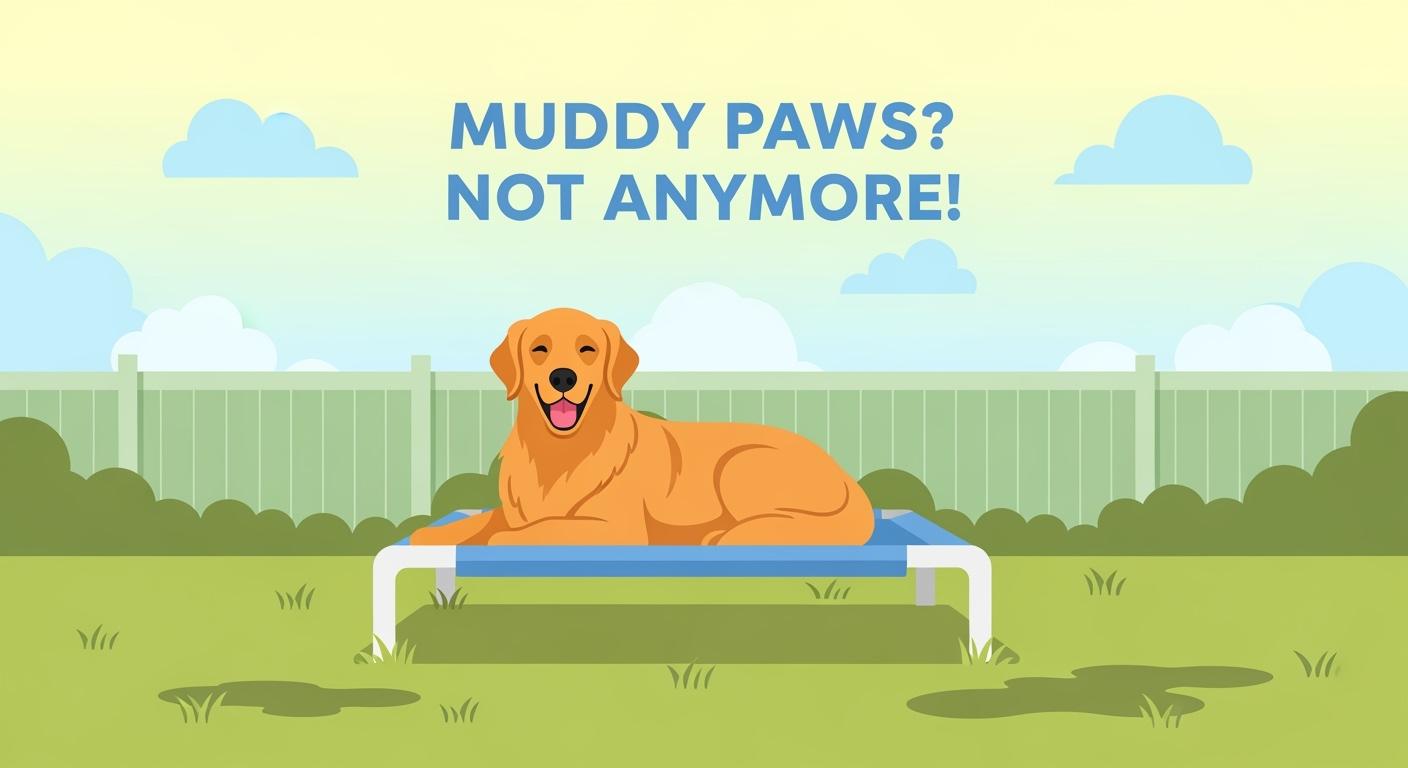
You drag the bed back inside after a backyard session and the top looks fine. But run your palm across it. Gritty. Press a knuckle into the fabric. Damp, even though it has not rained in two days. That is the gap between a bed that looks clean and a bed that actually is.
Most outdoor dog beds are not designed around the way grass delivers dirt — not in a single dump but in layers. Fine particles work into the fabric first. Moisture follows. Then grass clippings lodge in seams and folds. By the time you see the mess, the bed has been accumulating it for hours. The right surface and construction change what happens during that accumulation window. The wrong ones give dirt a head start.
Why Grass Turns a Dog Bed Into a Dirt Trap
Mud, grass, and fur collect in layers — not all at once
Grass does not just leave visible clumps. It leaves a sequence. First comes moisture — dew, damp soil, urine — that wets the bed surface. Then fine silt and grass fragments land on the damp fabric and stick. Body heat from the dog presses the layer into the weave. Fur follows, and the combination forms a paste that hardens as it dries.
Artificial turf or a patio slab drains and evaporates. Grass holds water in its thatch layer and stays damp for hours after rain. A bed placed directly on grass sits on a moisture reservoir. The underside pulls water up while the top collects debris. You clean the surface and think the job is done. The damp core tells a different story.
In practice: Shake the bed out before rinsing — loose grass blades and surface fur come off dry. Once you add water, that same debris turns into a slurry that seeps deeper into seams and edges.
Why thick fabric and raised seams slow cleanup — the physics of it
The problem is not just that thick fabric holds more material. It is how it holds it.
Fabrics with pile — loops, naps, textured weaves — create mechanical interlock with grass blades. Each blade has microscopic barbs along its edge. When a dog lies down, body weight drives those barbs into the fabric surface, where they catch on fiber loops. Rinsing pulls water across the surface but cannot break the mechanical bond between grass barb and fabric loop. You need friction — scrubbing — to release it. A smooth, non-porous surface denies the barb anything to grab in the first place.
Raised seams create a second problem. Each seam forms a ridge that acts as a collection shelf. Debris slides across the flat surface and hits the ridge edge, piling up along the stitch line. Water follows the same path — it sheets off the flat area and pools against the seam, carrying dissolved dirt into the thread line. The seam wicks that moisture into its core. Even after the flat areas dry, the seam stays damp. Odor-causing bacteria colonize the damp thread line within hours.
That is why the same bed design can fail on grass but work on a dry deck. The substrate underneath determines how much moisture reaches the bed, and the bed’s surface determines whether that moisture stays or leaves.
| Design difference | What fails on grass | Why it matters | Where it works |
|---|---|---|---|
| Textured/pile fabric | Grass barbs lock into fiber loops; rinsing cannot release them | Turns a 30-second rinse into a scrub session | Indoor use, dry deck surfaces |
| Raised seams and stitch channels | Collect debris along ridges; wick moisture into thread core | Damp seams breed odor even when the surface looks dry | Low-debris environments |
| Deep edge folds and soft corners | Trap mud and moisture where a cloth cannot reach | Hidden dampness accelerates bacterial growth | Indoor dry use only |
| Thick absorbent padding | Capillary action pulls moisture and fine silt into the core | Surface looks clean; interior stays wet and grit-laden | Climate-controlled indoor settings |
Edge dampness and the odor cycle
Edges fail quietly. A soft folded edge drapes over the bed frame and rests against the grass, soaking up ground moisture through capillary action. The fabric wicks water upward into the fold, where airflow cannot reach it. Dampness sits there for hours. Bacteria multiply. After three or four sessions, the bed develops a musty smell that seems to come from nowhere — the top is dry, the center is clean, but the edges carry the odor signature of every wet backyard session.
Clean, hard edge profiles break this cycle. A rolled or welded edge that sits above the ground plane leaves an air gap. Moisture cannot wick upward because there is no fabric bridge to the damp surface. The edge dries at the same rate as the center, and odor never gets a foothold.
Pass/Fail after one backyard session:
- Pass: Mud rinses off without scrubbing. Run a dry palm across the surface — no grit transfers. Flip the bed after 30 minutes — the underside is dry or barely damp. No grassy smell when you press your nose to the fabric.
- Fail: Dirt stays visible in stitch lines after rinsing. Edges feel damp an hour later. Fabric smells grassy or musty when pressed. Surface looks clean but feels gritty to the touch.
Design Details That Speed Up Cleanup
Smooth sleep surfaces that release debris instead of holding it
Surface texture is the single largest lever for cleanup speed. A smooth synthetic surface — coated oxford, TPU-laminated mesh, or tightly-woven Textilene — presents nothing for grass barbs or fur to grip. Mud sits on top of the material rather than embedding into it. A hose spray or damp cloth lifts it off in one pass.
Quick-dry synthetics add a second advantage. These materials do not absorb water into their fiber structure. Water beads on the surface and evaporates or runs off. In contrast, cotton canvas or thick padding acts like a sponge — water penetrates the fiber, and evaporation must pull it out from within. That takes hours. On a humid day, it may never fully dry before the next use. The fabric choice alone can cut cleanup time from ten minutes of scrubbing to a 20-second rinse — and that gap widens with every successive backyard session.
Production-level material selection amplifies this difference. In manufacturing, a smooth coated textile holds consistent surface properties across production runs — the coating process is repeatable, and the finished surface behaves predictably. Textured or piled fabrics vary more between dye lots and batches. The seam sealing on a coated surface is also more reliable in volume production because the coating layer provides a uniform substrate for welding or taping.
Fewer seams in the sleep zone
Every stitch line is a dirt magnet. Thread creates a raised ridge with microscopic gaps between each stitch penetration point. Those gaps collect fine silt first, then grass fragments, then fur. The sequence repeats with every use.
A bed with a single-piece sleep surface eliminates the collection shelves entirely. Debris has nowhere to stop. Water sheets off without pooling. Beds built around fewer seams and simpler panel layouts dry faster not because the material is different but because there are fewer places for water to linger. This is a construction choice, not a material upgrade — and it costs less to produce than adding more panels and stitch lines.
Clean edge shapes that dry at the same speed as the center
A rolled edge that sits flat on the ground picks up moisture from below. A raised or tapered edge does not. The difference is a few millimeters of clearance — enough to break the capillary bridge between damp grass and bed fabric.
Coated mesh edges add a third benefit: visual inspection. You can see debris on a flat, light-colored edge from across the yard. Deep folds and dark fabrics hide buildup until it is severe. Quick visual checks become part of the routine rather than a separate inspection task.
Pass/Fail after hosing down:
- Flip the bed 30 minutes after rinsing. Run your hand along the underside edge. Bone dry? Pass. Cool or damp? The edge is still wicking moisture from the core. That bed will smell within a week.
Quick-dry fabric instead of absorbent padding
Padding looks comfortable. But outdoors, padding becomes a liability the moment it gets wet. Open-cell foam acts like a sponge — water enters through the surface and stays trapped in the cell structure. The surface may feel dry within an hour while the core stays saturated. Mold spores germinate in damp foam within 24 to 48 hours.
Elevated bed designs with suspended mesh surfaces solve this by removing the padding layer entirely. The mesh stretches across a frame, leaving air underneath. Moisture drains through rather than soaking in. The dog’s weight is supported by fabric tension, not foam compression — so there is no material to collapse or retain water. Air circulation underneath also cools the dog in warm weather, a benefit padding cannot match.
A suspended mesh bed dries in 15 to 20 minutes of direct sun. A padded bed with the same sun exposure can take 4 to 6 hours. If the dog returns to the bed before it is fully dry, the cycle resets with moisture still inside.
When a Waterproof Outdoor Bed Fits Backyard Use — and When It Does Not
Where waterproofing helps
A waterproof surface earns its place when the bed sits on grass that stays damp from dew, rain, or irrigation. The impermeable layer stops ground moisture from wicking into the sleep surface. Spills and urine sit on top rather than soaking through — you wipe them off before they reach the core.
Waterproofing also protects the bed frame or base layer from rot. On an elevated outdoor setup with frequent sun and rain exposure, a waterproof-coated fabric extends the useful life of structural materials that would otherwise degrade from repeated wet-dry cycles.
Where waterproofing alone falls short
Waterproofing addresses only one path of moisture entry — from the outside in. It does nothing for moisture already inside the bed, or for debris collection on the surface. A waterproof cover over thick padding still has raised seams that trap grass. The cover itself may bead water, but the seam lines underneath stay damp because the waterproof coating prevents evaporation from within. You create a sealed chamber where moisture cannot escape.
This is the central trade-off: a waterproof layer that blocks external moisture also traps internal moisture. If the padding was damp before the cover went on, it stays damp. If condensation forms inside from temperature swings, it has nowhere to go. The bed becomes a closed system with its own internal humidity — and that is where mold starts.
Disclaimer: This pass/fail check assumes a short-coated dog on maintained lawn grass. Dogs with thick undercoats that shed heavily may leave hair that embeds differently in mesh surfaces — a visual check may miss embedded undercoat strands. For double-coated breeds, run a fingernail along the mesh weave after cleaning; if hair lifts out of the weave, the bed needs a more aggressive rinse or brush step.
Pass/fail after a normal backyard session
Pass:
- Mud rinses off without scrubbing. Surface grit does not transfer to a dry hand. Edges feel dry within 30 minutes of rinsing. No musty or grassy odor when fabric is pressed to the nose. The dog returns to the bed without hesitation.
Fail:
- Dirt stays lodged in stitch lines after a full rinse. Edges remain damp an hour later. Fabric holds a grassy or sour smell. The surface looks clean but feels gritty or tacky when you drag your palm across it. The dog sniffs the bed and walks away.
| Design difference | What fails on grass | Why it matters | Where it works |
|---|---|---|---|
| Waterproof cover over thick padding | Blocks external water but traps internal moisture; seams still collect debris | Creates a sealed damp chamber — mold risk increases | Short-term use on dry ground |
| Quick-dry mesh on elevated frame | Nothing to fail — moisture drains through, air circulates underneath | Eliminates the moisture trap and dries in minutes | Backyard grass, camping, wet ground |
| Smooth coated surface, no padding | Minimal failure points — check edge stitching after heavy use | Quickest rinse-to-dry cycle of any outdoor bed type | Daily backyard sessions, multi-dog homes |
Focusing on surface texture, seam count, and edge design changes the daily routine from scrub-and-wait to rinse-and-reset. The bed that dries in 20 minutes gets used every day. The one that needs hours becomes a chore. A bed a dog actually uses outside starts with design decisions made at the material level — not with higher price tags or thicker padding.
FAQ
How often should you clean an outdoor dog bed used on grass?
Rinse after every session where the dog was on wet or muddy grass. For dry conditions, shake out loose debris and do a full rinse every two to three uses. The real signal is the palm test — if your hand comes up with anything after dragging across the surface, rinse now.
What materials make outdoor dog beds easiest to clean?
Tightly-woven Textilene mesh, TPU-coated oxford, and PVC-laminated polyester all shed debris and water on contact. The common thread: no fiber pile for grass barbs to grip, and no internal structure that absorbs water. Avoid any fabric you can push a fingertip into — if it gives under pressure, it traps debris at that depth.
Can you use a waterproof dog bed indoors?
You can, but a waterproof surface is usually overbuilt for indoor conditions. The coating adds weight and reduces breathability — on a climate-controlled floor, a washable fabric cover over breathable padding tends to be more comfortable and equally easy to maintain.
Why do edges matter more than the center for odor control?
Edges contact the ground and trap moisture where airflow is weakest. A damp edge becomes a bacterial reservoir that pumps odor into the rest of the bed. The center can be bone dry while the edges rot — and because most owners check the center first, edge decay is often missed until the smell spreads.
Does an elevated bed keep a dog warmer or cooler on grass?
Cooler. The air gap underneath allows convection to pull heat away from the dog’s underside. On grass, the ground itself acts as a heat sink. A padded bed on grass blocks that airflow and insulates the dog’s body heat against the ground — warmer in summer, not better. In cold weather, the same air gap works against you, and a padded bed may provide more warmth.






