
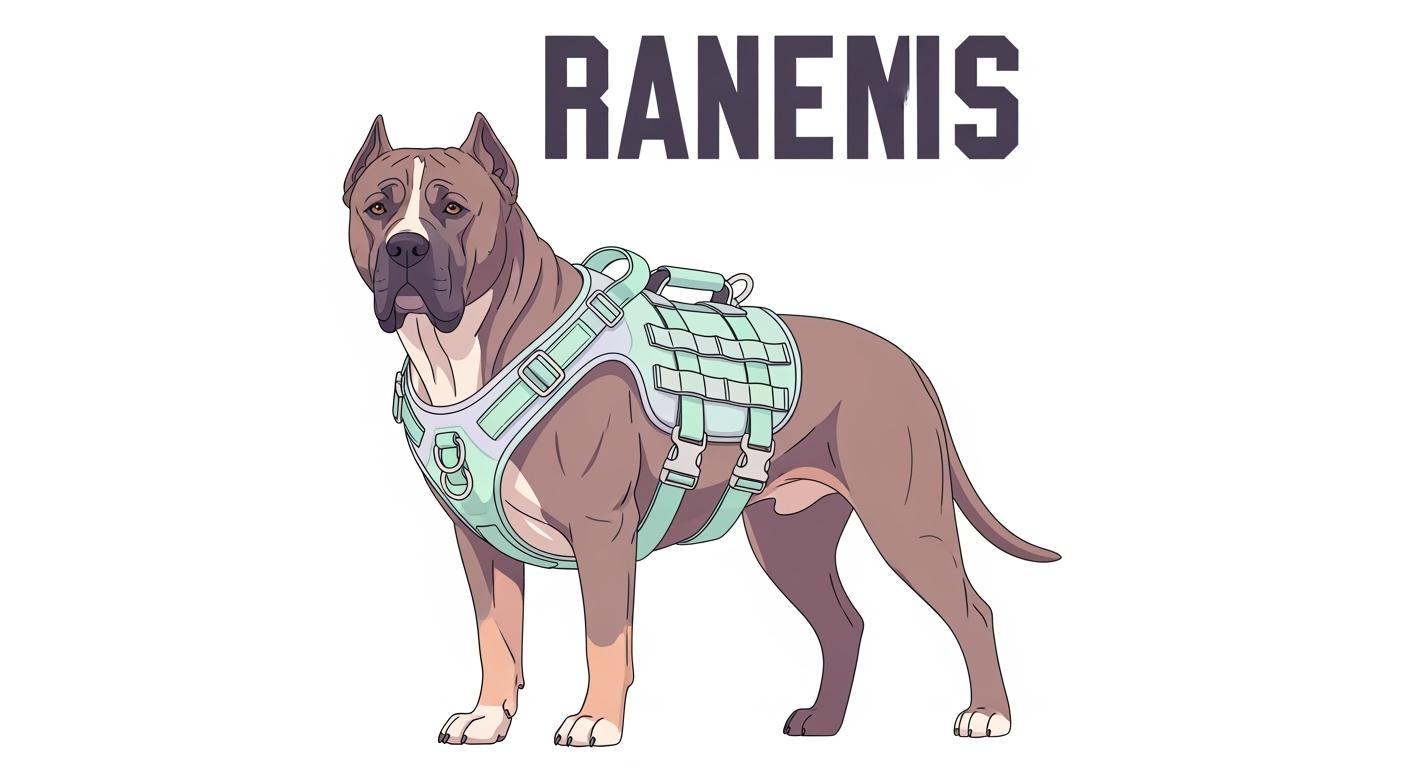
A big dog shifts sideways, and the harness follows — chest panel riding up, back clip drifting off-center, the handle suddenly useless because it has rotated out of reach. The fit was fine standing still. The problem is not the size label. It is that most harnesses are built for forward pull, not angled force. A large tactical dog harness uses a different set of design priorities: wider load distribution, balanced anchor points, and a back panel rigid enough to hold its shape under lateral stress.
When a Snug Harness Fails Under Side Load
A harness that checks out at a standstill can fail the moment the dog cuts across your path or braces at an angle. The reason is mechanical. Narrow straps concentrate force into a thin band. When that force comes from the side instead of straight ahead, the strap has nothing to resist rotation. It rolls. The chest panel follows. Within a few steps, the harness has migrated off-center and the back clip can drift several inches away from the spine.
Tight spaces amplify the effect. A doorway, a stairwell, the gap between parked cars — these force sudden direction changes that load the harness at unpredictable angles. What looked like a solid fit two minutes ago has turned into a control liability. Tightening another strap will not fix it. The structure itself is wrong for the force it is taking.
| Side-Pull Problem | Design Cause | What a Stability-Focused Harness Does Differently |
|---|---|---|
| Harness twists to one side | Narrow girth strap pulls unevenly | Balanced girth adjustment from both sides |
| Back clip drifts off-center | Soft back panel folds under tension | Reinforced back panel resists folding |
| Chest panel rides toward throat | Forward-only load path, no lower anchor | Wide chest panel with lower belly anchor |
| Dog shortens stride | Strap edge crowds the shoulder joint | Panel cut clears the point of shoulder |
What Harness Instability Looks Like in Motion
You spot it before you feel it. The chest panel rides upward toward the throat. The girth strap gapes on one side and digs in on the other. The dog shortens stride on the tighter side. In warm weather, heavier panting arrives earlier than usual — not from exertion, but from restricted chest movement. When the same harness looks fine the moment the dog stands still, the issue is not intermittent. It is hidden by the absence of load.
Three Design Details That Resist Twisting
Not every harness labeled tactical solves the side-pull problem. The difference is in three design choices: how wide the load-bearing panels are, how the girth straps anchor, and how the back panel connects to the handle. Miss one, and the harness can still rotate under angled force even if the other two are well-executed.
Wide Chest and Body Panels
When force spreads across more surface area, the harness has less reason to rotate. A wide chest panel resists folding because the load path runs through a broader section of material. Instead of the entire pull concentrating on a single strap edge, it distributes across the panel face. The harness stays flatter against the body. The same principle applies under the ribcage: a wider belly contact patch gives the harness more surface friction, resisting the sideways slide that happens when a narrow strap skates across short fur.
Note: Wide panels should clear the shoulder joint. When the front edge sits behind the point of the shoulder, the dog can extend fully without the panel edge pressing into soft tissue.
A wide panel with only top attachment points still pivots. The panel needs lower anchor points that prevent the bottom edge from lifting when the dog pulls at an upward angle. A dog harness built for stability anchors the panel at both top and bottom so the entire structure resists rotation rather than just the top half.
Balanced Girth Straps and a Secure Belly Anchor
A girth strap that tightens only from one side pulls the harness off-center with every movement. Balanced adjustment — straps that cinch from both sides or anchor to a centered belly panel — keeps tension equal across the chest. The back clip stays aligned with the spine because nothing pulls harder on one side than the other.
On deep-chested dogs, the difference compounds. A single-side girth adjustment creates a built-in bias toward whichever side has the buckle. Over the course of a walk, that bias accumulates with every turn. A balanced system resets to center after each movement because both sides share the same structural limits. A harness fit checked against real movement reveals whether the straps hold equal tension during direction changes — especially on breeds where the chest drops below the elbow and the harness has farther to climb if one side loosens.
Reinforced Back Panel and a Handle That Stays Put
The back handle on a tactical harness earns its value in half-second moments: crossing a street, threading through a crowd, catching a dog mid-lunge. But the handle only works if it stays where your hand expects it. A soft back panel folds when the harness twists, carrying the handle with it out of position.
A reinforced panel resists that fold. The handle connects through the panel to the structural webbing underneath, so pulling it loads the same load path the leash uses — not just the top layer of fabric. Grab handles sewn to a single nylon layer can tear out or bunch the panel under real force. A reinforced back panel keeps the handle flat and indexed to the same position regardless of how the dog moves underneath it.
Tip: The handle is built for brief control moments, not sustained lifting. Repeated hoisting concentrates force through the back panel attachment points in ways the stitching is not designed to endure.
Side Adjustments for Deep-Chested and Muscular Dogs
Deep-chested and muscular dogs create a fitting problem where the chest circumference that fits at the girth may leave the neck opening too loose, or the reverse. Standard harnesses with one or two adjustment points force a compromise between measurements that do not scale together. The result is either a gap that lets the harness rotate or a tight spot that restricts shoulder movement.
Multiple side adjustment points — at the neck, behind the shoulders, and along the belly — let each section fit independently. The chest panel can sit flush without pulling the neck opening forward. The belly strap can anchor without over-tightening the girth. Independent control at each point keeps the harness from developing the slop that leads to twisting during direction changes.
Hardware That Holds Under Angled Load
Buckles and clips take the highest stress during a side pull because the force concentrates at the connection points before it distributes through the webbing. Metal buckles tend to resist deformation under sustained angled load better than plastic, which can develop micro-cracks at stress points over months of use. A buckle that flexes slightly under tension may look fine at rest but can fail when loaded at an unexpected angle. Solid metal hardware removes that variable — the connection fails at a higher, more predictable threshold.
| Design Difference | Why It Matters for Lateral Stability | Main Limitation |
|---|---|---|
| Wide chest and belly panels | Distributes force across more surface, resists rotation | Holds more heat in warm weather |
| Balanced girth adjustment | Keeps tension equal on both sides, back clip stays centered | More adjustment points add setup time |
| Reinforced back panel | Handle stays indexed, back clip does not drift | Adds weight compared to soft-back harnesses |
| Multiple side adjustment points | Independent fit at neck, chest, and belly for deep-chested dogs | More straps can confuse during initial fitting |
| Metal hardware | Predictable failure threshold under angled load | Heavier and can feel cold in low temperatures |
Where Lateral Stability Helps — and Where It Becomes the Wrong Tool
Conditions That Reward a Stability-First Harness
The design earns its keep in environments where the force vector changes direction repeatedly: crowded sidewalks, trail switchbacks, any space where the dog moves through tight turns. Reactive moments also play to the design’s strengths — when a dog lunges sideways, the harness loads instantly at an angle, and the wide panel distribution keeps the force from concentrating into a thin pressure line.
The reinforced handle proves useful in brief-control moments measured in seconds: stepping off a curb into traffic, moving through a doorway past another dog, stabilizing a dog during a vet exam. Walking control depends on how well the harness holds its position during direction changes — not just on leash technique.
When a Tactical Harness Is the Wrong Tool
A stability-focused harness adds material where a standard harness leaves open space. That extra coverage holds more heat, weighs more, and takes longer to dry. For a dog that walks calmly on a loose leash along straight, predictable paths, the design features that prevent twisting solve a problem that does not exist. The bulk becomes a liability in hot weather — wider panels trap heat against the chest and belly.
Dogs at the edges of breed size ranges often struggle with tactical harness fit. The proportions assume a broad-chested, medium-to-large frame. A narrow or unusually shaped dog may find the coverage restrictive even when measurements match. If the dog shows shortened stride, reluctance to sit, or heavy panting within the first ten minutes, the harness design is working against the dog. When the harness adds reinforcement the dog does not actually need, extra bulk in a military-style harness can work against comfort without improving control. A tactical vest harness balances control and bulk only when the dog’s walking pattern involves the kind of off-axis force the design was built to handle. For calm, straight-line walkers, a tactical harness with handle for daily walks may offer more structure than the situation calls for — the handle and reinforcement become features without a job.
FAQ
How do I tell if a tactical harness fits my large dog correctly?
Check fit while the dog is moving, not standing still. Slide two fingers under the chest panel at the sternum — snug, not tight. Watch for the chest panel riding up toward the throat or the back clip drifting more than an inch off-center during turns. The front edge of the panel should sit behind the point of the shoulder so the dog can extend fully without restriction.
What specific design features prevent a harness from twisting during side pulls?
Three features work together: wide load-bearing panels that distribute force across more surface area, balanced girth straps that cinch evenly from both sides, and a reinforced back panel that resists folding. When all three are present, the harness tends to stay centered because no single pressure point can lever the entire structure off-axis. A harness missing any one of these can still rotate even if the other two are well-designed.
When is a tactical harness the wrong choice for a large dog?
When the dog walks calmly on a loose leash along predictable routes, a tactical harness adds heat and bulk without solving a real problem. Dogs sensitive to heat, those with unusually narrow builds, or dogs that spend most walk time at a steady pace on open paths gain little from lateral stability features. The harness becomes the right choice when walks include frequent direction changes, crowded spaces, or reactive lunging — conditions where off-axis force is routine rather than rare.






