
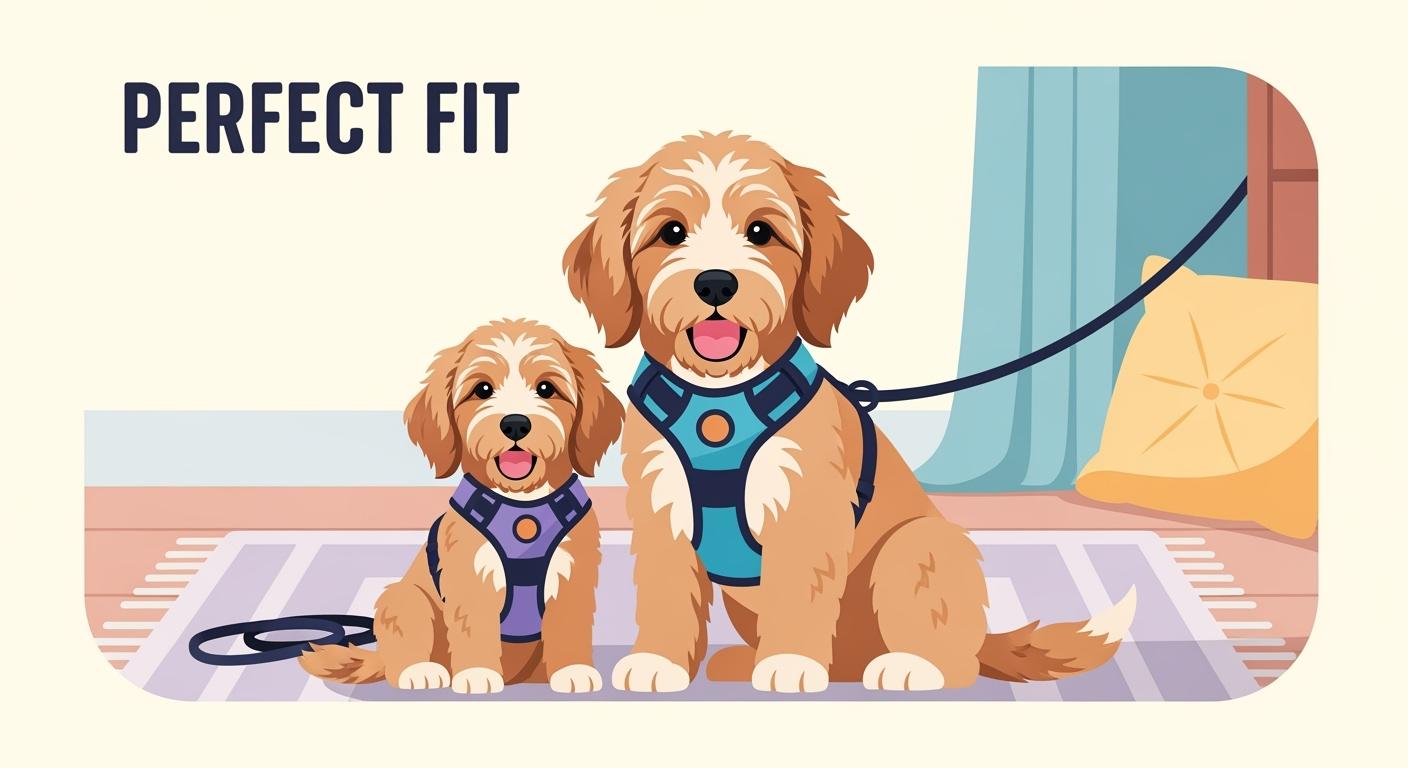
For most dogs in this breed mix, the best dog harness for Goldendoodle walks is an adjustable harness with lower bulk, smooth strap contact, and enough structure to stay centered when the dog moves. That matters more than any single brand name. A style like the Ruffwear Front Range can work well when the fit stays flat at the neck and chest, the underarm area stays clear, and the coat still brushes out easily after a walk.
Goldendoodles are not hard to fit because they are one specific shape. They are hard to fit because coat volume, chest depth, body size, and activity level can vary a lot from one dog to the next. Puppies add another layer because the fit that works this month may not work after the next grooming appointment or growth spurt.
Key Takeaways
- Start with adjustability, light coverage, and smooth seams before you worry about extra padding or heavy panels.
- Measure the dog, then confirm the fit on the body after a short walk because curly coats can hide shifting and rubbing.
- Use front-clip control only when you need it for training or stronger pulling, not as the default for every Goldendoodle.
- If the coat mats, stays damp, or looks flattened after walks, the harness setup needs to change even if the dog seems tolerant of it.
Why Goldendoodles need a closer fit check
A Goldendoodle’s coat can hide problems that are easy to spot on shorter-coated dogs. A harness may look fine from above while the chest panel twists, the straps creep into the underarm, or damp curls start bunching underneath. Mini and standard sizes also carry weight differently, so the same harness shape does not behave the same way across the breed mix.
| Fit factor | Why it matters on a Goldendoodle |
|---|---|
| Coat volume | Curly or fluffy coats can hide rubbing, hold moisture, and change how snug the straps feel. |
| Body size | Mini, medium, and standard Goldendoodles often need different strap lengths and chest coverage. |
| Growth stage | Puppies can outgrow a good fit quickly, especially through the chest and shoulders. |
| Movement style | Dogs that bounce, pull, or turn sharply expose twist and drift much faster than calm walkers. |
Questions about strap width, body coverage, and buckle placement overlap with daily-walk harness sizing and material choices. The same basics decide whether the harness feels balanced or starts causing friction after ten minutes outside.
Harness styles that usually work better
The safest starting point is usually a harness that leaves more coat exposed instead of wrapping the whole front half of the dog. Lower coverage makes it easier to spot fit problems, dry the coat after wet walks, and brush out tangles before they turn into mats. If your Goldendoodle pulls, a front-attachment option can help, but only if the rest of the harness still sits cleanly through the shoulders.
| Harness style | What it does well | Common drawback | Best use |
|---|---|---|---|
| Lower-coverage adjustable harness | Less friction, easier brushing, simpler daily checks | May offer less body coverage than some owners expect | Most everyday Goldendoodle walks |
| Vest-style harness | Can feel stable on calm walkers | More surface area can trap moisture and flatten curls | Dogs that tolerate coverage and stay dry |
| No-pull or front-clip harness | Adds directional control during training | Poor fit becomes obvious fast if the dog leans into it | Pulling, leash practice, or transition training |
| Heavily padded harness | Can feel substantial in hand | Extra bulk often adds heat, coat compression, and slower drying | Short, controlled use when the fit is genuinely good |
Some owners prefer a dog training harness set when they want front-attachment control and a matching leash during loose-leash practice. A balanced harness-and-leash setup for fit, comfort, and leash length often works better than trying to fix pulling with a much heavier harness body.
Tip: If the dog’s coat is thick after bathing or brushing, fit the harness when the coat is sitting naturally instead of pressing it down to make the straps seem tighter.
How to check fit without flattening the coat
The best dog harness for Goldendoodle dogs should stay in place while the dog walks, turns, and sniffs without leaving rough, damp, or tangled patches behind. That means the fit test should happen in motion, not only while the dog is standing still.
Chest depth and ribcage shape matter more than label size, which is why chest and girth measurements that stay comfortable in motion are worth checking before you buy. First-walk problems usually show up at the shoulders and underarms, and first-walk fitting steps make those pressure points easier to catch.
- Brush the neck, chest, and underarm coat before the first fitting.
- Lay the harness flat and check how much of the chest and shoulder area it will actually cover.
- Buckle it, then part the coat at the neck, sternum, and behind the front legs so you can see where the contact points sit.
- Walk the dog for a few minutes on a loose leash and watch for twisting, drift, or shoulder restriction.
- Take the harness off and inspect the coat for damp spots, flattening, tangles, or red skin.
- Repeat the check after grooming, rain, muddy walks, or noticeable growth.
| Check area | Pass signal | Fail signal | What to change |
|---|---|---|---|
| Neck | Lies flat without pinching or rotating | Gaps, rolling straps, or bunching coat | Adjust the neck or try a different cut |
| Chest | Centered and stable through a short walk | Slides sideways or crowds the front legs | Shorten or lengthen the chest setting |
| Underarm | No rubbing and easy shoulder movement | Chafing, matting, or shortened stride | Choose less coverage or smoother seams |
| Coat after removal | Brushes out normally and dries quickly | Damp clumps, flattened curls, or tangles | Switch to a lighter, more open harness style |
Failure signs that matter after a walk
| Symptom | Likely cause | Fast check | Best response |
|---|---|---|---|
| Matting under straps | Too much coverage or rough edge contact | Part the coat after the walk | Move to a lower-coverage harness |
| Damp patches that linger | Thick fabric holds water against the coat | Check chest and underarm areas indoors | Use a more breathable design and dry the coat sooner |
| Harness sits to one side | Loose adjustment or body shape mismatch | Recheck after turns and pulling | Refit the chest and girth or change harness shape |
| Redness or rubbing | Tight contact point or seam friction | Look at the skin, not only the fur | Stop using that harness until the fit changes |
If the coat looks flat, damp, or rough after ten minutes outside, tightness checks that reduce chafing are often more useful than switching to a thicker harness right away.
Note: If you see red skin, limping, obvious stress, or repeated hot spots, stop using that harness and ask your veterinarian what to change.
Daily care makes a good harness work better
Even the right harness will not stay comfortable if the coat underneath is already tangled. A short brushing routine after walks matters most behind the front legs, across the chest, and anywhere the dog stayed damp. Puppies usually need more frequent checks because the body shape changes faster and the tolerance for rubbing is lower.
That is why the best dog harness for Goldendoodle dogs is usually the one you can fit quickly, inspect easily, and remove before the coat starts holding dirt and moisture. A harness that looks impressive but takes too much effort to monitor often ends up being the wrong everyday choice.
FAQ
What is the best dog harness for Goldendoodle puppies?
For most puppies, an adjustable harness with light-to-moderate coverage works best because it is easier to refit as the chest, shoulders, and coat change.
Should a Goldendoodle use a no-pull harness every day?
A no-pull harness can be useful for training or stronger pulling, but it is only a good everyday choice when it stays centered and does not create extra chest or underarm friction.
How often should you check harness fit on a Goldendoodle?
Check it before walks at first, then again after grooming, wet weather, growth spurts, or any time the coat starts matting where the harness sits.
What signs mean the harness is wrong even if the dog still walks normally?
Matting, damp hold, flattened curls, red skin, strap drift, and shoulder restriction are all signs the harness is not working as well as it should.






