A leash handles straight-ahead pulling reasonably well. Most do, anyway. The problem starts when the dog lunges sideways. That off-angle force hits the connection point differently. The clip torques. The webbing rolls. Within a few strides, the handle has rotated out of reach and the handler is gripping twisted nylon instead of making a correction.
This is not a strength problem. It is a geometry problem — and the right design choices solve it at the connection point, not by adding more material.
Why Side Lunges Twist Most Leashes at the Connection Point
A forward pull transmits force along the leash’s long axis. The webbing stays flat, the clip stays oriented, and the handle remains where the hand expects it. Straight-line tension is what most leash hardware is built for.
A side lunge redirects that force at an angle. Instead of traveling straight down the webbing, the load enters from roughly 30 to 60 degrees off-axis. The clip — if it cannot rotate independently — becomes a torque accumulator. Every sideways step winds a small amount of rotational energy into the connection. The webbing, now under torsional load in addition to linear tension, begins to roll at the edges. A rolled strap has a fraction of its normal surface area in the hand. Grip weakens. Reaction time stretches.
The failure cascade moves fast: off-angle force → fixed clip resists rotation → torque transfers into the webbing → webbing rolls → handle orientation shifts → handler loses grip reference → correction arrives late.
Walk for ten minutes with a dog that alternates between forward pulling and sideways lunging, then stop and look at the leash. If the webbing has spiraled between the clip and the first 12 inches of strap, the clip is not rotating freely. A properly functioning swivel leaves the webbing flat along its entire length, regardless of how many direction changes happened during the walk. That flat webbing is the observable difference between a connection that absorbs torque and one that transmits it.
| Failure signal | Design cause | What changes the outcome |
|---|---|---|
| Webbing spirals into a corkscrew within minutes | Fixed clip transmits rotation into the strap | 360-degree swivel clip decouples clip rotation from webbing |
| Handle drifts sideways during the walk | Torsional load rotates the entire leash assembly | Wider, low-stretch webbing resists edge rolling under side load |
| Clip jams at an angle after a lunge | Single-axis clip binds when pulled off-plane | Multi-directional swivel joint maintains free rotation under angled load |
How a Swivel Clip Breaks the Torque Cycle
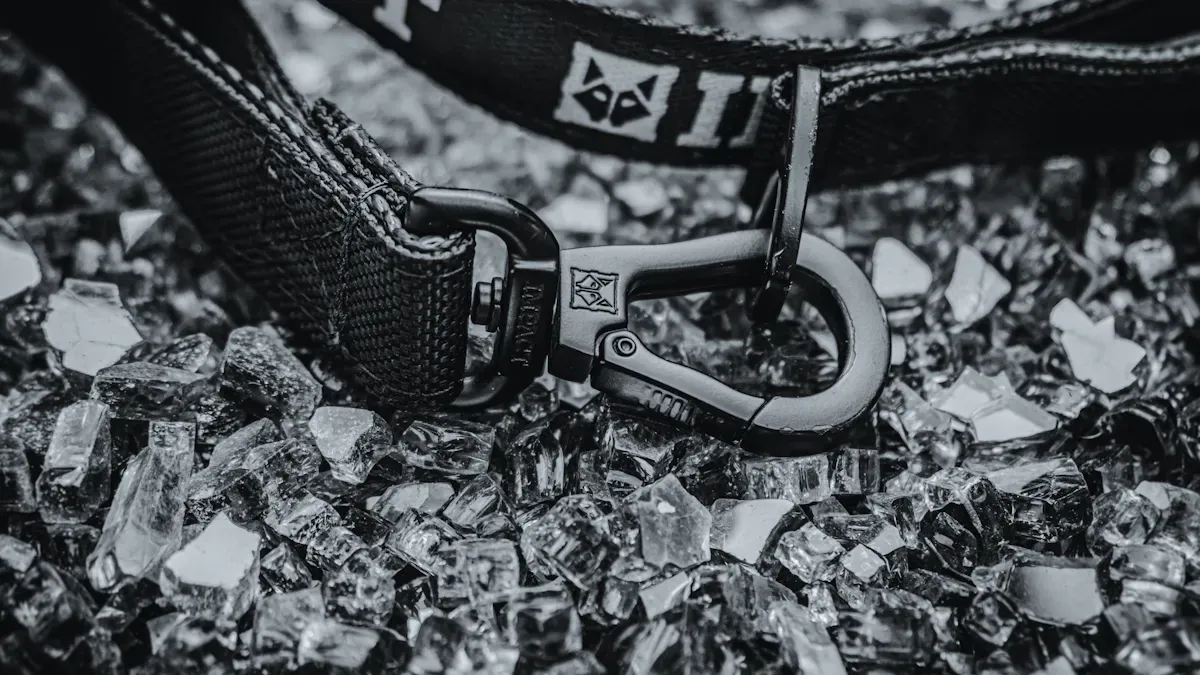
The swivel clip looks like a small detail. Mechanically, it is the single largest control variable between a leash that stays straight and one that does not.
Here is the causal chain that runs through every walk with a pulling dog. When the dog changes direction, the clip’s attachment ring receives force from a new angle. A fixed clip — one that is riveted or molded as a single rigid piece — cannot follow that angle change. The mismatch between the force vector and the clip’s fixed orientation creates a rotational moment. That moment has nowhere to go except into the webbing. The webbing, designed for linear tension not torsional load, complies by twisting. Once twisted, the flat strap becomes a rounded cord in the hand. Surface area drops. Friction drops. The handler squeezes harder to compensate, and hand fatigue sets in within minutes.
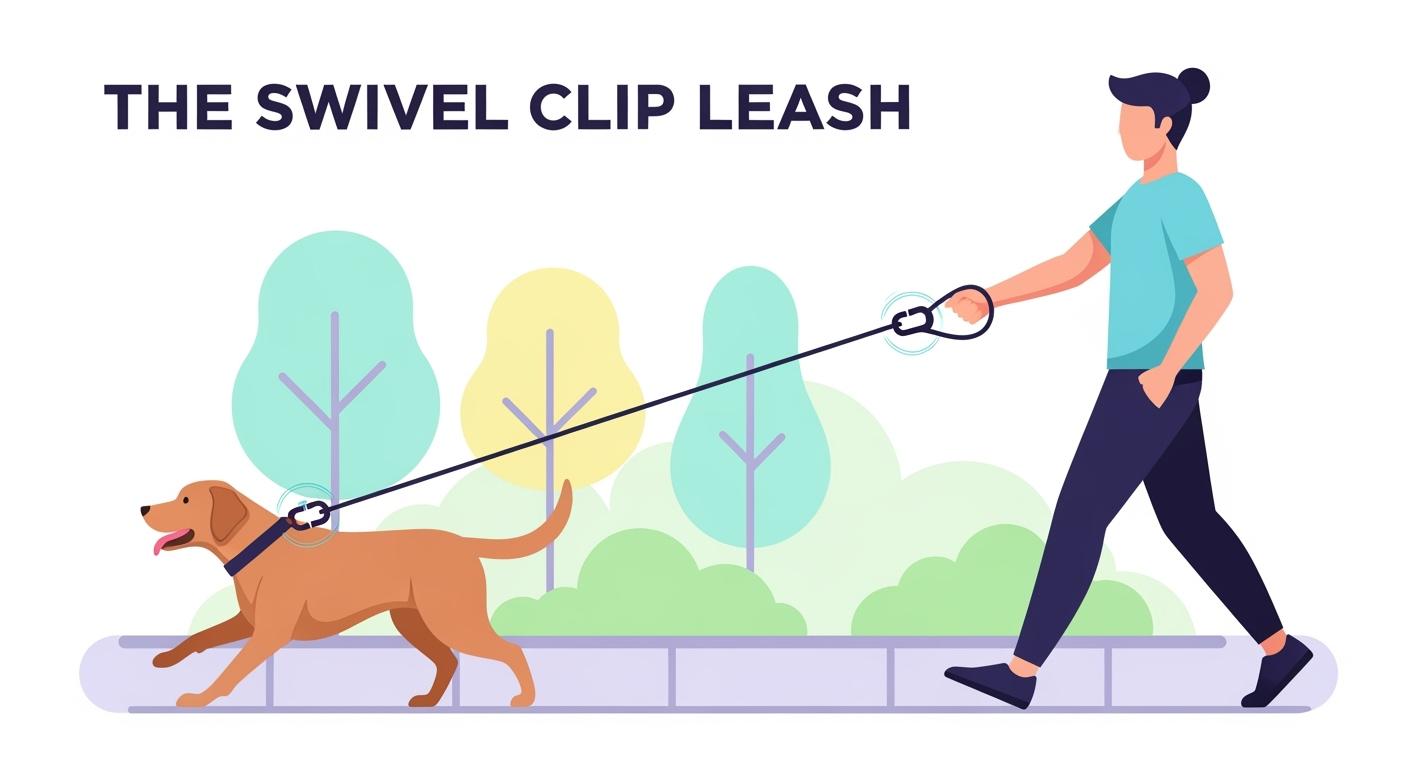
A 360-degree swivel clip interrupts this chain at the first link. When the dog’s force angle shifts, the clip body rotates around its longitudinal axis independently of the webbing. The rotational moment dissipates at the swivel joint rather than transferring downstream. The webbing stays flat because torque never reaches it. This is not a comfort feature — it is a control geometry decision that determines whether the handler feels a flat strap or a twisted rope three minutes into the walk.
You can verify this directly. Clip the leash to a fixed point — a fence post or door anchor — and pull at a 45-degree angle. Rotate your hand as if the dog circled. With a swivel clip, the webbing behind the clip stays flat and the clip body follows your hand. With a fixed clip, the webbing begins to roll within two or three rotations. Same test, same force, different outcome at the connection point.
Clip material matters for longevity, not just function. Zinc alloy clips, common on lighter leashes, are brittle under repeated impact loading — the kind that comes from sudden lunges. A rust-resistant steel carabiner or snap bolt holds its swivel action through more cycles and is less likely to bind after exposure to rain, salt, or grit. For no-pull walking setups, the clip is the component that sees the highest momentary loads, and it is also the component most likely to be overlooked during pre-walk checks.
What Webbing Behavior Means for Feedback Speed
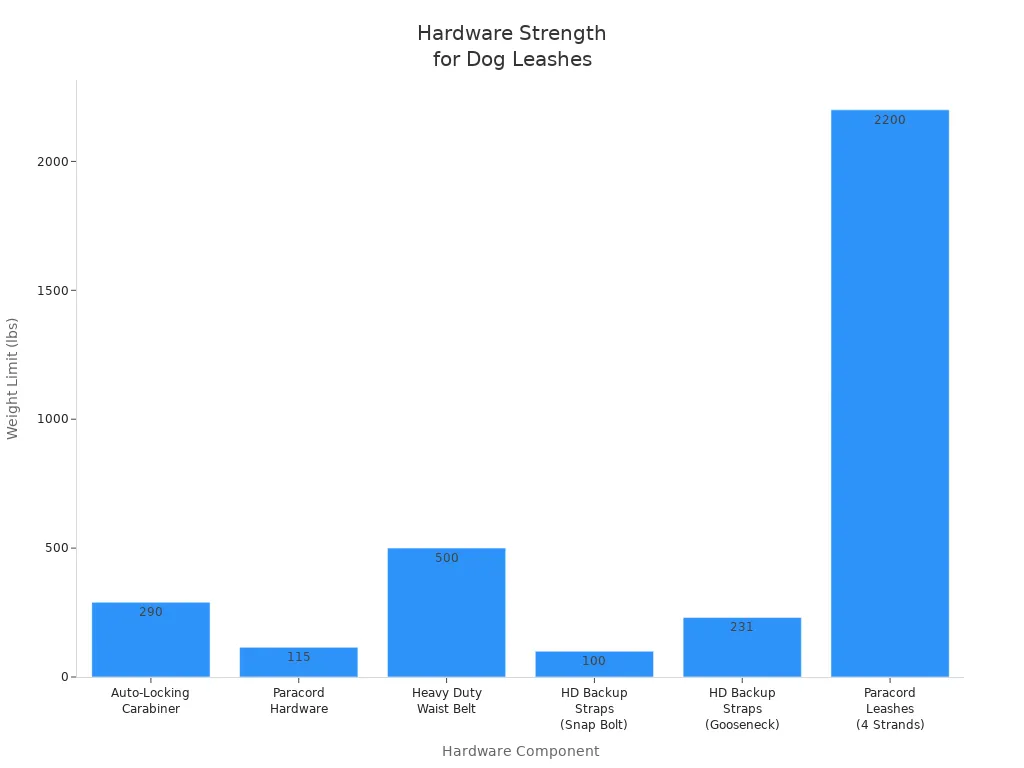
Webbing choice splits into two camps: stretchy and low-stretch. The difference shows up not in how the leash feels at rest, but in how fast the handler receives information during movement.
Elastic webbing — bungee-style leashes — delays force transmission. When the dog accelerates into a lunge, the elastic section stretches first, absorbs the impulse, and only then passes the remaining force to the handler’s hand. This delay window may be a fraction of a second. But a dog moving at a brisk pace covers ground in that window. By the time the handler feels the pull, the dog is already at full extension. The correction — a change in grip, a verbal cue, a direction shift — arrives after momentum has built.
Low-stretch webbing transmits force almost instantly. There is no absorption phase between the dog’s movement and the handler’s perception of that movement. The signal path — dog moves → clip transmits → webbing carries → hand feels — stays direct. The handler can react while the dog is shifting weight, not after the lunge is underway. This is the design logic behind a leash marketed as a reflective bungee dog leash — the stretch is a deliberate tradeoff, not a defect, and whether it helps or hurts depends entirely on whether the dog pulls in bursts or maintains steady tension.
Webbing width affects twisting behavior independently of stretch. A narrow strap — half an inch or less — has a small cross-sectional moment of inertia. Under side load, the edges of a narrow strap roll more easily because there is less material resisting the torsional deformation. A wider strap distributes the same rotational force across more surface area, resisting edge roll. The practical difference: after a walk with multiple direction changes, a leash that handles side lunges poorly shows visible spiraling in the first 18 inches behind the clip, while a wide, low-stretch design stays flat across the same section.
Handle placement is the last variable in this chain. A secondary traffic handle positioned about 12 to 18 inches from the clip gives close-quarters control — but only if the webbing between the handle and the clip is flat. If the webbing has twisted, the handle rotates with it and the handler’s knuckles end up pressed against a rolled edge instead of a flat grip surface. The design works as a system: swivel prevents twist at the clip, wide webbing resists twist along the strap, and both together keep the handle oriented for a usable grab.
Most leash failures concentrate at the connection points — clip springs, swivel joints, and stitching where the webbing meets the hardware. A quick pre-walk control check takes under 30 seconds: run the clip through its full rotation, pull the webbing flat and look for edge fray or stitch gap, and confirm the handle stitching has not started to pull. If the swivel binds or the webbing shows uneven wear along one edge, the leash is accumulating damage that straight-line walking would not expose.
Where These Design Advantages Hold — and Where Conditions Override Them
Swivel clips and low-stretch webbing make the biggest difference under specific conditions. When the dog changes direction frequently — zigzagging on a scent trail, reacting to other dogs, darting after squirrels — the swivel prevents cumulative twist that builds across dozens of small direction shifts. On open, straight paths with a dog that pulls consistently forward, the advantage shrinks; the force stays near the leash’s long axis and the clip has little need to rotate.
Low-stretch webbing is most valuable with dogs that lunge in bursts — a sudden acceleration from a standstill or mid-stride. The instant feedback lets the handler respond during the weight-shift phase. With a dog that maintains steady, constant tension — a determined puller leaning into the harness — the feedback-speed difference between low-stretch and elastic webbing narrows, because there is no impulse to absorb and no delay window to close.
Wet conditions change the equation. Nylon webbing absorbs water and becomes heavier and slightly more pliable, which can reduce its resistance to edge rolling. Coated webbing or materials like biothane resist water absorption and maintain their torsional stiffness when wet. If most walks happen in rain or near water, the webbing material choice starts to matter as much as the width and stretch characteristics.
These design features do not train the dog. A swivel clip prevents torque transfer; it does not teach loose-leash walking. Low-stretch webbing provides fast feedback; it does not replace the timing and consistency that shape a dog’s behavior over time. The leash is a signal conduit — it either transmits clearly or it does not. Fit and sizing checks for walking gear matter equally: a leash with ideal hardware paired to a harness that shifts under load still produces delayed, muddled feedback. The whole setup works or fails as a system.
Disclaimer: The twist and alignment checks described here assume a standard flat leash clipped to a back-attachment harness or collar ring. Front-clip harnesses add rotation at the harness ring itself, which can mask or compound leash-twist behavior — a flat leash behind the clip does not guarantee the harness ring is also oriented correctly. For double-coated breeds, webbing twist may be harder to spot visually; run your hand along the first 18 inches of webbing after a walk instead of relying on a visual check alone.
Frequently Asked Questions
Does a swivel clip actually make a noticeable difference on a walk?
It depends on how the dog moves. With a dog that pulls straight forward without changing direction, a fixed clip may perform fine. With a dog that lunges sideways, circles, or zigzags, the swivel prevents the cumulative twisting that turns a flat leash into a spiral within minutes. The difference is visible: after a 15-minute walk with frequent direction changes, compare the webbing behind a swivel clip to the webbing behind a fixed clip. One stays flat; the other corkscrews.
Is low-stretch webbing always better than elastic?
Not always. Elastic webbing absorbs shock, which can reduce the jarring sensation on both the handler’s arm and the dog’s neck or chest during sudden lunges. The tradeoff is feedback delay — the handler feels the lunge a moment later. For dogs that pull in bursts, low-stretch gives faster information. For dogs that maintain steady tension, the practical difference between the two is smaller than the marketing suggests.
How can I tell if my current leash’s clip is failing?
Three signs. One: the swivel no longer rotates smoothly — it catches, sticks, or grinds. Two: the clip body shows visible rust or corrosion around the spring mechanism. Three: the clip gate does not snap shut cleanly or requires manual reseating. Any of these means the clip may release under sudden load. Replace the leash before that happens.
Does a wider leash strap really help with control?
Wider webbing resists edge rolling under side load because the torsional force is distributed across more material. It also spreads hand pressure more evenly during sustained pulling. The tradeoff is weight — a very wide, heavy strap on a small dog adds unnecessary bulk. For medium to large dogs that pull, the stability gain from a wider strap tends to outweigh the weight penalty.