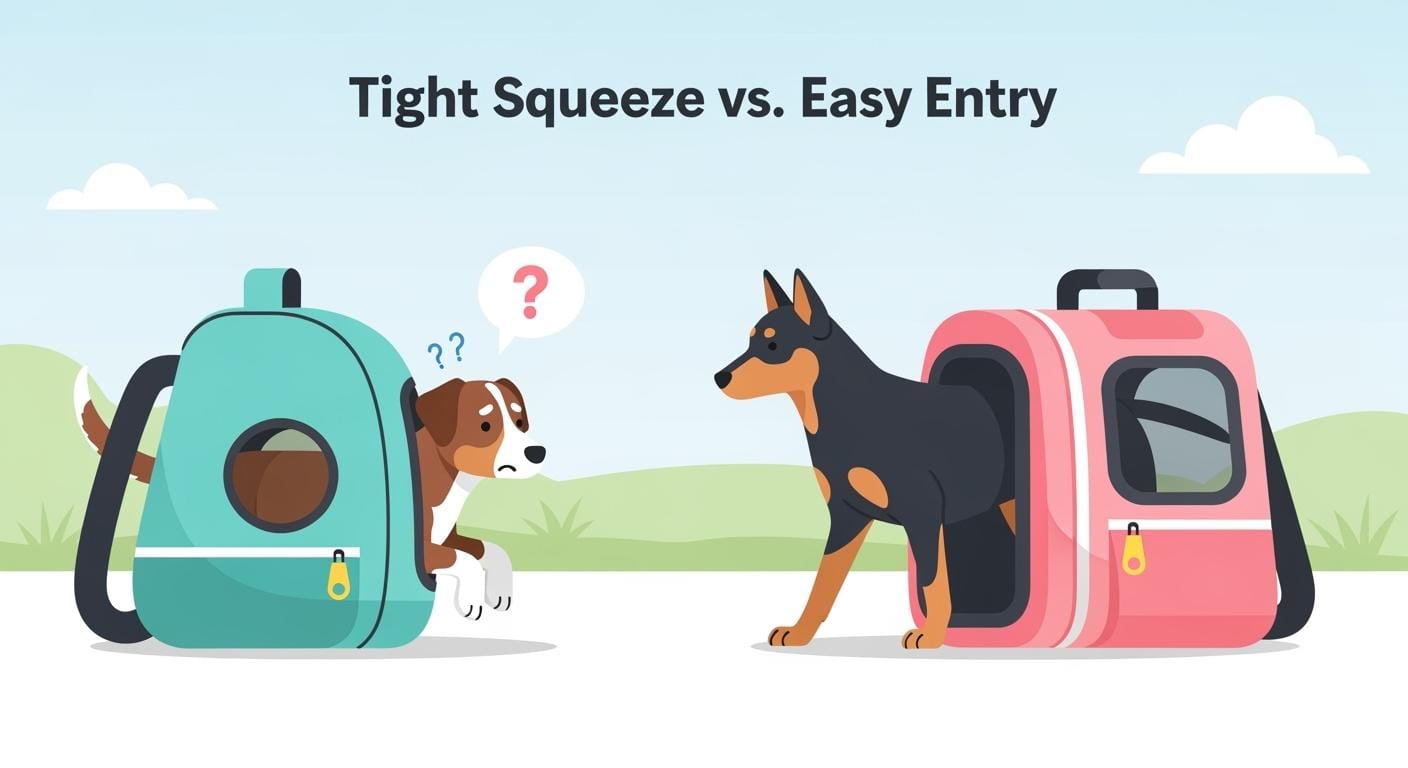
A weight rating is not a space guarantee. A carrier labeled for 20 pounds can still leave a dog hunched against mesh walls once stowed under an airline seat. The difference comes down to structure — whether the panels resist vertical compression, whether the floor stays flat under load, and whether the frame holds its shape after three hours of a dog shifting position.
Why the 20 lb Rating Leaves Less Interior Space Than It Promises
Interior Dimensions vs. Weight Capacity
A carrier stamped “20 lbs” tells you one thing. The interior dimensions tell you another. Weight capacity reflects how much load the stitching and fabric can bear before failing structurally. It says nothing about whether a dog of that weight can turn around, lie flat, or lift its head. A 20 lb dog that measures 14 inches from floor to ear needs vertical clearance the label does not address. The carrier’s listed dimensions often measure the exterior — the interior is smaller by the thickness of padding, frame members, and seam allowances. Those subtracted inches matter more than the weight number.
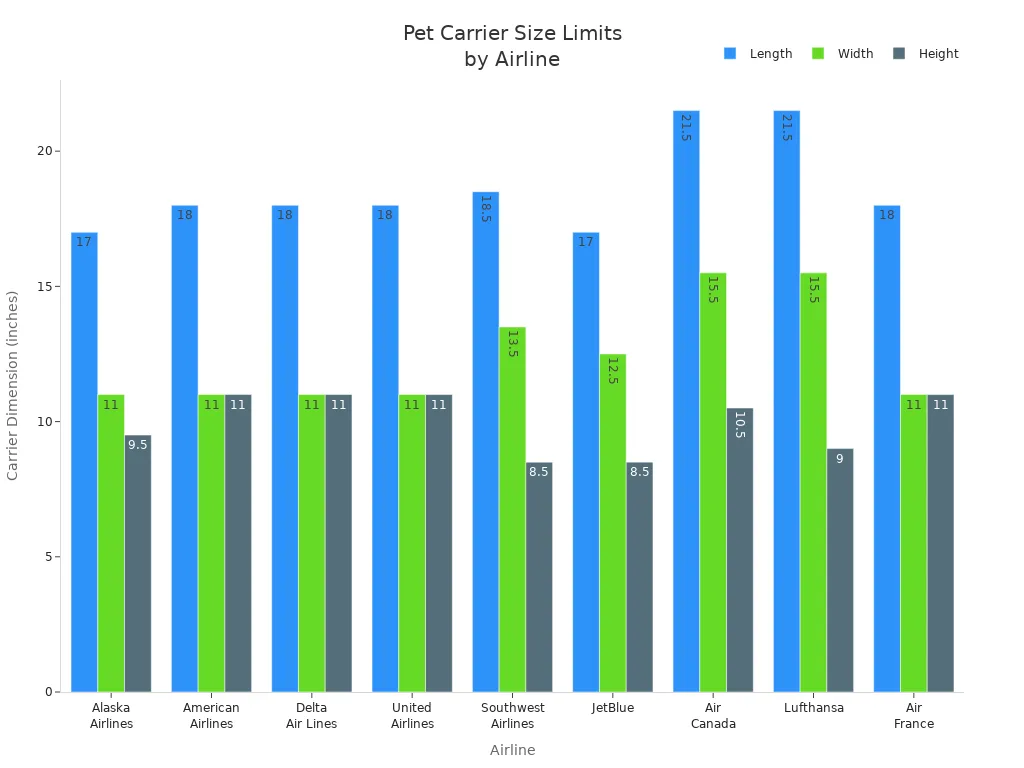
Airline size rules add a second constraint. Each carrier sets its own maximum, and those numbers do not match across airlines:
| Airline | Maximum Dimensions (L x W x H in inches) | Common Pet Weight Limit |
|---|---|---|
| Alaska Airlines | 17 x 11 x 9.5 | Varies by flight |
| American Airlines | 18 x 11 x 11 | Varies (carrier must fit) |
| Delta Air Lines | 18 x 11 x 11 | Varies (carrier must fit) |
| JetBlue | 17 x 12.5 x 8.5 | 20 lbs (pet + carrier) |
| Southwest Airlines | 18.5 x 13.5 x 9.5 | Varies (carrier must fit) |
| United Airlines | 17.5 x 12 x 7.5 | Varies (carrier must fit) |
A carrier that slides under a Delta seat at 11 inches tall may not clear United’s 7.5-inch limit. The weight rating stays the same. The usable space does not.
Under-Seat Compression and Real-World Space Loss
A carrier that passes a living-room fit check can fail when wedged under a narrow seat. A carrier that clears the dimension check empty may collapse far below it once a dog is inside and the seat back applies pressure. The seat bottom above is not a flat plane — it angles, has support rails, and may dip closer to the floor near the seat track. Soft-sided carriers with no internal frame compress unevenly. One corner stays tall while the opposite corner folds. The dog shifts toward the low side, adding more weight there, accelerating the collapse. Interior volume shrinks progressively over the flight, not all at once.
Where Soft-Sided Carriers Give Way Under a Heavier Small Dog
When a 20 lb dog settles inside a soft carrier, body weight transmits downward through the floor panel. If that panel lacks structural support — no rigid insert, no frame member — it deflects. That deflection pulls the lower attachment points of the sidewalls inward. As the sidewalls pull in, the roof panel loses its four-corner tension. The frame, if one exists at all, was designed for vertical load, not the diagonal tension created by a sagging floor. The result is simultaneous compression from above (seat back pressure), below (floor deflection), and the sides (wall bow). Interior volume shrinks from all six faces at once. The same structural mechanics apply regardless of species — a rigid roof member distributes the dog’s concentrated weight across its length, converting a point load into distributed pressure the fabric walls can manage without buckling.
| Failure signal | Likely carrier design cause | Better design direction |
|---|---|---|
| Roof sags | Weak top panel | Reinforced roof |
| Floor bends | Thin or soft base | Sturdy, stable floor |
| Dog cannot turn | Thick bedding, crowded sides | Slim pad, firm structure |
| Poor airflow | Blocked mesh, bulging pockets | Mesh on multiple sides |
Floor Panel Flex and Bedding Compression
A floor that flexes under 20 pounds of dog does two things simultaneously: it angles the dog’s body toward the center of the depression, and it pulls the carrier’s lower perimeter inward. Thick bedding compounds the problem. What looks like comfort in a product photo becomes a space thief — the padding compresses unevenly under the dog’s weight, reducing usable height by an inch or more. A firm, thin pad paired with a non-flexing base keeps the dog closer to the floor plane, preserving headroom. Testing fit on an open living room floor skips the variable that matters most: vertical compression under sustained load.
In practice: After a 10-minute loaded test, unzip the carrier fully and inspect the mesh panels. Mesh that is loose, wrinkled, or sagging away from its attachment points indicates frame shift — the square panel alignment that looked correct empty has been distorted by the load path. Airflow and outward visibility both degrade from this point.
Pocket Bulge and Handle Stress
Side pockets fill with leash clips, treats, and travel documents. Each filled pocket pushes inward. Two filled pockets on opposite sides can eat nearly two inches of interior width. Handles that stretch under load cause the carrier to tilt when lifted, dumping the dog toward one end. A carrier carried by a single shoulder strap transmits twisting forces the frame was never designed to resist. These secondary loads — pockets, handles, lifting — amplify the primary problem of floor flex and roof sag.
How a Reinforced Frame Changes What the Dog Actually Experiences
A carrier built around a rigid perimeter frame and a non-flexing base panel changes the under-seat equation. Instead of the dog’s weight dictating remaining space, the frame sets the volume and the dog occupies a portion of it. A steel-wire perimeter or rigid plastic insert at the floor keeps the base from cupping under load. The sidewalls attach to a stable rectangle rather than a collapsing one, so the roof stays square.
| Feature | Reinforced Soft-Sided Structures | Standard Soft-Sided Carriers |
|---|---|---|
| Shape Maintenance | Holds form under load due to frame | May sag or collapse |
| Structural Integrity | Resists multi-directional compression | Prone to sidewall folding |
| Weight Capacity Handling | Suitable for dogs near the 20 lb mark | Often struggles above 15 lbs in practice |
An internal safety tether anchored to a rigid base point stays functional — the anchor does not pull loose because the floor does not deform. Mesh panels attached to a stable frame stay taut, which keeps airflow paths open and gives the dog a clear view outward. These details do not show up in a weight rating, but they determine whether a three-hour flight is tolerable or stressful.
Tip: Load the carrier with 20 pounds of books or free weights. Slide it under a chair set to match your airline’s underseat height. Measure interior height at the center before and after 10 minutes of compression. A drop of more than 2.5 inches means the dog’s headroom is gone.
Controlled Flexibility and Mesh Strategy
A soft-sided carrier must compress to slide under a seat whose clearance may be 7.5 to 9.5 inches. But compression should be controlled — the frame gives just enough to clear the seat rail, then stops. It does not keep giving. This is the difference between flexibility and collapse. Strategic mesh placement matters here too. Mesh on five sides means the dog can see out regardless of which direction the carrier faces under the seat. Solid panels concentrated at the base and short ends add compressive strength where the carrier contacts the floor and seat supports.
What makes one carrier work where another folds is rarely visible on a product page — it is the hidden frame, whether steel wire, rigid plastic inserts, or high-density foam, that resists compression from multiple directions. Without it, even carriers rated for heavier dogs collapse predictably once wedged under a seat.
Usable Interior Height After Loading
For a 20 lb dog, usable interior height is the dimension that disappears first. A carrier listed at 11 inches tall may have 9 inches of interior clearance after accounting for the frame, padding, and floor thickness. Load a dog inside, and the floor sags another inch. The roof presses down half an inch under seat pressure. What started as 11 inches is now 7.5 — and the dog still needs to hold its head up. A carrier with a rigid base and reinforced roof loses less of that original height because the frame resists both downward and upward deflection.
| Feature | Description |
|---|---|
| Ventilation | Reinforced panels with mesh fabric allow air to flow through even when the carrier is wedged into tight spaces |
| Visibility | Mesh windows give the dog sight lines outward, which tends to reduce stress during extended confinement |
When a Soft-Sided Carrier Is Not the Answer for a 20 lb Dog
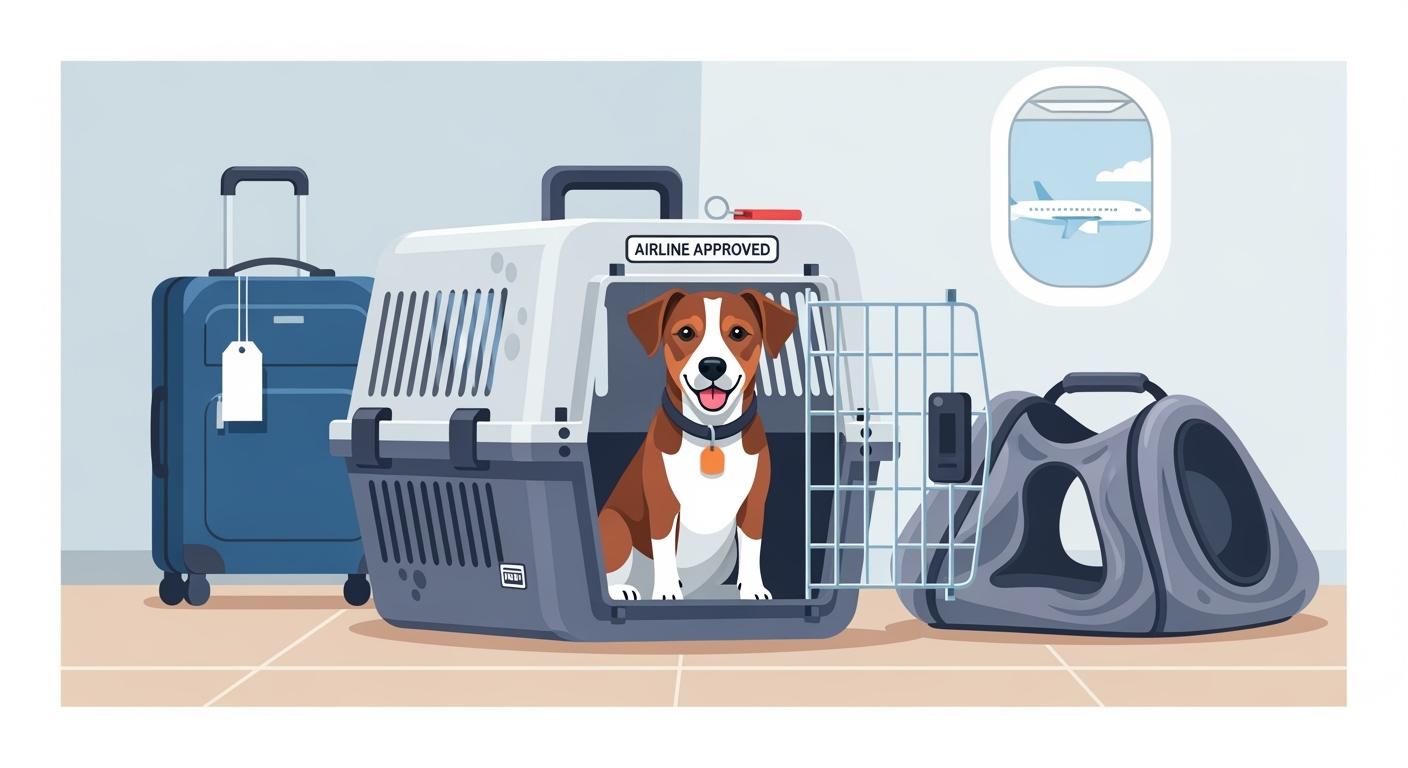
Reinforced soft-sided carriers handle most 20 lb dogs through most flights. But the design has limits. A dog that stands taller than 14 inches at the shoulder in a carrier with 9 inches of clear interior height will travel hunched regardless of frame quality. A dog that thrashes or claws at confinement can pull mesh panels away from their stitching even in a well-framed carrier — the attachment points, not the frame, become the failure mode. And on very short under-seat clearances — the 7.5-inch United limit, for example — a dog near the top of the weight range may simply not have enough vertical room in any soft-sided design. A hard-sided carrier becomes the safer choice in these cases, trading under-seat flexibility for guaranteed interior volume. An airport-ready carrier faces scrutiny that a car-trip carrier never does: gate agents checking dimensions, single-digit under-seat clearance, and hours of confinement.
Disclaimer: This assessment assumes a dog near the 20 lb limit whose body shape approximates breed-typical proportions. Dogs with a deep, narrow chest — common in sighthounds like Whippets — concentrate weight over a smaller floor area, increasing point pressure on the base panel. Barrel-chested breeds like French Bulldogs press more mass against the sidewalls. If the dog’s chest depth exceeds 60% of the carrier’s interior width, or if standing shoulder height exceeds 70% of interior height, a soft-sided carrier may lack adequate structural margin regardless of reinforcement level.
Häufig gestellte Fragen
How do you measure a dog for an airline carrier correctly?
Measure from the base of the tail to the tip of the nose for length, and from the floor to the top of the ears or head — whichever is taller — for height. Add at least 1.5 inches to the height measurement to account for head movement. Compare these numbers against the carrier’s interior dimensions, not the exterior dimensions printed on the tag.
Can a soft-sided carrier support a 20 lb dog for an entire flight?
Only if the frame maintains structural integrity under sustained load. A carrier that holds shape for five minutes in a living room may begin to sag after 90 minutes under seat compression. The frame material matters — steel wire holds longer than plastic inserts, which hold longer than foam-only reinforcement. A carrier that uses a rigid floor panel and a wire-perimeter roof frame tends to keep its dimensions through the full flight duration.
Do all airlines enforce the same under-seat dimensions?
No. United and JetBlue enforce tighter height limits than Delta or American. A carrier that fits one airline may be refused at the gate by another. Check the specific airline’s published in-cabin pet policy for the flight you are taking — not a general airline policy page — because regional jets often have smaller underseat clearance than mainline aircraft on the same carrier.
What signals indicate a carrier is collapsing during a flight?
The dog begins crouching lower than it did at the start of the flight. The roof appears closer to the dog’s head when viewed from the side. The mesh panels lose their flat, taut appearance and begin to wrinkle or sag inward. If you can reach under the seat, check whether the carrier’s floor feels soft or cupped rather than flat — a cupped floor means the base has deflected and the dog is sinking into a depression.