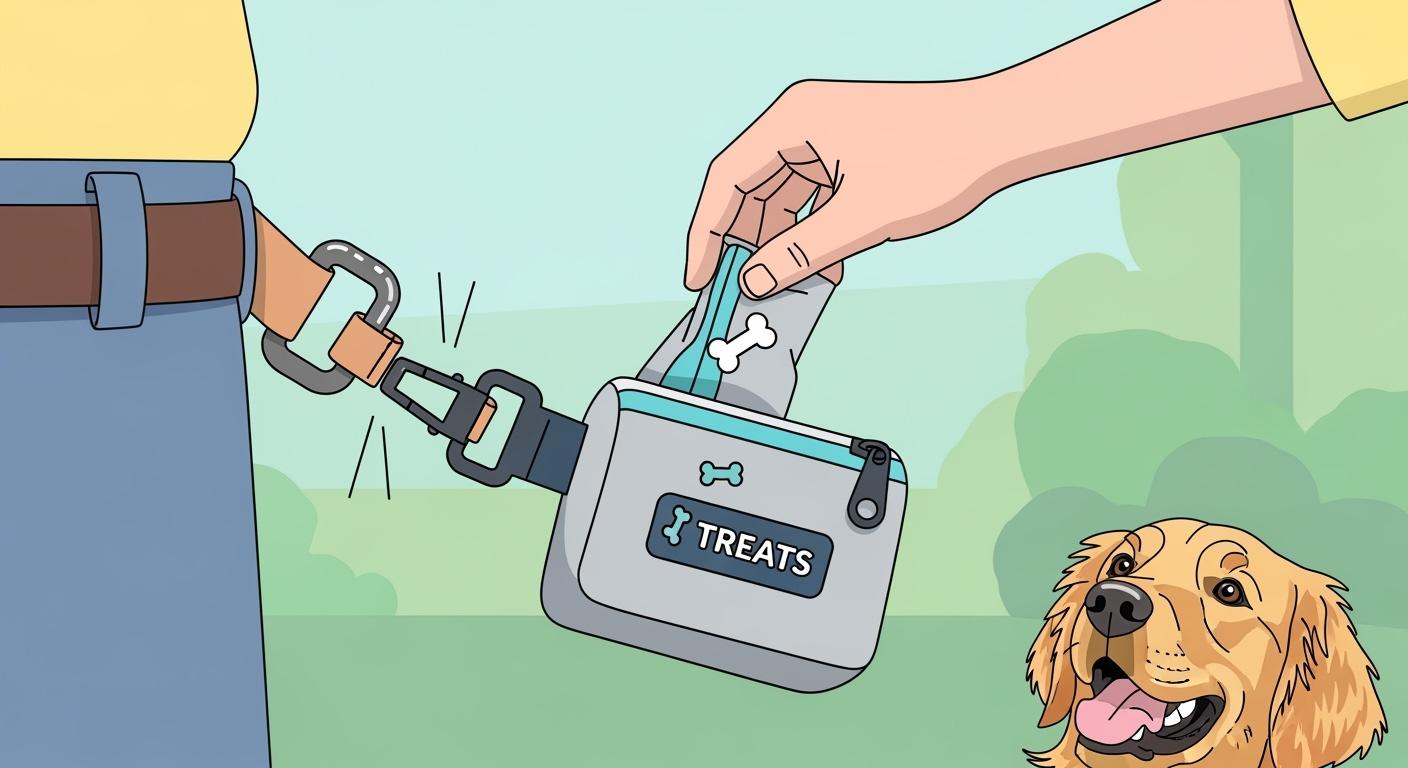
A narrow clip looks convenient. You snap it onto your waistband and go. But bend down to reward a sit, and the pouch tilts. Squat to pick up a dropped toy, and it swings outward. Run a recall drill, and it bounces against your hip. The problem is not the clip itself. It is what a clip does under off-axis load.
Most dog training treat pouches fail at the attachment point long before the fabric or stitching gives out. A clip concentrates the full weight of treats, keys, and waste bags onto a contact area the size of a fingernail. When you stand upright and still, the force vector points straight down and the clip holds. Bend forward and the vector rotates — now the clip experiences a torque it was never designed to resist. That is the moment the pouch starts to slip.
Tip: A pouch that stays put during a standing fit check may still slide after three minutes of bending and squatting. Test movement, not stillness.
Why Narrow Clips and Soft Back Panels Lose Grip During Movement
Think of a clip as a single-point anchor. When the load hangs straight down, the friction between the clip jaws and your waistband is enough to hold. But the moment you lean forward — say, to hand a treat at ground level — the pouch’s center of mass shifts forward. The clip becomes a pivot point. The pouch rotates around it, and the top edge of the clip jaws starts to lever open. On a stretchy waistband, the fabric itself deforms, and the clip walks sideways millimeter by millimeter. After a few bends, the pouch is hanging at an angle.
This is the core mechanical problem: a clip resists vertical pull well. It resists rotational torque poorly. And most training involves rotation — bending, squatting, twisting to watch the dog. A clip that feels secure in a standing posture is fighting a fundamentally different set of forces the moment you move.
Note: Fast direction changes during training multiply the effective load on a clip. What feels like a half-pound pouch can briefly exert several times that force on the attachment point during a quick turn.
Why Soft Back Panels Amplify the Problem
A soft, unlined back panel does two things wrong at once. First, it cannot resist the diagonal pull that comes from an off-center load. The fabric buckles, and the buckle becomes a hinge — the pouch folds outward instead of staying flat. Second, a soft panel conforms to your body in a way that feels comfortable at rest but creates a rolling fulcrum under motion. As you move, the panel’s edge catches and releases against your clothing in a cycle that progressively tilts the pouch.
Rounded pouch backs make this worse. A curved surface against a curved hip has no stable resting plane. The pouch can rotate freely in any direction. A flat back panel, by contrast, creates a broad contact patch that resists rotation in all axes. It is the difference between balancing a book on your palm versus trying to keep a ball from rolling off.
Here is how different movement patterns stress the attachment differently:
| Movement | Force on Pouch | Design That Handles It |
|---|---|---|
| Bending forward to reward | Forward rotation, clip jaws lever open | Wide belt loop distributes torque across a broader anchor |
| Squatting | Upward fabric pull, clip detaches | Adjustable waist belt locks vertical position |
| Quick turn or jog | Lateral swing, pouch bounces off hip | Flat back panel plus wide loop eliminates the gap |
What a Full Pouch Does to the Equation
An empty pouch is easy to carry. Fill it with treats, a roll of waste bags, and a set of keys, and the math changes. Every extra gram increases the rotational moment around the clip. Soft panels that looked fine with a light load start to sag. Clips that held a near-empty pouch begin to slide.
This is where the interaction between panel stiffness and clip placement matters most. A pouch with a reinforced base panel keeps its shape as the load increases. The weight stays centered and low, which keeps the center of mass closer to your body. A soft pouch, by contrast, bulges at the bottom. The bulge pushes the center of mass outward and down — exactly the direction that maximizes rotational torque on the clip.
After a 10-minute training session with a full pouch, check whether the pouch has shifted more than an inch from where you clipped it. If it has, the panel is buckling under load and the clip is creeping. That is observable right now — no lab needed.
Which Carry Design Keeps the Pouch in Place
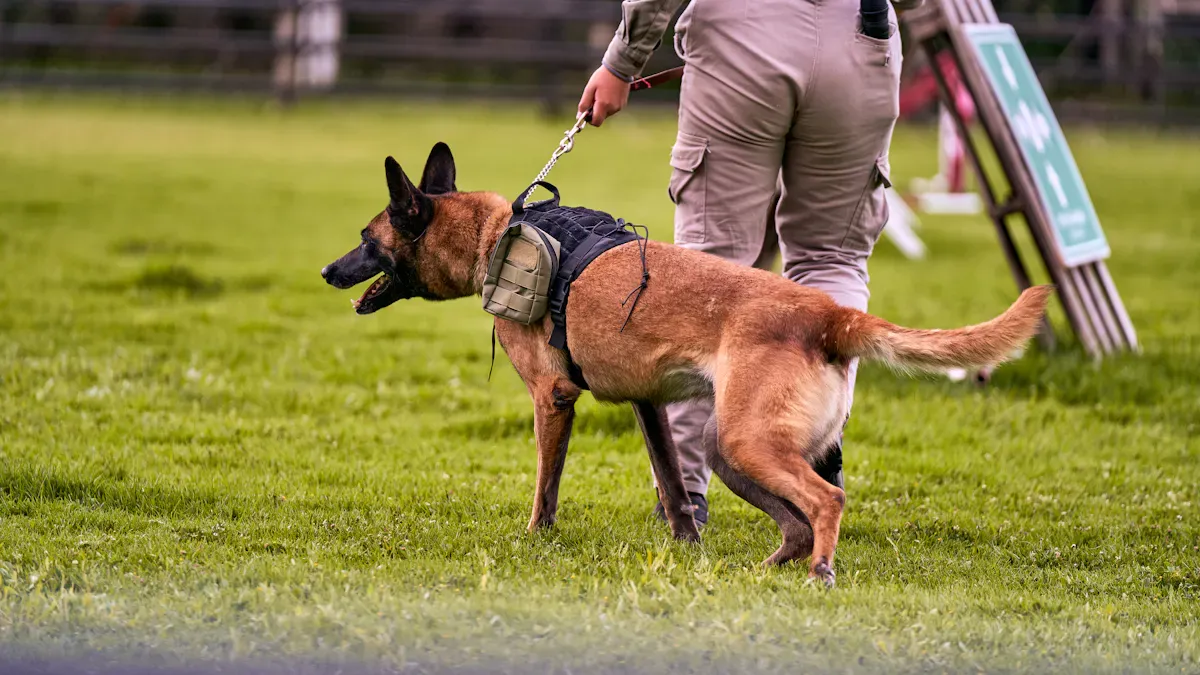
Three design features change how a pouch behaves under motion: the width of the attachment point, the shape of the back panel, and where the clip or loop sits relative to the pouch’s center of mass. Each solves a different part of the stability problem.
Wider Belt Loops Change the Leverage Equation
A narrow loop or a single clip concentrates the pouch’s entire load onto a contact patch roughly the width of your thumb. A wide belt loop — two to three inches across — spreads that same load over a contact patch four to five times larger. That matters for two reasons.
First, friction scales with surface area. A wider contact patch generates more grip against your waistband for the same downward force. The pouch is less likely to slide when you turn or bend. Second, a wide loop resists rotation. When the pouch tries to tilt forward, the outer edges of the loop push back against your belt or waistband. A narrow clip has no edges to push back — it just pivots.
This is the same principle that makes a wide stance more stable than standing on one foot. The wider the base of support, the more rotational force it takes to tip the system. A training pouch with wide loops brings that principle to the attachment point.
In practice: The difference becomes obvious the first time you bend to pick up after your dog. With a clip, you reflexively reach for the pouch to steady it. With a wide loop, you do not think about it — the pouch is where you left it.
Flat Back Panels and Edge Reinforcement
A flat back panel does more than sit flush against your hip. It creates a stable reference plane. When the pouch tries to rotate, the entire flat surface has to lift away from your body simultaneously. That takes more force than tipping a rounded back, which can roll away incrementally.
Reinforced edges add another layer. Unreinforced fabric edges fold under diagonal tension — think of a piece of paper curling when you pull one corner. Double-stitched piping or a foam insert along the edges creates resistance to that folding. The pouch holds its shape under off-axis load. Combined with a flat back, this means the pouch’s geometry stays consistent throughout a training session. The attachment point does not drift because the panel behind it has not deformed.
After a session that includes repeated bending, flip the pouch over and look at the back panel. If the edges are creased or the fabric shows diagonal fold lines, the panel is flexing under load and gradually transferring that movement to the attachment point. A flat, reinforced panel will show no such creasing.
Centered Clip Placement and Attachment Height
Where the clip or loop sits on the back panel determines how the pouch balances. A clip placed high on the pouch — near the top edge — creates a long lever arm between the attachment point and the pouch’s center of mass. The weight hangs far below the clip, and any forward lean sends the bottom of the pouch swinging outward.
A clip centered vertically on the back panel shortens that lever arm. The pouch’s weight sits closer to the attachment point, so the rotational moment is smaller during the same forward lean. The pouch tends to stay upright rather than tilting.
Two-clip designs go further: by anchoring the pouch at two points, they eliminate the single-axis pivot entirely. The pouch cannot rotate because rotation around one clip is blocked by the other. The trade-off is that two-clip setups are slower to attach and remove. For sessions under 20 minutes, a single centered wide loop is often the better balance of stability and convenience.
| Clip Position | Behavior Under Forward Lean | Where It Works |
|---|---|---|
| High, near top edge | Pouch tilts outward, bottom swings | Standing-only use, short sessions |
| Centered on back panel | Stays upright, minimal tilt | Active training with frequent bending |
| Dual-clip or wide double loop | No rotation, slowest to attach | Long sessions, heavy loads, running |
When a Body-Hugging Pouch Is the Right Call — and When It Is Not
A body-hugging treat pouch with wide loops, a flat back, and a centered attachment solves the stability problem for handlers who bend, squat, and move. But it is not the right answer for every scenario.
For a short walk where you carry three treats in a pocket, a dedicated pouch adds bulk you do not need. For a handler who trains from a stationary position — standing beside an agility course, treats on a nearby table — the stability features of a wide-loop pouch add cost without adding utility. The pouch never faces the rotational forces these designs are built to resist.
For handlers who switch between a belt, a jacket, and no waistband at all — think of layering across seasons — an adjustable waist belt system with its own strap removes the dependency on what you are wearing. But that same strap adds a step to every on-off cycle. For a trainer running back-to-back 30-minute sessions, those seconds add up.
The design that works best is the one matched to your actual movement pattern. A pouch built for bending and sprinting is overbuilt for a handler who never leaves a standing position. A clip-on pouch that feels fine standing still becomes a distraction the moment the training involves ground-level rewards.
Disclaimer: The stability checks described here assume the handler is wearing a belt or waistband with enough structure to support the pouch. If you typically train in athletic wear with a thin elastic waistband, even a wide-loop pouch may struggle — the waistband itself becomes the weak link. In that case, a pouch with its own adjustable waist strap bypasses the clothing variable entirely. Also, handlers who use a wheelchair or train from a seated position experience different force vectors on the pouch; the forward-lean torque described here may not apply in the same way, and a clip-on design may perform adequately.
Häufig gestellte Fragen
Why does a clip-on pouch slip even when the clip is tight?
Tightness helps with vertical friction but does almost nothing against rotational force. When you bend forward, the pouch pivots around the clip. The clip jaws can hold the waistband firmly and still let the pouch body tilt outward. The fix is not a tighter clip — it is a wider attachment that resists rotation.
Do wider belt loops work with thin waistbands?
They help, but the waistband itself must have enough structure to act as a stable rail. A wide loop on a thin elastic band still gives you a stable loop-to-pouch connection, but the band may stretch and roll. An adjustable waist strap that wraps fully around you removes the waistband from the equation entirely.
How do I test whether my current pouch is stable enough?
Clip the pouch on with a full load of treats. Walk for two minutes, then bend forward at the waist ten times in a row — the motion you would use to deliver a treat to a dog at heel position. Check the pouch. If it has drifted more than one inch from its starting position, or if the back panel shows diagonal crease lines, the attachment system is losing the fight against rotational force.
Is a pouch with its own belt better than a clip-on?
It depends on your clothing. If you always wear a sturdy belt, a wide-loop clip-on performs nearly as well and is faster to put on and take off. If your waistband changes day to day — jeans one day, joggers the next — a self-belted pouch is more consistent because it does not rely on what you are wearing to stay put.
Do I need a different pouch for different training scenarios?
Not necessarily. One well-designed pouch with a wide belt loop, a flat back panel, and a centered attachment can cover most scenarios. The exception is if you regularly carry very heavy loads — multiple dogs’ worth of treats, water, and accessories — in which case a dual-clip or fully belted design reduces the fatigue of constantly re-seating the pouch between exercises.