A dog carrier backpack sways because the load is not locked to your torso. The dog shifts. The weight re-centers. One shoulder strap goes slack while the other digs in. In the next few strides, the unweighted strap walks its way toward the edge of your shoulder and drops.
That slide happens for a mechanical reason most carrier backpack designs overlook. Two shoulder straps are two independent lines of force. Without something bridging them, any lateral movement breaks the tension balance between left and right. The strap that loses tension slides. The strap that gains tension pulls the carrier off-center.
A chest strap fixes this by closing the loop. The design logic is straightforward once you see the force path — and that is what this article walks through.
Why Shoulder Straps Slide and Spread on a Dog Carrier Backpack
What Happens When the Dog Shifts Inside
A dog in a carrier backpack is live weight. Unlike a static hiking load strapped tight against a frame, a dog adjusts position. Stands up. Sits down. Turns its head. Each shift displaces the carrier’s center of mass a few inches in an unpredictable direction.
When the center of mass moves left, the left shoulder strap takes more of the vertical load. The right strap loses tension. Losing tension means losing friction — the strap no longer grips the fabric of your shirt or the surface of your shoulder. It is now free to slide.
And slide it does. The human shoulder slopes downward and outward from the neck. A shoulder strap under zero tension follows that slope like water following grade. The narrow webbing of a typical strap has almost no surface area to resist lateral movement once friction drops below a threshold. Within a few steps, the strap is off the shoulder.
The Missing Cross-Chest Connection
Two independent shoulder straps form a V-shape when viewed from the front. A V is structurally unstable under lateral load. Push sideways on either arm of the V and it deforms — the arms spread wider, the vertex drops, the shape collapses.
This is the core design flaw in a dog carrier backpack that ships without a sternum strap. The shoulder straps are engineered for vertical load — the dog’s weight pulling straight down. But walking is not vertical. It generates lateral force with every step: the dog shifts, the carrier swings, one strap unweights, and the V opens.
Tip: After walking 10 minutes, stop and check whether both shoulder straps sit the same distance from the center of your neck. A difference of more than an inch means the carrier has migrated asymmetrically and the strap system is losing its grip.
| Failure Signal | Likely Design Cause | Better Design Direction |
|---|---|---|
| Straps slide outward | No chest strap, straps form an open V | Add chest strap, adjust attachment angle |
| Carrier sags or swings | Soft back panel, narrow strap width | Firmer back structure, wider shoulder straps |
| One strap rides higher than the other | Strap length mismatch, uneven tension | Symmetric adjustment, chest strap balances tension |
How a Chest Strap Locks the Shoulder Straps into a Closed System
From Two Independent Lines to One Closed Loop
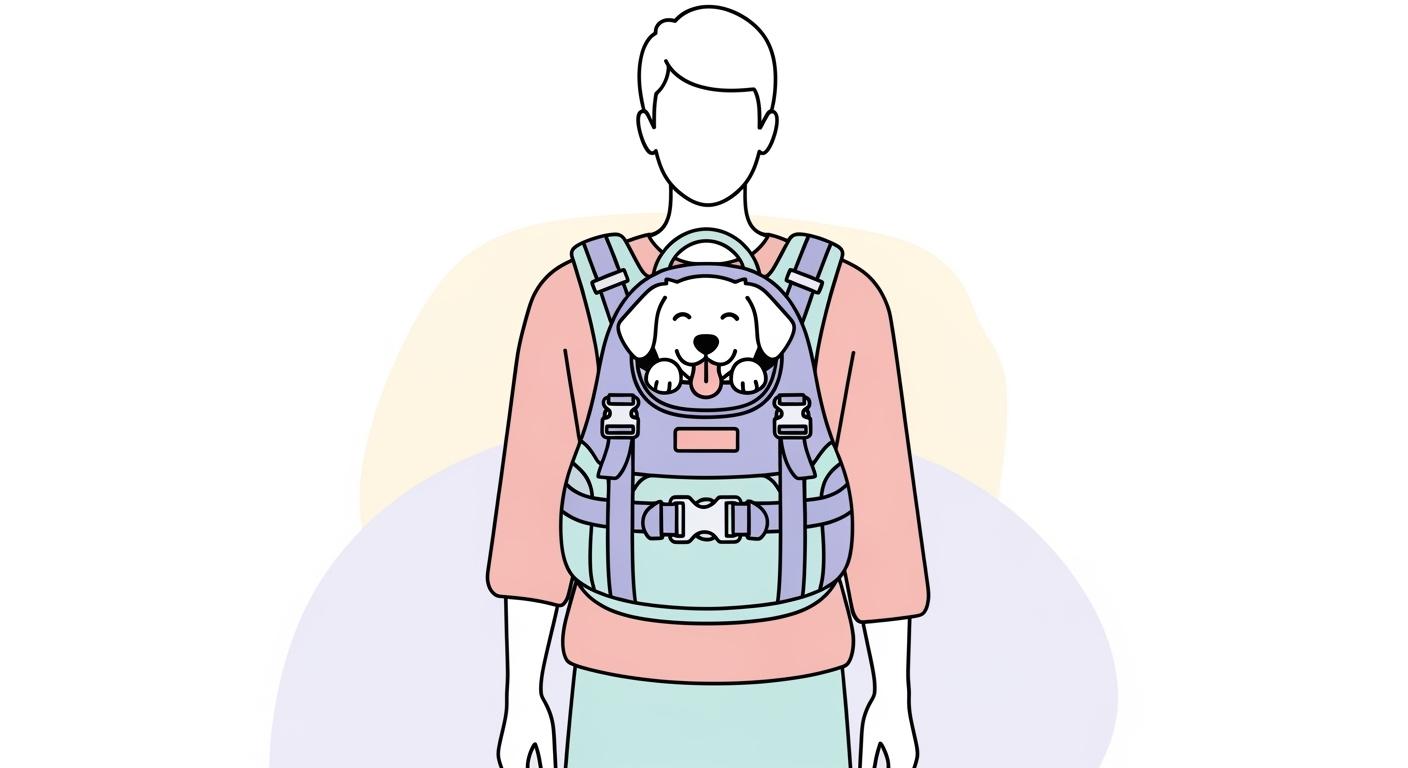
A chest strap — sometimes called a sternum strap — connects the left and right shoulder straps across the chest at approximately mid-sternum height. The moment you clip it, the geometry changes. Two separate straps become a single closed loop.
Here is the causal chain. When the dog shifts and lateral force pushes the left strap outward, that force travels through the chest strap to the right strap. The right strap — still under tension from the weight it carries — pulls back. The chest strap becomes a tension bridge, transferring force from the side losing tension to the side holding tension. The outward-moving strap hits resistance before it can reach the edge of the shoulder.
A V-shaped system deforms under lateral force. A triangulated system resists it. Push one shoulder strap outward and two things constrain it: the chest strap pulling it back toward center, and the opposite shoulder strap anchoring the other end of that pull. The system self-stabilizes.
The strap’s position at mid-chest height is not arbitrary. At sternum level, the chest strap transfers horizontal stabilizing force into the ribcage — a bony structure that accepts compression without restricting breathing. Place the strap too high, near the collarbone, and it rides up into the throat. Too low, near the solar plexus, and it loses the mechanical advantage needed to resist shoulder strap spread. Mid-chest is the sweet spot where structural support meets comfort. But getting the position right also depends on getting the overall fit and strap sizing dialed in — a chest strap cannot compensate for shoulder straps set at the wrong width.

What Changes During a Walk
You can verify the chest strap’s effect in real time. Before a walk, note where each shoulder strap sits relative to your collarbone. Walk 10 minutes on uneven ground — a mixed surface with some incline — without the chest strap clipped. Stop and check. One strap has likely drifted outward by an inch or more.
Now clip the chest strap at mid-chest height, snug but not tight enough to restrict a full breath. Walk the same route. Stop and check again. Both straps should sit at roughly the same position. The drift stopped because the closed loop resisted the lateral forces that previously pried the straps apart.
This same diagnostic works on mixed terrain — hiking with a carrier backpack amplifies every fit problem that a flat sidewalk hides. If the chest strap is adjusted correctly and the straps still drift, the issue may be in the strap angle or back panel structure. The chest strap can only close the loop if the shoulder straps are positioned to form a functional triangle to begin with.
Note: A chest strap that slides downward during use signals that the shoulder straps are set too wide or too narrow at the attachment point — creating a downward force vector on the buckle. The shoulder straps should sit parallel, not angled inward or outward, where they meet the chest strap clip point.
When a Chest Strap Reaches Its Limit
The Hip Belt Anchors What the Chest Strap Cannot
A chest strap stabilizes the upper portion of the carrier. It does not manage the lower half. Without a hip belt, the carrier’s base swings freely with each step, and the chest strap absorbs forces it was not designed to handle — vertical bounce from the dog’s weight cycling up and down with your stride.
Pairing a chest strap with a padded hip belt splits the load across two structural zones. The hip belt anchors the bottom of the carrier to the pelvis, transferring a meaningful portion of the vertical weight to the hips. The chest strap keeps the top from pulling away from the body. Together they create a four-point anchor that handles multi-directional movement — uphill, downhill, side slope, quick turns.
A carrier backpack set up for hiking exposes these multi-directional forces more aggressively than a short walk on pavement. A firm back panel, a hip belt, and a chest strap distribute the dog’s live weight across three structural zones. Remove any one, and the remaining two compensate in ways they were not designed for.
Conditions That Amplify the Limits
Chest strap effectiveness degrades predictably in specific conditions. On steep descents with a dog carrier backpack, the forward-tilting carrier pulls the chest strap upward toward the throat. Dogs over roughly 25 pounds amplify the sway forces the chest strap must counter, and a single cross-chest connection may not provide enough lateral resistance on its own. Users with narrow or sloping shoulders will find that straps drift even with a chest strap because the shoulder geometry offers less natural grip surface.
Getting the strap adjustment sequence right matters because each adjustment changes the geometry of the next. Hip belt first. Then shoulder straps. Then chest strap. Then load lifters, if present. Reversing this order — cinching the chest strap before setting the shoulder straps — locks in a fit that may feel snug while standing but shifts the moment you take a step.
Disclaimer: These fit observations assume a smooth-coated dog of typical proportions for its breed. Dogs with barrel chests or very deep keels shift the carrier’s center of mass differently, and the strap-geometry checks described here may not catch every pressure point. If the dog’s build falls outside breed norms — particularly a pronounced barrel chest on a short-backed dog — hand-check strap tension at multiple points during a walk rather than relying on visual alignment alone.
| Design Element | What It Stabilizes | Where It Falls Short |
|---|---|---|
| Chest strap | Upper carrier, shoulder strap spread | Vertical load, lower carrier sway |
| Padded hip belt | Lower carrier, vertical weight transfer | Upper carrier pull-away on descents |
| Firm back panel | Carrier shape, load distribution | Does not stop strap spread on its own |
| Load lifter straps | Top-of-carrier pull toward shoulders | Ineffective without chest strap to anchor position |
| Wide shoulder straps | Vertical pressure distribution | Lateral stability — still slide without cross-chest bridge |
Häufig gestellte Fragen
Does a chest strap help if the carrier already has wide, padded shoulder straps?
Wide padded straps spread vertical pressure better than narrow webbing, but padding does not solve the lateral stability problem. A padded strap that slides outward still falls off the shoulder. The chest strap addresses spread directly — padding addresses pressure. They are separate design variables that solve separate problems.
Can a chest strap be added to a carrier that did not come with one?
Some carriers have webbing loops or D-ring attachment points along the shoulder straps for aftermarket sternum straps. If the shoulder straps lack attachment hardware, adding a chest strap is unreliable — the clip-on variety tends to slip under load because it cannot hold a fixed position without a sewn anchor point.
At what dog weight does a hip belt become necessary?
No single threshold applies to all users and carriers. A useful observation: if your shoulders feel noticeably sore after a 30-minute carry, the load is exceeding what shoulder straps alone can manage. A hip belt transfers a meaningful portion of that weight regardless of the dog’s exact poundage.
Does a chest strap help with ventilation?
Indirectly. When the carrier sits flush against your back — held there by the chest strap — the back panel’s ventilation features can do their job. If the carrier swings and gaps form between the panel and your back, sweat accumulates in the gaps and evaporates more slowly. A stable carrier vents more effectively even with the same mesh panel.
Why does the chest strap keep sliding down during use?
A chest strap that slides downward signals the shoulder straps are pulling it at an angle. Check that the shoulder straps run parallel — not angled inward or outward — where they meet the chest strap clip point. If the strap height won’t stay set, the attachment hardware may lack sufficient friction against the shoulder strap webbing, which is a materials-level limitation rather than an adjustment error.
| Failure Signal | Likely Design Cause | Better Design Direction |
|---|---|---|
| Straps slide outward | No chest strap, V-shaped strap geometry | Add chest strap at mid-chest height |
| Carrier sags or swings | Soft back panel, no hip belt | Firmer back structure, padded hip belt |
| Chest strap rides up to throat | Straps set too narrow at shoulders | Widen shoulder strap spacing at top anchor |