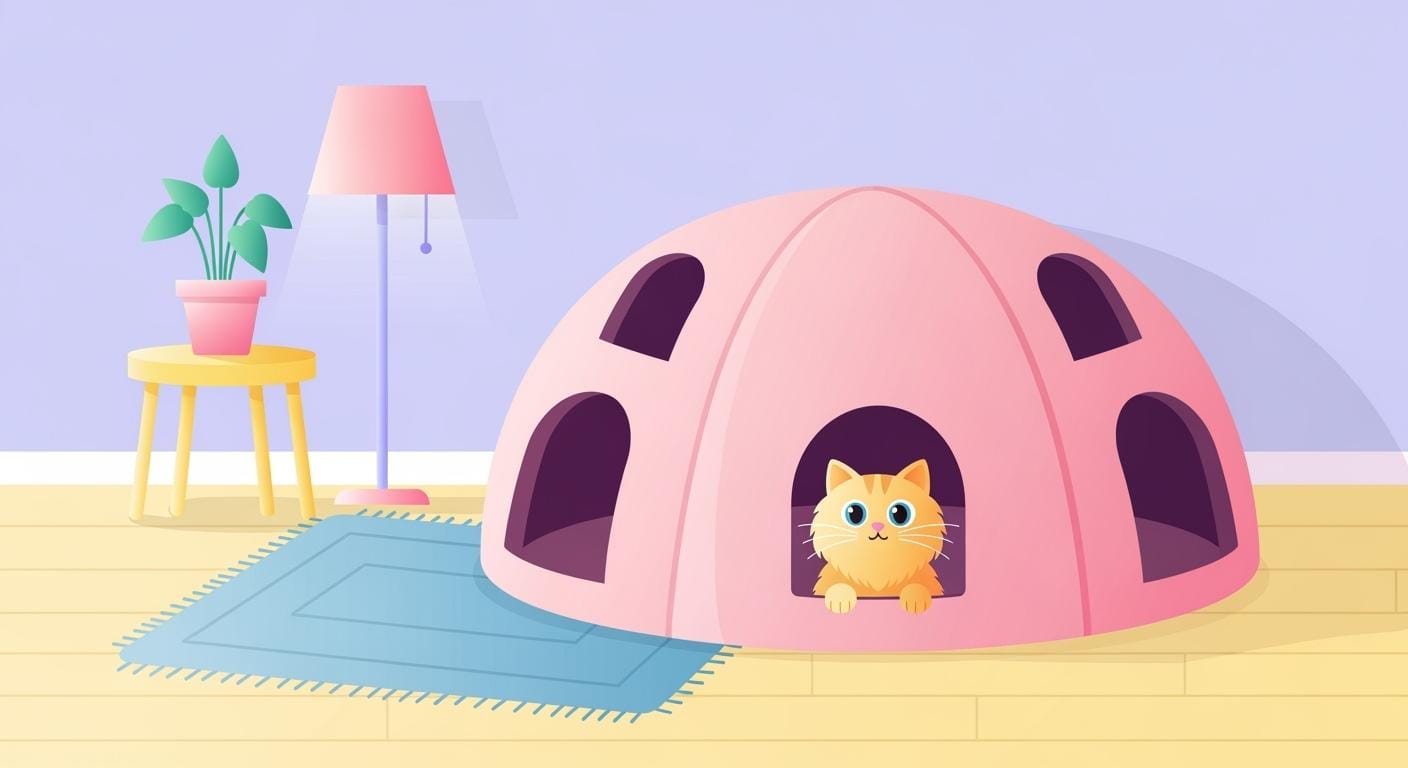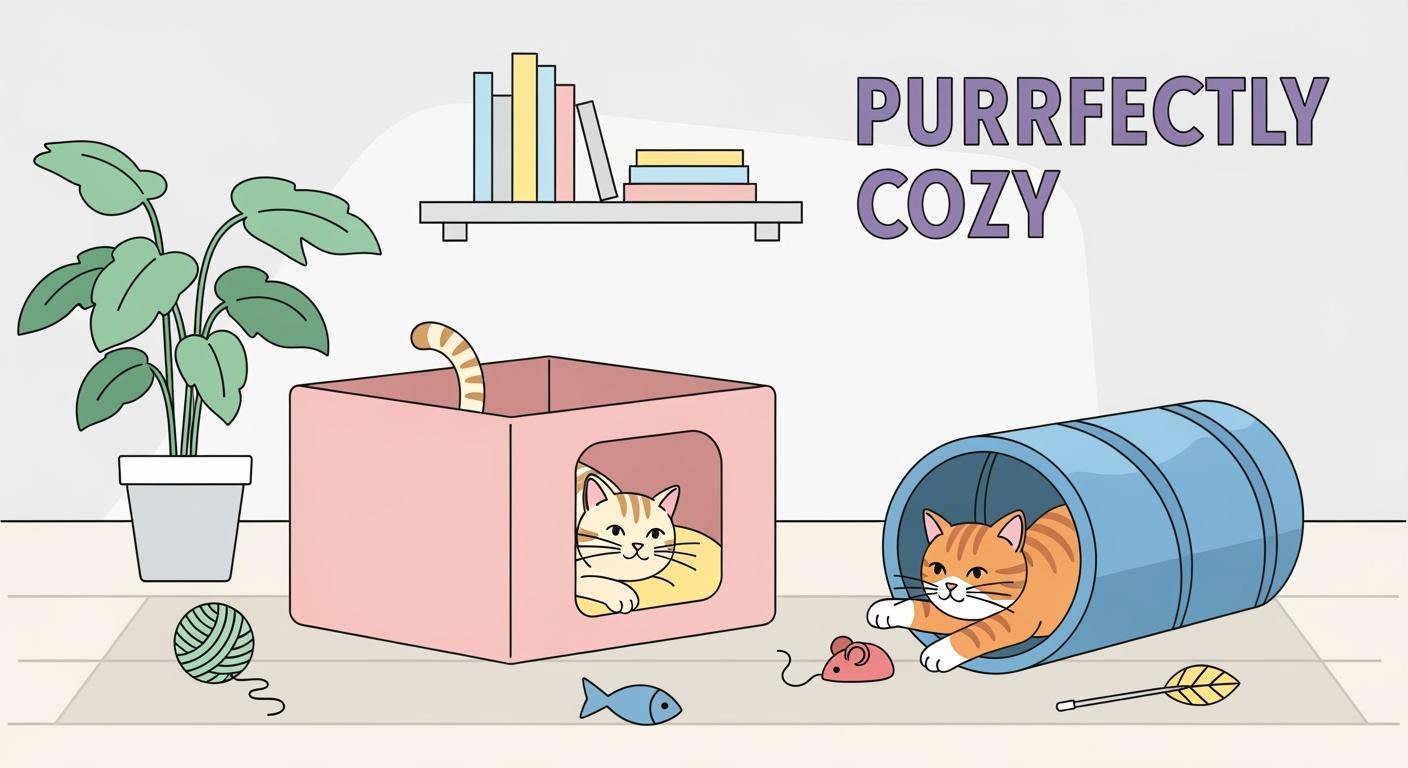
A cat walks up to a bed, circles it twice, and walks away. That is not a picky cat. That is a cat running a threat-assessment check and failing it. When a bed has one way in and one way out, the cat’s brain registers a trap — not a resting spot. The problem is rarely the cushioning. It is the layout. Four-side tunnel cat beds address this with two design moves that single-exit beds get wrong: multi-directional access and functional surface separation. A bottom tunnel handles hiding and darting. A top mat handles open resting. Those two decisions account for most of the difference between a bed a cat uses and one it ignores.
Why a Single Exit Makes a Cat Walk Away
The One-Entrance Threat Calculus
Felines assess resting spots through a specific filter: can I see threats coming, and can I leave in more than one direction? A single-opening bed fails both checks. The cat cannot scan the room without turning around. It cannot exit without passing back through the same opening it entered through.
This is not a comfort preference. It is a hardwired heuristic. A cat that beds down in a dead-end space outdoors becomes prey. The domestic cat does not know why it hesitates — but the hesitation is consistent across breeds, ages, and household types.
There is a mechanical dimension too. When a cat’s body blocks the only entrance, escape requires a sequence: rise, turn, orient toward the opening, exit. In a four-side bed, exit is a single motion in any direction. One movement versus four. That gap is what separates a bed a cat uses from one it ignores.
Enclosed walls also degrade peripheral vision and sound localization. A cat resting inside a closed bed cannot see movement to the side or rear. Familiar footsteps and household sounds become harder to place because the shell scatters acoustic cues. The cat is not just physically constrained — its sensory picture of the room is thinned out. Anxious cats and cats in multi-pet households feel this most acutely.
Note: After a week with a new bed, check whether your cat settles facing the opening or facing away from it. A cat that always faces the exit is treating the bed as a temporary perch, not a resting spot. The layout still reads as exposed.
Rejection Signals That Point to Layout, Not Padding
The signals are consistent. The cat sniffs the entrance, circles, and leaves. Some paw at the opening without stepping in. Others sit beside the bed and watch it — close enough to show interest, far enough to signal no commitment. These form a clear rejection pattern tied to entry architecture, not cushion softness or placement.
| Failure Signal | Likely Design Cause | Better Design Direction |
|---|---|---|
| Hesitation at entrance | Single exit, closed shell | Four-side tunnel cat bed |
| Refusal to settle inside | Limited escape routes | Multiple openings, stable base |
| Avoids resting entirely | Poor sightlines, tight enclosure | Open-sided tunnel with top mat |
What Changes When a Bed Opens on Four Sides
Entry From Any Direction Resets the Risk Equation
A four-side opening layout changes the cat’s decision at the approach stage. The cat does not have to commit to one entry path. It can walk up from any angle, step partway in, and still see a clear exit on the far side. That through-line visibility — being able to look through the bed to the other side of the room — is what dissolves the trapped-boxed-in feeling.
The physics here is straightforward: the cat’s body never fully occludes all escape routes at once. In a single-exit bed, once the cat turns around inside, its own shoulders block the only way out. With four open sides, no matter which way the cat faces, at least two exits remain unobstructed. This is not about the cat liking the design more. It is about the design removing a physical constraint that triggers an instinctive rejection.
A tunnel bed with a center mat also gives the cat something no enclosed cave bed can: the option to use the bed without entering the tunnel at all. A cat not in the mood to hide can hop onto the top mat and settle in the open. The bed works for both behavioral modes — hide mode and lounge mode — without forcing the cat to override its own threat-assessment system.
Why a Stable Base Cuts Entry Hesitation
An unstable floor adds friction to the entry decision. If the base shifts or the fabric buckles when the cat steps onto it, the cat registers unstable footing — another threat signal. A non-slip base keeps the bed stationary. Older cats and cats with joint stiffness are especially affected; a bed that slides even an inch can become one they stop attempting.
The material underfoot matters too. A slick polyester shell on the tunnel floor can cause a cat’s paws to slip during the turn-around motion inside. That micro-slip triggers the same righting reflex a cat uses on a unstable surface — and once triggered, the cat associates the bed with instability. Fabrics with a slight texture or low-pile fleece liner give the paws enough grip to turn without triggering that reflex. This is a production-level detail: the same tunnel shape built with a slicker fabric will get lower use rates than one with a slightly gripped interior surface, even if the external dimensions are identical.
Tip: Place a bed on a hard floor and press one hand firmly into the center. If the far side lifts or the whole bed shifts more than half an inch, expect a cautious cat to hesitate at the entrance.
Why the Tunnel and the Mat Need to Be Separate
Two Surfaces for Two Behavioral Modes
Cats do not use hiding spaces and open resting spaces the same way. A hiding space — a tunnel, a box, a draped chair — supports short-duration, high-alert behavior: the cat ducks in, scans, and either emerges or settles briefly. An open resting surface — a mat, a cushion, a sunny patch of floor — supports extended, low-alert rest: sprawled out, eyes closed, limbs loose.
Most cat beds ask one surface to serve both modes. That fails because the characteristics that support hiding — enclosure, low ceiling, concealment — conflict with those that support open resting — visibility, ventilation, room to stretch. A covered cave or open donut forces a binary choice: a bed that works for one mode but not the other.
A four-side tunnel design splits the two functions across physically separate surfaces: a bottom tunnel for hiding and short-play darting, a top mat for extended open rest. The cat can switch between them without leaving the bed. That matters because a cat that finishes a play session inside the tunnel may be inclined to rest — but if resting means relocating, the moment is often lost. Keeping both surfaces in the same footprint means the transition from play to rest does not require a change of location, and the cat tunnel bed layout supports this shift without interrupting the cat’s natural rhythm.
How tunnel bed materials and fit affect daily use depends on fabric choices and sizing — a bed too short for the cat’s body length limits both hiding depth and top-mat stretch room.
Cleaning and Long-Term Use
A bed that is hard to clean stops getting used — not because the cat rejects it immediately, but because accumulated hair, dander, and odor gradually make the surface less appealing. A removable, machine-washable top mat lets the most heavily used surface stay fresh without requiring the entire bed to be disassembled. The tunnel itself collects less direct body contact and can usually be maintained with a vacuum pass and an occasional wipe-down.
| Design Difference | Warum das wichtig ist | Main Limitation |
|---|---|---|
| Four-side open entry | Cat never blocks all exits at once; threat-assessment check passes on approach | Takes more floor space than a single-opening bed of the same mat area |
| Separate tunnel + top mat | Hiding mode and resting mode get dedicated surfaces; cat can switch without relocating | Top mat height may be harder for kittens or cats with mobility limits to reach |
| Non-slip base | Removes foot instability from entry sequence; critical for older or joint-stiff cats | Non-slip coatings wear with repeated machine washing; grip fades over time |
When a Four-Side Tunnel Bed Is the Wrong Call
This design is not universal. A cat that strongly prefers elevated perches — window sills, cat trees, the back of a sofa — may ignore a floor-level tunnel bed regardless of how many openings it has. The four-side design solves an entry/exit problem, not a height preference problem. If the cat has never used any floor-level bed, adding more openings will not change that. An elevated bed that matches the cat’s height preference may be the better starting point in those cases.
Cats recovering from surgery or managing mobility issues may struggle with the tunnel component, which requires some ducking and turning. A simple open mat with a low-profile edge may serve better than a full tunnel-and-mat structure.
In tight spaces — a small apartment corner, a narrow hallway nook — a four-side bed’s footprint may crowd the surrounding area to the point where the cat loses the sightlines the design is meant to preserve. A bed placed too close to a wall on two sides loses two of its four entry paths, functionally reverting to a two-opening layout.
Disclaimer: The entry-and-exit behavior checks described here assume a smooth-coated cat on a hard floor. Double-coated or long-haired breeds may show subtler paw-slip and hesitation signals that need hand-checking rather than visual observation — run your palm over the tunnel floor fabric after a week of use to check for compacted fur that may be reducing grip. If the cat’s body shape falls well outside breed norms — particularly cats with a barrel chest or very short legs — the turn-around clearance inside the tunnel may be tighter than expected. Measure the cat’s body length from shoulder to hip and compare it to the tunnel’s interior length before assuming the fit will work.
Häufig gestellte Fragen
What types of cats take to a four-side tunnel bed fastest?
Cats that already use boxes, under-chair spaces, or hide-and-peek spots tend to adopt a tunnel bed within days. The strongest predictor of quick adoption is whether the cat already seeks out multi-exit hiding spots — if it does, the four-side layout maps directly onto an existing behavior pattern. Cats that prefer open resting but occasionally duck under furniture may take longer but usually use at least the top mat.
Does placement override design?
To a point. A well-designed bed placed against a wall on two sides loses half its entry paths. Placed in a high-traffic corridor, even a four-side bed may go unused because ambient disturbance overrides security. The best results come from a quiet corner with sightlines into the room and at least two sides clear. How quiet placement and simple cleaning routines affect adoption matters as much as the bed itself.
How do the tunnel dimensions affect whether a cat will use it?
The tunnel needs to be long enough for the cat to turn around inside without compressing its spine, and wide enough that the cat’s shoulders do not brush both sides simultaneously. A cat that cannot turn around in one smooth motion will treat the tunnel as a dead-end rather than a pass-through — and a dead-end tunnel triggers the same single-exit aversion the four-side design is meant to solve.