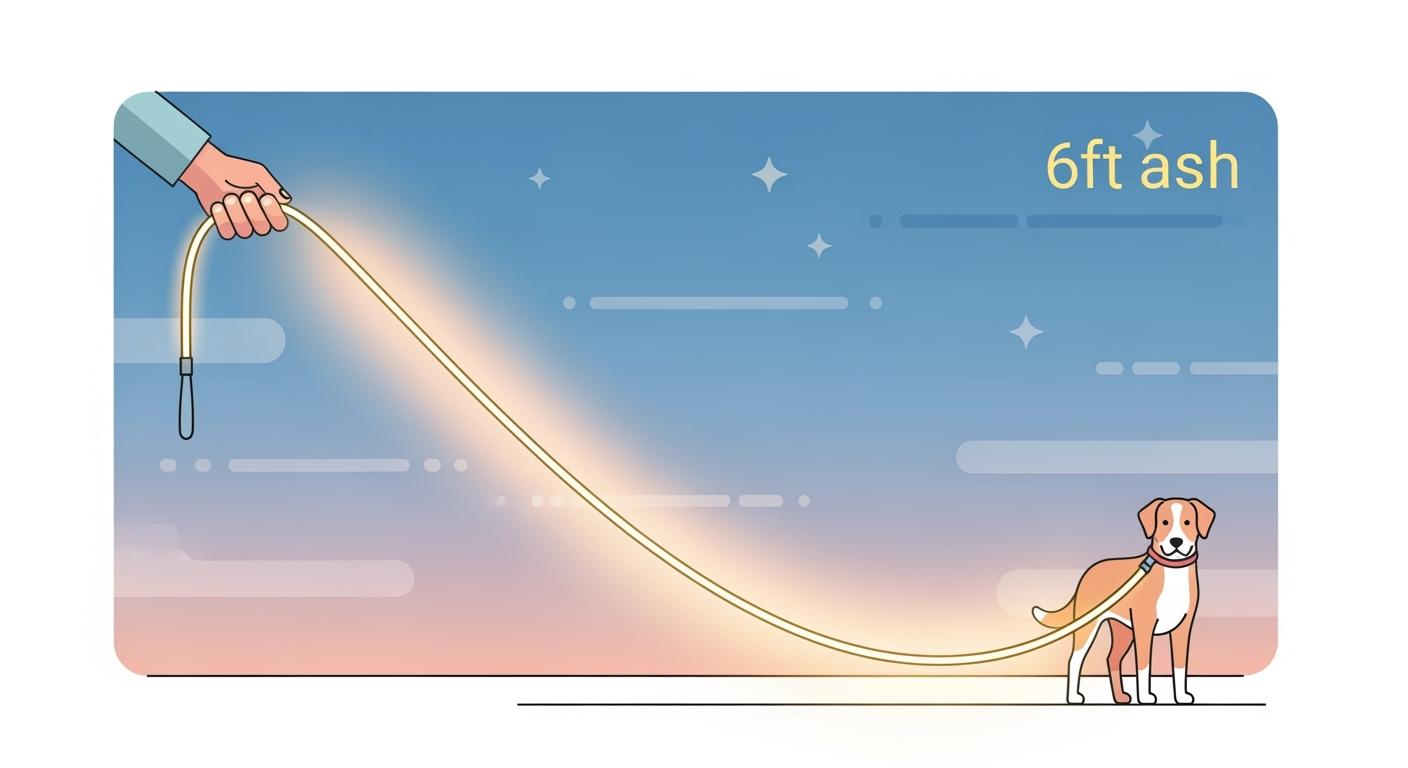
A 6-foot reflective dog leash sounds like it should be easy to spot at night. The length is right there. The word “reflective” is in the name. But walk one through a dimly lit street and the middle section can vanish — not because the reflection is weak, but because the leash rarely stays flat and facing outward.
That gap between what the label promises and what actually happens on a walk comes down to three design decisions: how much of the webbing carries reflective material, whether both sides reflect, and how the leash behaves when it sags or twists. A reflective leash design that works on a product page may not hold up once a dog starts circling, pulling, or changing pace in the dark.
Why Reflective Coverage Fails Mid-Leash
When the Middle Section Twists Out of Sight
A leash under tension forms a roughly straight line. Slack changes everything. The moment a dog stops to sniff or circles back, the middle drops into a catenary curve. Any reflective patch positioned near the handle or clip stays roughly where it started, but the sagging midsection rotates downward — away from headlights, away from streetlights, away from any light source that would make it visible.
This is the core physical problem: reflective material only works when its surface faces a light source and the viewer sits near that same axis. Rotate the reflective plane by 30 or 40 degrees and the return signal drops sharply. A 6-foot leash gives a dog more roaming room than shorter lengths, which also means more slack, more sag, and more opportunities for the middle to twist into a dead angle.
In practice: have a partner stand 50 feet back with a flashlight at roughly car-headlight height while you walk your dog at night. Ask them to call out every time the leash middle disappears. You will hear it often — and each time it does, that section of the leash is invisible to a driver approaching from that distance.
Why One-Sided Trim Disappears When the Leash Rolls
Many leashes carry reflective material on only one face of the webbing. The manufacturing logic is straightforward — it saves material and keeps the leash flexible. But a leash is not a flat sign. It rolls in your hand. It twists when your dog changes direction. It flips when you adjust your grip.
Each time the reflective side faces inward or downward, the leash becomes functionally non-reflective for anyone approaching from the opposite side. On a 6-foot line, where the middle has more freedom to rotate than the anchored ends, single-sided trim creates a visibility pattern that flickers on and off as the leash moves — visible one second, gone the next.
How Stiff Overlays and Edge Stitching Hide Reflection
Some designs add reflective overlay strips or edge stitching instead of weaving reflective thread into the webbing itself. Overlays resist bending. When you pull slack, the stiff section kinks rather than flowing. That kink turns the reflective face toward the ground or toward your own body — not toward the driver who needs to see it.
Edge-placed reflective stitching has a narrower problem: it sits on the thinnest profile of the leash. Rotate the leash even slightly and the reflective edge presents a fraction of its surface area to incoming light. The return signal is too weak to register at distance.
| Real-use failure | Likely design cause | Better leash design |
|---|---|---|
| Middle of leash disappears in darkness | Short reflective patches | Full-length reflective webbing |
| Reflection vanishes when leash twists | One-sided reflective trim | Double-sided, flexible reflective material |
| Leash feels stiff and hard to manage | Bulky overlay strips | Low-stretch, flexible webbing |
What Keeps the Full 6-Foot Line Visible

Full-Length Reflective Webbing vs. Patch-Based Designs
Full-length reflective webbing threads retroreflective material through the entire weave, not just the ends. Every inch of the leash carries the same reflective capability. When the middle sags, it still reflects. When the leash twists, the reflective threads are distributed through the webbing cross-section — not sitting on one surface waiting to be rotated away.
The design difference matters at the material level. Patch-based construction applies reflective segments after weaving, bonding or stitching them onto the finished webbing. These segments create stiffness transitions — the points where soft webbing meets rigid reflective overlay become natural kink points. Full-length integrated webbing eliminates those transitions. The entire leash flexes uniformly, so slack adjustments do not create sudden directional changes that hide the reflective surface.
After a nighttime walk, run your hand along the full length of the leash. If you feel sections where the reflective surface has rolled to face downward or inward, those are the sections invisible to drivers during that walk. A leash with integrated full-length reflective webbing tends to show fewer such sections because the reflective material is part of the structure, not an add-on that fights the webbing’s natural flex.
| Design Difference | Why it matters | Main limitation |
|---|---|---|
| Full-length reflective webbing | Maintains visibility through sag and slack | Higher material cost per unit |
| Patch-based reflective segments | Lower production cost | Middle disappears when leash drops below line of sight |
| Single-sided reflective trim | Preserves standard webbing feel | Reflection lost on every twist or roll |
| Stiff overlay strips | Large reflective surface area when flat | Kinking turns reflective face away from light source |
Double-Sided Reflection for Visibility at Any Angle
Double-sided construction puts reflective material on both faces of the webbing. If the leash rolls, the opposite side takes over. There is no “wrong side” to present to a headlight. This is not twice the material cost for twice the visibility — it is a design choice that removes the rotational failure mode entirely.
For a 6-foot leash, where the longer span creates more rotational freedom, double-sided reflection makes a measurable difference. A single-sided leash at 6 feet can rotate 180 degrees along its length under normal walking movement. Half of those rotations put the reflective face in the wrong direction. Double-sided webbing accepts any rotation and still returns light.
In practice: walk the same nighttime route with a single-sided leash, then with a double-sided one. Have an observer note how often the leash line “breaks” — moments where a visible segment suddenly goes dark. The double-sided design breaks less often because there is no dark side to rotate into view.
Flexible Stitching and Low-Stretch Webbing
Stitch pattern affects how the leash moves, and how it moves affects what stays visible. Box stitches and box-x stitches anchor hardware securely but do not stiffen the webbing body. Lock-step machine stitching prevents thread unraveling under tension — relevant because a loose thread can snag and pull reflective material out of alignment.
Low-stretch webbing made from nylon or similar materials keeps the leash length predictable. When a dog pulls, a high-stretch leash elongates, adding more slack when tension releases. That extra slack creates deeper sag, which creates steeper rotation angles away from light sources. Low-stretch construction keeps the leash line tighter and closer to horizontal, which keeps more reflective surface area oriented toward approaching vehicles.
| Stitch Type | Description | Benefits |
|---|---|---|
| Fishtail Stitch | Creates fewer holes in the material | Stronger join, keeps reflective threads intact |
| Box Stitch | Reinforced square or rectangle shape | Increases strength, holds hardware securely |
| Box-X Stitch | Adds an x-shaped cross stitch inside the box stitch | Enhances durability, keeps webbing from unraveling |
| Lock-step Machine | Ties a knot in the middle of a stitch to lock it in place | Prevents stitches from unraveling under tension |
The handle matters too, but for a reason most reviews miss. A padded, non-slip grip lets you hold the leash with less constant readjustment. Fewer grip changes mean fewer opportunities to twist the webbing and rotate the reflective face out of position. A similar design-analysis approach applies to harness fit and material selection — the gear that stays put without constant correction tends to perform more consistently in low light.
When Full-Length Reflection Still Is Not Enough
Full-length double-sided webbing solves the biggest visibility problem — the disappearing middle — but it does not turn a leash into a light source. Retroreflective material depends entirely on incoming light: headlights, streetlights, a porch light. On an unlit rural road with no ambient light and no active light source aimed at the leash, even the best reflective webbing stays dark.
Wet conditions add another layer. Water on the reflective surface can refract incoming light away from the retroreflective beads or prisms, reducing the return signal. Most quality reflective webbing is designed to shed water quickly, but heavy rain combined with mud splatter can coat the surface enough to dim reflection. A quick wipe restores most of the performance.
Wear matters over time. Reflective threads woven into nylon webbing tend to hold up better than surface-applied reflective coatings, but abrasion from dragging, chewing, or repeated washing will eventually reduce reflectivity. A dull or patchy-looking reflective surface under a flashlight test means the material has degraded past the point of reliable visibility.
Disclaimer: This visibility check assumes a smooth-coated dog on urban or suburban streets with standard street lighting or vehicle headlights. Double-coated breeds that shake off water or mud near the leash may deposit debris on the reflective surface faster, requiring more frequent wiping to maintain reflectivity. On roads with no ambient light source and no approaching vehicles, a reflective leash alone will not make you visible — supplement with an active light such as an LED collar or lighted leash attachment.
Frequently Asked Questions
How does full-length reflective webbing differ from reflective patches?
Full-length webbing integrates reflective thread into the entire weave. Every inch reflects. Patches only cover small sections — typically near the handle and clip — leaving the middle dark when slack sags or the leash twists. The distinction matters most on a 6-foot leash, where the longer span creates more unmonitored middle sections.
Does double-sided reflection really matter, or is single-sided enough?
It matters once the leash rotates. A single-sided leash has a correct and incorrect face; the incorrect face returns almost no light. Double-sided webbing removes that variable. For walking routes that mix open streets with tight curbside sections, where the leash is constantly shifting position relative to traffic, the difference is not subtle.
Can I wash a reflective dog leash without damaging the reflection?
Hand washing with mild soap and air drying tends to preserve reflective threads longer than machine washing. Harsh detergents and machine agitation can abrade the reflective surface coating on individual threads, dulling the return signal over repeated cycles.
Is a reflective leash enough for very dark areas?
No. Reflective material is passive — it needs light hitting it to work. On unlit rural roads with no streetlights and no approaching vehicles, the leash produces no light of its own. In those conditions, combining a reflective leash with an active LED attachment covers both the passive-reflection and active-illumination needs.
How often should reflective webbing be checked for wear?
Shine a flashlight at the leash from 20 to 30 feet away in a dark room every few months. If sections appear dull or patchy compared to a new section (near the handle, which typically sees less abrasion), the reflective material in those areas has degraded. Replacement is the only fix — reflective thread cannot be re-coated or restored once the surface has worn down.