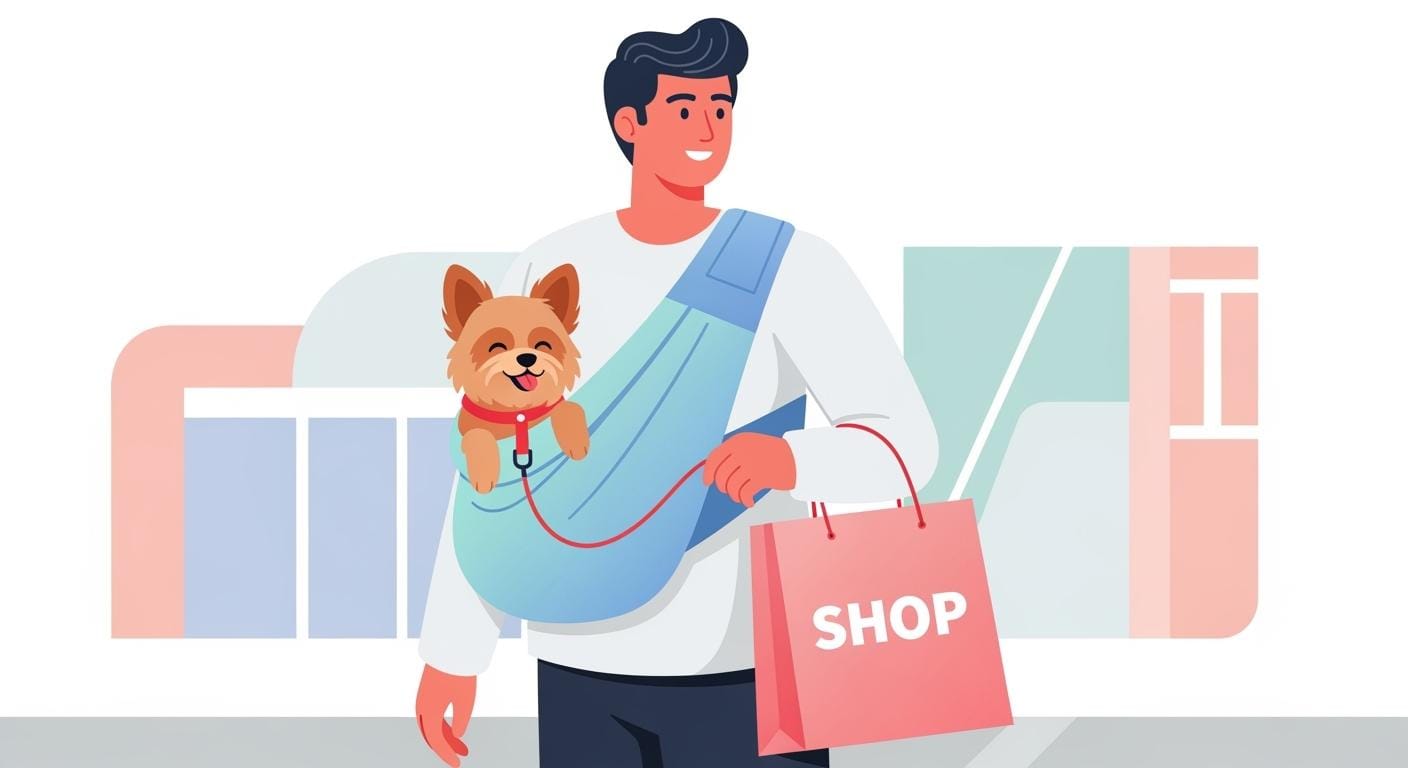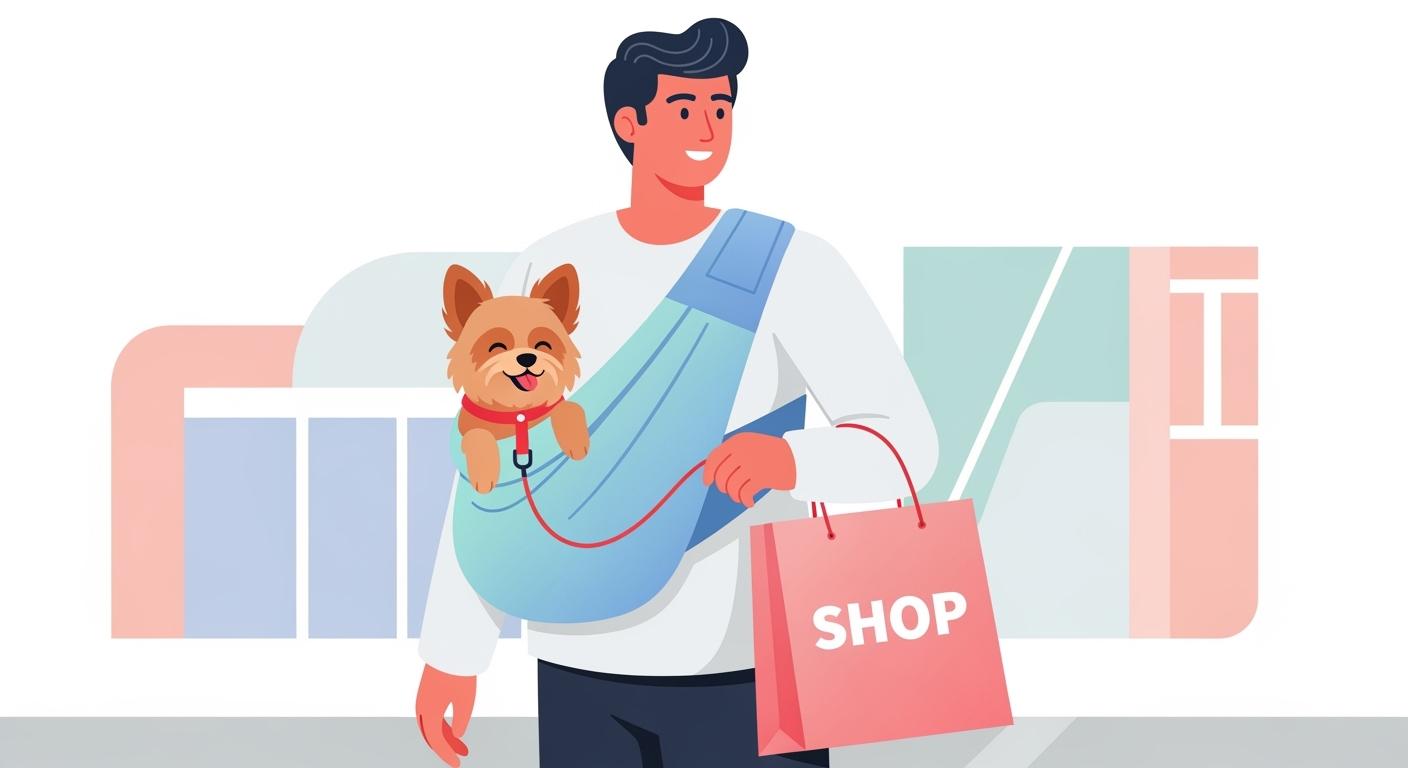
Not all small dog sling carriers contain the same way. A dog that sits quietly at home can turn into an escape artist the moment a store aisle narrows or a bus lurches. The difference is rarely the dog. It is the geometry of the pouch.
When the pouch edge sits below a dog’s center of mass, it becomes a pivot point. The dog leans forward, the edge catches under the ribcage, and forward momentum turns into a tip. Soft fabric that collapses under body weight makes this worse — the effective edge height drops further with every shift. A small dog sling carrier that keeps a dog in does not rely on the dog’s cooperation. It removes the pivot.
| Visible problem | Likely sling design cause | Better product design direction |
|---|---|---|
| Dog leans out or climbs | Shallow opening, no tether | Deep body, secure opening, tether |
| Sling swings or shifts | Loose strap, poor structure | Wide, stable crossbody strap |
| Dog seems restless | Lack of support, loose fit | Supportive, quality construction |
Why the Pouch Edge Becomes a Pivot Point
Center of Mass vs. Pouch Edge Height
A small dog carried in a sling has a center of mass roughly at the lower chest, just behind the front legs. When the pouch edge sits below that point, the dog’s body weight naturally tips forward over the rim. The edge does not block the dog — it gives the dog something to lever against.
This is the physics that separates a secure small dog sling carrier from one that just looks cozy. A deep pouch brings the edge above the dog’s balance point. The dog can shift, look around, even startle, and the edge catches the chest rather than the belly. No pivot means no leverage for a climb-out.
You can verify this yourself. After five minutes of walking, check whether the pouch edge has slipped below your dog’s shoulder line. If it has, the containment geometry has already failed — even if the dog has not climbed out yet. That is the warning before the event.
What Soft, Unstructured Fabric Does to Containment
Fabric that folds under load reduces pouch depth dynamically. When a dog leans against the side wall and the material buckles, the effective edge height drops by an inch or more in an instant. The dog feels the wall give way and pushes harder — exactly the feedback loop that ends in escape.
This is where material choice at the manufacturing level matters. A fabric with enough body to hold its shape under side pressure — often a lined or lightly padded construction — keeps the pouch geometry stable across a range of dog positions. The difference between a sling that holds shape versus one that goes limp under body weight is the difference between containment and a climb-out waiting to happen.
Tip: Press the side wall of an empty sling with your palm. If the fabric folds flat with light pressure, it will do the same under a dog’s weight — and the effective pouch depth will be shallower than the listed dimension.
Four Design Features That Change Containment

Pouch Depth and Structured Side Walls
Depth is the first line of defense. A pouch deep enough to support the dog’s chest and back keeps the center of mass well below the rim. The dog settles into the carrier rather than balancing on top of it. When the side walls have enough structure to resist folding, that depth stays consistent through movement.
Structure does not mean stiff. A lined fabric that holds a gentle curve gives the dog a defined space without pressure points. The dog can curl, turn, or shift weight without the wall collapsing and creating a new, lower edge to lever against.
Walk ten minutes with your dog in the sling, then stop and check: has the back seam of the carrier drifted more than an inch from your hip? If so, the strap is letting the whole pouch migrate — and a migrating pouch changes the edge angle relative to the dog’s body, effectively shallowing the opening on one side.
A Secure Opening Above the Shoulder Line
An opening that sits above the dog’s shoulders changes the escape equation entirely. The dog can lift its head and look around, but the chest and shoulders stay below the rim. Drawstrings, zippered gussets, or adjustable toggles let the opening tighten to the dog’s build rather than leaving a one-size gap.
On busy errands — crowded sidewalks, checkout lines, public transit — this is the feature that does the most work. The dog startles, the body tenses, and instead of finding open air above the rim, the dog meets a barrier at shoulder height. Urban carrying solutions that prioritize a close-adjustable opening tend to produce fewer escape incidents than those that rely on a fixed wide mouth with no closure.
The Safety Tether as Last-Line Defense
A tether is not the primary containment strategy. It is what catches the dog when the first two lines — pouch depth and opening closure — are overwhelmed. Attached to a harness, never a collar, it absorbs the force of a jump or sudden lunge without concentrating pressure on the neck.
The attachment point needs reinforced stitching. A tether anchored with a single line of straight stitch can tear through under the load of a startled dog. Bar-tacked or box-stitched anchors hold. This is a detail worth checking before relying on a sling in unpredictable environments.
The Strap That Keeps the Pouch Stationary
A narrow strap concentrates the carrier’s weight on a small contact patch. As you walk, that patch shifts, the strap slides, and the pouch swings. Each swing is a balance disturbance for the dog — and each disturbance is a potential escape trigger.
A wide crossbody strap spreads the load across the shoulder and upper back. Friction keeps it in place. The pouch stays close to your body, moving with your center of gravity instead of lagging behind it. The dog senses less motion and stays calmer. Less restlessness means fewer climb-out attempts. For short-errand use, a sling with a stable crossbody strap tends to produce noticeably fewer shift-and-adjust cycles during a typical shopping trip.
Note: Adjust the strap so the carrier sits against your hip, not hanging free at your side. A carrier that hugs your body moves with you. One that hangs away swings with every step — and the dog feels every swing.
Where the Design Works Best — and Where It Falls Short
A deep, structured small dog sling carrier performs best on short errands with dogs under roughly 15 pounds — dogs that settle once supported and are content to ride rather than patrol. The conditions that amplify the design advantages are predictable, low-swing environments: grocery runs, post office stops, quiet sidewalks.
The design’s limits become visible with certain builds and temperaments. Barrel-chested breeds like French bulldogs may find a standard pouch shape mismatched to their ribcage profile — the deep pocket that contains a lean-bodied dog can press uncomfortably against a broader chest. Dogs that insist on a head-out, forward-leaning posture at all times will fight the containment that a deep pouch provides. And highly active small dogs that never settle — the ones that treat every errand as a surveillance mission — may need a carrier type with more structural enclosure, like a fully zippered sling or a backpack carrier, rather than an open-top design.
The strap configuration has its own trade-off. A crossbody carry puts the dog slightly behind the hip on one side. For someone navigating tight aisles or reaching across counters repeatedly, this offset can be awkward. A front-carry position solves the reach issue but changes the dog’s sightline and may increase restlessness in dogs that prefer side contact.
Disclaimer: The pouch-depth-and-shoulder-line fit check described here assumes a smooth-coated dog of typical small-breed proportions. Double-coated breeds may show subtler signs of poor fit — the extra fur can mask a pouch edge that has slipped below the shoulder line. For these dogs, supplement a visual check with a hand check: slide two fingers between the pouch edge and the dog’s shoulder after walking. If the edge has migrated downward by more than a finger’s width, re-tighten the opening. Similarly, dogs with a very deep keel or unusually narrow chest may fall outside the body profile that standard sling pouch patterns were designed around — sizing and fit checks specific to the sling category become more important for these builds.
Häufig gestellte Fragen
Should the safety tether attach to a collar or a harness?
Always attach the tether to a harness. A collar concentrates the force of a jump or sudden pull on the neck. A harness distributes it across the chest and shoulders. If the dog lunges while tethered to a collar, the injury risk is neck compression. With a harness, the same force spreads across a larger, less vulnerable area.
How do I know if the pouch is deep enough before buying?
Measure from your dog’s shoulder to the base of the chest while the dog is standing. The pouch depth should exceed this measurement by at least an inch. If the listed depth is equal to or less than the shoulder-to-chest measurement, the edge will sit at or below the dog’s center of mass — and the pivot problem described above applies from day one.
Does a structured fabric mean a heavier carrier?
Not necessarily. Structure comes from fabric body and lining, not from added weight. A lightweight Oxford weave with a thin foam or mesh backing can hold shape without adding bulk. What matters is whether the material resists folding under side pressure, not how much it weighs on a scale.
When is a sling carrier the wrong choice entirely?
A sling becomes the wrong tool when the dog will not settle in a side-carry position — typically dogs over 15 pounds whose weight pulls the strap off the shoulder, or highly active dogs that insist on constant visual scanning. In those cases, an enclosed front-pack or a structured backpack carrier with full zippered containment matches the dog’s behavior better than an open-top sling ever will.