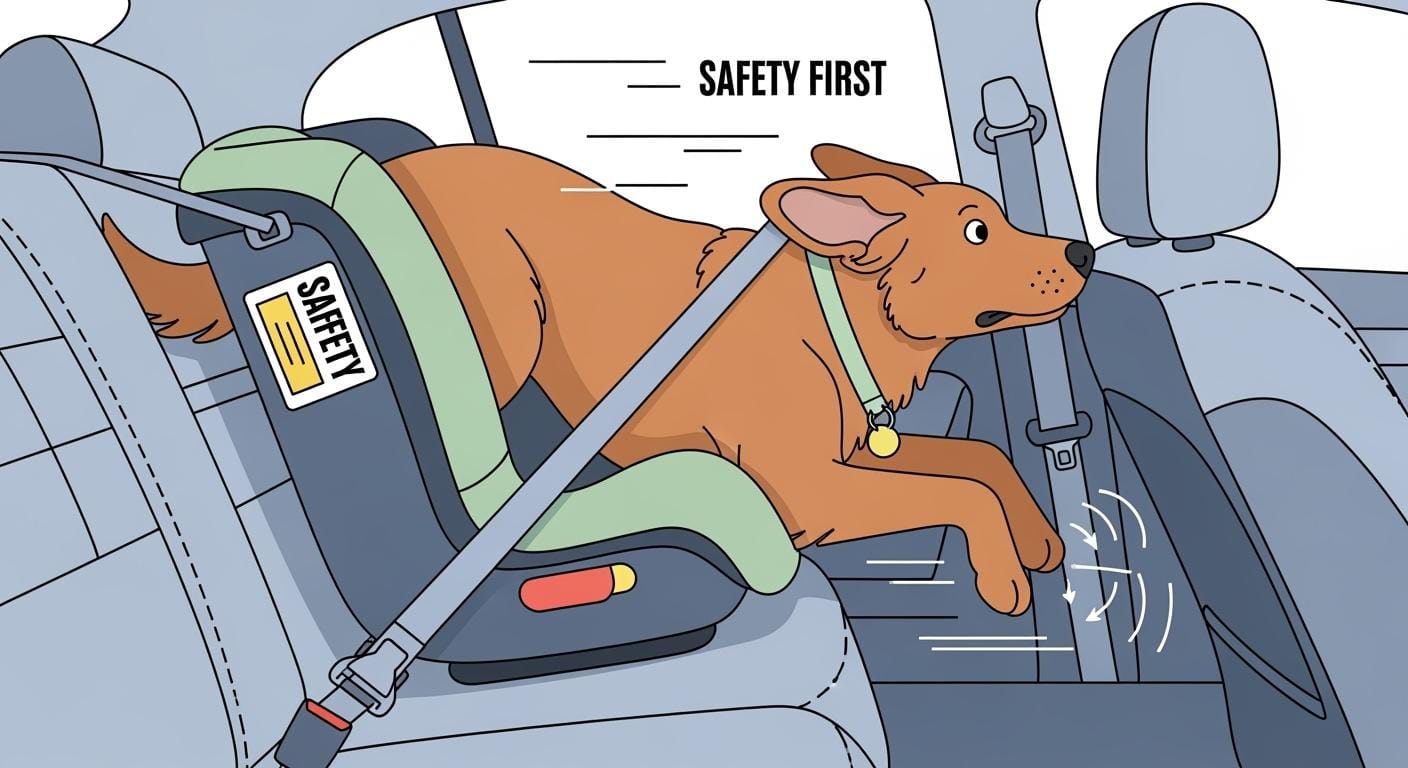
A dog car seat lives under assault. Claws dig into side panels. Teeth work at exposed seams. Body weight shifts against fabric during every turn and stop. Most seats fail at predictable points — corners, zipper paths, and anywhere thin material meets concentrated pressure. The construction differences that separate a seat that lasts three years from one that shreds in three months come down to how well the design interrupts a specific failure chain.
Where the Failure Chain Starts
A claw concentrates force onto a tiny contact patch — far smaller than a fingernail. On woven fabric with low thread density, that point load separates individual fibers. Once a single thread breaks, its neighboring threads inherit the tension it was carrying. Each is now overloaded beyond what the weave was rated to handle. The next claw pass snaps those weakened threads faster. Within weeks, an invisible separation becomes a frayed edge. Within months, a hole.
This is not random wear. It follows a clear mechanical sequence: the weave lacks enough cross-threads per inch to distribute a point load laterally. Force cannot spread sideways, so it travels straight down the thread line, breaking fibers in sequence. Thin polyester covers with loose weaves are especially vulnerable — their low thread count provides too few redundant load paths to stop a tear from propagating once it starts.
Run a fingernail across the fabric under moderate pressure. If individual threads shift or visibly separate, a claw — which applies more force on a smaller contact patch — will open the weave within weeks of regular use. Fabric that shows zero thread movement under the same test has the density to resist the initial breach. When the material fails this check, keeping the car interior protected from claw damage over hundreds of trips becomes a matter of how well the cover handles repeated stress at the same failure points.
Corners and side bolsters fail first. The reason is geometric, not behavioral: leaning concentrates body weight onto a smaller fabric area. A 50 lb dog pressing into a corner can channel over 30 lbs through a single paw, all delivered through claw tips into a few square millimeters of material. A cover built solely for mess protection rarely accounts for this level of point loading. The design brief for a scratch-resistant seat starts with recognizing where force concentrates — and building outward from those points.
Construction Choices That Interrupt the Chain
The failure chain has specific intervention points — material surface, stitch architecture, hardware placement, and internal structure. The most durable designs address all four as an integrated system rather than treating each as an isolated feature.
Outer material. 600D Oxford fabric uses a basket-weave construction with high thread density per inch. When a claw tip strikes the surface, the tight weave distributes the point load across more intersecting fibers. Instead of one thread taking the full force, a dozen share it. The load per fiber stays below the break threshold, and the weave holds. PU leather takes a different approach: its non-porous surface denies claws the microscopic purchase they need to separate fibers. Scratches that would open a woven surface instead leave shallow surface marks that do not compromise the material’s structural integrity.
Stitch architecture. Single-stitched seams place one thread line at every stress point. When that line fails — and under repeated clawing, it eventually will — the seam opens completely. Double-stitched construction runs two independent thread lines in parallel. If one line breaks, the second holds the seam closed, buying time before the damage progresses to the fabric panels themselves. The construction of a seat designed for medium to large breeds typically places this reinforcement at corners, zipper paths, and tether anchor zones — the points where force concentrates most.
Zipper placement. An exposed zipper sits directly in the claw path. Dogs paw at what protrudes. When zipper teeth bend or the pull breaks, the entire closure becomes unreliable — and the surrounding fabric, now unsecured, faces more movement and more wear. Hiding zippers under fabric flaps or inside seams removes them from the contact zone entirely. The zipper still functions. The claws never reach it.
Side panel structure. Soft, unsupported side walls collapse under leaning pressure. When the panel folds, the fabric goes slack, creating wrinkles and loose sections. Those slack zones are exactly where claws catch and tear. A structured panel — built around dense foam or a rigid insert — maintains surface tension across the fabric. The wall stays upright. The fabric stays taut. The claw slides across rather than catching. After a month of regular use, checking how the seat holds up under daily driving conditions reveals whether the side panels maintain their shape: collapsed sides with wrinkled fabric indicate the internal structure has already degraded.
| Visible Damage Sign | Design Weakness | Main Limitation | Better Direction |
|---|---|---|---|
| Frayed edges at corners | Low-density outer fabric | Point loads travel straight down single thread lines | 600D Oxford or PU leather with high cross-thread count |
| Loose threads, torn seams | Single-stitch construction | One thread line failure opens the entire seam | Double-stitched reinforcement at stress points |
| Bent or stuck zipper | Exposed zipper in claw path | Protruding hardware becomes a target | Hidden zippers under fabric flaps or inside seams |
| Collapsed or folded sides | Soft, unsupported panels | Slack fabric creates catch points for claws | Structured panels with dense foam or rigid inserts |
The construction features described above add weight, cost, and manufacturing complexity. They earn their place under specific conditions — and add unnecessary bulk under others.
Conditions that amplify the need. Dogs over 40 lbs generate enough body weight to turn a lean into a fabric-stressing event. Dogs that dig or nest compulsively — common in breeds with strong burrowing instincts — apply repeated claw strikes to the same zones, accelerating the failure cascade. Untrimmed nails concentrate force onto sharper, smaller contact points. Long highway drives keep the dog in the seat for hours, multiplying the number of loading cycles the fabric endures per trip. In these scenarios, the full system — high-density fabric, double stitching, hidden zippers, structured panels — is not overengineering. It is the minimum that survives.
Conditions where standard construction suffices. Dogs under 15 lbs rarely generate enough point force to separate even moderate-density weaves. Calm riders who sleep through most trips apply almost no dynamic load to the seat walls. Short errand trips under 15 minutes give the fabric too few loading cycles for the failure cascade to progress meaningfully. Smooth-coated breeds with naturally blunt nails are less likely to snag individual threads. For these use cases, a cover that prioritizes material comfort and easy cleaning may serve better than one optimized for maximum scratch resistance.
The thread density and panel structure a seat needs is not a function of quality — it is a function of the forces the specific dog and trip profile will apply. Material selection and sizing checks that match the seat to the real use conditions prevent both underbuilding and overbuilding.
Disclaimer: The durability assessments here assume direct claw-to-fabric contact as the primary wear mechanism. Dogs that chew rather than scratch create a different failure pattern — tooth pressure can puncture even high-denier fabrics that resist surface clawing. For heavy chewers, no fabric-only solution replaces a structured hard-bottom insert. Double-coated breeds may leave fewer visible scratch marks on the surface while still causing internal foam compression that only becomes apparent when the seat loses sidewall rigidity weeks later.
Häufig gestellte Fragen
Which outer material resists clawing longest?
600D Oxford and PU leather resist scratching through different mechanisms. Oxford’s tight weave distributes point loads across more fibers; PU leather’s non-porous surface denies claws the purchase needed to separate threads. Both outlast thin polyester by a wide margin. The choice between them turns on secondary factors — breathability, cleaning method, and whether the dog tends to run hot in enclosed spaces.
How can someone tell if a seat’s stitching will hold up?
Inspect the seam lines at corners and zipper paths before buying. Tight, even stitches with no visible gaps between thread segments indicate consistent tension during manufacturing. Double rows of stitching running parallel — not just a single line — mean the seam has a redundant load path. After a month of use, check those same seams. Individual broken stitches with gaps between them signal progressive failure. Continuous, intact stitch lines suggest the construction is holding.
Do small dogs need the same level of scratch-resistant construction?
Rarely. A 10 lb dog cannot generate the point force needed to separate fibers in even a moderate-density weave. For dogs under 15 lbs, standard polyester or Oxford fabric with single stitching typically lasts the full service life of the seat — unless the dog is an aggressive chewer, which is a separate failure mode requiring a hard-bottom insert rather than heavier fabric.
Can a waterproof layer make the seat more scratch-resistant?
Not directly. Waterproof backing sits behind the outer fabric and does not interact with claws. However, some waterproof coatings add stiffness to the outer layer, which can marginally reduce thread movement under point loads. The more meaningful durability contribution from waterproofing is indirect: it prevents moisture from weakening fibers and accelerating seam degradation over time.