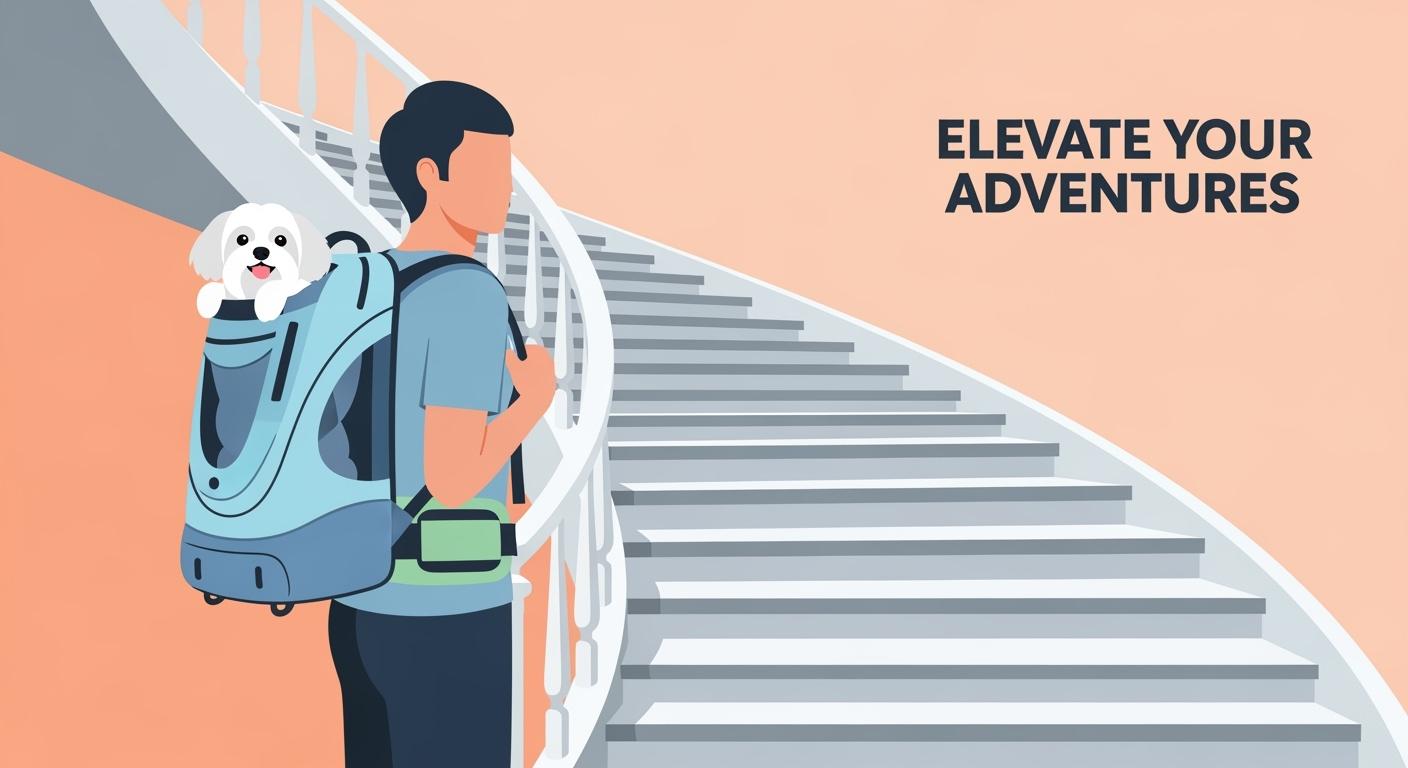
A carrier dog backpack that feels steady on flat ground can swing and pull backward the moment you start climbing stairs. The angle changes. The load shifts. And designs that rely on shoulder straps alone fall apart fast. The core difference between a backpack that stays put on stairs and one that does not comes down to where the load sits relative to your spine and how well the compartment resists deforming under your dog’s weight.
Why Stairs Make a Carrier Dog Backpack Swing
What Changes on an Incline
On flat ground, your torso stays mostly vertical and the backpack hangs from your shoulders with the load path running nearly straight down. Each stair step tilts your body forward. The shoulder straps become angled suspension lines rather than vertical supports. The backpack’s center of mass — already sitting behind your spine — now also sits below the strap anchor points on a diagonal. That diagonal creates a pendulum.
Every step up adds a forward impulse to your body while gravity pulls the backpack backward and down. The gap between these two force vectors is what makes the pack swing. The wider the gap — meaning the farther the load sits from your back — the larger the swing arc. After about four or five steps, you feel it. The pack sways side to side. Your shoulders tighten to compensate. Your lower back starts to arch. The dog inside braces against the walls, and that bracing adds another shifting mass to an already unstable system.
In a crowded stairwell the problem compounds. A bump from behind pushes the pack sideways. Without a lateral constraint, the load keeps moving after the bump stops. You correct. The dog shifts. The pack swings the other way.
| Stair Carry Failure Sign | Likely Design Cause | Better Design Direction |
|---|---|---|
| Side-to-side swinging | Loose shoulder straps, soft compartment walls | Firm base, structured side panels, sternum strap |
| Backpack drifting from your back | Load sits too far from spine, no waist belt | Close-back fit, load-transferring waist belt |
| Lower-back bumping | Flexible base, poor strap geometry | Stiff base panel, ergonomic strap angles |
Why Flat Walking Hides the Problem
Flat walking keeps your torso upright and your stride even. The backpack hangs passively. There is little angular acceleration, so the forces that drive sway never build up. A design with no waist belt and a flexible base can feel acceptable on a sidewalk. Take that same backpack up three flights of stairs and the missing support becomes obvious within the first five steps.
This is not about build quality in the abstract. It is about whether the structural decisions made during design — how the straps anchor, where the base panel sits, whether the side walls hold shape under load — account for the mechanics of angled movement. Many dog backpack carriers are sized and shaped for flat-ground use, which works until the first staircase proves otherwise.
The Three Design Features That Decide Stability on Stairs
Shoulder-Only Straps vs. a Load-Transferring Harness System
A carrier dog backpack that uses only shoulder straps places the entire load on your upper back. On stairs, that load pulls rearward and downward at an angle. Your shoulders become the sole counterforce. The backpack drifts away from your body with each step. You lean forward to bring the center of mass back over your feet. That forward lean changes your gait and puts your lower back into extension.
Add a waist belt and the load path splits. The waist belt anchors the bottom of the pack to your iliac crest. Now roughly 60 to 70 percent of the weight transfers to your hips — a structure better suited to carrying sustained loads than your shoulder girdle. The shoulder straps still stabilize the top of the pack, but they no longer carry the full weight. A sternum strap connects the two shoulder straps across your chest, preventing them from sliding outward when your arms move. The result is a three-point anchor system that resists sway in both the frontal and sagittal planes.
Tip: After adjusting a backpack with a waist belt and sternum strap, walk ten steps on a flight of stairs. Stop and check whether the back panel has drifted more than an inch from your spine. If it has, the belt is not transferring enough load — tighten it until the pack stays put through a full stride cycle.
Tall Soft Compartments and the Pendulum Problem
A tall compartment with soft fabric walls creates two problems at once. First, the dog can shift position inside — sliding forward, leaning to one side, or turning around. Every shift moves the load’s center of mass. Second, the compartment itself deforms. A side wall that collapses under lateral force no longer constrains the dog’s movement, so the dog shifts farther, which deforms the wall more.
This feedback loop turns a small movement into a large sway event. The mechanics are straightforward: a soft wall has low bending stiffness. Under side load from a shifting dog, it deflects. As it deflects, the dog’s weight moves farther off-center, which increases the bending moment on the wall, which increases deflection. The cycle runs until the dog hits the opposite wall or you counterbalance hard enough to stop it.
A structured compartment with rigid or semi-rigid side panels breaks that loop. The wall resists the initial deflection. The dog’s weight stays centered. No feedback loop forms. The comparison between design approaches for dog backpack carrier fit and sizing often overlooks this dynamic — many sizing guides focus on static measurements while ignoring how the compartment behaves under shifting load.
| Design Difference | Warum das wichtig ist | Main Limitation |
|---|---|---|
| Structured side panels vs. soft fabric walls | Stops the dog-shift-to-wall-deflection feedback loop that amplifies sway | Adds weight and reduces packability when empty |
| Waist belt + sternum strap vs. shoulder-only | Splits load across three anchor points, prevents drift and twisting on angled steps | More straps to adjust; takes longer to put on and remove |
| Firm base panel vs. flexible floor | Keeps dog level, prevents sliding that shifts the center of mass mid-stride | Less forgiving if the dog wants to shift position intentionally |
Base Stiffness and the Sliding Mass Problem
A flexible base sags under the dog’s weight. On level ground the sag is mostly vertical — uncomfortable, but not destabilizing. On stairs the sag works at an angle. The base slopes. The dog slides toward the low end. The pack’s center of mass shifts rearward and the backward pull intensifies.
A stiff base panel — typically a high-density foam sheet or a reinforced plastic insert — keeps the floor flat regardless of the pack angle. The dog stays level. The center of mass stays where the harness system expects it. You can verify this yourself: load the backpack with weight equivalent to your dog — books or a bag of rice work — set it on a stair, and press down. If the base bends visibly, it will bend more under dynamic stair movement. If it holds flat, the design has passed the first structural test.
What Changes When the Load Sits Close to Your Back
The Physics of a Short Lever Arm
Distance between the load and your spine is a lever arm. The longer the arm, the more torque the load exerts around your center of gravity with every step. Torque is what you feel as backward pull. Cutting that distance in half cuts the torque in half — same weight, same movement, half the strain on your lower back.
A design that pulls the compartment tight against the wearer’s back achieves this mechanically. Side compression straps cinch the pack horizontally. A well-anchored waist belt prevents the bottom from drifting. Padded back panels with contoured foam fill the gap between the flat pack wall and the curve of the human spine. The result is a load that rides where a hiking pack rides — inside the footprint of your torso, not cantilevered behind it.
The practical test is simple. After ten minutes of stair climbing, take off the backpack and check your shirt for sweat marks. If the sweat pattern shows full contact across your upper and mid back, the pack stayed close. If there is a dry stripe down the center with sweat only at the edges, the pack pulled away repeatedly — a sign that the harness system is not controlling the load distance. This same principle applies to backpack dog carriers used on hiking trails, where uneven terrain creates the same kind of angular movement as stairs.
Firm Base and Stable Compartment Under Dynamic Load
A firm base does more than keep the dog level. It creates a predictable load platform that the harness system can manage. When the base is stiff and the side panels hold shape, the dog-plus-pack behaves as a single unit rather than two masses coupled by fabric. That unit moves with your body instead of against it.
The compartment walls should not collapse inward when pressure is applied from outside — think of a crowded stairwell bump — and they should not bow outward under the dog’s weight. Mesh panels for ventilation need a structured frame around them. Without that frame, the mesh itself provides zero lateral resistance, and the ventilation opening becomes a weak point in the compartment structure.
- A stable compartment keeps the dog from bracing against the walls, which eliminates the secondary sway source.
- High-density foam in the base absorbs step impact rather than transmitting it through the dog’s joints.
- Structured side panels maintain ventilation gap even when the pack is fully loaded — collapsed mesh blocks airflow.
Waist Belt, Sternum Strap, and Side Compression as a System
These three features are sometimes treated as independent add-ons. They are not. They form a tension network that encircles the wearer’s torso at three levels: hips (waist belt), chest (sternum strap), and mid-torso (side compression straps). When all three are tensioned correctly, the backpack cannot drift in any direction — up, down, side-to-side, or away from the back.
The sternum strap solves a specific problem: shoulder straps that slide off the deltoids when your arms swing during stair climbing. Without it, the straps migrate outward and the pack gains lateral freedom. The side compression straps solve the depth problem by pulling the load toward your spine. The waist belt solves the vertical problem by transferring weight downward into the pelvis.
If even one of these three is missing or under-tensioned, the remaining two cannot fully compensate. A tight waist belt without a sternum strap still lets the top of the pack twist. A sternum strap without side compression still lets the pack bounce away from the back. The system works as a whole or not at all. For everyday urban use, urban-carry solutions built around this three-point tension design tend to handle stair-heavy routes with less adjustment mid-trip.
When a Close-Carry Design Is Not the Right Choice
A carrier dog backpack built for stair stability prioritizes a snug, structured fit. That design direction has trade-offs. It is not the right tool for every dog or every trip.
- Dogs with IVDD or other spinal conditions need horizontal carry positions. A vertical backpack, no matter how stable, places the spine in a posture that can aggravate disc issues. A wheeled carrier or a horizontal sling is the safer direction here.
- Brachycephalic breeds — dogs with shortened airways like pugs or bulldogs — already work harder to breathe under normal conditions. The upright posture and confined space of a backpack can compound respiratory strain, especially in warm weather.
- Dogs that panic in enclosed spaces will fight the compartment walls. A structured compartment resists that movement well — but a panicking dog creates forces no backpack harness can fully absorb, and the safest response is to not enclose a distressed dog in the first place.
- Long trips in hot conditions push ventilation beyond what mesh panels can provide. Even the best-ventilated backpack traps more heat than an open carrier.
Disclaimer: The fit and stability checks described here assume a smooth-coated dog of typical proportions for its breed. Double-coated breeds may show subtler pressure marks that need hand-checking rather than visual inspection after use. If the dog’s chest shape falls well outside breed norms — particularly dogs with a barrel chest or a very deep keel — the compartment dimensions that work for most dogs may create pressure points this article’s general checks will not catch. When in doubt, have a second person watch the dog’s posture from the side during a short stair test.
A stair-stable backpack works best for short to medium-duration carries with a calm, small to medium dog. It excels in apartment buildings, subway stations, and urban environments where stairs are unavoidable and hands-free movement matters. For other scenarios — long hikes with a restless dog, transport of a medically fragile pet, hot-weather all-day carries — different pet backpack carrier designs with different structural priorities may serve better.
Essential Features for Stair-Friendly Dog Carrier Backpacks
Firm Base Construction
A firm base keeps the dog level and prevents the sliding that shifts the pack’s center of mass on angled steps. The base panel typically uses a high-density foam sheet or a reinforced composite insert. The material choice matters less than the structural result: the base should not visibly deflect under the dog’s full weight.
Test this by pressing down on the base with your hand with the force you would use to compress a firm mattress. If the panel bends, it will bend more under repeated stair impacts. A base that holds flat also keeps the mesh ventilation panels from collapsing, maintaining the airflow path that keeps the dog cool during exertion. The sizing and measurement approach described in dog carrier backpack sizing guides applies equally here — a base that fits the dog’s length prevents the dog from sliding forward or back within the compartment, which is the first step toward stability on stairs.
Tip: Press down on the center of an empty backpack’s base with both hands. It should resist like a hardcover book — not like a pillow.
Ergonomic Waist and Shoulder Straps
Wide, padded shoulder straps spread the remaining shoulder load across more surface area, reducing pressure points. The padding needs to be dense enough that it does not fully compress under load — thin pad that bottoms out is worse than no pad at all, because it creates a false sense of cushioning while the strap edge still digs in. An adjustable waist belt with a wide hip pad transfers weight to the pelvis and prevents the pack bottom from drifting. The sternum strap slides up or down on tracks to accommodate different torso lengths and keeps the shoulder straps from migrating outward during arm swing.
- Wide straps prevent the edges from cutting into the shoulder when the pack is loaded.
- A waist belt that sits on the iliac crest, not the soft tissue above it, transfers load effectively.
- A sternum strap placed at sternum height — not collarbone height — controls lateral spread without restricting breathing.
Anti-Sway Design Elements Working Together
Anti-sway is not one feature. It is the result of several design choices that reinforce each other. A waist belt without side compression leaves the pack free to bounce away from the back. Side compression without a sternum strap leaves the shoulder straps free to slide. A firm base without a structured compartment still lets the dog shift sideways.
The full anti-sway system looks like this: a waist belt anchors the bottom of the pack to the hips, side compression straps pull the load toward the spine, a sternum strap prevents shoulder strap migration, and a structured compartment with a firm base keeps the dog stationary so none of those strap adjustments get undone by internal movement. Each piece addresses a specific degree of freedom. Together they constrain the pack in all three axes.
Tip: After adjusting all straps, climb one flight of stairs and stop at the top. If you need to re-tighten any strap, the initial adjustment was not enough. A well-designed harness system holds its tension through a full stair carry.
Ventilation and Safety Combined
Ventilation and structure are often treated as opposites — more mesh means less support. A well-designed carrier dog backpack integrates them. Structured frames around mesh panels keep ventilation paths open when the pack is loaded and under side pressure. Auto-lock zippers prevent the dog from pushing the closure open from inside. An interior safety tether clipped to the dog’s harness provides a backup restraint if the main compartment opening fails.
| Design Difference | Warum das wichtig ist | Where It Falls Short |
|---|---|---|
| Framed mesh panels vs. unsupported mesh | Maintains airflow under load; prevents collapse when dog leans | Adds weight; framed panels do not fold flat for storage |
| Auto-lock zippers vs. standard zippers | Prevents escape if dog pushes against the closure | Slightly slower to open one-handed |
| Interior tether clipped to harness vs. no tether | Backup restraint independent of compartment closure | Adds a setup step; dog can tangle if tether is too long |
Häufig gestellte Fragen
How do I know if my dog carrier backpack is stable enough for stairs?
Load it with weight equal to your dog. Climb ten stairs. At the top, check whether the back panel has drifted more than an inch from your spine. Check whether you leaned forward during the climb. If either answer is yes, the harness system is not transferring load effectively — a waist belt adjustment or a different strap configuration may help, but the fundamental design may lack the anchor points needed for stair stability.
Can a carrier dog backpack work for a dog over 20 pounds?
Weight capacity depends on the base panel stiffness and the harness system’s load rating, not on the backpack’s external dimensions. A larger compartment on a flexible base is less stable than a smaller compartment on a stiff base. The limiting factor on stairs is usually not the absolute weight but the combination of weight and load distance — a heavier dog carried close to the back may feel more stable than a lighter dog in a pack that sits far from the spine.
What features make the biggest difference for stair stability?
A waist belt that transfers weight to the hips, a sternum strap that prevents shoulder strap migration, and a firm base that keeps the dog from sliding. These three features work as a system — removing any one of them degrades the other two. Side compression straps add a fourth layer of control by pulling the load toward the spine.
Does a structured compartment make the backpack harder to store?
Yes. A structured compartment with rigid or semi-rigid side panels does not collapse flat the way a soft-sided carrier does. Some designs use removable stiffening panels as a compromise — the panels slide out for storage and back in for use. The trade-off is setup time versus stair stability. For a carrier used primarily on stair-heavy routes, the added bulk of a structured design pays for itself in reduced sway and fewer mid-climb adjustments.