
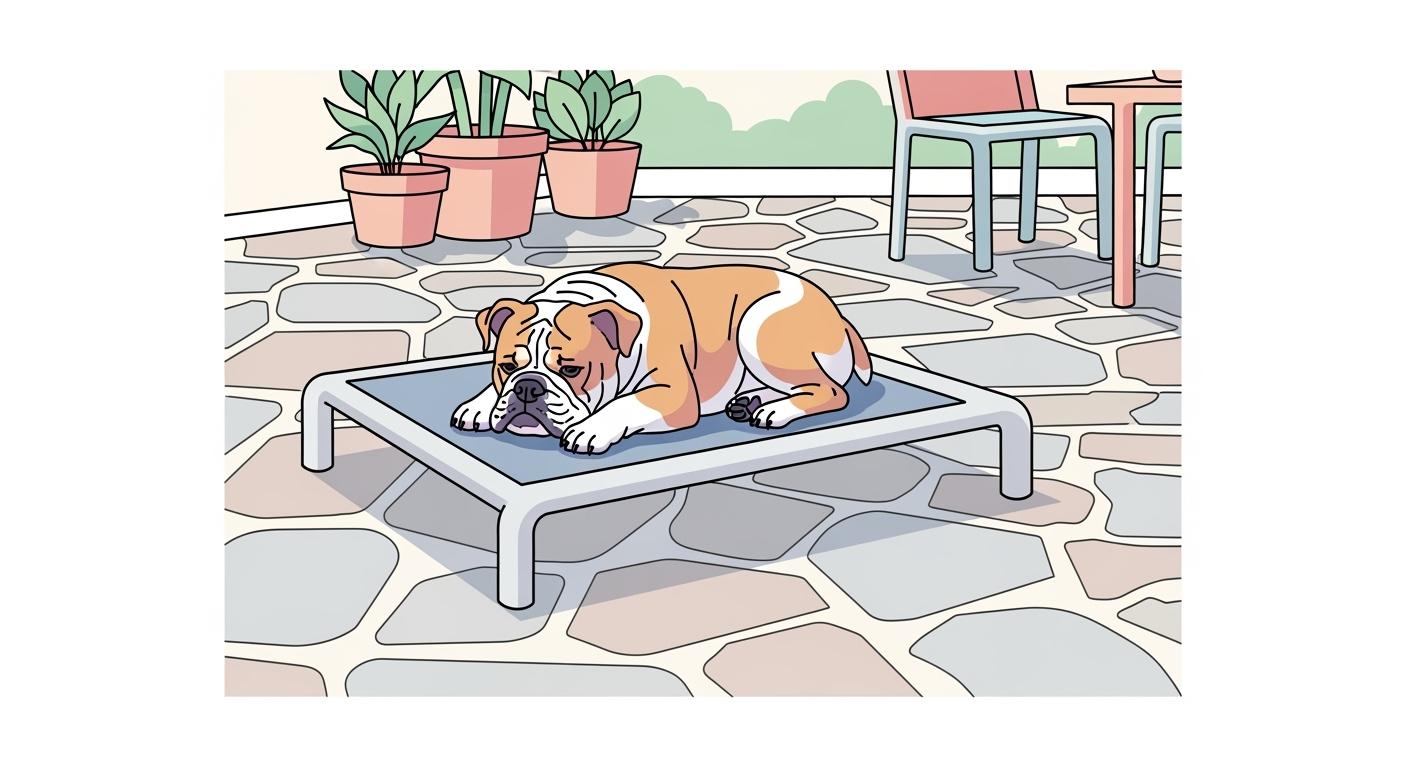
A raised cot with a steel frame looks sturdy on a store page. Set it on a sloped patio, damp lawn, or soft dirt, and the whole equation changes. The frame absorbs every jump, turn, and shift of weight — and the ground under it is rarely flat, rarely dry, and rarely consistent from one leg to the next. What keeps the bed planted is not the fact that it has a steel frame. It is whether the tube walls are thick enough to resist flex, whether the corner joints stay rigid under side load, and whether the feet grip instead of skate.
An elevated outdoor dog bed that wobbles on first use has already failed — not because the idea is wrong, but because the frame was never built for the ground it sits on.
Why an Outdoor Steel Frame Bed Fails on Real Ground
What Happens When a Dog Jumps, Turns, and Lands Near the Edge
Every time a dog steps onto a raised cot, the frame takes a pulse of force — not evenly across all four corners, but concentrated where the paws hit first. A dog that jumps on and lands near the front edge dumps most of its body weight into two front legs and one corner joint. The tube at that corner flexes downward. If the tube wall is thin, that flex travels along the rail and twists the adjacent joint. The corner that was carrying the dog a second ago now lifts slightly off the ground. The bed rocks.
This sequence repeats dozens of times a day. The physics is simple: a downward force at one corner creates a rotational moment around the diagonal axis of the frame. A thick-walled tube resists that rotation. A thin-walled tube transmits it. The difference shows up as wobble — slight at first, worse as joints loosen.
Walk around the cot after your dog has spent an hour on it. Check whether any foot has lifted clear of the ground or left a fresh scuff mark where it dragged. That is your stability report.
Why the Ground Under the Bed Changes Everything
Patio slabs have a drainage slope. Lawns have crowns and dips. Dirt compresses unevenly under load, especially after rain. Place a four-legged cot on any of these surfaces and at least one leg will carry less weight than the others — or none at all.
A frame with rigid, well-braced corners can bridge small surface irregularities without transferring movement to the mesh. A frame with loose joints cannot. The leg that sits in a low spot sags. The mesh loses tension on that side. The dog feels the give and shifts to the firmer half, concentrating weight further. The table below shows how different outdoor surfaces interact with frame design:
| Ground Condition | How It Challenges the Frame | Why Frame Design Determines the Outcome |
|---|---|---|
| Damp grass (dew, rain) | Legs sink into soft soil; moisture pools at ground contact | Wide feet spread load so legs penetrate less; coated steel resists rust at the wet line |
| Hot patio (direct sun) | Fabric absorbs radiant heat from below and above simultaneously | Raised clearance creates an air gap that interrupts heat conduction from the slab |
| Mud, sandy soil | Grit packs into foot caps and joint crevices; abrasion wears coating | Smooth, sealed foot caps shed debris; joints with full-penetration coating resist grit abrasion |
| Uneven or sloped ground | One or two legs float; dog weight shifts to the low side | Rigid joints and thick tubing keep the frame plan square across surface variation |
Moisture Exposure and What It Does to a Steel Frame Over Time
Moisture attacks a steel frame at its weakest points: scratches, welds, and ground-contact zones. Dew settles overnight. Rain pools around the feet. When the coating is thin or chipped, water reaches bare steel and oxidation begins. The rust front starts at the scratch and creeps under the surrounding coating, lifting it in flakes.
Raised clearance helps — airflow under the mesh dries the frame faster after rain — but clearance alone does not stop rust. The coating quality determines whether moisture exposure becomes frame failure. Powder-coated tubes with full weld coverage resist water ingress far longer than dip-coated or spray-coated alternatives where weld seams get thinner coverage. After wet weather, run a finger along the weld at each corner joint. Orange dust on your fingertip means the coating has already been breached at that spot.
On the materials side, a dog cot bed built with the right fabric and frame materials exposes the gap between coatings that hold up and coatings that fail within a season.
Where Frame Stability and Rust Problems Usually Start
Thin Tubes, Weak Corner Joints, and the Mechanics of Frame Flex
A steel tube under vertical load behaves predictably. Load at the midpoint of a rail creates bending stress. Load at a corner creates torsional stress — a twisting force that the joint must resist. Most outdoor cot frames use tubular steel joined at corner brackets or welded directly. A welded corner with a thick tube wall distributes torsional stress into both intersecting rails. A bracket-style corner with thin tubes concentrates it at the bolt hole or weld point.
The failure cascade runs like this: torsional load at one corner exceeds the joint’s resistance → the joint opens slightly → the mesh loses tension on that side → the dog feels instability and avoids that half of the bed → more weight concentrates on the remaining joints → those joints degrade faster. Each cycle widens the gap.
Set the bed on level ground and press down firmly at one corner with your hand. Watch the opposite corner. If it lifts, the frame is twisting — and it will twist more under the dynamic load of a dog landing. That is the frame telling you where it will fail first.
Coating Failure and the Rust Zones You Can Predict
Rust on a steel dog bed frame follows a pattern. It starts at welds — where the coating is thinnest and surface porosity traps moisture. It starts at feet — where the frame touches wet ground nightly. It starts at scratches — where a dog’s claws or a mower’s debris have opened a path to bare steel.
A guide to outdoor dog bed sizing and support features notes that coating type often matters more than tube diameter for long-term durability — a powder-coated 18-gauge tube can outlast a poorly coated 16-gauge tube in wet conditions. High humidity, frequent rain, and clay-heavy soil that holds water against the legs accelerate the timeline. Salt air near the coast compresses it further.
Here are the failure signals and what they point to:
| Design Difference | Why It Matters | Main Limitation |
|---|---|---|
| Tube wall gauge: 16 vs. 18 vs. 20 | Thicker walls resist both bending and torsional flex; the frame stays square under off-center load | Heavier gauge adds weight; a 16-gauge frame may be harder to move or fold |
| Welded corners vs. bracket-joined corners | Welds create a continuous load path; brackets concentrate stress at fastener holes that can elongate | Welds can have thinner coating; they need inspection for rust more often than bolted joints |
| Powder coat vs. dip coat vs. spray coat | Powder coating bonds electrostatically and covers welds more evenly; dip and spray coats tend to pool thin at edges | Powder coat chips under sharp impact; a dropped frame on concrete can expose steel the same as any other coating |
| Rubber-capped feet vs. bare steel feet | Caps prevent direct steel-to-ground contact, reduce sliding, and block moisture wicking at the leg end | Caps can trap water inside if not sealed at the rim; check for moisture between cap and tube after heavy rain |
Unstable Legs, Uneven Mesh Tension, and Why They Amplify Each Other
Leg stability and mesh tension are coupled problems. When one leg sits in a depression, the mesh on that side sags. The sag shifts the dog’s weight to the other three legs, which dig in further. The low leg floats. The cycle reinforces itself.
Mesh tension that is balanced across the frame acts as a structural element — it preloads the frame in tension and helps resist racking. Mesh that is already loose when the bed is empty provides no preload. The frame alone absorbs all side forces, and thin tubes do that poorly. A steel frame elevated dog bed with evenly tensioned mesh acts as a single structural unit; one with loose mesh acts as a frame waiting to twist.
Tip: Before first use, check that all four feet contact the ground evenly on the surface where the bed will live. If one foot hovers, do not shim it — move the bed to a flatter spot. A shimmed leg changes the frame geometry and can concentrate stress at the opposite corner.
What Makes a Steel Frame Cot Hold Up Outdoors
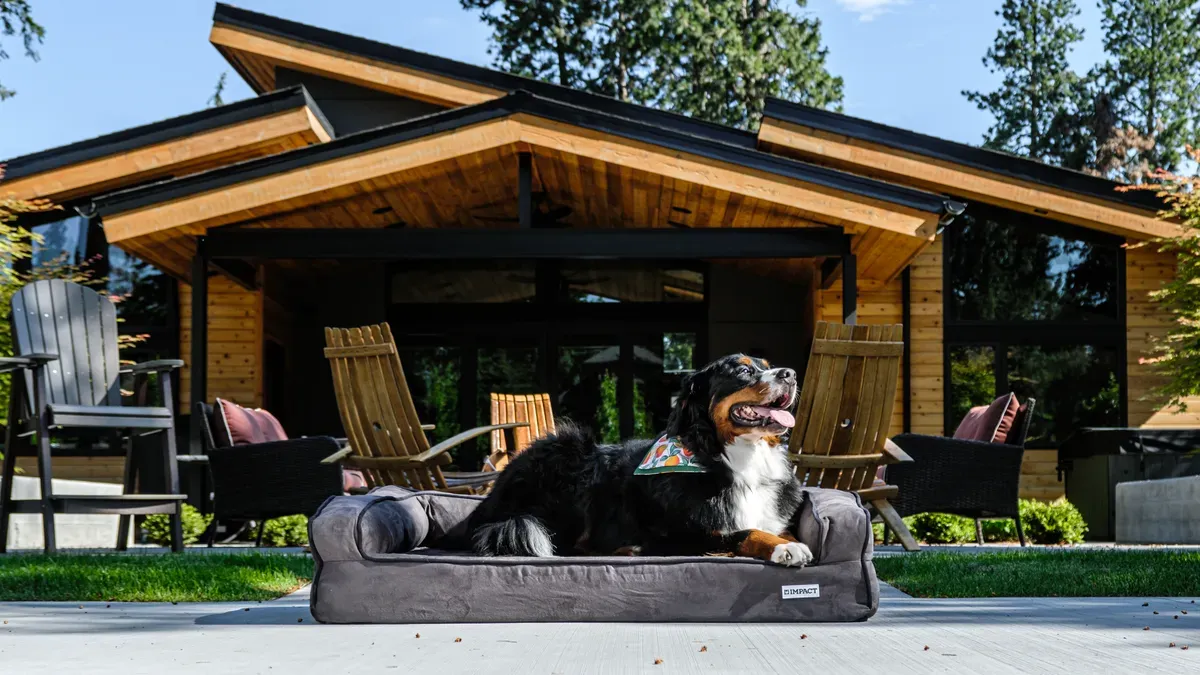
Raised Clearance, Wide Leg Layout, and Why Geometry Determines Stability
Raised clearance serves two functions that compound each other. First, it creates an air gap that dries moisture — protecting the coating and the mesh from the wet-ground problem. Second, it changes the frame geometry: the higher the bed sits, the wider the leg stance must be to maintain the same stability against tipping.
A bed with narrow-set legs and high clearance tips easily — the center of gravity rises while the base shrinks. A bed with wide-set legs and moderate clearance stays planted. The ratio matters more than either dimension alone. On a camping or backyard shelter setup, where ground is rarely level, that ratio determines whether the dog uses the bed or avoids it.
After a week of use, measure the distance between each foot and its original position on the ground. If any foot has migrated more than half an inch, the leg layout is not wide enough for the surface or the dog’s movement pattern.
Reinforced Corners, Balanced Mesh Tension, and How They Share the Load
A reinforced corner is not just a thicker bracket. It is a design choice about how force moves through the frame. When a dog’s weight lands off-center, the corner nearest the impact takes the highest stress. In a bracket-style corner, that stress travels through a single bolt or weld. In a fully welded corner with gusset reinforcement, the stress splits across two planes — the horizontal rail and the vertical leg — and dissipates into the larger tube cross-section.
Balanced mesh tension completes the system. A mesh pulled evenly across all four sides pre-tensions the frame inwards, counteracting the outward and torsional forces from the dog’s weight. The frame does less work because the mesh shares it. Loose mesh means the frame does all the work — and thin tubes working alone fail fast.
A quick field test: press your palm into the center of the mesh with moderate pressure, then release. The mesh should snap back flat without ripples. Ripples mean the tension is uneven, and uneven tension means the frame is already carrying loads it was not designed to handle alone.
Rust-Resistant Coating and What Maintenance Actually Extends Frame Life
Coatings delay rust — they do not prevent it permanently. The practical question is how long the delay lasts under real conditions. Powder-coated zinc-primed steel in a dry climate can go multiple seasons with no visible rust. The same coating in a humid coastal environment, with daily dew and salt air, may show rust at the welds within months.
What extends frame life is not the coating alone but the combination of coating, raised clearance, and a habit of drying the frame after wet weather. Mesh that drains and dries quickly leaves less standing water around the frame rails. The materials that perform best outdoors share a common trait: they do not hold water against the steel.
| Material | Design Advantage | Where It Works Best |
|---|---|---|
| Heavy Duty Vinyl Mesh | Non-absorbent surface; water beads and runs off rather than soaking through | Frequent rain exposure, high-humidity regions, dogs that drool or track mud |
| UV-Treated Outdoor Mesh | Allows water and air to pass through; dries from both sides simultaneously | Full-sun patios and yards; hot climates where trapped moisture would breed mold |
| Textured Cordura-Style Fabric | Abrasion-resistant surface with mechanical grip; dogs are less likely to slide when stepping on | Dogs with mobility issues or slick coats; beds placed on hard surfaces where padding provides no traction |
Frame Weight, Rubber-Capped Feet, and Ground Grip on Different Surfaces
Frame weight is a tradeoff. A heavier frame plants more firmly because inertia resists the impulse of a dog jumping on or off. On soft ground, the weight helps the feet settle into a stable position. But weight also makes the bed harder to carry from patio to lawn or into a vehicle.
Rubber-capped feet shift that tradeoff. A lighter frame with high-friction rubber caps can outperform a heavier frame with bare steel feet on hard surfaces — the caps convert horizontal sliding force into grip without adding mass. On soft ground, the caps increase the effective footprint of each leg, reducing sink. On slick surfaces, they are the difference between a bed that stays put and one that skates across the patio when a dog launches off it.
In practice: Check the rubber caps by trying to slide the empty bed sideways on the surface where it will live. If the frame moves with less than 10 pounds of side force, a dog’s exit jump will send it sliding. Caps that have hardened or glazed over have lost their grip — replace them before the bed becomes unpredictable.
When a Raised Steel Frame Bed Is Not the Right Choice
A steel frame cot makes sense when the dog is medium to large, the ground is variably damp or uneven, and the bed stays outside for extended periods. The design solves a specific set of problems: ground moisture, surface irregularity, and airflow under the dog.
It solves them less well — or not at all — for small dogs under 15 pounds. The mesh tension that supports a 60-pound dog without sagging can feel rigid under a 10-pound dog, and the elevation that improves airflow for a Labrador puts a Chihuahua at a height where getting on and off becomes a daily negotiation. Elderly dogs or dogs with joint stiffness may find the step-up clearance difficult or unsafe, even on a bed with moderate elevation.
The steel frame that excels on damp grass becomes a liability on a smooth indoor floor without rubber-capped feet — the bed slides, the dog loses confidence, and the frame’s outdoor design advantages become mismatches in an indoor context. For indoor use where floor grip matters more than ground clearance, a raised dog bed set up for comfort and security indoors follows different rules entirely.
Disclaimer: The stability checks described here assume a medium-to-large dog on a frame that is correctly sized and assembled. Small dogs under 15 pounds distribute weight differently across the mesh and may not trigger the same wobble signals — a frame that feels steady to a hand press may still shift under a small dog’s concentrated paw pressure. If the dog has a barrel chest, a very deep keel, or disproportionate weight distribution for its breed, the standard leg layout may not place support where the dog’s center of mass actually sits. In those cases, check for mesh sag directly under the dog’s chest after 30 minutes of use rather than relying on corner-level wobble tests alone.
FAQ
How do you clean the frame and mesh without damaging the coating?
Rinse the mesh with a hose and let it dry in full sun — the open weave drains in minutes. For the frame, use a damp cloth rather than a pressure washer, which can lift coating at the edges of chips or scratches. After cleaning, check the weld areas with a dry fingertip. Any orange residue means rust has started under the coating at that joint.
Can the cot stay outside through winter?
Freeze-thaw cycles stress the frame differently than summer heat — water trapped in joints expands when frozen and can widen gaps in the coating. If the bed stays outside year-round, the critical variable is not temperature but whether standing water can pool around the feet. Raise the legs onto pavers or a gravel pad during the wet season to break ground contact.
How do you tell if the mesh tension is still adequate?
Press your palm into the center of the empty mesh. Let go. If ripples remain for more than a second, the tension has loosened. Re-tension the mesh before it sags further — loose mesh accelerates frame wear because the frame absorbs more of the dynamic load on its own.






