
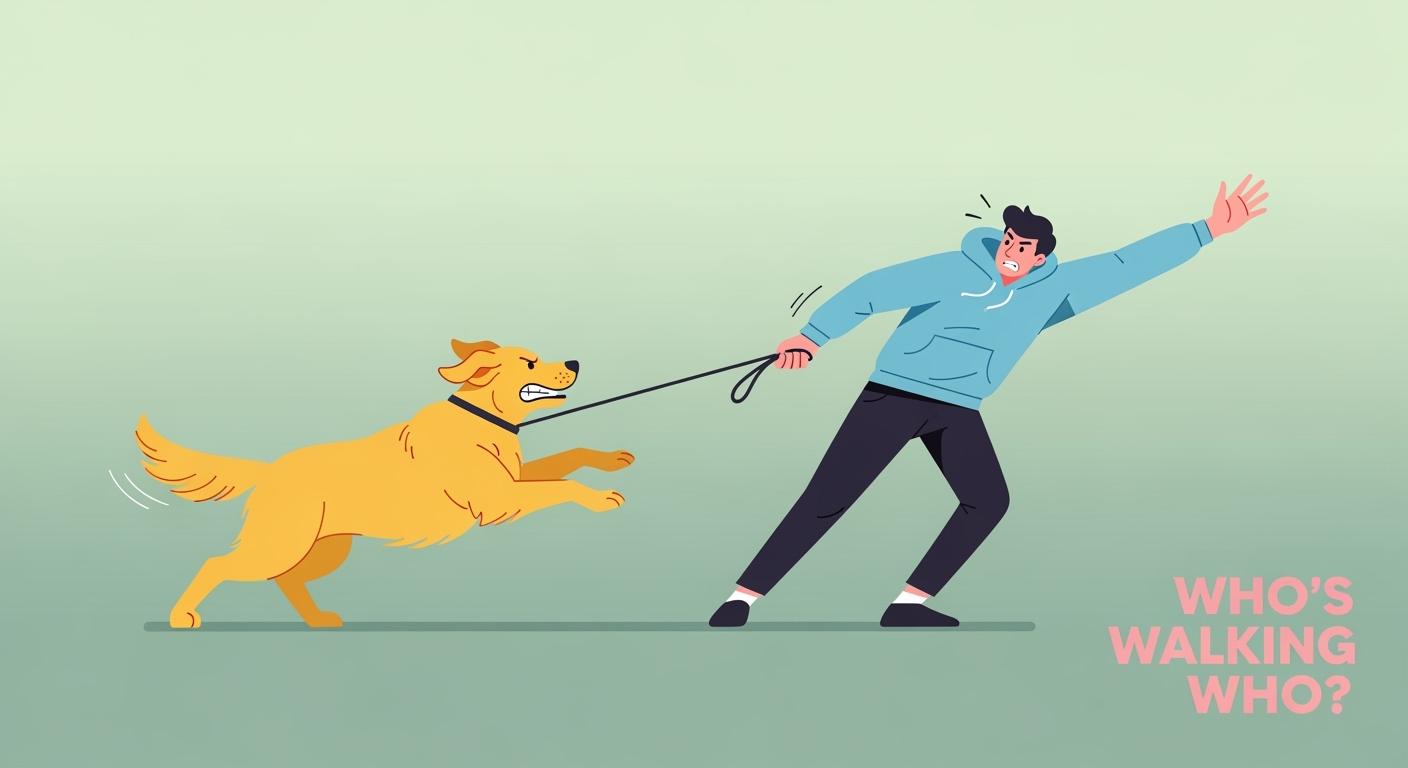
If a large dog pulling on leash hurts shoulder, the problem is usually not strength alone. The sharp jolt often comes from slack before the first step, a clip point that lets the dog drive straight ahead, a handle that twists your wrist, or a harness that shifts once the walk starts. Shoulder pain often improves when you treat the leash, harness, and body position as one system instead of changing only one piece.
The first clue is timing. Pain right at the door usually points to too much leash slack or an excited launch. Pain during turns or surprise lunges often points to harness rotation, off-center pull, or a leash path that drags your arm out of line. If fit keeps drifting, measuring your dog for a harness fit is usually more reliable than tightening straps by eye every few blocks.
What usually causes the shoulder jolt
Slack makes the first pull hit harder
When the leash hangs loose, your dog can build momentum before the line goes tight. That is why the first step often feels worse than the rest of the walk. A shorter working length usually gives you more time to react and less room for a full-body lunge. If the line itself keeps creating delay, comparing fixed-length and retractable leash setups can make the control tradeoff much clearer.
Clip location changes where the force goes
A back clip lets a strong dog lean directly into the leash. A front clip can interrupt that straight-line drive by turning the chest back toward you. That does not mean every front-clip design is better. If the chest section rides too high, rotates to one side, or crowds the shoulders, your dog may push harder or move less naturally. Pairing fit changes with front-clip harness training steps usually does more than swapping hardware alone.
Handle feel and leash path matter more than most people expect
If the handle is thin, slippery, or forces your wrist to bend, the pull travels up your forearm into one shoulder instead of staying close to your center. Keep your elbow softly bent, your hands closer to your body, and the leash line as straight as possible from dog to hand. Wrapping the leash around your wrist can make a bad pull much worse.
| Setup choice | What it usually does | What to watch for |
|---|---|---|
| Fixed-length leash | Keeps timing more predictable and limits the launch before the line tightens | Too much length can still create slack and a hard first jolt |
| Front-clip harness | Can redirect a strong forward pull before it builds | It needs to stay centered and leave room for a full stride |
| Back-clip harness | Often feels simple and comfortable on calm walkers | A strong dog may lean straight into it and load your shoulder |
| Collar | Works best for dogs that already walk loosely | It does little to soften the handler jolt and can add neck pressure |
Harness and leash choices that usually help
For a large dog that surges, a front-clip or dual-clip harness often gives more control than a collar or a simple back-clip setup. The best match still depends on how your dog pulls. A steady leaner and a sudden lunger do not load your shoulder the same way, so the tradeoffs in harness choices for steady pullers and sudden lunges are worth thinking through before you buy again.
Fit matters just as much as style. A harness should stay low on the chest, remain centered under light tension, and let the front legs extend cleanly. If the front straps keep leaving hot spots, preventing chafing on active outings usually comes down to strap path and body length, not extra padding alone. For a broader baseline on shape, adjustability, and everyday fit, dog training harness fit and sizing checks can help narrow down what belongs on a daily walk.
Some handlers prefer the extra structure of a heavy duty dog harness, especially with broad, powerful dogs. That only helps when the added bulk stays off the shoulder joint and does not make the chest panel float, rub, or trap too much heat.
Warning signs that your setup is failing
- Your shoulder gets hit hardest at the door or in the first few steps.
- Your wrist bends, twists, or feels sore after a pull.
- The harness shifts off center once your dog starts moving.
- Your dog shortens stride, stumbles, or looks crowded through the front end.
- You keep bracing with one shoulder instead of staying square.
| Symptom | Likely cause | Fast check | Usually helps |
|---|---|---|---|
| Sharp shoulder jolt at the start | Too much slack before the dog moves | Look at leash length before you open the door | Start shorter, pause, and move only when the line is organized |
| Wrist twist during a pull | Handle shape or leash path is forcing your arm off line | Watch whether your wrist stays neutral under light tension | Change grip, keep elbow bent, or switch handle style |
| Dog pulls you sideways | Harness rotates or the clip point is pulling off center | Check the chest panel after five minutes of walking | Refit the harness or move to a shape that stays centered |
| Dog takes shorter steps | Front panel or straps are crowding the shoulders | Compare gait before and after the harness goes on | Resize, lower the front section, or change harness shape |
| One shoulder always absorbs the force | You are walking twisted or reaching too far forward | Notice whether one elbow locks out when the dog loads the leash | Bring the hands closer to your body and reset your stance |
Note: If shoulder pain, weakness, numbness, or reduced range of motion keeps showing up after walks, talk to a medical professional.
What to change before the next walk
Start with the simplest fix that changes force early. Shorten the working leash length. Pause before the doorway so your dog does not explode through it. Keep your hands close to your body instead of reaching out in front. If the dog is still loading the leash hard, move to a better-centered harness setup rather than trying to muscle through it.
Then watch one short walk closely. You want a setup that stays centered, does not twist your wrist, and reduces the first jolt before your shoulder takes it. If one change helps, keep it for a few walks before changing something else. When several things are wrong at once, it is easy to blame the leash when the real problem is the whole chain from clip point to grip.
Training still matters. Equipment can lower the force you feel, but it will not replace loose-leash practice. Calm starts, consistent stopping when the dog loads the leash, and rewarding the position you want usually protect your shoulder better than buying another leash every month.
FAQ
Why does my shoulder hurt most during the first pull?
The first pull usually hurts most because your dog has room to build momentum before your body is ready and the line tightens all at once.
Is a harness usually better than a collar for a large puller?
A well-fitted harness usually gives better force distribution and steering than a collar when a large dog pulls hard.
What leash length is usually easiest to control?
For most everyday walks with a large dog, a fixed leash around 4 to 6 feet usually gives a better balance of control and movement than a retractable line.
How do I know the harness fit is wrong even if it looks fine standing still?
If it shifts off center, rubs, rides up, or changes your dog’s stride once the walk starts, the fit is wrong in real use.






