
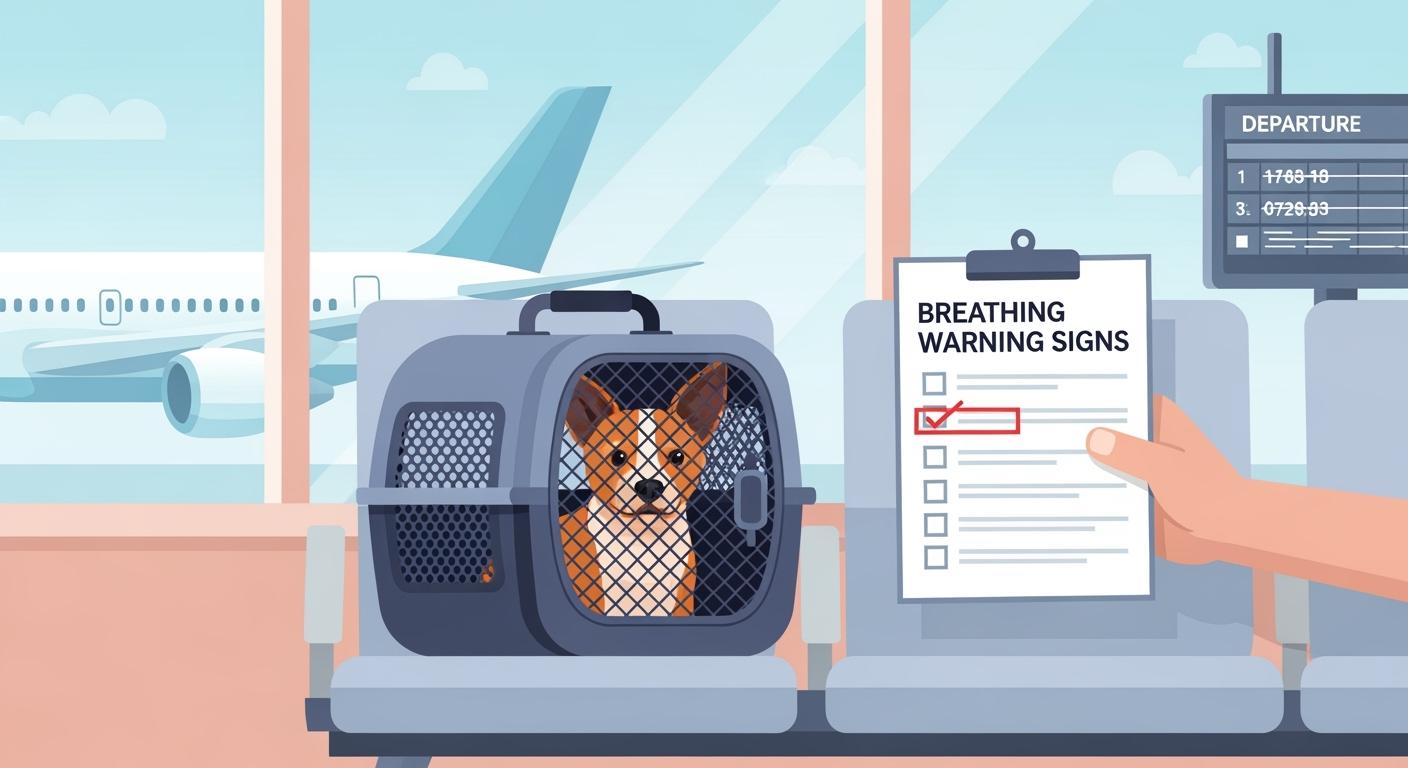
A dog carrier for airplane travel can pass the under-seat size check and still be the wrong product for the dog inside it. For retailers, distributors, pet brands, and OEM/ODM buyers, the main question is not only whether the carrier fits an airline space. The stronger question is whether the carrier keeps airflow open, protects posture room, and limits heat buildup once it is closed, loaded, and stowed under a seat.
This is especially important for short-nosed dogs. These breeds have less breathing margin when heat, stress, and restricted ventilation happen together. A carrier that looks suitable in product photos may perform differently when the sidewalls flex, mesh panels are blocked, or the dog cannot change position naturally. For B2B buyers, that turns a simple size claim into a product-fit risk.
Buyer focus: Do not judge a dog carrier for airplane travel only by the “airline approved” label. For short-nosed dogs, airflow, structure, and usable interior room decide whether the product fits the scenario.
When an airplane carrier fits the seat but not the dog
Why short-nosed breeds need a different carrier standard
A carrier labeled as airline approved can still be a poor match for a brachycephalic dog. Breeds such as Pugs, French Bulldogs, Boston Terriers, and Pekingese have shorter upper airways, which can reduce their ability to cool down through breathing. When these dogs are placed in a tight carrier with limited ventilation, the product has less room for error.
For B2B buyers, this means a dog carrier for airplane travel should not be evaluated as a generic small-dog bag. The same outer dimensions may work for one small dog but fail another if the dog needs more airflow, a higher resting posture, or more space to shift position. Testing a carrier at home does not predict how it will perform under a seat, where mesh panels can bend, sidewalls can press inward, and airflow can drop.
- Brachycephalic-use suitability depends on:
- Open mesh placement that still works when the bag is stowed
- Sidewall structure that resists collapse under pressure
- Interior room that allows natural sitting, turning, and lying down
- Materials that do not trap heat around the dog
Why airline size rules do not guarantee a safe carrier
Airline under-seat dimensions are a clearance requirement, not a complete product suitability standard. A carrier can pass the outside measurement check while still offering poor interior posture room or weak ventilation. Many soft-sided carriers include mesh, but the real question is whether that mesh stays open when the carrier is pushed into a narrow footwell.
This is where buyers should separate marketing claims from real-use performance. Airline pet policies vary by carrier and aircraft type, and most size rules do not judge breed-specific breathing risk. A product page that only says “fits under seat” may be incomplete if the carrier is being positioned for short-nosed dogs, heat-sensitive dogs, or longer in-cabin use.
| Failure signal | What to watch | Buyer judgment | Better product direction |
|---|---|---|---|
| Heavy panting or pushing at mesh | Airflow or posture restriction | Carrier not suitable | More mesh panels, stable shape |
| Dog cannot settle or freezes | Stress or heat buildup | Carrier too confining | Increase interior space, reduce bulk |
| Mesh collapses under seat | Blocked ventilation | Poor under-seat performance | Firm mesh, avoid over-flexible walls |
Reading distress signals as product-fit feedback
Signs such as open-mouth breathing, repeated pushing against the mesh, weakness, pale gums, or refusal to settle should not be treated only as pet-owner care details. They are also product-fit feedback. If a dog reacts this way inside the carrier, the carrier may be too restrictive for that breed type, cabin setup, or temperature condition.
For a B2B buyer, these signals help define product boundaries. The carrier may still be suitable for general small-dog travel, but not for short-nosed dogs, heat-sensitive dogs, or tight cabin spaces where airflow can be blocked. Ventilation and interior dimensions matter more than whether a bag is labeled as airline-compatible, because the label does not prove that the carrier performs well for every small-dog body type.
Why airflow, posture, and heat tolerance come first
Ventilation as the primary safety factor
For short-nosed dogs, ventilation is not a decorative mesh detail. It is one of the first features buyers should verify in a dog carrier for airplane travel. Mesh on multiple sides is useful only if it remains open when the carrier is zipped, lifted, compressed, and placed under a seat. If the mesh folds inward or presses against a seat frame, the real airflow can be much lower than the product image suggests.
Buyers should also check whether the mesh is strong enough to handle anxious pawing without tearing. A carrier that loses mesh integrity during use can create both escape risk and airflow loss. For B2B product selection, claw-resistant mesh, multiple vent zones, and a stable frame are more important than simply increasing the amount of visible mesh.
Tip: Check whether mesh panels stay open when the carrier is compressed from the top and sides — not just when the carrier sits open on a table.
| Ventilation feature | Why it matters |
|---|---|
| Claw-proof mesh | Resists tearing from anxious dogs, keeps airflow consistent |
| Multiple vents on separate sides | Maintains cross-ventilation, reduces heat buildup |
| Firm mesh panels that resist collapse | Prevents airflow blockage when carrier is stowed |
Posture support and interior room
A carrier that forces the dog into one cramped position can be a poor choice even if the outer dimensions meet airline limits. Short-nosed dogs may need to sit upright, turn, or reposition to breathe more comfortably. If the carrier forces the dog to stay low, twist sideways, or press its head against the ceiling, the design has a product-fit problem.
For B2B buyers, interior posture room should be checked after the carrier is closed and lightly compressed. A bag that looks spacious when open may feel very different once the zipper is closed, the top panel flexes downward, and the base sits inside a narrow aircraft footwell.
- Signs of poor posture support:
- Dog pushes against the mesh repeatedly
- Dog freezes or pants heavily without settling
- Dog cannot turn without distorting the carrier shape
- Dog refuses to re-enter the carrier after removal
Heat buildup when the carrier is stowed
Heat risk is not only about the cabin temperature. It is also about whether the carrier traps warm air around the dog. Thick panels, blocked mesh, poor cross-ventilation, and non-breathable interior materials can create a warmer microclimate inside the bag. For short-nosed dogs, this weakens the safety margin.
From a product-choice perspective, buyers should look for breathable surfaces, stable mesh placement, and a base that supports the dog without trapping moisture or heat. A waterproof base is useful for airplane travel, but it should be paired with a washable, comfortable pad so the carrier does not become slippery, damp, or heat-retaining during longer use.
Note: Dogs with known breathing sensitivity, heat intolerance, or high travel stress should not be treated as a universal fit for every airplane carrier. Product positioning should leave room for medical and breed-specific boundaries.
What to prioritize, limit, or avoid in a carrier for this scenario
Features that matter for real cabin conditions
The airline approved label tells buyers only part of the story. It does not show whether the carrier keeps its shape under pressure, whether the dog can maintain a natural posture, or whether airflow still works after the carrier is stowed. Buyers should prioritize features that solve real cabin-use problems instead of relying on label language alone.
| What to look for | Why it matters in the cabin |
|---|---|
| Locking safety zippers | Prevents escape when the dog is stressed; clips or buckles resist pawing |
| Claw-proof mesh on multiple sides | Withstands anxious scratching without tearing; keeps air moving even if one side is blocked |
| Firm, waterproof base | Provides stability on uneven seat bottoms; contains accidents per airline rules |
| Multiple entry points | Reduces loading and unloading stress; helps during security screening |
| Breathable, washable interior pad | Offers grip and familiarity without trapping moisture |
| Sidewall structure that resists collapse | Protects posture room and ventilation when the bag is squeezed into the footwell |
Soft-sided carriers often make sense for in-cabin travel because they can flex into the aircraft footwell. But the carrier should not be so soft that it folds onto the dog. A carrier chosen for airport and cabin use needs to balance flex with structure — too rigid and it may be hard to stow; too soft and it may compromise airflow and posture room.
Decision rule: Choose a carrier based on how it holds up when compressed and stowed, not on how it looks unzipped at home. The dimensions that matter most are interior posture room with the carrier closed and under downward pressure.
Common selection mistakes
Many weak dog carrier for airplane travel choices come from treating all small dogs as the same use case. For B2B buyers, that creates a mismatch between product claims and actual customer needs. A carrier can be a good general travel bag but still need more cautious positioning for short-nosed or heat-sensitive dogs.
- Common mistakes buyers should avoid:
- Choosing only by outside dimensions without checking usable interior room
- Assuming any mesh panel provides enough airflow
- Ignoring whether sidewalls collapse under seat pressure
- Selecting the smallest possible carrier to reduce weight
- Using broad “for all small dogs” wording when some breeds need a stricter fit boundary
- Overlooking handles, straps, or buckles that may catch during stowing and retrieval
What a well-matched carrier for this scenario does
A well-matched carrier for this scenario should maintain airflow through multiple mesh areas, hold its sidewalls away from the dog’s body, and provide enough closed-carrier interior space for natural movement. For short-nosed breeds, these are not premium extras. They are the product details that decide whether the carrier is appropriate for the use case.
Models that prioritize under-seat fit at the expense of airflow and posture room may look acceptable on paper but create a weaker real-use experience. Buyers should treat under-seat fit as only the first filter, then evaluate ventilation, structure, posture room, and claim accuracy before choosing or positioning the product.
Sourcing note: If a dog shows repeated signs of distress — panting, pushing, freezing, or refusal to re-enter — the carrier does not fit the use scenario. Listing a model as airplane-ready for all small dogs creates a product-fit gap when some breeds need a more cautious travel boundary.
Selecting a dog carrier for airplane travel means looking past the under-seat clearance check. The carrier must keep mesh open, hold its sidewall shape under pressure, and give the dog enough interior room to maintain a natural breathing posture throughout the flight. For B2B buyers, this is not just a pet comfort point. It is a product suitability issue that affects how the carrier should be chosen, described, and positioned.
Focus on these checks before choosing or positioning the carrier:
- Locking zippers and reinforced mesh reduce escape and tearing risk
- Ventilation must stay open when the carrier is compressed into the footwell
- Short-nosed breeds need airflow and posture room to be treated as core fit requirements
Airflow is the carrier’s most important performance feature in this scenario. Place the carrier away from direct heat vents and sunlight. A carrier with stable structure, clear mesh, and enough posture room gives buyers a stronger product direction than a carrier selected only by the airline approved tag. Superior ventilation, posture support, and heat management keep the carrier on the right side of the clearance-versus-safety gap.
FAQ
Is an airline approved label enough for a dog carrier for airplane travel?
No. The airline approved label mainly relates to size or travel compatibility. It does not prove that the carrier keeps airflow open, protects posture room, or manages heat when stowed under a seat. Buyers should treat the label as a starting point, not the full product judgment.
What should buyers check first in a carrier for short-nosed dogs?
Start with ventilation and structure. Mesh should appear on multiple sides and stay open when the carrier is closed and compressed. The sidewalls should resist collapse, and the dog should have enough room to sit, turn, and lie down naturally inside the closed carrier.
Can one dog carrier for airplane travel fit all small dogs?
It is safer to avoid broad claims. Small dogs vary by body shape, breathing tolerance, heat sensitivity, and travel stress. A carrier may fit many small dogs, but short-nosed breeds need a clearer use boundary and stronger airflow-focused product checks.
What product details make a carrier stronger for this scenario?
Useful details include claw-resistant mesh, multiple vent zones, locking zippers, a stable but flexible frame, a firm waterproof base, and a breathable washable pad. These features matter because they support airflow, containment, posture, and comfort when the carrier is used in a tight cabin space.






