
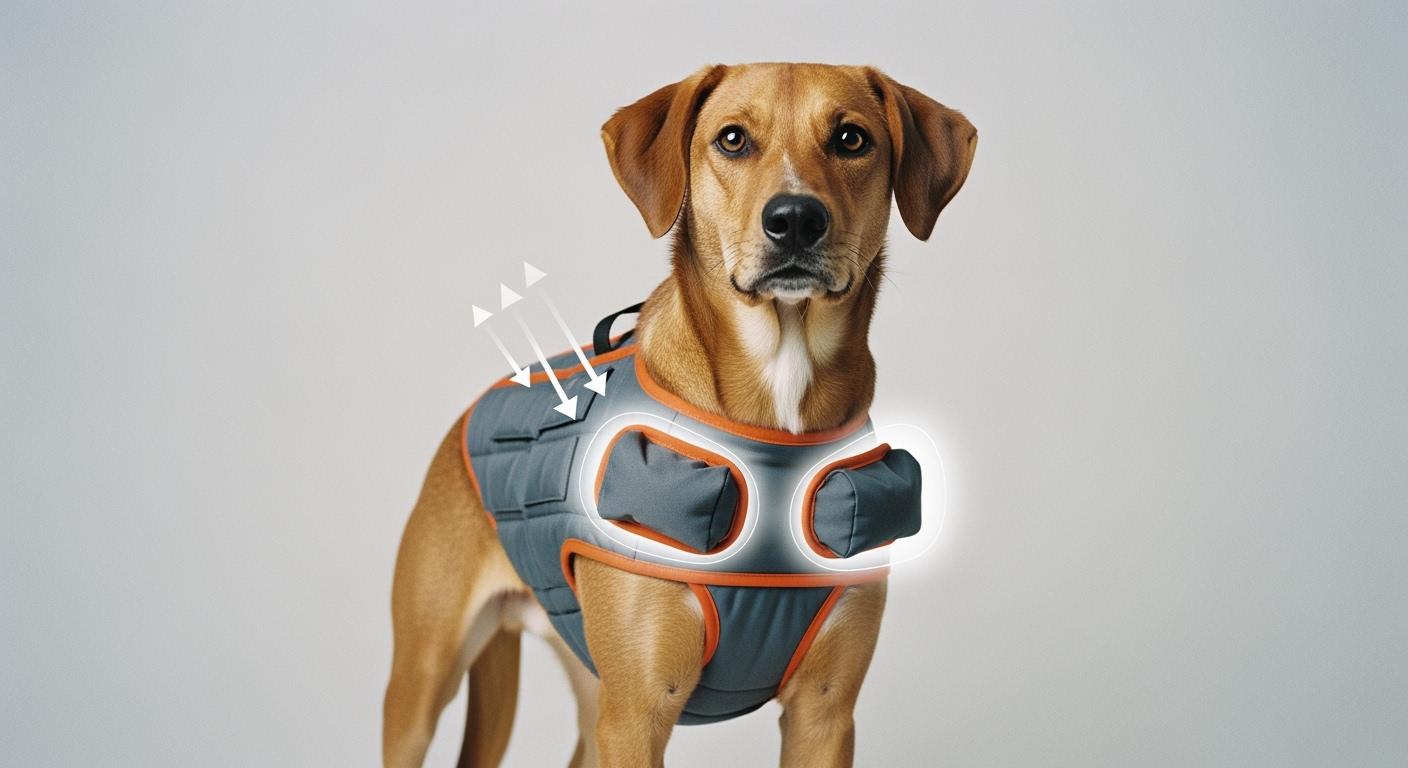
A weighted vest looks fine on a standing dog. The pockets sit evenly. Nothing pulls forward or bunches. That snapshot is misleading.
The real test starts the moment the dog moves. A vest that looks centered at a standstill can creep forward within thirty seconds of walking. The pockets drift toward the neck. Weight that was supposed to sit over the ribcage lands on the shoulders instead. That shift is not subtle to the dog. It changes how the vest feels, how the dog moves, and whether the dog tolerates wearing it at all.
The problem is not the weight itself. It is where the weight sits and whether the vest can keep it there during movement.
Why Front-Loaded Pockets Concentrate Pressure During Movement

Pockets positioned close to the neck or shoulders create a mechanical problem that compounds with every stride. When a dog walks, the shoulders rotate forward and back. If the front edge of a weighted pocket sits near the scapula, that motion pushes against the pocket from behind. The pocket cannot move with the shoulder. It gets nudged forward instead.
Each stride becomes a tiny shove. Over a few dozen steps, the vest migrates toward the neck. Weight that was distributed across the torso now concentrates on a much smaller area over the shoulders.
This is not a conventional fit problem. The vest may measure correctly and pass every static fit check. The issue is structural. A pocket center that sits forward of the torso midline has nothing anchoring it from behind. Gravity and shoulder motion work together to pull it forward until something stops it. Usually that something is the dog’s neck or shoulder blades.
The causal chain is straightforward: forward pocket placement means shoulder rotation pushes against pocket edges, the vest migrates toward the neck, weight concentrates over a smaller surface area, and pressure spikes at the shoulder contact zone. A vest with the same total weight can feel dramatically different depending on whether that weight sits over the ribcage or creeps onto the scapulae.
Three design choices determine whether this migration happens. The first is pocket position. Designs that place weight more centrally or slightly rearward keep the load anchored over the torso, where the ribcage provides a stable platform. The second is body panel length. A short panel cannot reach far enough back to stabilize the rear of the vest. Without that rear anchor, front-loaded weight pulls the entire vest forward. The third is rear stabilization. Adjustable rear straps or a panel that wraps further under the belly resist the forward tug.
A vest that combines rearward pocket placement, a longer body panel, and adjustable rear stabilization creates a system where the weight stays put. Not because the vest is tighter, but because the load is balanced over a stable surface. Weighted training vests with MOLLE-style pocket grids that extend further back along the torso give the weight a longer base to sit on, which reduces the forward-creep tendency compared to short-panel designs with front-only pockets.
Contact width matters here too. Narrow straps or stiff pocket edges concentrate force on a smaller area. When that narrow contact zone sits over the shoulders — whether by design or because the vest migrated there — the pressure per square inch spikes. Wider, softer contact areas spread the same weight over more surface, keeping peak pressure lower even if the vest shifts slightly during movement. The same principle applies across weighted gear: materials that conform rather than resist distribute load more evenly across the contact patch.
How to Check Pocket Layout and Shoulder Clearance
You do not need lab equipment to evaluate whether a weighted vest puts pressure on the shoulders. What you need is a movement test and a before-and-after position comparison.
Start with the vest unloaded. Place it on the dog and check that the pocket center — the midpoint of the weighted insert — sits over the ribcage rather than the neck or shoulder blades. Slide two fingers under each strap. The fit should be snug enough that the vest does not slide freely but loose enough that your fingers pass under the edge without resistance.
Now add the weights and walk the dog for ten minutes on a flat surface. Use a phone propped on a table to film from the side. After ten minutes, stop and check two things without adjusting the vest.
First, compare the pocket center position to where it was before you started. Has it moved forward? Place a finger on the dog’s shoulder blade and note where the front edge of the pocket sits relative to that point. If the pocket edge has crept onto or past the shoulder blade, the vest is migrating. The same forward-shift failure shows up in other gear: harnesses on large dogs tend to shift during walks when the body panel is too short or the rear stabilization is too weak to hold position.
Second, flip the chest panel up and feel the skin underneath where the front pocket edges sit. Warmth is normal. A defined red line or indentation that does not fade within thirty seconds is not. That pattern tells you pressure is concentrating at that edge. The dog may have shown no obvious discomfort during the walk, but the skin does not lie.
Watch the dog’s movement during the test. A shortened stride — where the front legs do not extend as far forward as they normally do — often shows up before visible pressure marks. The dog may lower its head or try to shake the vest off. These are not personality quirks. They are mechanical responses to restricted shoulder motion. A vest that stays stable during running and active play passes the same underlying test: the load does not migrate when the dog moves through its full range of motion.
The key difference between a vest that passes and one that fails comes down to whether the pocket center stays over the torso during movement. Weighted training vest fit checks that include movement testing catch forward migration before it becomes a comfort problem. Short-panel designs with front-heavy pocket maps tend to fail.
| Design Difference | Why It Matters | Main Limitation |
|---|---|---|
| Central or rearward pocket placement | Keeps weight over the ribcage, clear of the shoulder rotation zone | May reduce total front-load capacity for dogs that need more chest weight for conditioning |
| Longer body panel | Provides a rear anchor point that resists forward creep during movement | Requires accurate torso length measurement; one-size scaling does not work across breeds |
| Wide, soft contact areas | Spreads load over more surface area, reducing peak pressure per square inch | Adds material bulk; may trap more heat during warm-weather use |
| Adjustable rear stabilization | Locks the rear of the vest in place so front-loaded weight cannot pull the panel forward | Extra adjustment points add setup time and can confuse first-time users |
| Size-specific pocket maps | Repositions pockets for different body lengths rather than scaling one layout across all sizes | A small vest may have fewer pocket positions, limiting weight placement options |
One common mistake is assuming one pocket layout works for every size. A pocket position that sits correctly on a medium vest may shift onto the shoulders when scaled down to a small, or fall too far back on a large. Pocket maps should change with size grading — not just the vest dimensions, but the actual pocket coordinates on the panel.
In practice: After a 10-minute walk, the pocket center should still sit over the ribcage. If it has moved forward by more than an inch, the vest’s rear stabilization or panel length is not holding the load. Do not tighten the straps to compensate. That adds pressure without fixing why the vest is migrating.
When a Weighted Vest Is Not the Right Choice
Weighted vests work best on dogs with a fairly standard torso shape: a level topline, moderate chest depth, and enough body length for the panel to anchor on. Dogs at either end of the shape spectrum can run into problems that no amount of strap adjustment fixes.
Barrel-chested breeds present a particular challenge. The chest pushes the front of the vest upward, tilting the pocket angle forward. Even a well-designed pocket map can end up angled toward the shoulders on a dog with a deep, rounded ribcage. The same vest that sits flat and stable on a Labrador may ride forward on a Bulldog within the first minute of walking.
Very short-backed dogs face the opposite problem. The panel is often too long for the available torso space. Extra material bunches behind the shoulders and pushes the front edge forward. There is simply not enough flat real estate on the back for the panel to lie properly.
Dogs with a very deep keel or pronounced tuck-up may also struggle. If the belly strap sits too far forward because the chest drops away sharply behind it, the vest loses its lower anchor point. Without that bottom stabilization, the entire vest can rotate forward around the chest strap as a pivot.
Disclaimer: The fit checks described here assume a smooth-coated dog where pressure marks and vest position are visible without parting the coat. Double-coated breeds may show subtler rub marks that need hand-checking rather than visual inspection — run your fingers under the pocket edges after movement and feel for warmth concentration or skin indentation rather than relying on visible redness alone. If the dog’s chest shape falls well outside the breed norms this vest was patterned for — particularly barrel-chested dogs, dogs with a very short back relative to their girth, or dogs with a pronounced tuck-up — the pocket-position checks described here may not catch every pressure point. In those cases, gradual weight introduction with close movement observation is the more reliable evaluation method.
Also worth considering: a weighted vest adds resistance during walks. That resistance is the point for conditioning work. But on hot days, the combination of added weight, restricted airflow under the vest panel, and elevated exertion can push a dog past its heat tolerance faster than expected. If the dog is panting heavily within the first five minutes of a weighted walk, the vest is adding too much load for the conditions — even if the fit is technically correct.
FAQ
How do I know if the weight is sitting on my dog’s shoulders instead of the torso?
Check the pocket center position before and after a 10-minute walk. If the front edge of the weighted insert has crept forward past the shoulder blade, the vest has migrated. A secondary check: feel under the front pocket edges for concentrated warmth or indentations that do not fade within 30 seconds. Either signal means the load is not staying where it should.
Can a weighted vest that shifts forward still be safe to use?
If the migration is minor and the contact area is wide and soft, the pressure may stay low enough to avoid discomfort. But if you see shortened stride, head lowering, or the dog trying to shake the vest off, those are mechanical signs that shoulder motion is restricted. Continued use in that state can create pressure points that build over multiple sessions even if each individual walk seems fine.
Does a tighter fit prevent the vest from sliding forward?
Not reliably. Tightening the straps increases overall pressure but does not fix the root cause — a short body panel or front-loaded pocket map that lacks rear stabilization. A tighter vest with the same pocket position can actually concentrate more pressure on the shoulders because the vest has less room to redistribute the load across a wider contact area.
What design features should I look for to avoid shoulder pressure?
Three features matter most: pocket centers positioned over the torso rather than near the neck, a body panel long enough to anchor behind the ribcage, and rear stabilization — either adjustable straps or a panel that wraps far enough under the belly to resist the forward pull. Wider, softer contact edges help by distributing whatever pressure remains over more surface area.
Are weighted vests suitable for all breeds?
No. Dogs with barrel chests, very short backs, or a pronounced tuck-up may have trouble with panel fit even when measurements are correct. Heat tolerance also varies by breed — brachycephalic dogs and thick-coated breeds can overheat faster under a weighted vest, particularly in warm weather.






