
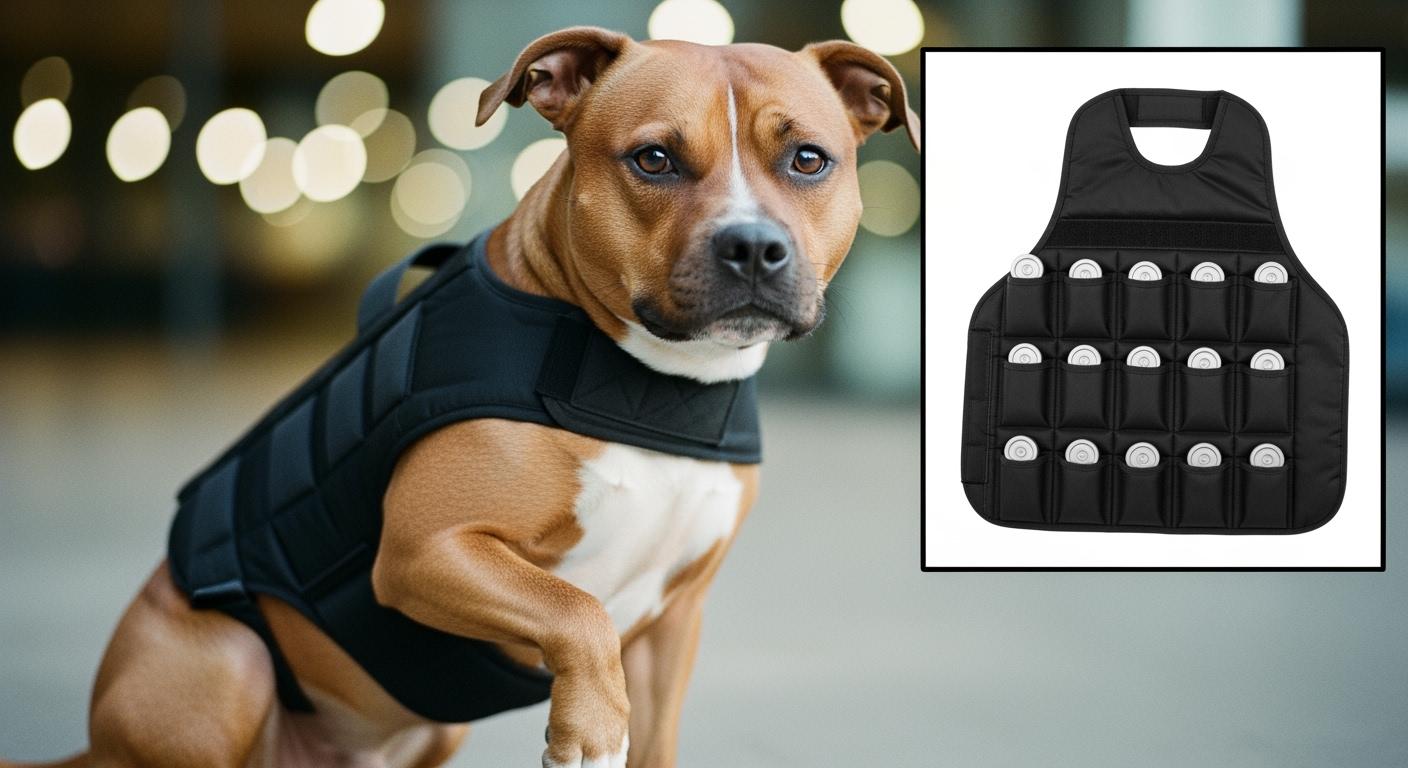
A weighted dog vest that drifts to one side mid-walk is not a training problem. It is a design problem. The root cause sits in three places: where the pockets are positioned relative to the dog’s center of mass, how stiff the panels stay under dynamic load, and whether the strap system holds tension evenly as the dog turns, stops, and changes direction.
Movement exposes every imbalance. Stand the dog still and the vest looks centered. Take ten steps, make a right turn, let the dog sniff low to the ground — the vest rotates. What changed is the direction of force relative to the load. A pocket placed too far from the body’s midline turns into a lever the moment the dog moves laterally. The weight swings outward, the panel follows, and the vest shifts.
In practice: The shift rarely starts at the pocket. It starts at the gap between the pocket floor and the dog’s ribcage. Close that gap and the lever arm shortens. Most shifting problems trace back to this single geometric relationship.
What Makes a Weighted Vest Rotate Off-Center During Movement
Pocket Placement and the Lever Arm Effect
Picture a weight sitting inside a pocket sewn onto the side of a vest. When the dog walks straight ahead, the force vector points downward. Gravity pulls the weight toward the ground, and the vest’s contact with the dog’s back and chest resists it. The system is stable.
The moment the dog turns, the force vector tilts. The weight now has a lateral component. If the pocket floor sits two inches away from the dog’s ribcage, that two-inch gap becomes a lever arm. Lateral force multiplied by lever arm equals rotational moment. The vest twists around the dog’s torso. The wider the gap, the more torque the same side force generates.
This is why two vests that look similar on a product page behave differently on a moving dog. One has pockets sewn flush against the body, the seam line following the rib contour. The other has pockets that hang — sewn to the outer shell with an air gap behind them. Same weight, same dog, completely different stability. That gap is also why a vest that stays centered on a straight sidewalk can rotate sharply on the first turn. The same rotational problem shows up in other dog gear that carries weight — any equipment with mass held off the body’s midline shifts predictably once lateral force enters the equation.
Strap Tension and Why Loose Fit Multiplies the Problem
A vest that fits loosely gives the weight room to accelerate before the straps catch it. Think of the strap as a spring: when it is already under tension, any additional force transmits immediately to the dog’s body and the vest self-corrects. When it is slack, the weight builds momentum before the strap engages. By the time the strap tightens, the pocket has already moved.
Two strap design choices determine whether this sequence plays out. First, how many independent adjustment points the vest has. A single chest strap cannot control rotation around the torso — it can only tighten a ring. Two straps placed at different angles, chest and belly, create a triangulated load path that resists twist. Second, whether the strap material stretches under load. Nylon webbing elongates a few percent under tension; that is enough to let a pocket drift half an inch before the system stabilizes. Half an inch at the pocket translates to a visible shift at the vest’s outer edge.
The fit standard for weighted vests is stricter than for unloaded vests. A non-weighted vest can sit slightly off-center without consequence — there is no load to amplify the error. Add weight and the same half-inch of strap slack becomes a failure point. Vest stability during movement depends on strap geometry and tension distribution, not just how firmly the buckles are cinched.
Panel Structure Under Dynamic Load
Most shifting problems are diagnosed as fit problems. Many of them are panel problems in disguise. When a dog trots, the vest experiences a repeating load cycle: the weight presses down, the panel flexes, the dog’s stride lifts the torso, the panel rebounds. If the panel material creases or collapses during the load phase, the pocket angle changes. The weight settles into a new position. Over a few dozen strides, the vest walks itself off-center.
Soft fabric panels — unbacked nylon, single-layer polyester, thin mesh — fold along a crease line under repeated loading. Once a crease forms, it acts as a hinge. The pocket tilts outward, the gap between weight and body widens, and the lever arm grows. This is a compounding failure: each step makes the next step’s shift slightly worse. Stiff, multi-layer panels with edge binding or internal reinforcement resist crease formation. They distribute the load across the entire panel face instead of concentrating it along a fold line.
Design Features That Keep the Weight Centered Through Movement
Balanced Pocket Layout Anchors the Load
Symmetrical pocket placement is the non-negotiable starting point. The left and right pockets must sit at the same height, the same distance from the spine, and the same angle relative to the ribcage. A quarter-inch asymmetry in pocket placement means one side’s weight sits slightly farther from the body’s midline. That side generates more torque during turns. The vest will always drift toward the side with the longer lever arm.
Balanced placement also means the pocket floors are sewn parallel to the ground plane when the dog is standing. Pockets angled downward funnel the weight toward the bottom seam, concentrating force on a narrow contact patch. That creates a pivot point. Flat pocket floors spread the weight across the full panel surface. The load path runs vertically through the panel into the strap system, with no lateral component to initiate rotation.
Even loading is the other half of this equation. A vest with symmetrical pockets but unequal weight left-to-right behaves like one with asymmetrical pockets. The heavier side wins every turn. Load both sides to within half an ounce of each other — small imbalances may not register at a standstill but become visible after a minute of walking. For a vest with reinforced, body-conforming panels and balanced pocket placement, the geometry works as a system — each part depends on the others to keep the load centered.
Body-Conforming Panels Resist Lateral Collapse
A panel that curves around the dog’s ribcage is stiffer in the lateral direction than a flat panel of the same material. The curvature creates geometric stiffness — the same principle that makes an eggshell strong under compression despite being thin. When a vest panel follows the dog’s body contour, side forces get transmitted along the curve into the strap attachment points rather than folding the panel inward.
Multi-layer panel construction adds material stiffness to the geometric stiffness. A panel built from an outer shell fabric bonded to a stiff inner liner — or a shell with sewn-in reinforcement ribs — resists crease formation better than a single-layer panel. The layers shear slightly under load, dissipating energy that would otherwise concentrate at a single fold line. This is the same design logic used in load-bearing equipment where panels must hold their shape under repeated dynamic loading: the structure matters more than the material name on the tag. The materials in a weighted vest determine how panels behave under repeated loading, but the panel construction — how those materials are layered, stitched, and shaped — determines whether they hold or collapse.
Here is how these design features compare when present versus absent:
| Design Difference | Why It Matters | Main Limitation |
|---|---|---|
| Pockets sewn flush against body contour vs. hanging with air gap | Eliminates the lever arm that generates rotational torque during turns | Requires accurate body measurement; a misfit vest cannot close this gap |
| Multi-layer reinforced panels vs. single-layer fabric panels | Prevents crease formation that lets pocket angle shift under repeated loading | Adds weight and reduces breathability compared to unlined mesh |
| Two-point independent strap adjustment vs. single chest strap | Creates triangulated tension that resists rotation around the torso | More adjustment points mean more setup time and more points that can loosen |
| Flat pocket floors vs. angled or sagging pocket bottoms | Spreads weight evenly across the panel instead of concentrating it at a pivot point | Relies on the panel maintaining its shape; soft panels negate this benefit |
Strap Geometry and the Triangulated Load Path
Two straps create a triangle. One strap creates a ring. A vest held by a single chest strap can spin around the dog’s torso — the strap defines a circle, and the vest is free to rotate within it. Add a belly strap set at a different angle and the vest is now pinned at two points. Rotation requires stretching both straps simultaneously or sliding the entire vest as a unit. The geometry resists twist.
The angle between the two straps matters. Straps set nearly parallel — both running vertically around the girth — behave almost like a single strap. The triangulation effect is weak. Straps set at divergent angles — one angled forward toward the chest, one angled back toward the belly — create a wider stability base. The wider the base, the more lateral force is needed to rotate the vest.
Observable check: after a 15-minute walk, mark the position of the back seam relative to the dog’s spine with a piece of tape before removing the vest. If the seam has drifted more than an inch from the midline, the strap geometry is not holding. Getting the sizing right so the straps land at the correct angles is the starting point — a strap sized correctly but placed at the wrong angle still allows rotation.
When Centered Design Works — and the Conditions That Undo It
A well-designed weighted vest stays centered under most walking conditions: straight-line walking, moderate turns, sniffing stops, climbing shallow inclines. The design advantages hold best during steady-state movement on predictable terrain. The load is stable, the force vectors are consistent, and the panel and strap system can do its job.
The advantage narrows under three conditions. First, rapid direction changes — a dog zigzagging after scents, sudden stops from a run, sharp pivot turns. Each direction reversal applies a brief but high lateral force spike. Even the best panel geometry needs a moment to re-center after a spike, and if spikes come faster than the system can settle, the vest accumulates drift.
Second, deep-chested breeds with a pronounced tuck behind the elbows. The ribcage curves inward sharply, creating a natural low point where the vest wants to slide forward. A vest shaped for a barrel-chested dog will not sit flat on a Greyhound or Doberman — the curvature mismatch means the panels can only make partial contact, and the gaps become pivot points.
Third, wet conditions. Water adds weight unevenly if the outer fabric absorbs moisture on one side faster than the other. A vest that stays centered dry may shift after splashing through a puddle if the pocket fabric holds water on the leading side.
Disclaimer: The stability checks described here assume a smooth-coated dog where the vest panels make direct contact with the coat. Double-coated breeds with dense undercoat create a slippery intermediate layer — the vest panels sit on fur, not skin, and the fur can compress and shift independently of the vest. On these dogs, check for rub marks by running your hand under the vest edge rather than relying on visible seam drift alone. If the dog’s chest shape falls outside the breed norms this vest was patterned for — particularly dogs with a barrel chest or very deep keel — the panel contact geometry changes and the stability advantages described here may not fully apply.
Observable check for pocket balance: load both sides equally, walk the dog for ten minutes on a familiar route, then stop and check. Is the back seam still aligned with the spine? Is one pocket riding higher than the other? If the vest shifted toward the same side on two consecutive walks, the pocket placement or panel stiffness on that side likely differs — even if the difference is not visible by eye. Setting up a weighted vest so it stays stable across different activities starts with checking these symmetry signals during the first few uses, before the vest develops any permanent creases or stretch patterns.
FAQ
Why does the vest shift only during walks and not when the dog stands still?
Standing still, only gravity acts on the weight — a vertical force straight down. The vest panels and straps only need to resist that single vector. Walking introduces lateral forces from leg drive and torso rotation, plus centripetal forces during turns. Each of these applies torque to the pockets. If the pocket placement creates any lever arm — any gap between the weight and the body — that torque rotates the vest. No lateral force, no rotation. That is why the vest looks fine at a standstill and shifts the moment the dog moves.
How much weight difference between left and right pockets causes shifting?
There is no universal threshold — it depends on the pocket placement and panel stiffness. On a vest with pockets flush against the body and stiff panels, a half-ounce difference may go unnoticed on a 60-pound dog. On a vest with soft panels and pockets that hang away from the body, the same half-ounce difference creates visible drift within a block of walking. The tighter the pocket-to-body gap, the more imbalance the system tolerates before shifting becomes visible.
Can a weighted vest fit correctly but still shift?
Yes. Correct fit — the measurements matching the dog’s girth and torso length — addresses one variable. But if the pockets are placed asymmetrically, if the panels collapse under load, or if the strap geometry creates a single-ring constriction instead of a triangulated hold, the vest shifts despite fitting. Fit is necessary but not sufficient for stability under load.
Does the type of weight inside the pockets affect shifting?
It can. Loose fill — sand packets, individual weight bars that slide within the pocket — shifts its own position inside the pocket before the pocket itself moves. That internal movement changes the pocket’s center of mass, which changes the lever arm, which initiates rotation. Weight inserts that fill the pocket completely and sit snug against all four seams keep their own center of mass fixed, so any shift must come from the vest structure, not from the weight migrating inside.
Note: Check the vest after each activity session. A stable fit with balanced loading and stiff panels keeps the weight centered, but checking takes thirty seconds and catches strap loosening before it becomes a pattern.






