
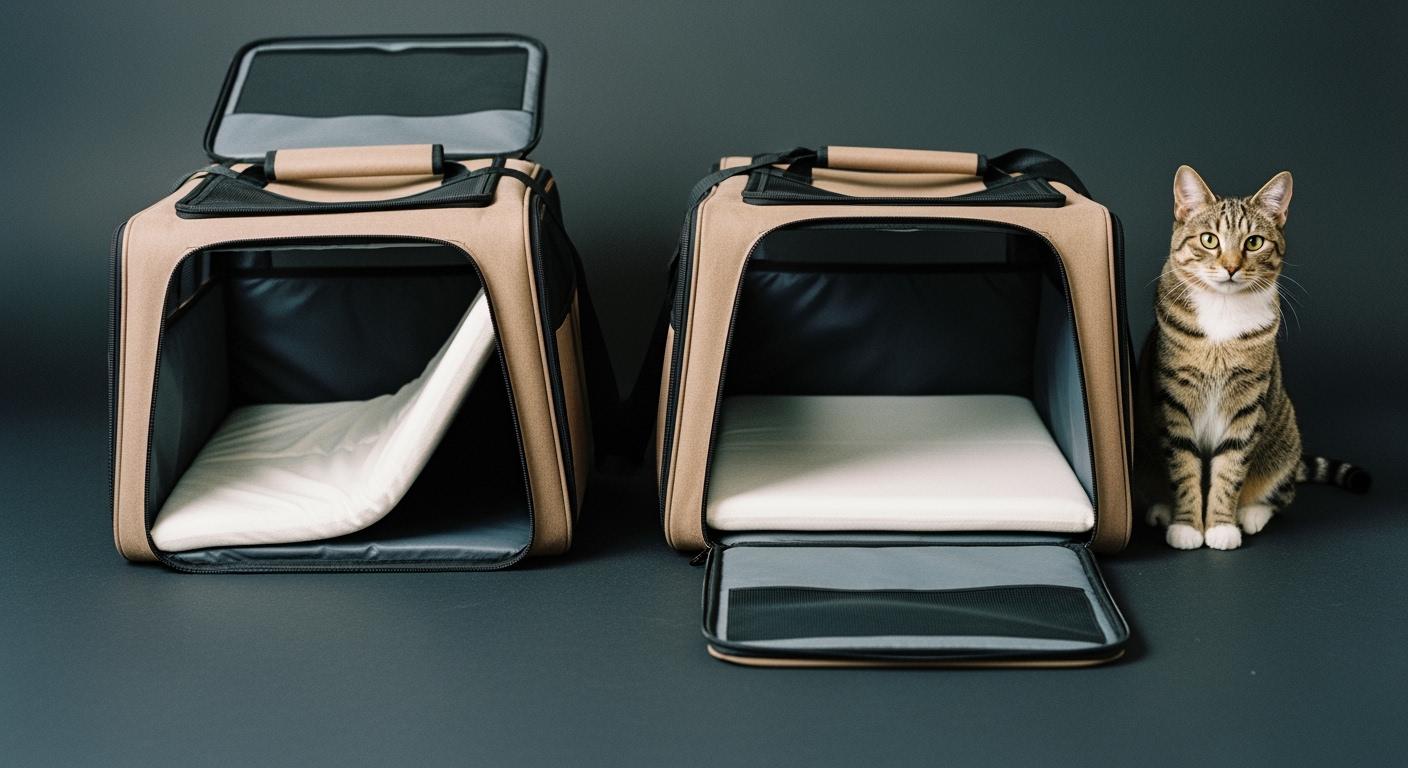
A removable pad that creeps across the carrier floor is not a quirk of how you carry the bag. It is a fit problem. When the pad does not match the carrier floor dimensions closely—when gaps sit between the pad edge and the carrier wall—lifting, tilting, or simply setting the bag down can send the pad sliding, curling, or bunching into a corner. The cat ends up standing on bare carrier lining instead of a padded surface. Edge-fit pad design addresses this at the source: a pad cut to sit flush against all four walls, supported by a firm base panel that does not flex under weight.
Why A Removable Pad Shifts Inside A Moving Carrier
It Looks Stable on the Shelf
On a store shelf, the pad sits flat. The base looks level. Nothing moves. But that scene is static—no weight, no tilt, no acceleration. Once you place a cat inside and pick up the carrier, every variable changes. The pad that looked firmly seated can drift because it was never mechanically locked to the floor. It was just resting there.
This is the gap between how a carrier presents at rest and how it performs in motion. A pad that loosely covers the floor does not account for the forces that act on it the moment the carrier leaves the ground.
What Happens During Lifting, Tilting, and Carrying
Pick up a carrier by one handle and the floor tilts. The pad, if it is even slightly undersized, slides downhill. Switch to a shoulder strap and the carrier swings—the pad follows the lowest point. Set the bag down on a hard surface and the sudden stop can jerk the pad forward. Each of these movements applies a brief lateral or rotational force to the pad. Without edge contact to resist that force, the pad moves.
The mechanics are straightforward: the force vector from lifting or tilting has a horizontal component. A pad that is not constrained by the carrier walls follows that component. The smaller the pad relative to the floor, the longer the run-up before it hits a wall—and the more floor gets exposed. This is why pad-to-floor sizing is the root variable, not how carefully you carry the bag.
A cat shifting its weight inside makes this worse. When the cat turns, stretches, or repositions, it pushes against the pad with its paws. On a smooth carrier floor with no edge stops, that push translates directly into pad displacement. In carriers that measure fine at home but fail during transit, the pad movement often goes unnoticed until the cat is already stressed and standing on exposed lining.
| Failure Signal | Likely Pad/Floor Design Cause | Better Design Direction |
|---|---|---|
| Pad slides to one side | Pad too small for carrier floor | Pad dimensions matched to floor footprint |
| Pad curls or bunches up | No edge constraint, weak bottom panel | Fitted edge boundary plus rigid base |
| Floor feels uneven when carried | Flexible base, loose pad placement | Stable, non-flexing bottom support |
The Design Details That Make Pad Shifting Worse
Loose Sizing Creates Gaps the Pad Drifts Into
An undersized pad leaves a runway—a gap between the pad edge and the carrier wall. That gap is not cosmetic. When the carrier tilts, the pad accelerates across that open space before hitting the wall. By the time it stops, part of the floor is bare. An oversized pad folds upward at the edges, creating ridges the cat has to stand on.
Neither condition gives the cat a flat, fully covered floor. The pad needs to match the carrier’s internal footprint closely enough that edge gaps stay minimal on all sides—near enough that the pad cannot build meaningful momentum before contacting a wall.
No Edge Support and a Slippery Lining
A pad without a defined edge boundary behaves like a loose mat on a polished floor. The edge support is what gives the pad a mechanical stop—a vertical face it butts against when lateral force hits. Without it, the pad relies entirely on friction against the carrier floor to stay put.
If that floor lining is smooth nylon or polyester taffeta, friction is minimal. The coefficient of static friction between a foam-backed pad and a slick fabric liner is low enough that the force from normal carrying motion overcomes it. The pad breaks free, slides, and does not self-correct. A textured or grippy floor surface raises that friction threshold, but the more reliable fix is mechanical: a pad that fits edge-to-edge so it cannot build travel distance.
| Failure Signal | Likely Pad/Floor Design Cause | Better Design Direction |
|---|---|---|
| Pad slides or bunches up | Loose sizing, low-friction floor lining | Fitted pad dimensions, grippy floor surface, edge stops |
| Floor feels uneven | No edge constraint, flexible base panel | Rigid edge boundary, stable bottom panel |
| Cat stands on carrier lining | Gaps between pad and walls | Close pad-to-floor dimensional match |
Too-Soft Padding and Flexible Bottom Panels
A thick, plush pad sounds comfortable. But if the carrier’s bottom panel is fabric-only with no rigid insert, the whole floor can sag under the cat’s weight. The pad compresses unevenly, the base bows downward, and the cat stands on a concave surface that tilts with every step.
This is a support problem, not a padding problem. Foam density matters more than foam thickness for stability. A low-density pad collapses to near-zero thickness under body weight, negating any cushioning benefit. A firm base panel—rigid plastic, composite board, or reinforced laminate—keeps the floor geometry intact regardless of how the pad compresses. The pad provides the soft surface; the base provides the structural plane.
To check this: with the cat inside, reach under the carrier and press upward on the bottom panel with your palm. If the floor deflects more than half an inch with moderate pressure, the base is too flexible to keep the pad flat during carrying.
Pad Curling at the Edges
Edge curling starts when the pad is slightly oversized or when the carrier walls push inward on a soft-sided bag. The pad folds upward at the perimeter, creating a lip the cat has to step over. Over multiple trips, a curled pad tends to retain that shape memory—the foam develops a permanent bend at the fold line.
Mechanical anchoring features help. Silicone or TPR grip dots on the pad underside increase friction. Velcro anchor points or snap-in base tabs lock the pad to the floor. These features work best when combined with correct sizing—anchors cannot compensate for a pad that is fundamentally the wrong shape for the carrier floor.
Note: A pad that stays flat and covers the floor edge-to-edge supports steady footing. Watch for curling at the corners after a short walk—that is a sizing signal, not a usage issue.
What Edge-Fit Pad Design Gets Right
Fitted Floor Shape Creates a Mechanical Stop
When the pad matches the carrier’s internal footprint, the four walls become mechanical stops. Lateral force from tilting or swinging pushes the pad against the nearest wall, where it meets a vertical surface it cannot climb. The pad cannot build momentum because there is no open floor for it to slide across.
The physics is different from a loose pad. With a loose pad, the horizontal force component from tilting produces acceleration across open floor—the pad gains displacement before hitting a wall, and that displacement is what exposes bare lining. With an edge-fit pad, the force transmits directly into the wall at near-zero displacement. The pad shifts millimeters, not inches. That is the mechanical difference: not that the pad never moves, but that it moves within a range too small to expose floor. Carriers designed with under-seat dimensions in mind tend to pair this fitted floor shape with pads cut to match precisely, since airline stowage adds pitching and rolling forces that a loose pad cannot survive.
You can verify edge fit before travel: place the pad in the carrier, press it into all four corners, then lift and tilt the empty bag roughly 45 degrees in each direction. Watch the pad edges. If any edge pulls away from the wall by more than half an inch, the fit is too loose to hold during normal carrying.
A Firm Base Panel Resists Sagging
A rigid insert under the pad changes how weight is distributed. Instead of the pad and floor forming a single flexible membrane that bows under the cat’s center of mass, the base panel spreads the load across its entire surface. The pad compresses where the cat sits, but the floor stays flat underneath.
This matters because uneven compression changes the cat’s posture inside the carrier. When the floor sags, the cat’s hips and shoulders drop relative to the paws—a subtle shift that makes standing and turning more effortful. Over a multi-hour trip, that effort accumulates.
Materials make the difference. A stiff plastic tray, a composite board insert, or a reinforced fabric laminate all resist bending under localized weight. The pad itself can remain soft and washable—the base handles the structural load. Carriers built with a rigid shell or reinforced base maintain floor flatness even when the bag is lifted from one end, which is the worst-case loading scenario for pad shift.
Tip: After a trip, remove the pad and check the base panel for permanent deflection. A base that stays bowed when unloaded was flexed past its recovery point—a sign the material is not stiff enough for the cat’s weight.
Close Pad-to-Floor Sizing Keeps the Surface Covered
Pad-to-floor sizing is the single most direct lever on pad shift. A pad that leaves a minimal gap on any side cannot drift far enough to expose bare floor, even under aggressive tilting. A pad that leaves a full inch on two sides can expose a wide stripe of lining with a single swing of the shoulder strap.
Close sizing also affects airflow. When the pad covers the floor completely, any ventilation ports in the carrier base push air through the gap between pad and floor, not around the pad edges. That airflow keeps the pad underside drier—a benefit that disappears when the pad shifts and ventilation paths get blocked or redirected.
For travel setups where the carrier goes through airport security and under-seat stowage, pad fit becomes a reliability issue, not just comfort. A pad that shifts during handling can end up crumpled under the cat by the time the carrier is stowed—and it stays crumpled for the duration of the flight because there is no way to reach in and reposition it. For cats that travel regularly, pad fit checks before every trip help catch sizing drift early, since foam pads can compress permanently over time and become effectively undersized even if they fit when new.
Stable Carrier Structure Holds the Floor Geometry
The carrier frame sets the baseline. If the frame twists, the floor twists with it. A soft-sided carrier with no rigid frame can deform when lifted from one handle, turning a rectangular floor into a parallelogram. The pad, cut for a rectangle, no longer fits.
A rigid shell or a well-braced frame keeps the floor shape constant regardless of how the carrier is handled. This is why airline-ready carriers that pass under-seat sizing checks tend to use structured bodies—the geometry has to hold under conditions the manufacturer cannot control, from gate-check handling to turbulence.
The same principle applies on a smaller scale with daily-use carriers. Every time you pick up the bag, the frame takes a torsional load. A carrier with a rigid shell distributes that load through the shell walls. A soft-sided carrier transfers it to the zippers and seams. Over months of use, the soft-sided carrier gradually loses floor flatness—the zippers stretch, the seams relax, and the floor that was flat on day one develops a permanent wave. A rigid shell does not have that failure mode.
In practice: The easiest pre-trip test takes ten seconds. Load the carrier with a weight roughly matching your cat—a bag of flour or a few books—lift it by one handle, and tilt it roughly 30 degrees. If the pad shifts more than half an inch, it will shift with the cat inside.
When A Fitted Pad Alone Is Not Enough
Edge-fit design solves the mechanical displacement problem. It does not solve every problem. A pad that fits perfectly can still create issues if the foam is too dense and transfers road vibration instead of absorbing it. A perfectly fitted pad in a carrier with no ventilation can trap heat and moisture against the cat’s underside. A firm base panel that never flexes can transmit impact forces directly into the cat’s joints when the carrier is set down hard.
Design is always a set of trade-offs. Edge fit trades some of the “any pad works” convenience for stability under motion. A firm base trades foldability for flatness. Carriers that handle pad shifting well are typically not the ones that collapse into the smallest storage footprint—they are the ones that prioritize structural integrity when occupied.
Disclaimer: The edge-fit checks described here assume a rectangular carrier floor and a pad cut to match its internal footprint. Carriers with tapered or irregular floor shapes—common in dome-style or backpack carriers with curved bottoms—may not achieve full edge contact even with a correctly sized pad. In those carriers, pad shifting is better managed through mechanical anchors like Velcro tabs or snap-in base fasteners rather than edge fit alone. For cats with mobility issues or arthritis, even a small amount of pad shift that a younger cat would ignore can cause hesitation or refusal to enter the carrier.
FAQ
Why does my pet carrier pad move even when the bag looks the right size?
The carrier shell can be the right size while the pad is not. A one-size pad sold with a range of carrier sizes often leaves gaps in the larger shells. The pad should match the specific carrier’s internal floor dimensions, not the carrier’s stated size category.
Can I reduce pad shifting without replacing the pad or carrier?
A thin non-slip shelf liner cut to match the carrier floor can reduce sliding on smooth surfaces. Adding Velcro strips between the pad and the base panel helps if the base has a loop-compatible surface. These are workarounds—they improve friction but do not create the mechanical edge stops that prevent displacement during sharp tilts.
Does a thicker pad reduce shifting?
No. Thickness primarily affects compression comfort, not positional stability. A thick pad on a flexible base can actually shift more because it creates a taller profile for lateral forces to act against. What reduces shifting is edge fit and base rigidity—pad thickness is a separate variable.






