

When you run trails with a large dog, the leash itself is the part of your setup other trail users need to see most. It is also the part most likely to vanish. A 70-pound dog draws the eye. A strip of dark nylon webbing stretched between the dog and your hand does not.
The problem is geometric, not just material. Most reflective stitching sits along one face of the webbing — the front or the back. That surface sends light back toward its source: a headlamp, a bike light, the sun. An observer standing at your 3 o’clock or 9 o’clock catches none of that return. The angle is wrong. The leash line disappears into tree trunks, soil, shadows, and dark clothing. This fails most acutely during wide trail passing, when the leash stretches horizontally across the path and a cyclist or runner approaches from the side.
Dark webbing compounds the issue. Nylon dyed black, brown, or olive blends into bark, dirt, and shaded undergrowth. Even bright hardware — a zinc clip or a stainless D-ring — loses its glint when the reflective face angles away from the sun. What you see looking down at your own gear is not what a fast-moving cyclist sees 40 feet out on a wooded bend.
A second failure mode is motion. Large dogs accelerate harder and cover more lateral ground than small dogs. Their direction changes create sudden leash swings. A thin leash line whipping across the trail at dog-shoulder height is hard for anyone to track. The eye needs a stable reference to judge distance and trajectory. When the leash bounces and swings unpredictably, other trail users lose that reference. They cannot tell where the line will be in two seconds. They guess. Sometimes they guess wrong.
Note: Most trail incidents involving dogs are not caused by aggression. They happen because another trail user did not see the leash line in time to adjust speed or path.
Why Side Visibility Depends on Reflector Placement, Not Just Brightness
A leash built for side visibility changes the geometry of reflection. Reflective strips or stitching placed along both edges of the webbing — not just one face — catch light across a wider set of entry angles. When light strikes edge-mounted reflective material, it scatters back across a broader exit arc. An approaching cyclist at 90 degrees to the light source still catches part of the return signal. A front-face-only strip, by contrast, has an effective visibility cone of roughly 30 to 40 degrees off-center. The edge-mounted design widens that cone — not by using brighter material, but by orienting the reflective surface toward the angles where observers actually stand during trail passing.
The physical mechanism is direct. Light hits a glass bead or prismatic surface embedded in the reflective thread. If that thread sits flat on the webbing face, the bead’s return path is narrow: light goes back roughly where it came from. If the thread wraps around the webbing edge, the bead presents a different facet to side-angle light. That facet returns the signal at an exit angle that reaches the side observer. The material is the same. The placement changes everything.
This is not about making the leash glow. It is about making the line readable from where it matters — the approach angle of an oncoming runner or cyclist during a wide pass on a mixed-use trail. For a closer look at how leash materials and fit affect control across different running setups, the differences between running-leash materials and attachment styles change how the reflective pattern holds its orientation during a run.
Stronger webbing plays a supporting role. When a large dog lunges or changes direction, the leash experiences a force spike. That spike travels as a wave down the webbing. Narrow, lightweight webbing transmits more of that wave — it whips. Wider webbing with a tighter weave and lower elasticity dampens the wave. The leash line stays steadier. A steadier line is easier for others to track, and the reflective pattern stays oriented correctly instead of twisting out of view.
| Design Difference | Why It Matters | Where It Works | Where It Falls Short |
|---|---|---|---|
| Edge-mounted reflective strips vs. face-only stitching | Side observer catches the return signal at passing angles; face-only goes dark beyond roughly 40° off-center | Mixed-use trails with side-angle passing, dawn and dusk runs, wooded bends | Open fields in full midday sun; high ambient light washes out reflective contrast |
| Wider, tighter-weave webbing vs. narrow lightweight webbing | Dampens force-spike wave from large-dog lunges; leash stays steadier and easier to track | Trails with frequent direction changes, strong pullers, multi-dog passing | Adds weight and bulk; may feel heavy on longer runs where the dog runs steady |
| Fixed-orientation clip vs. freely rotating swivel | Keeps reflective pattern consistently oriented; no unpredictable pivot point under load | Runs with frequent passing where consistent reflector orientation matters | Limits natural leash rotation; may twist webbing during repeated direction changes |
What a Side-Visible Leash Changes on Mixed-Use Trails
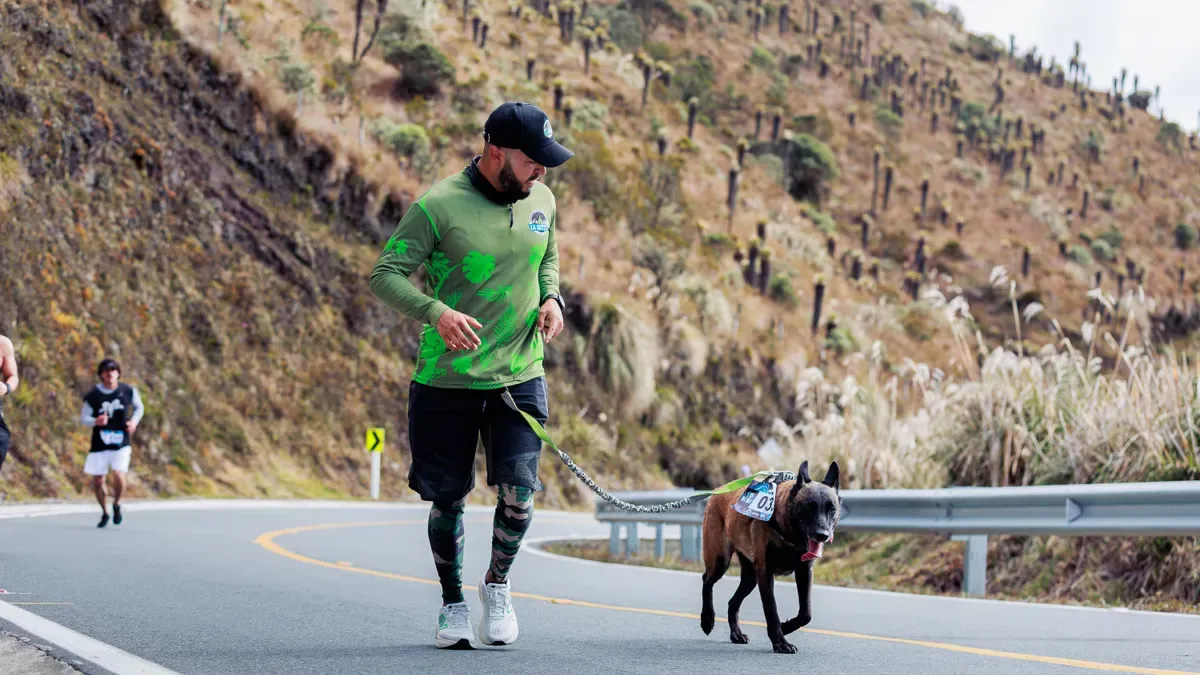
Edge-mounted reflective material does more than catch light at side angles. It keeps catching light even as the leash swings. When a large dog shifts direction and the webbing twists, a face-only reflective strip rotates away from the observer. An edge-mounted strip presents a fresh reflective facet toward the observer at some point in the rotation. The difference is not that the leash is always visible. It is that the gaps in visibility are shorter.
You can verify this yourself. After your next trail run, check whether other users consistently stepped over or around your leash line without slowing. If they did, the leash was likely invisible to them from the side. A leash with reflective material along both edges changes that pattern — you will notice others adjusting their path a stride or two sooner, because they spotted the line earlier.
Controlled leash length matters for the same reason. A leash that runs 4 to 6 feet keeps the line within a predictable zone. Longer leashes introduce more slack, more swing, and a wider arc of potential positions for other trail users to scan. That wider arc makes the reflective pattern harder to locate. A shorter, controlled length narrows the search area. For runners working through the trade-offs between leash length and control on mixed routes, the visibility benefit of a predictable line position often outweighs the freedom of extra length.
Hands-free compatibility — attaching the leash to a waist belt — changes the geometry again. When the leash anchors at your waist instead of your hand, the line runs closer to horizontal at dog-shoulder height. That horizontal line is exactly what other trail users need to see during wide passing. An edge-mounted reflective design catches more light at this angle than a face-only design would. But the trade-off is real: a waist-mounted leash moves with your hips, and hip movement during running introduces a different bounce pattern than hand-held control. The side-pull dynamics shift, too, which matters when a large dog lunges from an angle. How waist-belt bounce and side-pull behavior interact with reflective visibility determines whether the hands-free setup helps or hurts on crowded trails.
Stable clip hardware supports the whole system. A swivel clip that rotates freely under load adds an unpredictable pivot point between the dog and the reflective webbing. A fixed-orientation clip or a locking swivel keeps the attachment angle consistent, so the reflective pattern stays oriented correctly relative to the dog’s movement. The clip is not the star of the show. But when it fails to hold orientation, everything upstream — the reflective placement, the webbing stability, the controlled length — loses its effect.
| Design Difference | Why It Matters | Main Limitation |
|---|---|---|
| Nylon with encapsulated edge-reflective thread | High tensile strength for large-dog control; edge reflectors maintain side-angle visibility across the full webbing length | Absorbs water in rain or stream crossings; saturated webbing gains weight and reflective thread may lose return brightness if not waterproof-treated |
| Biothane with bonded edge-reflective strips | Waterproof; no strength loss when wet; bonded strips stay oriented even when the leash flexes | Heavier and less flexible in cold conditions; bonded strips can delaminate over time if the adhesive layer is not UV-stabilized |
Test your current leash at dusk. Have someone stand 15 feet to your side while you hold the leash at trail-running tension. Ask them to trace the line from clip to handle. If they cannot follow it without pointing, the side visibility is failing. A leash with edge-mounted reflectors changes that result. The line traces cleanly from any side angle.
When Reflective Leash Design Helps Most — and When It Does Not
The conditions where reflective side visibility provides the largest safety margin are predictable: dawn and dusk runs, heavily wooded trails with dappled light, narrow singletrack with blind bends, and any trail shared with cyclists moving at speed. The common thread in each is that the observer approaches from the side with limited time to react. The wider the reflective exit arc, the sooner the leash line registers.
The benefit narrows in open terrain under full midday sun. High ambient light washes out the contrast between reflective material and the background. The leash line is generally visible anyway because shadows are minimal and the trail is wide. Reflective side visibility is not useless in these conditions — it still catches direct sun glare from certain angles — but it is not the primary safety factor. A walking-control setup that prioritizes steady line tension and predictable positioning matters more in bright, open conditions than reflectivity alone.
Weather introduces another variable. Wet reflective stitching can lose return brightness because the water film alters the refractive index at the bead surface. Waterproofed reflective threads or encapsulated panels maintain more of their performance in rain or after stream crossings. This matters in regions with frequent trail rain. The reflective dog leash covered in the reflective bungee leash design shows how material choice and reflector placement interact under real-world trail conditions.
Fit and sizing decisions for the rest of the walking setup also shape how the leash performs. The way harness fit and sizing checks affect leash attachment height and angle can shift where the reflective pattern sits relative to other trail users’ sightlines. A harness that rides high on the shoulders places the leash clip higher, which changes the reflective line’s angle. A low-attachment harness drops the line closer to the ground, where grass and trail debris can partially obscure it.
Disclaimer: Reflective side visibility improves detection of the leash line — it does not prevent all accidents. This check assumes other trail users are paying attention and that a light source is present to activate the reflective material. In pitch-black conditions with no active light source, even the most reflective leash returns nothing. For dogs with thick double coats, reflective material on the leash may be partially obscured by fur when the leash runs close to the dog’s body; hand-check the visibility rather than relying on a visual scan. If the dog’s chest shape falls outside breed norms — particularly barrel-chested or deep-keel builds — the leash attachment angle may shift enough to change which reflective facets face approaching trail users.
FAQ
Does reflective stitching work if the leash gets wet?
It works, but with reduced return brightness. Water on the bead surface changes the refractive index at the point where light enters the reflective material. Waterproofed thread or encapsulated panels maintain closer to dry-condition performance. In sustained rain, expect a visible drop-off — the leash remains more visible than a non-reflective one, but the detection distance shortens.
Is a hands-free leash visible enough for trail running with a large dog?
A hands-free leash can be visible enough if the reflective material runs along both edges and the webbing stays controlled. The waist-anchor point changes the line angle relative to the ground, which can actually improve side visibility during passing — the line runs closer to horizontal at the height where other trail users scan. But hip bounce during running introduces movement that a hand-held leash does not have. The reflective pattern needs to stay oriented through that extra motion.
What leash length keeps the line most visible during wide passing?
A 4-to-6-foot leash keeps the line within a predictable zone that other trail users can scan quickly. Longer leashes introduce more slack and a wider arc of possible positions. The wider the arc, the harder it is for an approaching cyclist or runner to locate the reflective line in time. Shorter is not always safer — too short restricts the dog’s natural stride — but controlled length makes the reflective pattern easier to spot.
Can a reflective leash replace a headlamp or other active lighting?
No. Reflective material is passive — it needs an external light source to return any signal. In pitch-black conditions with no headlamp, bike light, or ambient light, a reflective leash returns nothing. Active lighting covers what passive reflectivity cannot. The two work together: active light illuminates the path ahead, and reflective material catches and returns that light to observers at side angles.






