
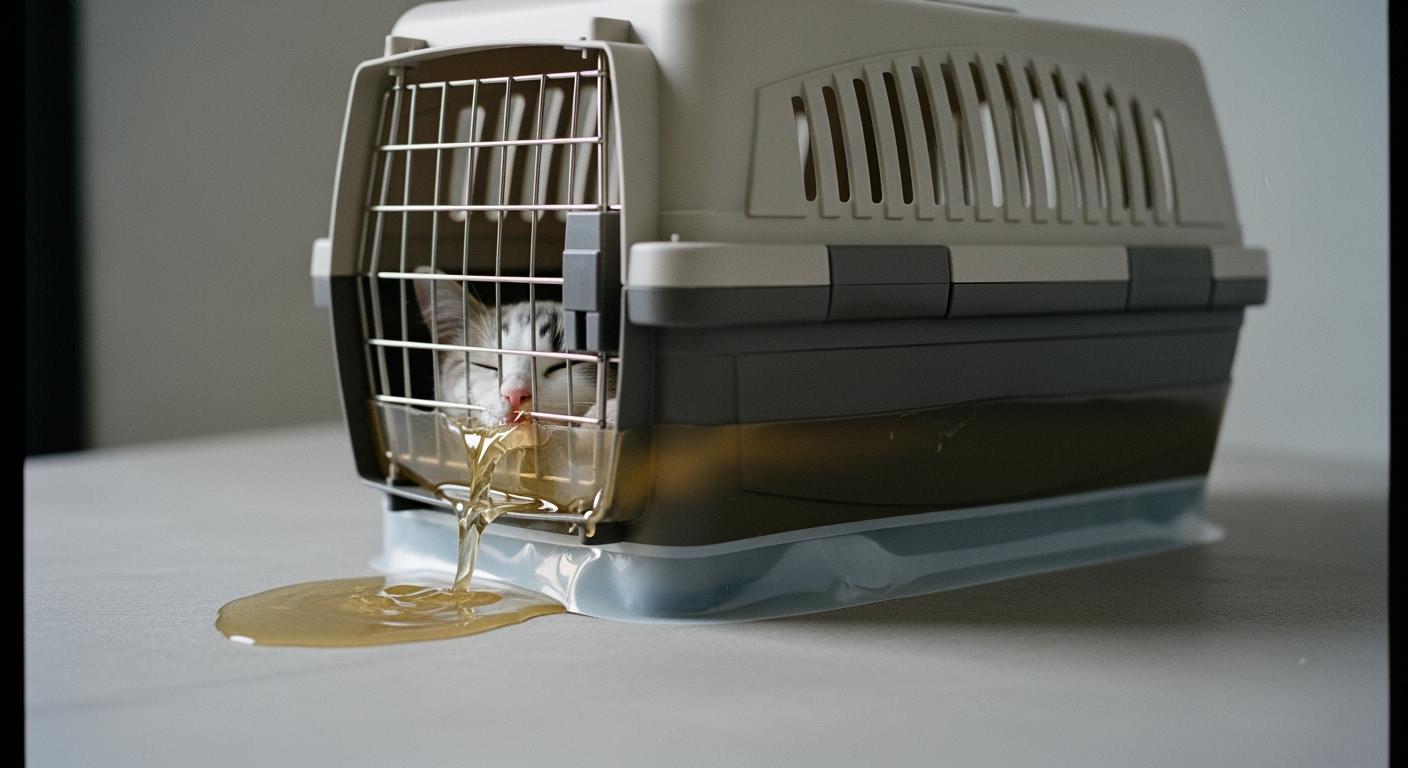
A pet carrier labeled leak-resistant gives you one expectation: mess stays inside. In practice, that promise depends less on a waterproof tag and more on how the bottom panel, liner, and sidewall seams interact when the carrier is not sitting flat. Lift it by the handle to load it into a car, carry it up a flight of stairs, or set it down at an angle on a passenger seat — and liquid inside travels. It does not pool obediently in the center. It moves toward whichever edge gravity sends it to, and that edge is often a stitched seam with nothing between the liquid and the outside world but a line of needle holes.
Why a Flat Leak-Resistant Base Fails When the Carrier Tilts
Liquid Follows Gravity, Not Marketing Labels
Put a small amount of water into any soft-sided carrier and tilt it 20 degrees. The liquid immediately migrates to the lowest edge. If the bottom panel has a waterproof coating only across its center surface — and the coating stops where the fabric meets the sidewall — that tilt puts the liquid right at the unsealed transition. This is the gap most “leak-resistant” designs leave open.
The physics is straightforward but easily overlooked in product photos that show the carrier sitting level on a studio floor. When you lift a carrier by its top handle, tension runs up the sidewalls. That tension pulls the base fabric upward. If the base is sewn to the sidewalls with a standard lockstitch, every needle penetration becomes a capillary path. A stitched seam under tension opens the stitch holes microscopically — and liquid under even slight pressure wicks through.
Tip: Before any trip, put half a cup of water in the empty carrier, zip it closed, lift it by the handle, and tilt it 15 to 20 degrees. Hold for 30 seconds. If you see moisture beading on the outside at any corner or seam, the bottom-to-sidewall seal has failed — and your pet’s accident will find the same exit.
The Flat-Base Problem in Motion
A flat waterproof panel works on a level countertop. It stops working the moment you pick the carrier up. The base flexes. Soft-sided carriers use fabric floors that sag under load. That sag creates a trough along the perimeter — precisely where the floor meets the walls. Liquid pools in that trough. If the trough aligns with an unsealed seam, the leak is immediate. If it aligns with stitching, the leak may be slower, but it is just as certain.
This is the central design tension in every soft carrier with the leak-resistant label: the same flexibility that makes the carrier collapsible and lightweight is what undermines the waterproof seal. A rigid base panel changes that equation, but only if the edge interface is sealed too. A removable rigid insert placed on top of an unsealed fabric floor helps with stability — it does nothing once liquid gets under or around it on a tilt.
| Failure Signal | Likely Bottom Design Issue | Better Design Direction |
|---|---|---|
| Wet spot at corner after tilting | Unsealed perimeter seam or stitch-path gap | Sealed edge or raised tray-style base |
| Pad slides or bunches during carry | Loose liner with no anchoring | Snug, shaped liner that matches base footprint |
| Odor persists after wiping | Absorbent surface layer without a barrier backing | Wipe-clean coated bottom with sealed seams |
Walk your finger along the interior seams 10 minutes after cleaning the carrier. If you feel dampness, the stitching is wicking residual liquid from the padding layer behind it — a sign that moisture already crossed the barrier. This check costs seconds and tells you whether a “leak-resistant” label matches the construction.
Where Soft Carrier Bottoms Leak First
Stitch Lines at Bottom-to-Sidewall Joins
The weakest point in most soft-sided carriers is the circumferential stitch line where the floor panel meets the four sidewalls. Each stitch is a hole. A single row of lockstitching through coated fabric creates hundreds of perforations around the entire base perimeter. Without a secondary seal — seam tape, liquid-applied coating, or a welded overlap — those perforations function as a chain of micro-drains.
This is a manufacturing tradeoff, not an accident. Seam taping adds a production step and material cost. Skipping it produces a carrier that looks sealed in flat product photography but leaks the first time a puppy urinates and the carrier gets lifted at an angle. You can verify whether a carrier has sealed seams by pinching the seam allowance between your fingers and checking for a flexible, continuous film bridging the stitch line on the interior side. No film, no seal.
The same problem shows up differently in carriers built with oxford-weave fabric and stitched-in floor panels — the weave itself can wick moisture along the thread path even if the outer coating is waterproof, because the stitch holes penetrate every layer.
Exposed Edges and Unsealed Perimeter Zones
Some soft carriers use a bolstered or padded edge for pet comfort. That padding wraps around the base perimeter and is often sewn in place with exposed seams on the outside. When liquid reaches the interior edge, it soaks into the padding wrap, travels along it, and exits through the exterior stitch line. You may not see a wet spot until minutes after the carrier has been set down — the padding acts as a slow-release wick.
Carrier bag designs that skip edge-sealing tend to show this problem first at the rear corners, where urine pools when the carrier is angled backward during carry. A raised tray-style base — one with walls that extend at least half an inch above the floor plane — shifts the liquid-to-edge contact point upward, away from the stitched join. That vertical offset is often the difference between a contained mess and a wet car seat.
Thin Liners and Shifting Pads
A removable liner pad that does not fill the entire base footprint leaves a gap at the edges. When liquid hits that gap, it bypasses the pad entirely and goes straight to the floor seam. The same thing happens when a liner is too thin or too loose — your pet shifts weight, the liner bunches, and a channel opens along one side.
A fitted liner that matches the base shape and stays in place under movement closes those edge channels. The best versions use a waterproof backing layer bonded to an absorbent top surface, positioned inside a raised edge that physically blocks lateral flow. That combination — barrier + absorbent surface + physical edge — covers three failure modes that a flat pad on a flat floor cannot address.
| Problem Area | Why It Leaks | What Helps Most |
|---|---|---|
| Bottom-to-sidewall stitch line | Needle holes create capillary paths | Seam-sealed or welded floor join |
| Exposed perimeter edges | No vertical barrier at edge transition | Raised tray base with coated walls |
| Thin or loose liner pad | Gaps let liquid reach seams directly | Fitted, waterproof-backed liner |
What Bottom Design Features Contain Mess Better
Raised Tray-Style Base Panels
A raised base panel creates what is effectively a shallow containment tray inside the carrier. The walls of that tray — typically half an inch to one inch high — intercept liquid before it can reach the sidewall seam. Even when you carry the carrier at a steep angle, liquid must climb the tray wall to escape. Gravity works against it twice: once to pool the liquid at the low edge, and again to keep it from climbing the vertical barrier.
Removable tray panels add a cleaning advantage that matters in practice. You pull the panel, rinse it separately, and leave the carrier body dry. This matters most after a veterinary visit or a long drive where stopping to deep-clean the whole carrier is not an option. Foldable carriers with rigid removable base inserts deliver this without adding the bulk of a hard plastic kennel — the panel provides structure when installed and packs flat when the carrier is stored.
Sealed or Coated Seam Construction
The seam is the leak path. Sealing it closes the path. That sounds obvious, but the execution varies. Heat-sealed seam tape applied to the interior of the stitch line is the most common approach in soft-sided carriers — it bonds a waterproof film over every needle hole along the perimeter. A less common but more durable alternative is a welded bottom join, where the floor and sidewall panels are fused without stitching at all.
The production reality: seam taping is not a one-pass process. The tape must bond to both the floor fabric and the sidewall fabric under heat and pressure, and it must flex without delaminating when the carrier is folded. A taped seam that lifts after a dozen folding cycles is functionally unsealed. You can check this by folding the carrier along the base crease a few times, then running the water-tilt test again — a seam that passes on day one and fails on day ten is a seal failure in slow motion.
| Failure Signal | Likely Bottom Design Issue | Better Design Direction |
|---|---|---|
| Wet seam after tilt test | Unsealed or partially delaminated seam tape | Sealed or welded bottom with bonded overlap |
| Liquid under carrier after carry | No waterproof backing beneath absorbent layer | Coated fabric floor with barrier membrane |
| Wet spot at edge despite dry center | Liner too small or unsecured | Snug-fitting liner with anti-slip base texture |
Wipe-Clean Surface Layers
Liquid containment is the first problem. Odor is the second. A carrier bottom that traps urine in absorbent fabric — even if it does not leak through — becomes a smell source that is difficult to eliminate. Wipe-clean surfaces made from coated polyester, TPU-laminated fabric, or silicone-treated nylon let you remove the liquid and the odor source in one pass with a damp cloth.
The material choice also affects how quickly the carrier dries after cleaning. An absorbent liner may stay damp for hours in a closed vehicle. A coated surface air-dries in minutes. For airport travel where TSA inspection may require opening the carrier, a dry, odor-free interior is not just pleasant — it reduces the chance of a secondary screening delay.
Snug-Fitting Liners That Stay Anchored
A liner that slides creates gaps. A liner that matches the base footprint and stays in position seals the edge. The difference shows up quickly: put your pet in the carrier, walk across a parking lot, and check whether the liner has shifted. If it has bunched toward the front, the rear half-inch of the base floor is now exposed — and any accident will hit that exposed zone directly.
What keeps a liner in place is not thickness. It is shape match and base friction. A liner cut to the exact interior dimensions of the carrier floor, combined with a slightly tacky or textured backing surface, resists sliding even when your pet readjusts position. Some designs add corner tabs or hook-and-loop anchor points. Those help, but the shape match matters more — if the liner leaves a half-inch margin around its perimeter, no anchor system closes that gap.
Rigid Base Construction Under Load
A flexible base floor sags under the weight of the pet. That sag creates a basin — and the basin drains toward the lowest seam. A rigid base panel made from a stiff plastic sheet, a composite board, or a reinforced fabric laminate resists flexing. The floor stays flat or near-flat, and liquid spreads evenly rather than channeling toward one edge seam.
Rigidity matters most with heavier pets. A 15-pound dog in a soft-sided carrier may not flex the floor enough to create a meaningful drainage channel. A 25-pound dog can — and the difference between a contained accident and a leak may be the stiffness of the base insert. Carriers with materials that hold their structure under load tend to separate the weight-bearing function from the liquid-barrier function — the rigid panel handles the first, the sealed liner handles the second, and neither depends on the other to work.
When a Leak-Resistant Design Is Not the Right Tool
No soft-sided carrier bottom is impermeable under every condition. The designs described here contain small to moderate amounts of liquid — a partial bladder release, wet paws, drool, a spilled water dish. They are not a substitute for a hard plastic kennel when you expect a fully incontinent pet or a multi-hour trip with no cleanup breaks. A raised tray base and sealed seams buy you containment time. They do not make the carrier a sealed vessel.
The carrier’s overall condition changes the math. A seam that was perfectly sealed at the factory can develop micro-tears after months of folding and unfolding. A liner that once fit tightly may lose its shape after repeated washing. Testing the carrier with the water-tilt method every few months catches degradation before a real accident does.
Disclaimer: This analysis covers soft-sided fabric carriers with removable or sewn-in base panels. Hard-sided plastic kennels and rotomolded crates handle liquid containment differently — their leak paths are at the door seal or the shell join, not at base seams. The tilt-test and seam-inspection methods described here apply to carriers carrying pets up to roughly 25 pounds; heavier loads can force liquid through coated seams that would otherwise hold, and the greater floor flex under heavier weight creates drain channels a lighter pet would not produce.
| Design Difference | Why It Matters | Main Limitation |
|---|---|---|
| Sealed edge seams | Closes the capillary path through stitch holes — the most common leak exit | Seal tape can delaminate with repeated folding; needs periodic recheck |
| Raised tray base | Creates a vertical barrier that liquid must climb to reach the sidewall join | Adds weight and reduces the carrier’s ability to fold completely flat |
| Snug fitted liner with waterproof backing | Covers the entire base footprint and blocks liquid at the edge before it reaches seams | Liner must stay precisely in position; shifting opens a gap instantly |
| Rigid base insert | Prevents floor sag that channels liquid toward one seam | Heavier pets can still flex thinner inserts; stiffness must match the expected load |
Pet carrier materials and fit decisions shape how each of these features performs during actual travel — a well-designed bottom system relies on the base, the liner, and the seam construction working together, not on any single layer doing all the work.
FAQ
Can a carrier with a leak-resistant bottom handle a full bladder release during a long trip?
It depends on volume and angle. The designs described here — sealed seams, raised tray base, waterproof-backed liner — manage small to moderate amounts of liquid if the carrier stays reasonably level. If your pet empties a full bladder and the carrier is tilted sharply during carry, liquid volume alone can overwhelm a raised tray edge, especially in smaller carriers where the tray walls are shallower. For multi-hour trips with a pet prone to full accidents, a hard-sided kennel with a sealed floor pan is the more reliable choice.
How do I know if a carrier’s seams are actually sealed — not just coated on the surface?
Unzip the carrier fully, turn the bottom panel inside-out if possible, and look at the interior side of the floor-to-sidewall join. A sealed seam has a continuous strip of flexible film bridging the stitch line. A surface-coated-only seam shows the same coating on both sides of the fabric but has visible needle holes with no covering tape. If you cannot see the interior, run the water-tilt test — a carrier with only surface coating will weep at the seams within 30 seconds.






