
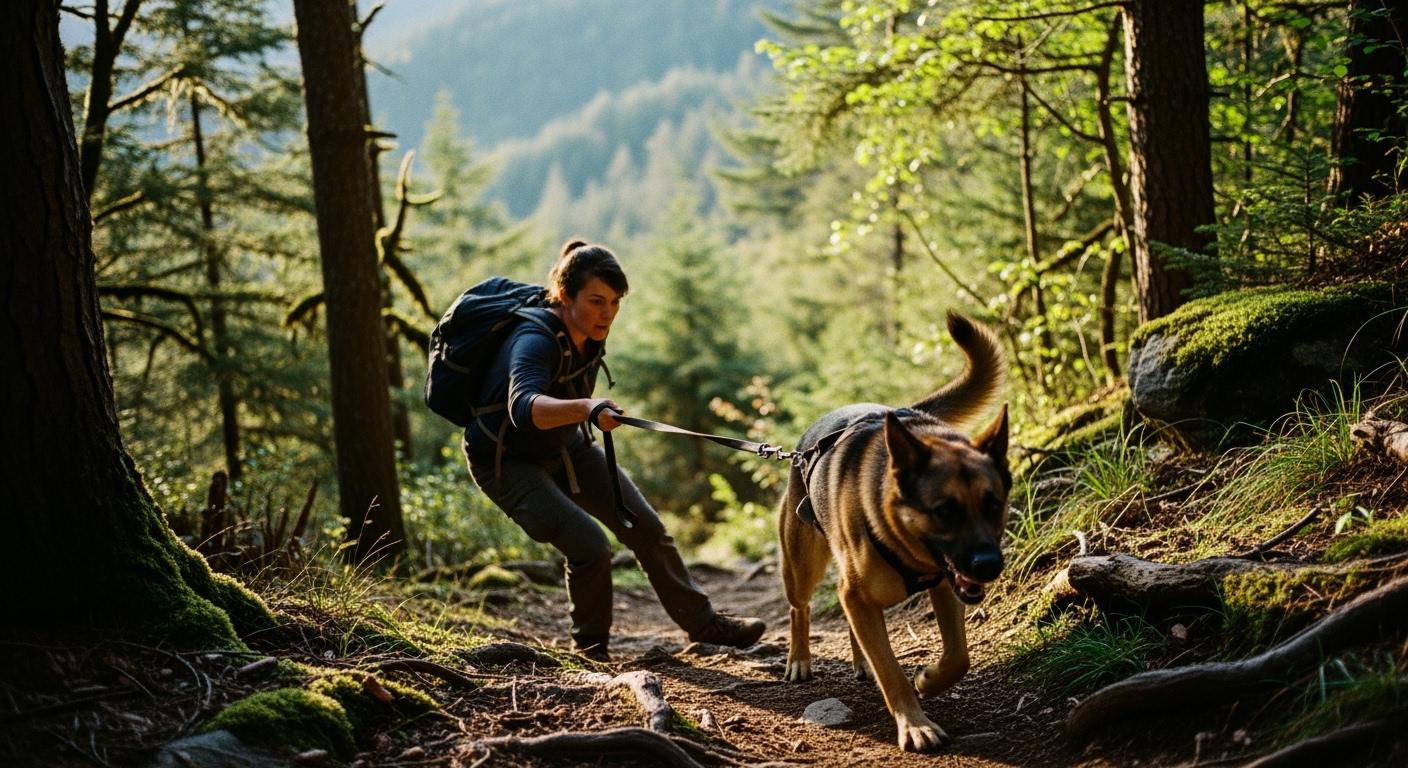
Gravity does not negotiate. On a downhill trail, your dog’s body weight and the slope work together — every stride carries more momentum than it would on flat ground. A strong dog that pulls moderately on a sidewalk can become a genuine control problem the moment the trail tips downward.
The leash is the only link between you and that force. And most leashes were not designed with a 15-degree descent and loose scree in mind.
Why a Downhill Trail Changes Everything About Leash Control
On level ground, a dog’s pull is mostly horizontal. The handler braces against it with body weight and footing. On a downhill slope, the force vector tilts — gravity adds a downward component to the dog’s forward drive. The same dog that pulls at 40 pounds of force on a sidewalk can generate substantially more on a descent because the slope reduces the friction under their paws while adding gravitational assist.
This creates a chain reaction. The dog accelerates faster. The leash reaches full extension sooner. The handler has less time to react. And if the surface is loose — gravel, pine needles, wet rock — the dog may lunge to regain footing after a slip, which adds an unpredictable surge to an already difficult situation.
That is the mechanical reality. The leash is absorbing force that arrives faster, from a less stable direction, with less warning. If the leash design cannot handle that combination, the handler is reacting late on every pull — and on a trail with blind switchbacks or sudden drop-offs, reacting late is not an option.
Wildlife scent trails cut across hiking paths unpredictably. A strong dog that catches a deer trail mid-descent can bolt from a steady walk to a full lunge in under a second. If the leash stretches too far or too long before transmitting that change in tension to your hand, the correction window closes before you feel anything.
| Trail failure signal | Likely leash design cause | Better design direction |
|---|---|---|
| Dog reaches the end of the leash before you react | Leash is too long or too elastic | Shorter usable range with a quick-grab handle |
| Handler gets pulled forward downhill | Hands-free setup reduces instant control | Moderate bungee plus reachable traffic handle |
| Leash feels late when dog surges | Over-stretchy bungee section | Controlled stretch instead of maximum stretch |
A leash that handles these conditions well does two things that sound contradictory: it absorbs enough shock to keep sudden lunges from jerking your arm or pulling you off balance, and it transmits enough tension to let you feel what the dog is about to do before it happens. That balance between absorption and feedback is where the design gets interesting — and where a leash built for pulling dogs either earns its place on technical trails or fails in ways that are easy to test.
Tip: Before a steep descent, plant your outside foot and shorten your grip. A strong dog can pull you forward faster than you can regain footing on loose ground.
Moderate Stretch Versus Maximum Stretch — Which One Keeps You Connected on Uneven Ground
Bungee leashes reduce the peak force that reaches your arm or shoulder. That part is straightforward. The spring section compresses the force curve — instead of a sharp spike when the dog hits the end of the leash, you get a rounded pulse spread over a fraction of a second longer.
The trade-off is reaction delay. Every inch of stretch is time. When a bungee section extends from 4 feet to 5 feet under load, that extra foot of travel happens before the dog feels a firm stop and before your hand receives clear tension feedback. On a flat sidewalk, that delay is negligible. On a downhill trail with loose footing and a blind corner ahead, a half-second delay in feeling the dog’s lunge is enough for the dog to round the bend before you can shorten the leash.
The causal chain: bungee cord stretches → force transmission to the handler’s hand is delayed → the handler’s corrective input (a leash shortening or directional cue) reaches the dog later → the dog travels farther into a potential hazard before the correction takes effect.
Over-stretchy bungee sections — those that extend more than roughly 25–30% of their resting length under moderate load — turn the leash into a timing liability on descents. But a leash with zero stretch transmits every lunge as a sharp jolt, which fatigues the handler’s grip and shoulder over a long hike.
The design sweet spot is moderate stretch: enough give to take the edge off sudden surges, but not so much that the leash goes slack-to-taut in slow motion. Rubber-core webbing or a short, controlled bungee section in a reflective bungee dog leash can achieve this — the stretch is there when you need shock absorption, but the leash firms up quickly enough that you still feel the dog’s intention through the line.
In practice: Test the stretch at home. Clip the leash to a fixed point, step back until it is taut, then pull steadily. If the leash extends more than a foot before you feel firm resistance, it will delay your reaction on a descent. If it barely gives at all, every lunge will travel straight to your shoulder.
Handle Position, Clip Angle, and the Hardware Details That Decide Control
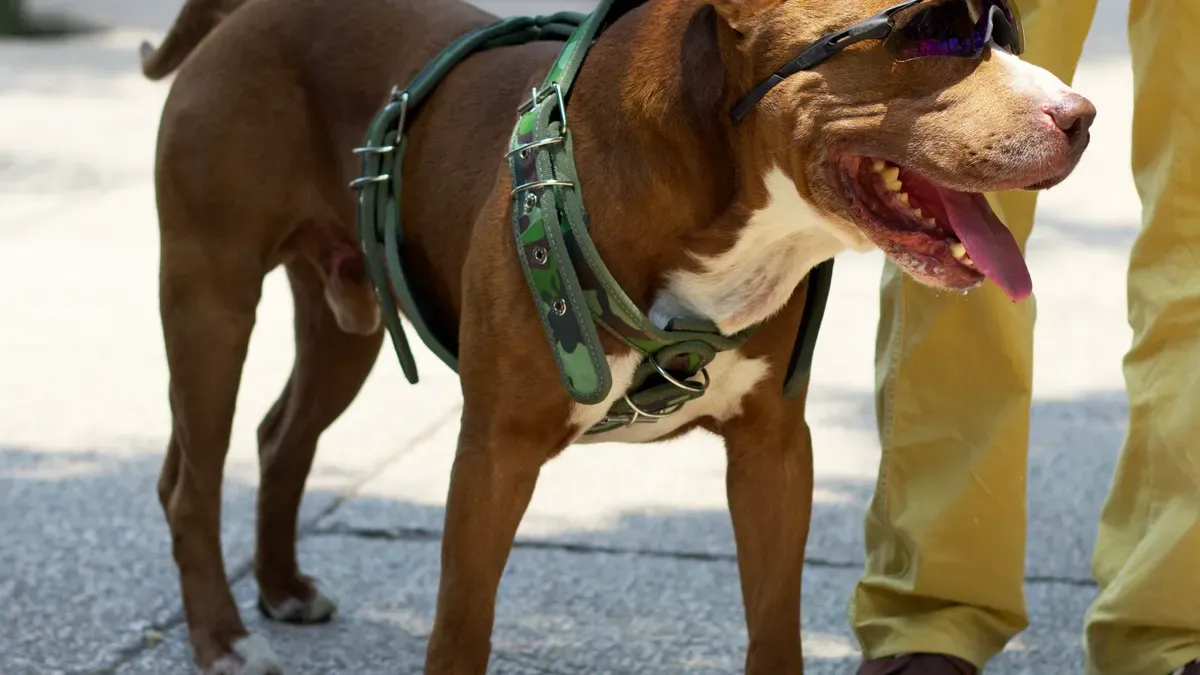
A handle placed at the end of a 6-foot leash is 6 feet from the dog. On a narrow trail with a blind turn ahead, those 6 feet represent a gap you cannot close fast enough if the dog lunges. By the time you pull in slack or wrap the leash around your hand, the dog has already committed to the corner.
A traffic handle positioned 12 to 18 inches from the clip changes the math. One hand moves down, grabs the handle, and the effective leash length drops from 6 feet to roughly a foot and a half. The dog is now at your side. The motion takes about a second. On a trail where unexpected hazards — another dog, a biker, a washed-out section of path — appear around bends with no warning, that one-second transition from cruising length to close control is the difference between a managed pass and a collision.
Walk 10 minutes on varied terrain and check whether you can reach the traffic handle without looking down or breaking stride. If you have to search for it or slow your pace to grab it, the placement is wrong for technical hiking. A leash designed for pulling dogs on varied terrain puts that handle where your hand naturally falls when you shorten your arm — not at a decorative midpoint chosen for symmetry.
Clip hardware is the other half of the equation. On a descent, the leash pulls at an angle — not straight back from the dog’s harness, but upward and laterally as the handler stands above on the slope. A non-swiveling clip twists the webbing under this off-angle load. The webbing bunches, the clip rotates sideways against the harness D-ring, and the connection point becomes a stress concentrator. A swiveling clip rotates freely, keeping the webbing flat and the load path straight regardless of the angle between dog and handler.
After 20 minutes of hiking, check the clip end of the leash. If the webbing is twisted, bunched, or showing wear on one edge more than the other, the hardware is fighting the angle instead of accommodating it. That failure mode accelerates webbing wear at exactly the point that takes the most load.
| Design difference | Why it matters | Main limitation |
|---|---|---|
| Traffic handle 12–18 in. from clip vs. handle at leash end only | Reduces effective leash length to ~1.5 ft in under a second on technical sections | Extra hardware adds weight; handle must be reachable without looking |
| Swiveling clip vs. fixed clip | Prevents webbing twist under off-angle load on descents and switchbacks | Swivel mechanism is a wear point — check for grit after muddy hikes |
| Wide reflective webbing vs. thin dark webbing | Visible to other trail users at dusk; lets handler track dog position in low light | Reflective coating can degrade with repeated machine washing |
Note: Inspect the clip and the first 6 inches of webbing before every hike. Bent clips, loose swivel joints, or webbing that stays twisted after you straighten it are signals that the hardware is degrading under the off-angle loads that define trail use.
When a Hiking-Focused Leash Is Not the Right Match
A leash with moderate bungee, a traffic handle, and swiveling hardware solves a specific problem: maintaining control of a strong dog on descents, loose surfaces, and technical terrain with limited visibility. That same leash adds bulk and weight that serve no purpose on a flat sidewalk loop through the neighborhood.
The traffic handle is useful only when you need to shorten the leash rapidly. On wide, open trails with clear sightlines in all directions, a standard single-handle leash works fine — the dog can move freely without creating a hazard. The moderate bungee section is valuable when sudden lunges are likely — wildlife, other dogs, unexpected noises. On a well-groomed rail-trail with predictable conditions, the stretch adds no meaningful benefit and slightly reduces the directness of leash communication.
For small dogs under 20 pounds, the force amplification from downhill slopes is proportionally less significant. The handler can typically manage a small dog’s pull with one hand even on a descent. A simpler, lighter leash without the extra hardware may be the better tool for that scenario. Similarly, a calm dog that walks at heel regardless of terrain does not need the same level of shock absorption — the design features that make a leash trail-capable are also features that add weight, cost, and maintenance points.
Choosing the right walking control setup means matching the leash’s capabilities to the conditions it will actually face. The best leash for a strong dog on steep trails is the wrong leash for a relaxed dog on a paved path — and recognizing that is how you avoid over-gearing for the walk you are actually taking. Getting the leash right is only half the picture — the harness it connects to also needs to handle off-angle pulls without shifting, which changes the fit checks you run before a hike compared to daily walks.
Disclaimer: The fit and rub checks described here assume a smooth-coated dog. Double-coated breeds may show subtler wear marks from leash hardware contact that require hand-checking rather than visual inspection — feel along the chest and shoulder area after a long hike rather than relying on visible marks alone. If the dog’s chest shape falls outside the breed norms this leash and harness setup was patterned for — particularly dogs with a barrel chest or very deep keel — the hardware contact points described here may not catch every pressure concentration.
FAQ
What leash length works best for hiking downhill with a strong dog?
A 6-foot leash keeps the dog close enough to react quickly while still allowing natural movement on open trail sections. On descents with poor visibility — switchbacks, heavy tree cover, narrow ledges — shortening to roughly 3 feet via a traffic handle gives you enough reach to let the dog navigate while staying within one stride of control.
Does a bungee leash help or hurt on steep descents?
It depends on how much it stretches. A moderate bungee — roughly 25–30% extension under load — absorbs the shock of a sudden lunge without creating a meaningful delay in tension feedback. A bungee that stretches 50% or more of its resting length creates a lag between the dog’s movement and your awareness of it. That lag becomes dangerous when the dog is pulling downhill toward a blind corner or drop-off.
Why does the traffic handle need to be close to the clip?
Distance from the clip determines how short you can make the leash with one grab. A handle 12–18 inches from the clip reduces the usable length to under 2 feet — the dog stays at your side. A handle at the midpoint of a 6-foot leash still leaves 3 feet of reach, which is enough for the dog to round a corner before you can redirect. The closer the handle is to the clip, the faster and tighter your control in emergencies.
How do you know if your leash hardware is failing?
Check the clip for smooth rotation — a swivel that sticks or grinds has grit inside the mechanism. Look at the webbing where it meets the clip: uneven wear on one edge means the clip is not rotating freely under load and the webbing is absorbing twist stress instead. Test the stitching at the clip and handle attachment points by pulling firmly — any thread separation, even a single loose stitch, is a failure warning for a bungee leash subjected to repeated off-angle loads.






