
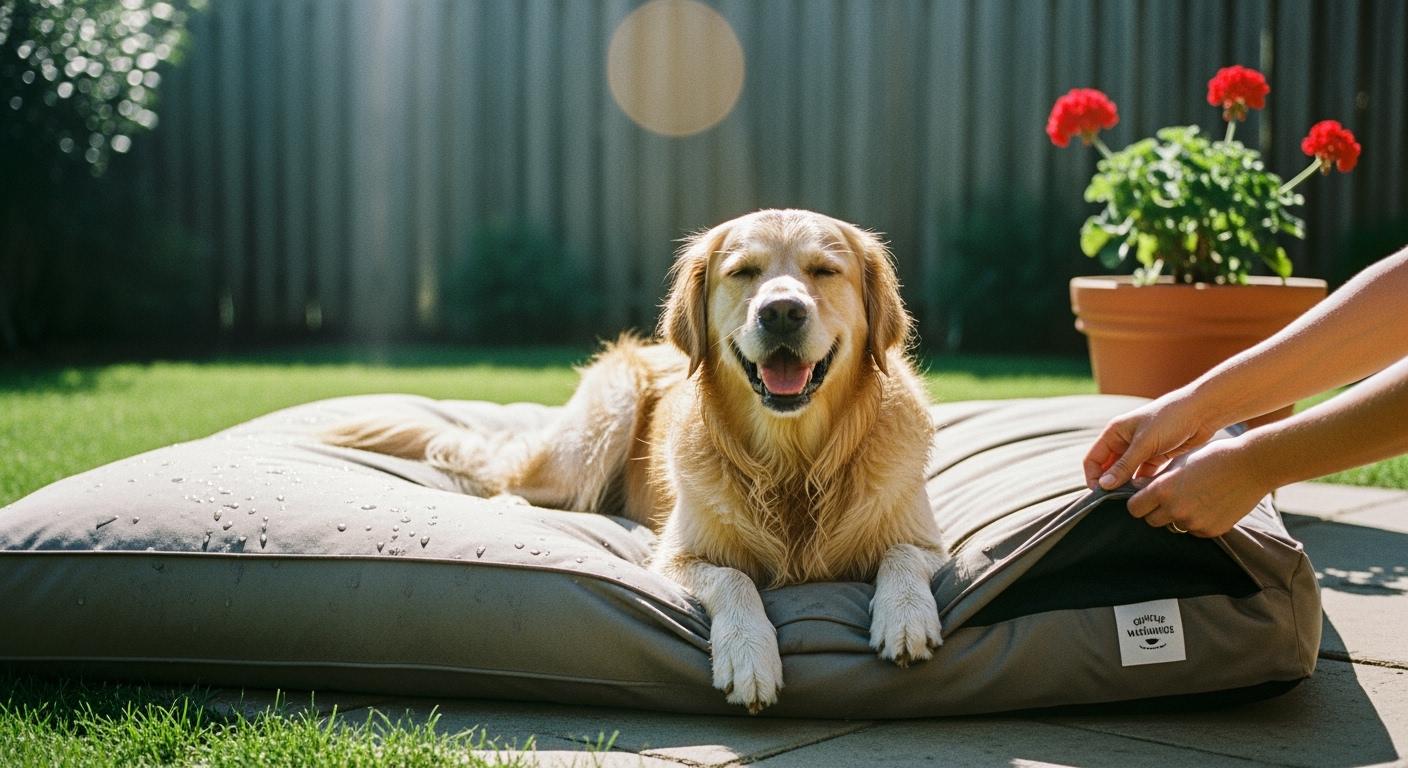
A dog bed smells again three days after you wash it. The cover felt dry to the touch. You checked. And yet the odor crept back — musty, sour, unmistakable. The problem is not how often you clean. The problem sits deeper: inside the foam, along the seams, under the bed where air never reaches.
Moisture drives every odor cycle in an outdoor dog bed. Rain, dew, wet paws, body oils — water enters the bed through a dozen routes. What happens next depends entirely on whether the bed was designed to let that water leave. Most are not. They were designed to look plush on a product page, not to shed moisture in a backyard. This article walks through which design features break the moisture cycle and why — not which brand to pick, but which design logic actually works.
Why Odor Returns Even After a Thorough Wash
Outdoor Exposure Adds Moisture Faster Than Indoor Use
An outdoor bed collects moisture from directions an indoor bed never faces. Grass transfers dew. Rain saturates the surface before you can bring the bed inside. A dog’s own body heat, pressing into damp fabric, creates a warm, wet microclimate inside the cushion. Saliva, mud, and surface water from a splash-prone water bowl add organic material — fuel for the bacteria that produce odor.
Elevated frames reduce ground contact, but they do not eliminate the moisture load. The bed still catches rain. The dog still tracks dirt onto it. What changes is whether the bed can release that moisture before bacteria colonize it. Outdoor bed designs differ sharply in how quickly they shed water from the core outward — a difference that matters more than cover material alone.
The Drying Gradient: Why the Cover Feels Dry While the Core Stays Wet
Here is the physical chain that causes odor to return. Water enters the bed through the cover fabric. The cover, being thin fabric with direct sun and wind exposure, evaporates its moisture within hours. The foam core behaves differently.
Closed-cell or high-density foam resists water penetration on the way in but traps it on the way out. The water that does enter — through seams, zipper paths, or prolonged soaking — becomes trapped inside a low-air-exchange cavity. Evaporation from the core requires two things: heat energy to convert liquid water to vapor, and a vapor pressure gradient to drive that vapor outward. A dense foam core provides neither efficiently. The surface vaporizes. The interior stagnates. Bacteria that survive the wash cycle — and some always do — find a warm, wet, oxygen-poor environment inside the foam. They multiply. Odor returns.
This is not a cleaning failure. It is a physics failure designed into the bed.
Tip: After the cover feels dry, press your palm firmly into the center of the cushion for ten seconds. If your hand comes away cool or damp, the core is still wet — and odor will return within days.
| Odor pattern | Design cause | Design fix |
|---|---|---|
| Musty smell within days of washing | Closed-cell foam trapping core moisture | Open-cell quick-dry fill, removable inner pad |
| Sour odor along edges | Stitched seams and zipper paths holding water | Reinforced seams, drainable base panel |
| Persistent damp underside | Flat base blocking air circulation | Elevated frame, mesh bottom panel |
Design Features That Break the Moisture-Odor Cycle
Removable, Machine-Washable Covers
A sewn-shut cover forces you to wash the entire bed — foam, frame, and all. That means the bed stays outside longer between washes because cleaning it is a project. A removable cover changes the maintenance rhythm. You strip it, throw it in the machine, and the bed is back in service within hours.
The design advantage is not just convenience. It is drying parallelism. When the cover comes off, the inner pad gets direct air exposure on all sides. The cover dries in the machine or on a line. The core dries separately in open air. Nothing stays sandwiched. Fabrics that release odor-causing residue during a standard machine cycle reduce the cleaning frequency needed to keep the bed usable outdoors — a material choice that matters as much as the removable design itself.
An observable check: after washing and drying the cover separately from the core, smell the inner pad directly — press your nose to it. Any mustiness means the core itself needs replacement or deeper drying. A bed that passes this check every time has a design that works with the cleaning routine, not against it.
Moisture-Isolated Inner Pads
Some beds add a waterproof barrier between the cover and the foam core. This is not about keeping rain out — a waterproof cover already does that. The barrier keeps liquid that penetrates the cover from reaching deep into the foam. Urine, spilled water, and heavy rain soak the cover, hit the barrier, and stop. You wipe the surface. The core stays dry.
Without this barrier, every spill becomes a core-soaking event. The foam acts as a sponge, and once saturated, it may take days to dry fully — if it ever does. Moisture-isolated pads use non-absorbent barrier layers that prevent liquid migration into the fill material. The trade-off: waterproof barriers reduce airflow through the pad, so they work best paired with breathable cover fabrics and an elevated frame that provides bottom-side ventilation.
Quick-Dry Fill Materials
Fill density determines drying speed more than any other single variable. Traditional high-density polyurethane foam — the kind used in indoor furniture — has a closed-cell structure that traps water in isolated pockets. Each pocket must dry individually, and the ones deep in the core may never receive enough airflow to complete the process.
Open-cell reticulated foam, by contrast, has a continuous air path through the material. Water drains through it rather than pooling inside it. Some outdoor beds use synthetic fiber fills with hydrophobic coatings that repel water at the fiber level — moisture beads and runs off rather than absorbing. A bed that stays dry on wet ground depends less on the top fabric and more on whether the core material can shed water from below. The fill inside matters more than the cover outside.
Disclaimer: Quick-dry fills work best when the bed has airflow on at least two sides. A quick-dry core inside a fully enclosed, non-breathable cover will still hold moisture — the fill cannot dry what the cover will not let escape. Double-coated breeds that carry more moisture into the bed after rain may overwhelm even well-designed fills; in those cases, a fully elevated mesh cot with no cushion layer tends to outperform any padded design.
Structural Airflow: The Difference Between Damp and Dry
Elevated Frames and Drainable Bottoms
A bed that sits flat on the ground has one side blocked from airflow at all times. The underside presses against soil, concrete, or deck boards — surfaces that hold moisture after rain and release it slowly. Condensation forms where the warm bed meets the cool ground. The bottom stays wet. Odor develops from below, even when the top stays clean.
An elevated frame breaks this contact. Air moves under the bed, carrying away water vapor from the bottom panel. If that bottom panel is also mesh or perforated, moisture drains straight through rather than pooling. A drainable bottom — one with visible perforations or an open-weave mesh — lets liquid from accidents or heavy rain pass through immediately. No standing water. No soaked-in odor.
The combination of elevation and drainage creates a drying cycle that works from all sides. Steel-frame elevated beds with tensioned mesh surfaces dry faster than any cushioned design because every surface is exposed to moving air. The trade-off: less cushioning under the dog’s joints. For dogs that need more support, the right compromise is a quick-dry padded insert on top of a mesh base — not a thick foam pad that blocks the airflow the frame was designed to create.
Breathable Mesh Surfaces and Reinforced Seams
Mesh surfaces solve a problem that solid fabric cannot: they let water exit through the same surface the dog lies on. When a wet dog settles onto mesh, body heat drives moisture downward. With solid fabric, that moisture spreads laterally along the surface and soaks into seams. With mesh, it passes through.
Seams become the weak point in any bed design. A straight-stitched seam on absorbent fabric wicks water into the thread holes and holds it there. The fabric on either side dries. The seam line does not. Over weeks, the seam develops its own odor signature — sour, distinct from the musty smell of a wet core. Reinforced seams with bonded or taped construction eliminate the needle holes that trap water. Some designs add a drainable bottom panel with edge binding that directs water outward rather than letting it pool along the seam line.
An observable test: after the bed has dried from washing or rain, run a dry paper towel along every seam and zipper path. If the towel picks up moisture, those seams are holding water — and odor is not far behind. Washing a stuffed bed without damaging the inner fill depends on protecting seams from the agitation that loosens thread tension and creates new water traps — a maintenance detail that extends the life of reinforced seam construction.
| Design difference | Why it matters | Main limitation |
|---|---|---|
| Elevated vs. flat base | Bottom-side airflow prevents condensation and ground moisture wicking | Less joint cushioning; may feel unstable for dogs unaccustomed to raised surfaces |
| Mesh vs. solid fabric surface | Water passes through instead of pooling; dries from both sides simultaneously | Less insulation in cold weather; foam padding underneath may still trap moisture |
| Reinforced bonded vs. stitched seams | Eliminates needle holes that wick and hold water along edges | Higher production cost; fewer budget options use this construction |
| Removable core vs. sewn-shut pad | Each component dries independently; core can be replaced without replacing the bed | Zipper failure over time; requires user discipline to reassemble correctly |
When These Designs Work Best — and Where They Fall Short
The designs described above perform best under specific conditions. They are weakest under others. Recognizing the boundary matters.
Where they work: warm or temperate climates with regular sun and breeze; homes where the bed can be hosed down and left to dry in open air; dogs with short to medium coats that do not carry excessive moisture onto the bed; setups where the bed is placed on a hard surface (deck, patio, concrete) rather than soil or grass that releases ground moisture.
Where they struggle: consistently humid climates where ambient air is already saturated — evaporation slows regardless of bed design; fully shaded yards with no direct sun exposure; double-coated breeds in wet weather that transfer large volumes of water onto the bed surface with every use; unheated outdoor areas in cold seasons where water freezes inside the fill rather than evaporating.
A washable waterproof bed designed for indoor orthopedic support uses different materials and a different drying strategy than an outdoor bed built for drainage speed. Using one where the other is needed leads to the odor cycles this article describes — no matter how often the cover goes through the wash.
Disclaimer: The drying and odor checks described here assume a smooth-coated or short-coated dog on a bed with full air exposure. Double-coated breeds like Huskies, Malamutes, and German Shepherds carry significantly more water into the bed and may leave behind oils that bind odor to fabric even when the bed dries completely. For these breeds, a fully mesh elevated cot with no cushion layer and a weekly enzyme-based surface rinse tends to outperform any padded washable design — the padding becomes a scent trap regardless of fill material.
FAQ
How often does a well-designed outdoor bed actually need washing?
With quick-dry fill, a removable cover, and an elevated frame, washing the cover every two to three weeks is usually sufficient. Beds with non-removable cores or flat bases need washing more often — and take longer to dry afterward. The real metric is not a calendar schedule. Check the cover with the palm-press test described above. If the core feels dry and there is no detectable odor, the bed does not need washing yet.
Does a waterproof cover solve the odor problem?
Only partially. A waterproof cover keeps external moisture from reaching the core. But it also traps internal moisture — body heat and humidity from the dog itself — inside the bed. If the waterproof cover has no breathable panel or ventilation path, condensation forms on the inside of the cover and soaks into the fill from within. A waterproof top paired with breathable mesh sides and bottom balances protection with ventilation better than full waterproof wrapping.
Can a regular indoor dog bed work outside if you wash it more?
No. Indoor beds use fill materials and cover fabrics optimized for climate-controlled environments. They dry slowly, hold moisture in their cores, and lack the structural airflow that outdoor beds rely on. Washing an indoor bed more frequently does not compensate for the design mismatch — the core will degrade faster and odor will return sooner. The bed type must match the environment, not the wash schedule.
What is the single most important design feature for odor control?
Airflow. Every other feature — removable covers, quick-dry fill, antimicrobial treatments — depends on air reaching the wet surfaces and carrying moisture away. If a bed design blocks airflow on one or more sides, moisture will accumulate regardless of the materials used. An elevated frame with a mesh surface is the simplest, most reliable odor-control design for outdoor use. Add features from there as needed for comfort, but never sacrifice airflow for padding.






