When you carry a dog in a sling or crossbody carrier, the strap presses into your shoulder. You might not notice it at first. Fifteen minutes in, the pressure has built into an ache. Thirty minutes in, you are shifting the strap every few hundred yards.
The difference between a carrier that stays comfortable and one that does not comes down to three design factors: how wide the strap is, whether the padding holds its shape under sustained load, and how well the carrier keeps the dog’s weight from swinging. These are not marketing details. They are mechanical realities that determine how force reaches your shoulder through a narrow strip of material.

Why Shoulder Pressure Builds Slowly During Long Walks
How Shoulder Fatigue Develops Over Time
You may not notice shoulder pressure right away. At the start, your shoulder muscles can handle the load. As time passes, pressure from a narrow strap becomes more noticeable. The weight of your dog stays focused on a small area of your shoulder. Your muscles work harder to support the load. Over time, this leads to fatigue. A dull ache or a burning sensation signals that your shoulder is under sustained stress.
The shoulder feels fine at first because muscles compensate temporarily. But sustained pressure from a narrow strap keeps force concentrated on a small patch of skin and soft tissue. Blood flow to the compressed area drops. The ache you feel at minute 20 was not caused at minute 20. It was accumulating since minute one.
The mechanics compound. Force from the dog’s weight travels through the carrier body, into the strap, and onto your shoulder. When the strap is narrow, that force lands on a strip perhaps an inch wide. The pressure—force divided by contact area—starts high. As the strap presses down, it also compresses the padding beneath it. If the padding collapses quickly, the effective contact area shrinks further, and pressure climbs higher still. This is a compounding problem: narrow strap concentrates force, force compresses padding, compressed padding reduces contact area, pressure increases, and discomfort accelerates.
In practice: Next time you walk with a loaded carrier, check after 10 minutes whether the strap has shifted from its original position and whether the padding feels noticeably thinner under your thumb. A strap that has migrated toward the neck or slid off the shoulder cap signals that the initial contact patch was too narrow to stay put.
| Shoulder Pressure Symptom | Likely Design Cause | Better Design Direction |
|---|---|---|
| Aching or soreness | Narrow, unpadded straps | Wider, padded straps |
| Digging or pinching | Compressed padding | Supportive, shape-holding padding |
| Uneven pressure | Unstable carrier position | Balanced, stable carrier design |
Why Discomfort Is Often Delayed
You might feel fine at the start. Discomfort usually builds up slowly. As time passes, the padding may flatten out, and the strap may shift. You realize the discomfort only after several minutes or miles. This delayed pain shows that strap design matters for long walks. A supportive carrier helps you avoid these problems before they start.
Your dog’s movement inside the carrier amplifies this delay. Each shift changes how the weight sits on your shoulder. If the carrier hangs low or swings, the pressure can spike. Narrow straps do not spread out these shifting forces. Padding helps, but if it compresses quickly, it loses its support just when the shifting load needs it most.
How Strap Width and Padding Materials Change the Force on Your Shoulder
Narrow Straps Concentrate Force on a Small Area
When you use a dog crossbody carrier with a narrow strap, the weight presses into one spot on your shoulder. The strap does not spread the load. It focuses all the force on a small area. This makes your shoulder feel sore faster, especially during long walks. The discomfort increases as you keep walking. Your muscles must work harder to support the weight in one place. If your dog moves or shifts, the pressure can feel even worse because the narrow contact patch has no room to absorb off-axis force.
Strap width plays a central role in how you experience dog shoulder carrier strap pressure. A strap that covers more shoulder width distributes the same dog weight across a larger surface area. The physics is straightforward. But the material behavior underneath is where most designs diverge. Some wide straps use a single layer of foam that feels plush when you squeeze it in your hand. Under sustained load, that same foam compresses to a fraction of its resting thickness. A wide strap with collapsed padding behaves, in practice, more like a narrow strap. Width and compression resistance work together—one without the other leaves part of the problem unsolved. This is why material performance under sustained load matters more than initial softness when evaluating carrier support.
Padding That Compresses Loses Its Function
Padding helps make a strap feel softer on your shoulder. If your carrier has little or no padding, the strap can dig into your skin. Thin padding can flatten out quickly. When this happens, the strap loses its cushion and starts to press harder into your shoulder.
The material property that matters is not initial softness. It is compression set—how much thickness the material loses after being loaded for an extended period. Closed-cell foams tend to resist compression better than open-cell foams at equivalent densities, though they trade some breathability. Synthetic nonwoven materials like Ultrasuede offer a different path: they distribute load through fiber entanglement rather than cell-wall compression, which means they tend to maintain effective thickness under load while staying lighter than comparable foam layers. The way carrier construction interacts with strap padding determines whether the materials work with or against the strap’s width.
| Material | Properties | Weight | Durability |
|---|---|---|---|
| CCF foam | Soft and warm, provides comfort under weight | Light | Moderate |
| Ultrasuede | Easy care, stain-resistant, mid-to-light weight | Lighter than vinyl | High |
| Synthetic insulation | Provides warmth and support, can be laid thick | Varies | High |
In practice: After a 15-minute walk, take the carrier off and press your thumb into the strap padding where it sat on your shoulder. If it rebounds immediately and feels nearly as thick as when you started, the material is holding up. If it stays dented or feels thin and hard, the padding has compressed and is no longer doing its job.
Carrier Stability and What Happens When the Dog Shifts During Movement

Why a Swinging Carrier Amplifies Shoulder Pressure
A dog in a carrier is not a static weight. The dog adjusts, looks around, shifts to the other hip. Each movement changes where the load vector points relative to your shoulder. If the carrier body hangs loose or swings freely, those shifts translate into lateral forces that a vertical strap was never designed to handle.
This is where design details compound. A narrow strap under vertical load concentrates pressure in one line. Add a lateral component—the dog leans left—and the strap edge digs in, creating a pressure peak at the rim. A wider strap resists this edge-loading better because the contact patch has more width to absorb the off-axis component before the edge bites. Crossbody designs that keep the dog high and close to the torso reduce the lever arm between the dog’s center of mass and the shoulder contact point. A shorter lever arm means less torque when the dog moves. Less torque means fewer lateral force spikes.
Stable Positioning Keeps Weight Centered
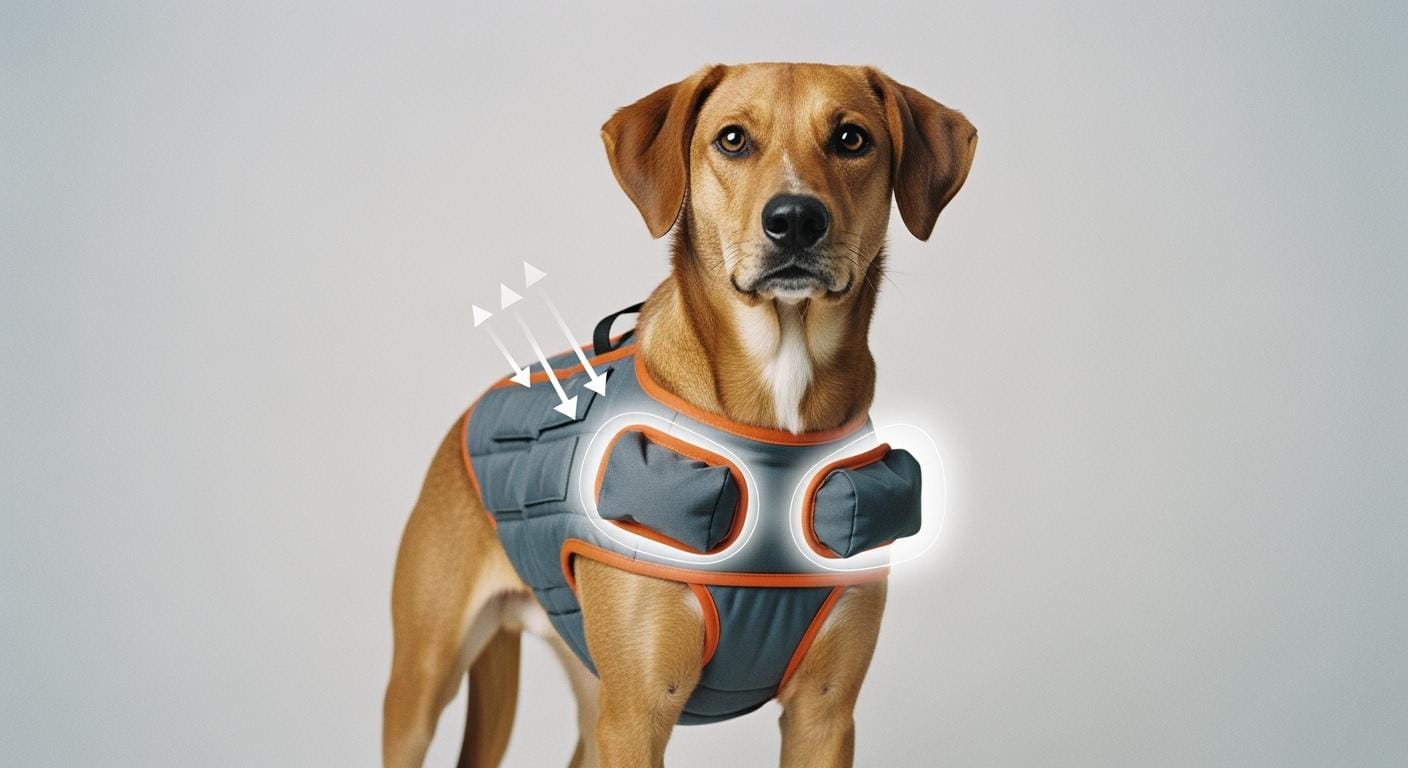
A well-balanced dog carrier sling spreads weight across your body rather than concentrating it on one point. Some carriers use a waist belt or a cross-body strap to move part of the load to your hips and back, which are stronger than your shoulder alone. These design features reduce the tension that builds up in a single muscle group.
When it comes to urban carrying setups for daily walks and errands, stable dog positioning matters as much as strap design. If your dog stays close to your body and does not swing around, you will not have to adjust the carrier as much. Stable carriers keep the load from shifting, which means you feel steady and the pressure stays even. If the carrier does not fit well or the straps lack adjustability, you may notice more soreness and fatigue.
In practice: Walk 10 minutes with the carrier loaded, then stop and check whether the back edge of the shoulder strap has drifted more than an inch from the spine-side of your shoulder. If it has, the carrier is generating enough lateral force to overcome the strap’s ability to stay put—a sign that the stability design is not sufficient for your dog’s movement pattern.
| Design Difference | Why It Matters | Main Limitation |
|---|---|---|
| Wider shoulder strap | Spreads force across more surface area | Width alone cannot compensate for padding that compresses quickly |
| Adjustable strap length | Lets you position the carrier high and close to reduce lever-arm torque | Requires readjustment when switching between users of different heights |
| Waist belt or cross-body routing | Redirects some load from shoulder to hips and back | Adds a step to putting on and taking off the carrier |
| Shape-holding padding | Maintains effective contact area under sustained load | Typically costs more to manufacture than basic open-cell foam |
When a Supportive Design Reaches Its Limit
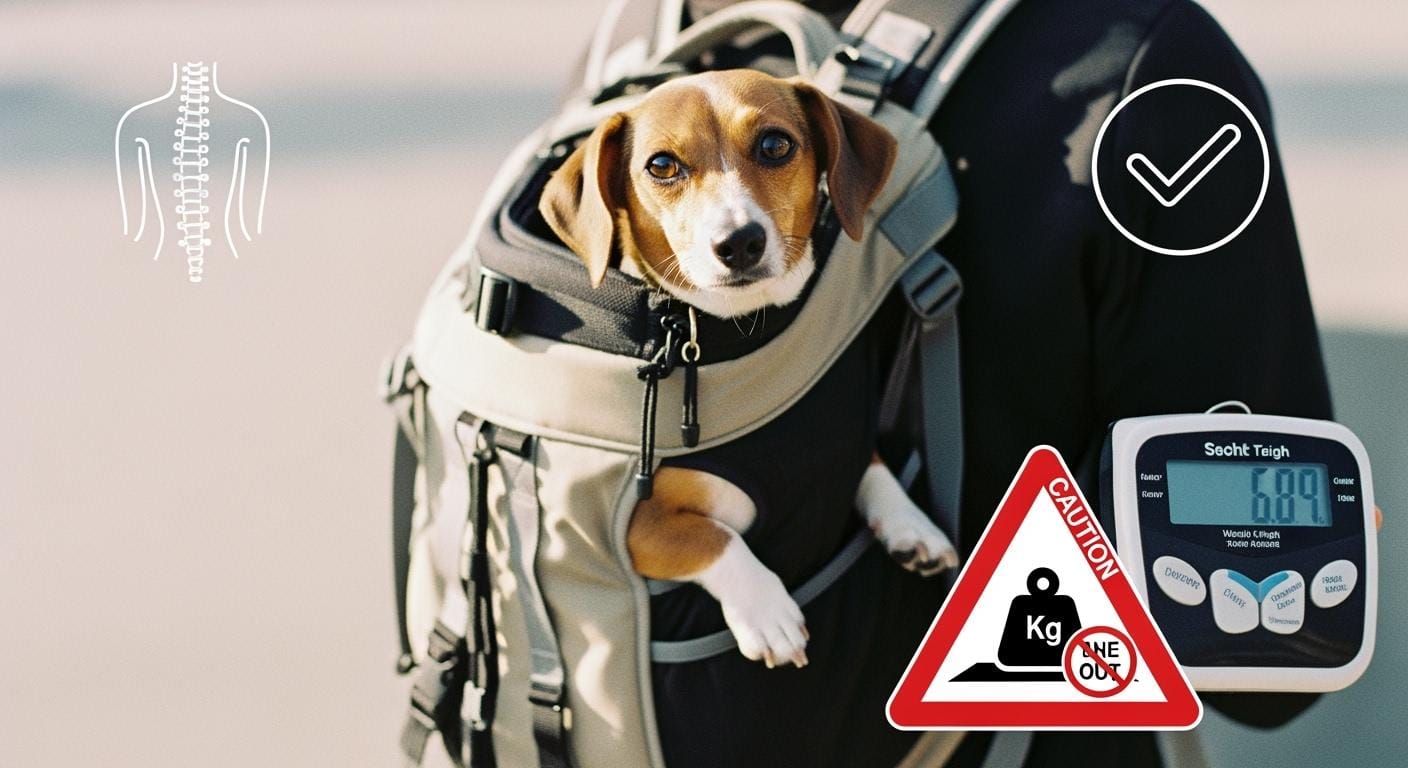
Even the most carefully engineered carrier has boundaries. A strap system designed for a smaller weight class will not perform the same way with a significantly heavier dog, regardless of how wide the strap or how resilient the padding. The force distribution math changes with weight. This is one reason understanding carrier weight limits matters as much as checking strap features.
Carrier fit interacts with body shape in ways no single design can cover. Someone with narrow or sloping shoulders may find that even wide straps migrate outward because the shoulder anatomy provides less of a horizontal shelf for the strap to rest on. In these cases, a crossbody design that routes the strap lower across the torso, or a carrier that includes a hip-support element where some load transfers to the pelvis, can reduce the shoulder pressure that strap design alone cannot fully solve.
Some carriers use an under-bag support strap to add stability. This keeps the carrier centered and close to your body. You feel less pressure on your shoulder because the load does not shift as you walk. Adjustable straps let you set the carrier at the right height for your body. A custom fit reduces the tendency for the strap to slide, bite, or concentrate force on one point.
Disclaimer: The fit checks described here assume a smooth-coated dog and a carrier worn over a single clothing layer. Double-coated breeds or heavy outerwear change how heat builds under the strap, which can make pressure feel more acute even when the mechanical load is unchanged. If your dog’s chest shape falls well outside breed norms—particularly barrel-chested breeds whose weight sits farther forward—the carrier may pitch differently against your body, and the strap contact pattern described here may not match your experience.
FAQ
Why does shoulder pain from a dog carrier take time to appear?
Muscle fatigue and padding compression are cumulative. The shoulder compensates at first, masking the pressure. Only after the padding begins to flatten and the muscles tire does the discomfort become noticeable, typically 10 to 20 minutes into a walk.
Does strap width alone solve the pressure problem?
Not if the padding underneath compresses quickly. A wide strap with collapsed foam behaves like a narrow strap in terms of effective contact area. Width and compression resistance work together. One without the other leaves part of the problem unsolved.
What does it mean when the strap keeps sliding off the shoulder?
Lateral force from the dog’s movement is overcoming the strap’s ability to stay positioned. This usually signals either insufficient strap width at the shoulder cap, a carrier design that allows too much swing, or a shoulder shape that slopes more than the strap was patterned for. A crossbody strap routed lower across the torso or a design that adds a waist belt can help redirect some of that lateral load.
Can padding that feels thick in the hand still fail during a walk?
Yes. Open-cell foams often feel plush when squeezed briefly but compress substantially under sustained load. The relevant test is not how the padding feels at first touch. It is whether the material rebounds to near-original thickness after carrying weight for 15 minutes. If it stays dented, it has stopped functioning as effective padding.
What features make a carrier stable enough to prevent pressure buildup?
| Feature | How It Reduces Shoulder Pressure |
|---|---|
| Wide straps | Spread weight across a larger contact patch |
| Thick, resilient padding | Prevents strap edges from digging in as material compresses |
| Adjustable fit | Keeps carrier positioned high and close to reduce lever-arm torque |
| Stable base | Limits swinging and load shifting during dog movement |