
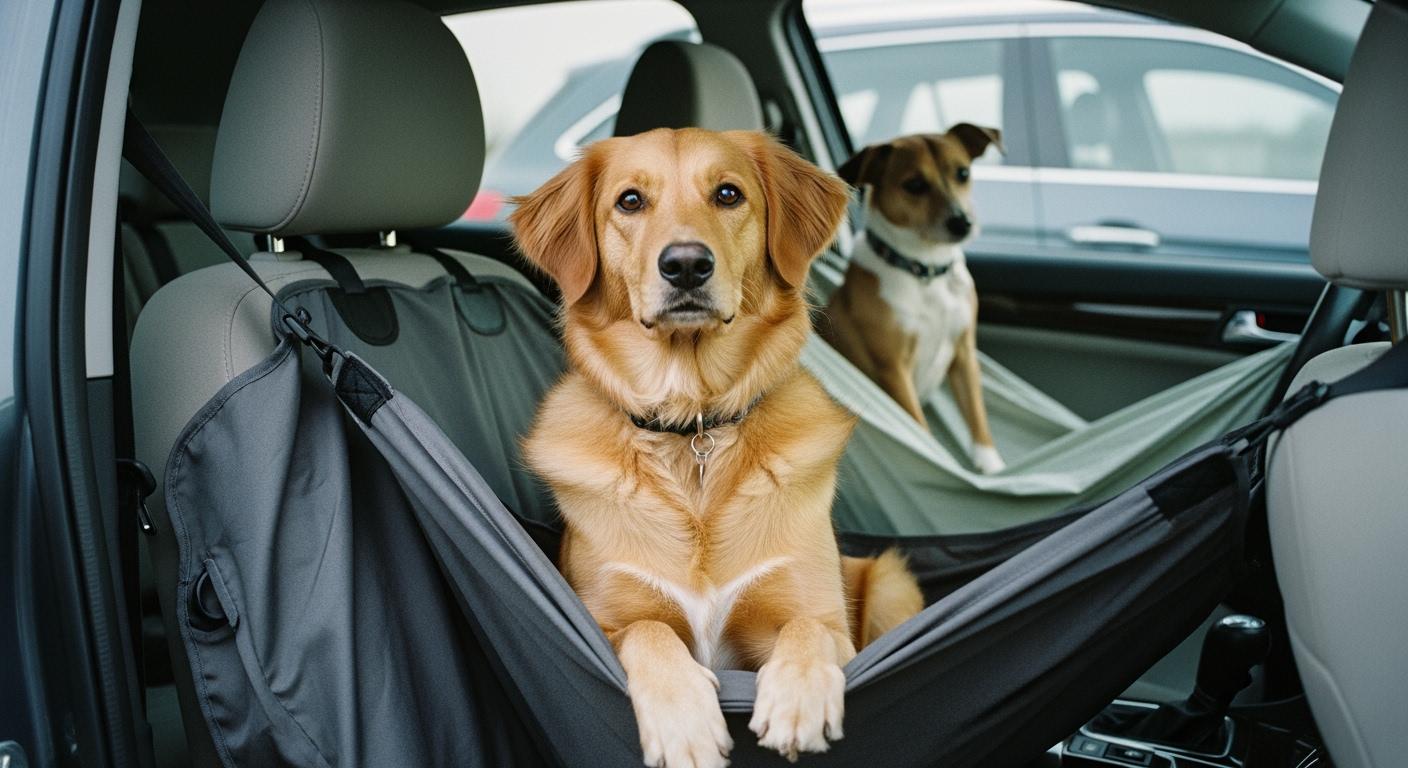
A hammock-style dog car seat cover looks straightforward: stretch fabric between the front and rear headrests, anchor the edges, and the back seat becomes a protected, stable platform. In practice, the middle sinks. The cover dips into the gap between the front and rear seats, and what should be a flat surface turns into a sling that shifts under the dog’s weight. The problem is not the fabric. It is what sits — or does not sit — between the fabric and the seat gap.
A cover stays flat when two things work together: a rigid layer that bridges the unsupported span and a strap system that holds consistent tension. When either is missing, sagging is a matter of time and load, not chance.
Why a Dog Car Seat Cover Sags in Hammock Mode
The Physics of a Sagging Hammock
When a dog stands on a hammock-style cover, body weight presses down on the fabric. That downward force converts to inward tension along the fabric plane — the front and rear edges pull toward the center, each side pulls toward the middle. If nothing rigid sits between the fabric and the seat gap, this inward pull drags the cover down into the void. The deeper the gap between the front and rear seat backs, the longer the unsupported span, and the more the cover sags under the same load.
A 60-pound dog does not just sit still. Braking shifts weight forward. Cornering shifts it sideways. The dog stands, turns, lies down, stands again. Each movement changes the load distribution, and a fabric-only hammock absorbs none of that energy — it transmits it directly into the anchor points. The straps stretch. The fabric creeps. The dip deepens.
This is why hammock stability has less to do with fabric thickness and more to do with whether a structural layer carries the load across the gap. Without that layer, even heavy-duty fabric eventually conforms to the shape of the void beneath it.
In practice: After your dog settles in the back, reach under the hammock and press upward against the middle of the cover. If your hand travels more than an inch before meeting resistance, the base is not bridging the seat gap — the cover is suspended by strap tension alone. That tension will drift.
What Happens When Straps and Anchors Give Way
Headrest straps carry the entire forward load of the hammock. A loose strap changes the approach angle of the fabric, lowering the front edge relative to the rear. The cover slopes forward, and the dog’s weight slides toward that low point — which is directly over the seat gap. Standard webbing straps stretch under sustained tension, especially when damp. Water-resistant coatings can make this worse: the coating prevents the fibers from locking, and the strap elongates by a noticeable margin within the first few drives.
Seat anchors — the wedge pieces pushed into the crease between the seat back and bench — are the rear counterpoint. Shallow anchors pull free on bumpy roads. Anchors made from the same fabric as the cover body offer no rigidity; they fold and slip rather than grip. When the rear anchors shift, the entire cover drifts forward. The middle sags. The side edges pull inward, exposing seat upholstery at the door sills. Full in-car protection depends on the cover remaining in position across the entire bench, not just the center sitting areas.
- Signs the support system is failing:
- The middle of the cover hangs visibly lower than the side bolsters
- The dog hesitates before stepping onto the cover or shifts weight repeatedly without settling
- The cover bunches into folds under the dog’s paws rather than staying smooth
Design Features That Keep a Cover Flatter in Hammock Mode
Firm Base Layer vs. Fabric-Only Support
A fabric-only hammock is a tensile structure — it works in tension alone. Pull it tight, and it holds. Release tension, and it collapses. A firm base layer changes the mechanics entirely: the rigid panel sits on top of the seat cushions and spans the gap independently. The dog’s weight transfers downward through the panel into the seat foam, not laterally into the straps. The fabric covering the panel is there for waterproofing and comfort, not for load bearing.
This is the same structural logic used in bench-mode versus hammock-mode setups: bench mode works because the seat cushion provides a continuous support surface. A firm-base hammock replicates that continuous support across the gap. Fabric-only hammocks do not.
The material choice for the base panel matters. A thin plastic sheet flexes under medium dogs and eventually cracks at the fold lines. A multi-layer panel — typically a rigid foam core laminated between waterproof outer layers — distributes load without flexing and survives repeated folding without fatigue. The difference is visible within the first drive: the panel stays flat, and the dog stands with the same confidence it shows on solid ground.
| Design Difference | Why It Matters | Main Limitation |
|---|---|---|
| Rigid multi-layer base panel | Spans the seat gap without flexing; transfers weight to seat cushions, not straps | Adds bulk when folding for storage; cheaper single-layer panels crack at fold lines over time |
| Fabric-only hammock | Lightweight; folds compactly; easy to install and remove | Suspends load on strap tension alone; sags progressively as straps stretch and fabric creeps under repeated loading |
| TPU-backed waterproof layer with sealed seams | Liquid barrier that does not stretch when wet; prevents moisture from reaching seat upholstery | Adds cost; water-resistant coatings without a true membrane layer allow seepage at stitch holes under sustained moisture |
| Double-stitched reinforced stress points | Prevents seam splits where the hammock body meets door flaps — the highest-stress junction during dog entry and exit | Single-stitched seams at these junctions tend to open within months of daily use, especially with dogs over 40 pounds |
Tip: Fold the cover along its base panel crease before buying. If the panel resists folding or makes a sharp cracking sound, the core material may be brittle. A quality panel folds smoothly with firm, even resistance — no sudden give, no audible stress.
Adjustable Straps, Anchors, and Anti-Slip Backing
Straps that adjust at both the headrest loop and the buckle give you control over tension at each attachment point independently. This matters because front and rear headrest heights rarely match, and a fixed-length strap forces a compromise — tight at one end means slack at the other. Adjustable straps let you set the front tension for angle control and the rear tension for gap coverage separately.
Reinforced hardware — buckles with a metal or glass-filled nylon core rather than unreinforced plastic — prevents the slow loosening that happens when clips flex under dynamic load. Each time the dog shifts, an unreinforced buckle body deflects by a fraction of a millimeter. Over a drive, those micro-deflections accumulate into visible slack.
Seat anchors work best when they are shaped as wedges, not flat tabs. A wedge pushes into the seat crease and resists both upward and forward pull. A flat tab pulls out under forward load. The most effective anchors use a rigid core wrapped in the same anti-slip material used on the cover’s underside — they grip the seat foam rather than sliding against it.
The anti-slip backing on the cover body itself follows a similar principle. Silicone or rubber dot patterns create point friction against the seat surface. A continuous backing sheet creates surface friction. The difference shows up on leather: dots can melt in hot weather and leave residue, while a continuous backing sheet distributes heat and resists deformation. Material selection for car travel gear follows the same logic — the backing that works on cloth may fail on leather, and vice versa.
Note: After a 15-minute drive, park on level ground and check whether the cover’s side edges have drifted away from the door sills. Run a finger along the edge where the cover meets the seat — a gap wider than two fingers means the anti-slip backing or anchors are not holding. This check takes 10 seconds and catches sag before it becomes a safety issue.
Reinforced Stitching at the Stress Points
The highest-stress junction on a hammock cover is where the horizontal body meets the vertical door flaps. When the dog steps onto the cover near the door, body weight pulls the flap upward while the main panel resists. That junction cycles through tension and release with every entry and exit. Single-stitched seams at this point open under repeated loading — the outer thread abrades, then snaps, and the seam unzips from one end.
Double-stitched or heat-welded seams at these junctions distribute load across two stitch lines or a fused bond. The failure mode changes from sudden seam separation to gradual wear that is visible long before it becomes structural. A cover with reinforced stitching at the flap junction also tends to hold its shape better over time — the seams do not stretch independently of the fabric, so the cover retains its original geometry through months of daily use.
A car-mat-style seat cover with these reinforcement patterns combines the rigid base with edge retention: the panel prevents sag in the middle, and the reinforced seams keep the edges from pulling inward. Both failures produce the same result — exposed upholstery and an unsteady surface — but they have different root causes and need different design fixes.
When a Firm-Base Hammock Cover Works Best — and When It Does Not
Conditions Where the Design Excels
A firm-base hammock cover shows its advantage most clearly with dogs over 40 pounds. Heavier dogs exert more downward force, which translates to higher inward tension on a fabric-only cover. The rigid panel neutralizes this relationship — the load path goes straight down into the seat cushions regardless of the dog’s weight.
Leather and smooth vinyl seats amplify the difference. On these surfaces, a fabric-only hammock slides even when straps are tight because the only friction comes from the strap tension itself. A firm base with anti-slip backing creates mechanical grip — the panel sits flat, the backing resists lateral movement, and the dog’s weight increases normal force, which increases friction. The cover actually grips better under load.
Dogs that move frequently during drives — standing, turning, switching sides — generate the kind of dynamic loading that exposes weak support systems fastest. A hard-bottom design handles these shifts without the progressive sagging that fabric-only covers develop over the course of a single trip. The panel does not creep. The dog feels the same surface under its paws at mile 50 as it did at mile 1.
Where the Design May Fall Short
A rigid base panel adds bulk. The cover folds into a larger package and weighs more than a fabric-only equivalent. For someone who removes and reinstalls the cover daily — switching between pet transport and human passengers — the extra handling weight and folded size may be noticeable.
Small dogs under 15 pounds rarely generate enough load to cause visible sagging in a well-tensioned fabric hammock. In these cases, the firm base is solving a problem that does not exist, and the tradeoff is extra cost and storage bulk for no functional gain. The same applies to dogs that lie still for the entire drive — static loading produces far less strap creep than dynamic loading, so a quality fabric-only cover may hold its position adequately.
Vehicles with captain’s chairs in the rear, a center console that extends into the back seat area, or an unusually wide gap between front and rear seat backs reduce the effective support surface available to the base panel. If the panel cannot find continuous support on both the front and rear edges, it may tilt rather than bridge — and a tilted panel creates its own stability problems.
Disclaimer: The firm-base design described here assumes standard bench-style rear seats where the gap between front and rear seat backs is under 8 inches. Vehicles with captain’s chairs, a full-length center console, or a gap wider than the base panel’s support span may not provide enough bearing surface for the panel to bridge effectively. In those layouts, test-fit the cover in hammock mode before relying on it for full coverage. Double-coated breeds may show subtler signs of cover instability — the thicker coat masks the tactile feedback a smooth-coated dog would react to, so check strap tension and edge position visually rather than relying on the dog’s behavior alone.
FAQ
How do you install a dog car seat cover in hammock mode so it stays flat?
Attach the front straps to the front headrests and the rear straps to the rear headrests. Push the seat anchors deep into the crease between the seat back and bench — they should resist when you tug forward. Adjust each strap independently: set the front tension first to control the approach angle, then tighten the rear straps to pull the cover flat across the gap. A firm-base cover will sit level immediately; a fabric-only cover may need strap re-tightening after the first drive as the webbing settles.
Can you wash a dog car seat cover with a rigid base panel?
Most covers with a firm base allow the panel to be removed before washing. Machine-wash the fabric shell on a cold gentle cycle and air-dry it — heat drying can delaminate waterproof coatings and shrink the fabric unevenly. Wipe the base panel with a damp cloth rather than submerging it. Check the care label for specific instructions; covers with heat-welded seams tolerate machine washing better than those with glued layers.
What features actually prevent sagging versus what is marketing?
A rigid or semi-rigid base panel is the single feature that directly prevents sagging — it bridges the seat gap structurally. Adjustable straps with reinforced hardware prevent the slow loosening that deepens the dip over time. Deep, rigid seat anchors keep the rear edge from creeping forward. Anti-slip backing prevents lateral sliding. Features that do not directly affect sagging include fabric thread count, color options, and mesh storage pockets — they may add convenience but do not change the structural behavior of the hammock under load.
Does a firm-base cover fit all vehicle types?
Most firm-base covers fit standard cars, SUVs, and trucks with bench-style rear seats. Adjustable straps accommodate different headrest heights and seat depths. The limiting factor is rear seat configuration — split-folding seats, captain’s chairs, and center consoles that occupy the seat gap reduce the continuous support surface the base panel needs. Measure the distance between your front and rear seat backs before buying; if it exceeds 10 inches, confirm the panel dimensions with the manufacturer.
Is a firm-base hammock cover safe for dogs with joint or mobility issues?
A stable, non-sagging surface helps dogs with hip dysplasia, arthritis, or recovering from surgery by providing a predictable platform that does not shift underfoot. The rigid panel eliminates the sinking sensation that causes hesitant stepping and repeated weight shifting. Side flaps with zippered openings also allow these dogs to enter and exit without climbing over a high fabric wall — the flap unzips to create a step-through opening at door level.






