
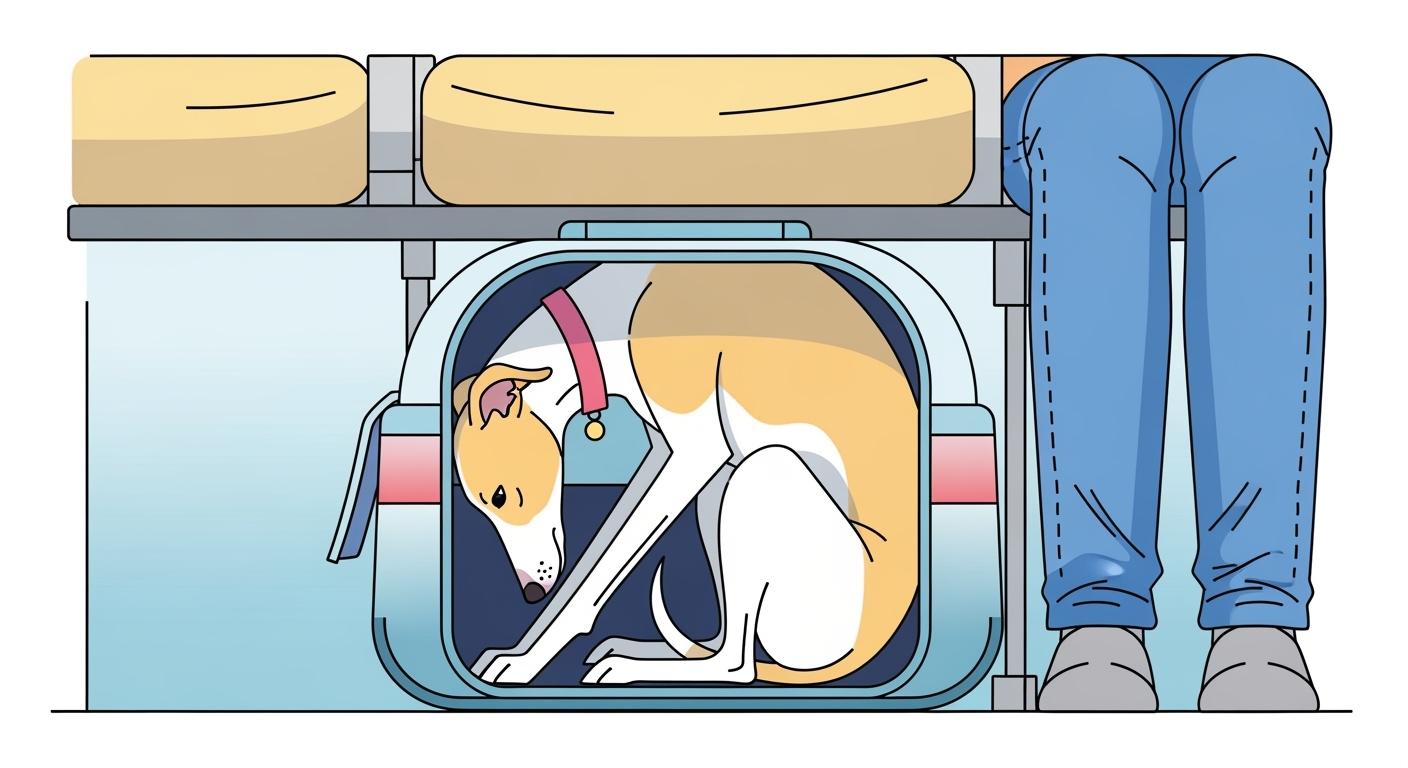
A carrier that fits your dog’s weight can still leave your dog unable to sit up straight. The problem is not pounds. It is inches — specifically, the vertical inches between the carrier floor and its roof. Most under-seat pet carriers are built for compact small dogs. Put a taller small breed inside — an Italian Greyhound, a long-legged Chihuahua, a Miniature Pinscher — and the roof lands on the dog’s head before the zipper closes. This article breaks down why interior height, not weight rating, decides whether a carrier works, and which design features actually preserve usable vertical space under an airplane seat.
Why Weight Ratings Leave Tall Small Dogs Cramped
A weight rating tells you whether the carrier can support your dog’s mass. It says nothing about whether your dog can stand, turn, or settle without pressing against the roof. Two dogs can weigh 12 pounds and occupy completely different volumes. One is built low and compact. The other has long legs and a tall frame. The carrier that fits the first dog will force the second into a permanent crouch.
The mechanical reality under an airplane seat makes this worse. The seat bottom above the carrier is not a flat, rigid surface — it is a contoured cushion that pushes downward unevenly. When a soft-sided carrier slides under the seat, the roof compresses at its highest point first. That compression transfers force through the carrier frame into the dog’s head and shoulders. The dog responds by ducking lower. Spine curvature changes. The dog settles into a hunched posture, not because it chooses to, but because the geometry of the space leaves no alternative. A dog that starts a four-hour flight in a crouch will exit the carrier stiff and stressed.
This is not about the carrier being too small in total volume. It is about vertical clearance — the single dimension that weight ratings do not measure and that under-seat placement directly attacks. A carrier that feels roomy in the living room can fail completely under a seat precisely because the compression that matters most happens from above.
Breed height, not breed weight, predicts carrier fit
Measure from the floor to the top of your dog’s head while standing. Add 2 to 3 inches for head clearance inside a soft-sided carrier; add 3 to 5 inches for a hard-sided one. That number — the minimum interior height — is what matters. If the carrier’s interior height is 10 inches and your dog measures 11 inches at the head, the carrier does not fit. The weight rating becomes irrelevant.
Breed charts organized by weight obscure this. A 10-pound Cocker Spaniel puppy and a 10-pound adult Italian Greyhound share a number on the scale. They do not share a height profile. The spaniel will clear a 10-inch roof. The Italian Greyhound will not. Weight-based sizing treats them as interchangeable when the critical dimension says otherwise.
Where Under-Seat Carrier Fit Breaks Down
Low roof height steals posture first
The most common failure point is roof height. Most airline-compliant soft-sided carriers top out at 10.5 to 11 inches of interior height. A dog that stands 12 inches tall at the head cannot straighten its neck inside that space. The dog folds downward — neck first, then shoulders, then spine. After 10 minutes inside, run your hand along your dog’s back while the dog is still in the carrier. If the spine is arched upward rather than carrying a neutral curve, the roof is too low. That is observable: neutral spine versus forced arch. No measurement tape needed once you know what to look for.
Under-seat carrier sizing depends on three interior dimensions working together, but height is the one that fails first and causes the most visible distress.
Collapsing side walls shrink usable width
A soft-sided carrier with unstructured walls looks spacious on the floor. Slide it under a seat and the side walls bow inward. The internal width the label advertised disappears. A dog that could turn comfortably in the unloaded carrier now finds its shoulders brushing both sides. The dog stops trying to turn. It lies still. Stillness looks like calm. It is not — the dog has simply run out of options.
The failure is structural, not dimensional. The carrier fabric lacks the stiffness to resist lateral compression from seat supports and nearby luggage. Every inch the side wall moves inward is an inch the dog loses. This is why carrier width on the spec sheet is less useful than whether the walls hold their position under load.
Unstable bases shift under movement
A soft bottom panel that sags under the dog’s weight creates a second problem. The dog’s paws sink into a concave depression. Long-legged breeds already struggle with vertical clearance; adding an unstable footing forces them to brace constantly against the carrier floor. During taxi, takeoff, and turbulence, the dog cannot settle because the surface beneath it keeps shifting. Check this by placing the loaded carrier on a chair and rocking it gently side to side. If the dog slides or the base deforms more than a half-inch, the base lacks the stiffness a long-legged dog needs.
Airline size limits cut closer than weight limits
Airlines enforce carrier dimensions, not pet weight, at the gate. The standard under-seat footprint is roughly 18 inches long by 11 inches wide by 11 inches high — but the height varies by aircraft and seat position. A carrier that passed on one flight may not fit on the next.
| Airline | Max Carrier Size (L x W x H) | Max Combined Weight | Carrier Type |
|---|---|---|---|
| Delta Air Lines | Varies by aircraft and seat | Must fit under seat | Soft or hard-sided |
| United Airlines | 18″ x 11″ x 11″ | Must fit under seat | Soft or hard-sided |
| American Airlines | 18″ x 11″ x 11″ | 20 lbs (pet + carrier) | Soft or hard-sided |
| Southwest Airlines | 18.5″ x 13.5″ x 9.5″ | Must fit under seat | Soft or hard-sided |
| Alaska Airlines | 17″ x 11″ x 9.5″ | 20 lbs (pet + carrier) | Soft or hard-sided |
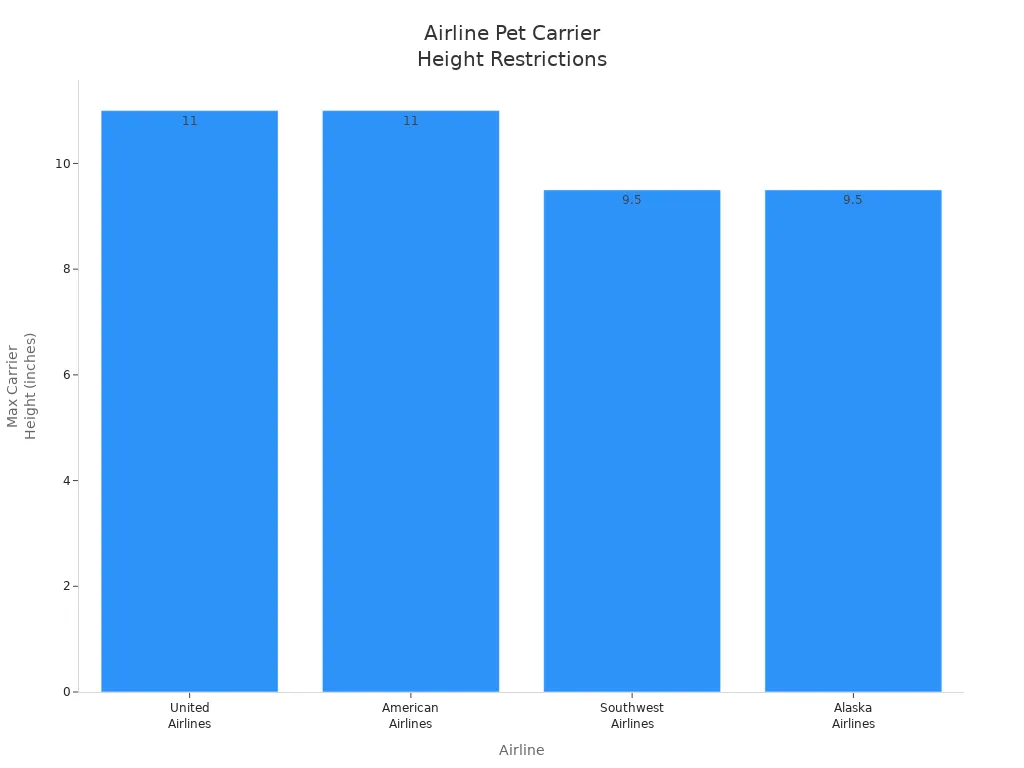
Notice the pattern: every airline in the table lists a height under 11 inches. A dog that needs 12 inches of vertical clearance will not fit under any of these seats in a rigid carrier. A soft-sided carrier with structured walls can compress slightly while maintaining interior shape — but only if the structure resists inward collapse. That is the design tradeoff: flexibility to fit under the seat versus stiffness to protect interior space. Getting through the airport and onto the plane with a tall small dog turns on that balance.
Structured Walls and Shape-Stable Bases Keep Vertical Space Usable

Frame panels resist compression from above and from the sides
The difference between a carrier that works for a tall small dog and one that does not often comes down to the frame. A carrier with rigid or semi-rigid panels built into the roof and side walls resists both vertical compression and lateral collapse. The panels act as struts: when the seat cushion pushes down, the roof panel distributes the force across its span instead of transferring it to a single point. When luggage presses from the side, the wall panel intercepts the force before it reaches the dog.
The panel material matters less than the presence of panels at all. A carrier with four soft fabric walls and a fabric roof will collapse under any uneven load. Add even a thin polypropylene sheet to each wall and the carrier holds its shape under the same conditions. The panels do not need to be thick. They need to be there.
A firmer base stabilizes long-legged dogs
Tall small dogs carry their height in their legs. When those legs press into a soft carrier floor, the dog sinks. The sinking creates instability. The dog tenses muscles to compensate. Over a multi-hour flight, that constant low-level tension produces the same fatigue as standing still on a tilting surface.
A firmer base panel — typically a removable rigid board covered in fleece or padded fabric — gives the dog a predictable surface. The legs do not sink. The dog does not need to brace. A well-built under-seat carrier with a structured base and locking zippers shifts the design focus from portable storage to usable interior space. The test is simple: load the carrier with weight equivalent to your dog, set it on an uneven surface, and check whether the base panel stays flat. If it bows, the dog will feel every contour of the floor beneath.
Breathable mesh panels and ventilation reduce stress without sacrificing structure
Mesh panels serve two functions. The obvious one is airflow — mesh sides prevent heat buildup during long flights. The less obvious one is visibility. A dog that can see its owner through a mesh panel tends to settle faster than a dog sealed inside opaque fabric. But mesh alone has no compressive strength. The carrier design needs framed mesh openings — mesh bonded to a structural border — not full walls of unsupported mesh that collapse the moment pressure arrives from outside.
The combination that works: framed mesh panels for ventilation and visibility, rigid or semi-rigid panels for vertical and lateral structure, and a firmer base for stable footing. Remove any one of those three and the carrier performs worse for a tall small dog.
| Design Feature | What It Does for a Tall Small Dog | Limitation |
|---|---|---|
| Structured roof panel | Distributes seat compression across span, protects head clearance | Adds bulk when stored; may limit compressibility for very tight seat spaces |
| Semi-rigid side walls | Prevents inward collapse from luggage or seat supports | Cannot compress width; under extra-narrow seats the carrier simply will not fit |
| Firmer base board | Stabilizes long legs, prevents sinking into concave floor depression | Removable boards can shift during carry if not secured in a sleeve or strap |
| Framed mesh panels | Airflow plus visibility without losing wall structure | Unframed mesh offers no compressive resistance and collapses immediately |
When Expandable Carriers Help — and When the Extra Bulk Works Against You
Expansion adds width and length, not height
Expandable carriers use zip-out panels to increase interior space — typically width, sometimes length. Unzip the panel and the carrier footprint grows. For a tall small dog, this can provide room to stretch and turn during layovers or before boarding. But expansion almost never increases height. The roof stays where it was. If your dog’s head already touches the roof in the unexpanded carrier, expansion changes nothing about vertical clearance.
This is the most common misunderstanding about expandable carriers. They solve the wrong dimension for tall dogs. A dog that needs more height gets more floor space instead. Floor space matters for comfort — the dog can lie fully extended during a layover — but it does not fix the fundamental height problem during flight.
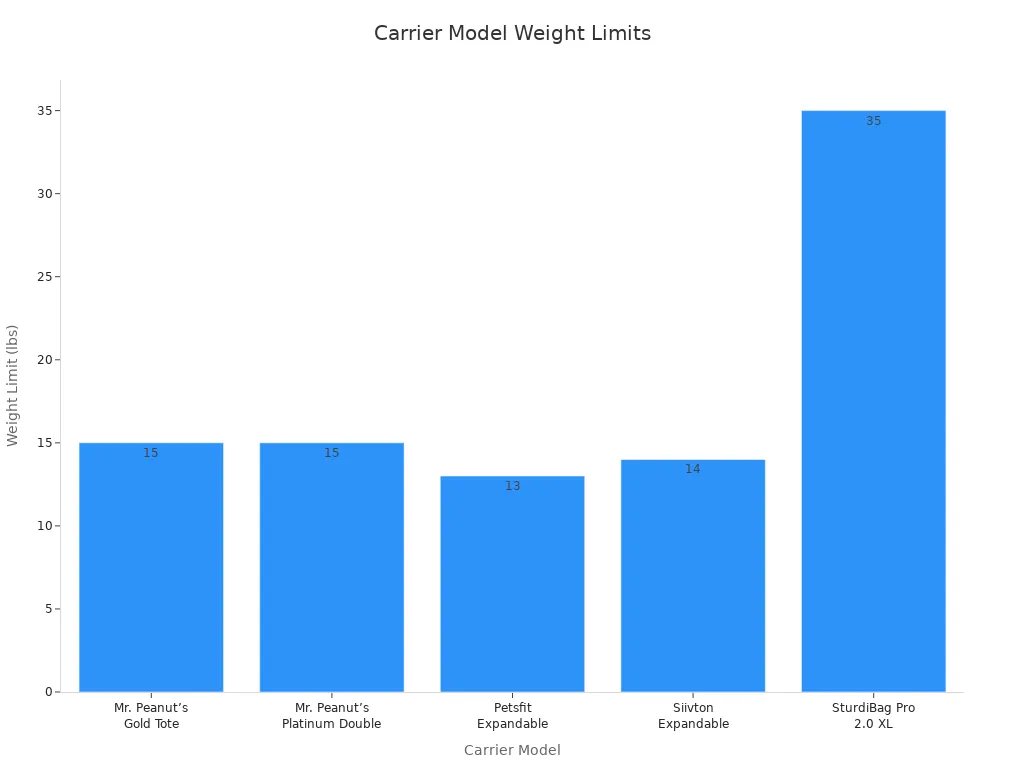
When expansion is worth the tradeoff
Expansion helps under two specific conditions. First, when your dog’s height fits the carrier but the dog needs more room to turn — a common situation for dogs whose length exceeds the carrier’s interior length. Second, during layovers — unzip the panels at the gate and the dog gets room to stretch while waiting.
The tradeoff: expanded carriers take up more floor space and may not fit between rows of airport seating or in tight gate areas. The expansion panels themselves add zipper lines — potential failure points that collect debris and require maintenance. Choosing between an expandable and a fixed-shape under-seat carrier comes down to whether your dog’s height already clears the roof. If it does not, skip the expansion feature and focus on carriers with greater static interior height.
Disclaimer: The height checks described here assume a smooth-coated dog where roof contact is visible. Double-coated breeds with thick fur may show subtler compression signals — fur can mask roof contact for the first hour before the dog begins shifting position repeatedly. For double-coated tall small breeds, check for repeated repositioning rather than relying on visible roof-to-head clearance alone. If the dog’s chest shape falls outside breed norms for the carrier’s sizing pattern — particularly barrel-chested dogs or those with a very deep keel — the fit checks described may not catch every pressure point.
FAQ
How do I measure my tall small dog for an under-seat carrier?
Measure from floor to top of head while standing. Add 2–3 inches for a soft-sided carrier, 3–5 inches for hard-sided. Then measure from nose tip to tail base and add 2 inches. Use a fabric tape measure — rigid rulers introduce error on curved body contours.
Can a 12-inch-tall dog fit under an airline seat?
Most airline under-seat spaces max out at 9.5–11 inches of height. A 12-inch-tall dog needs a carrier interior height of at least 14 inches to sit upright with clearance. That exceeds most airline limits. In practice, a tall small dog in this range will need to lie down for the flight. The carrier must be long enough for the dog to extend fully while lying flat.
Do expandable carriers increase interior height?
Typically not. Expansion panels add width or length, not height. If the unexpanded carrier roof is too low for your dog, expansion does not fix the problem. Look for carriers with taller static interior height instead.
What is the single most important measurement in an under-seat carrier?
Usable interior height — the distance from the carrier floor to the lowest point of the roof when the carrier is zipped closed and placed under a seat. Spec-sheet height often measures the outside or the tallest point. Usable height is what the dog actually experiences.
Are hard-sided carriers better for tall small dogs?
Hard-sided carriers maintain interior shape under compression — that is an advantage. The tradeoff is that they cannot compress at all to fit irregular seat geometries. If the hard carrier’s exterior height exceeds the airline’s limit by even half an inch, it will not fit. Soft-sided carriers with structured panels offer a middle ground: shape retention with some compressibility. Airline pet travel rules are enforced by dimension at the gate, and the carrier type that matches both your dog’s height and the airline’s limits depends on the specific numbers.
The carrier dimension that decides whether a tall small dog travels comfortably is interior height — not weight rating, not total volume, not brand reputation. Measure your dog from floor to head top. Compare that number to the carrier’s usable interior height. If the carrier roof compresses under seat pressure, that height shrinks further. Structured panels, a firm base, and framed mesh keep the space the spec sheet promised. Expansion helps width and length but does nothing for height. Match the carrier to the dog’s vertical profile and the airline’s under-seat limit. That fit — not the weight limit printed on the tag — is what gets a tall small dog through a flight without spending four hours folded in half.






