
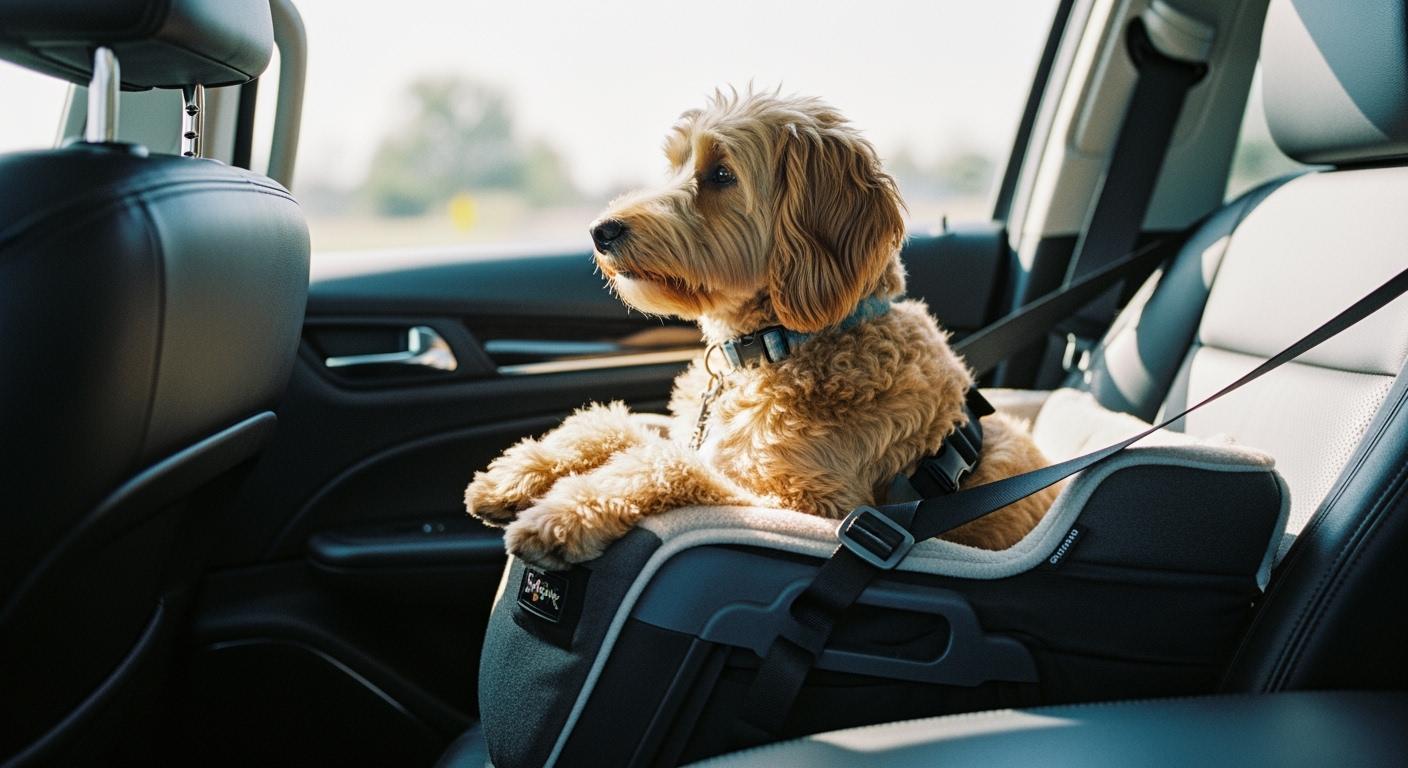
A soft pillow bottom looks inviting on a product page. Put a dog in it, drive through a few turns, and the cushion tells a different story. The foam cells collapse under sustained weight. The sitting surface tilts. The side walls, unsupported from below, lean outward. What started as a booster seat becomes a slumped bowl — and the dog inside starts sliding, bracing, or climbing out.
A dog car seat with hard base interrupts that chain at the first link. The rigid platform under the padding prevents the initial compression that triggers every downstream failure. What follows walks through what actually breaks in a soft-base seat, how a hard platform stops each failure, and the conditions where that difference is sharpest.
What Fails When the Base Is Just a Pillow
Cushion Compression Starts a Chain of Collapse
A dog’s weight on a foam-only base does not rest on top of the cushion. It pushes into it. Open-cell foam compresses unevenly — more under the hips and chest, less under lighter areas. Within minutes the sitting surface develops a slope. The dog’s pelvis tilts backward. The spine curves to compensate. That is not posture a dog can hold still for long.
Moisture accelerates the process. A dog’s coat carries humidity even on dry days. Add a damp paw or spilled water and the cushion core softens further — becoming less resilient and slower to rebound. The table below shows where water ends up in three common constructions:
| Material | Main Failure | Where Moisture Ends Up |
|---|---|---|
| Quilted polyester with stitched seams | Water enters through needle holes under body weight; each stitch point is a capillary | Cushion core, then car seat upholstery |
| Non-woven felt or fleece top | Absorbs and holds moisture; dries slowly; bacterial odor develops within hours | Trapped in top layer and core |
| Coated fabric with sealed seams | Surface stays waterproof but becomes slick under lateral force; dog slides | Moisture pools on top if the seat tilts |
A waterproof cover keeps the core dry but does nothing when that core has already collapsed. What resists compression is not the fabric choice — it is what sits beneath all of it.
Side Walls and Booster Height Lose Their Foundation
The side panels of a booster-style car seat are only as stable as the floor they attach to. When the base is foam, that floor softens under load. The stitching that connects the side wall to the base panel goes slack. The wall leans. The dog leans into it, and it leans further. The seat height drops — not because the walls shortened, but because the dog sank deeper into the base.
| Design Difference | Why It Matters | Main Limitation |
|---|---|---|
| Soft foam-only base | Feels plush at first touch; no rigid layer underneath | Compresses unevenly under weight; side walls lose foundation; seat height collapses within minutes |
| Hard base with comfort padding | Platform stays flat under load; side walls remain vertical; booster height is maintained | Adds weight; folding designs need a hinge mechanism that avoids pinch points |
| Semi-rigid molded foam insert | Lighter than a full hard board; resists collapse longer than plain foam | Still compresses on drives over 30 minutes; recovery slows with repeated loading cycles |
The height loss creates a secondary problem: the dog loses its sightline out the window. Dogs that cannot see out tend to stand up or climb the side walls — behaviors that make restraint systems less effective. For small dogs especially, base stability matters more than cushion thickness because a 12-pound dog already generates roughly 1.5 to 2 psi under the sit bones — enough point pressure to bottom out most open-cell foam pads within 10 minutes.
How a Rigid Platform Changes What the Seat Can Do
Flat Support Keeps Restraint Geometry Consistent
A hard base does one thing foam cannot: it resists bending. Dog weight on a rigid platform transfers through the panel to the car seat beneath — the panel itself does not change shape. The sitting surface stays flat. The dog’s hips stay level. The harness attachment point stays at the same height relative to the vehicle’s seat belt anchor.
That geometry matters. A restraint system — tether, harness clip, seat belt loop — works by limiting forward displacement. If the dog sinks three inches into a collapsing cushion first, the restraint is already slack before a sudden stop begins. The causal chain runs in one direction: weight compresses foam → sitting angle tilts → some body weight converts into a lateral vector against the side wall → wall deforms under a load it was not designed to resist → dog shifts position → restraint geometry changes.
In a rigid panel — typically injection-molded polypropylene or formed ABS sheet — flexural modulus is high enough that deflection under a 15-to-25-pound dog stays under a few millimeters. Open-cell polyurethane at 1.5 lb/ft³ density produces 2 to 4 inches of compression under the same load. Same dog, same weight, entirely different structural outcome.
An observable check: after a 20-minute drive, run your hand between the bottom of the seat cover and the car’s upholstery. If you feel the car seat fabric through the cushion at the pressure points, the base has compressed past useful support. A rigid platform passes this test cold — the gap between platform and car seat stays consistent.
Side Wall Structure Depends on What Is Underneath
When a dog leans into a side wall during a right turn, the top of the wall experiences outward force. That force creates torque at the base of the wall. A rigid base panel — bolted, riveted, or molded as one piece with the wall — counters that torque. Foam does not. The wall bends, recovers slowly, then eventually takes a set. A booster seat’s side wall stability traces directly to the base material underneath — the same wall sewn to a rigid panel stays vertical under load; the same wall sewn to foam leans within minutes.
A second check: look at the side walls from the front of the seat after a drive with moderate turns. If either wall leans more than roughly 15 degrees from vertical, the base is not providing enough lateral support at the attachment point. That lean angle tends to increase over weeks as the foam at the attachment degrades with each loading cycle.
Comfort Padding Works Better When It Is Not Also the Structure
Padding on a rigid platform serves a different purpose than padding that must also be structural. Structure foam needs density and thickness to resist compression; comfort foam needs only to soften the contact surface. Separating the two functions lets each layer do its job without compromise:
| Layer | Material | Function |
|---|---|---|
| Comfort top | Recycled polyester fiberfill, roughly 0.25 inch packed density | Soft contact surface; does not need density because the base handles load |
| Insulating mid | Closed-cell foam sheet, roughly 0.25 inch | Thermal barrier between dog and base panel; closed-cell structure does not absorb moisture |
| Structural base | Rigid panel — injection-molded PP or formed ABS | Spreads weight evenly; resists bending; anchors side walls and restraint points |
The closed-cell mid layer solves a subtle problem: open-cell foam against a rigid plastic panel creates a condensation point where warm dog meets cold base. Closed-cell foam interrupts that thermal bridge. The dog stays warmer without the cushion needing to be thick enough to insulate on its own. For daily drivers, the difference between a soft bottom and a rigid platform shows up fastest in seat recovery — after the dog exits, a foam-only seat can take 30 to 60 minutes to regain shape, while a hard-base seat is ready for the return trip immediately.
Where a Hard Base Helps Most — and Where It Cannot Fix Everything
A rigid base matters most under three conditions: frequent braking and turning — city and suburban driving; dogs that sit upright rather than lie down, because upright posture concentrates weight on a smaller contact patch; and booster-style seats where side wall height is part of the safety design.
The advantage narrows in two scenarios. On long highway drives where the dog lies flat and the car holds steady speed, base rigidity matters less — the load spreads out, lateral forces are minimal, and the dog adjusts gradually if compression occurs. And for dogs over roughly 30 pounds in a booster-style seat, even a rigid panel will flex if it is too thin or unsupported across the span. A larger dog transfers proportionally more force into the platform — panel thickness and material need to scale accordingly.
Disclaimer: This stability assessment assumes a smooth-coated dog under 30 lb on paved roads. Double-coated breeds may show subtler pressure marks that need hand-checking rather than visual inspection. Dogs over 30 lb in a booster-style seat may still experience platform flex even with a rigid base, particularly on rough terrain or during hard braking. If the dog’s chest shape or weight falls outside what the seat was patterned for, the fit checks described here may not catch every failure point.
A stable seating platform is the foundation of in-car restraint effectiveness — a harness tether does its job only when the dog stays in the position it was adjusted for. Collapse the base, sink the dog, and slack enters the system at precisely the moment it is least welcome.
FAQ
Can a folding hard-base seat hold up over time?
The weak point is the hinge, not the panel. A continuous rigid panel distributes weight without stress concentration. A two-piece panel with a fabric or plastic hinge creates a load line across that joint. Over repeated cycles — dog in, dog out, fold, unfold — the hinge is where wear appears first. Folding designs using a full-width fabric hinge with dual-layer stitching tend to outlast narrow plastic snap hinges because the load spreads across the entire panel width rather than concentrating at a few connection points.
Does a rigid base make the seat less comfortable?
A rigid panel under padding does not change how soft the contact surface feels — it changes how long that softness persists. A foam-only seat feels comfortable for a few minutes, then the support fades as the foam compresses. A padded hard-base seat feels the same at minute 20 as it does at minute one. The difference is support consistency, not initial softness.
How do you check if a base is rigid enough before buying?
Pick up the seat by one corner. If the base panel flexes more than a few degrees under its own weight, it will deflect significantly under a dog. A properly rigid panel resists torsional twist — grab opposite corners and try twisting. If the panel twists easily, the material is too thin or the wrong polymer for the span. The most frequent owner questions about hard-bottom covers trace back to this single check — a base that flexes in your hands will not stay flat under a dog in a moving car.
Is a waterproof cover enough, or does the base material matter more?
A waterproof cover keeps liquids out of the cushion core, but it cannot prevent that core from compressing. If the base underneath is soft foam, water protection is solving the wrong problem — the seat fails structurally long before moisture becomes the issue. Base material determines whether the seat holds its geometry; cover material determines whether moisture accelerates the failure. Both matter, but the base matters first.
A dog car seat with a hard base stops the compression chain where it starts. No collapse means no sitting-angle tilt, no side wall lean, no restraint slack, and no constant repositioning. The padding handles comfort. The platform handles everything else.






