
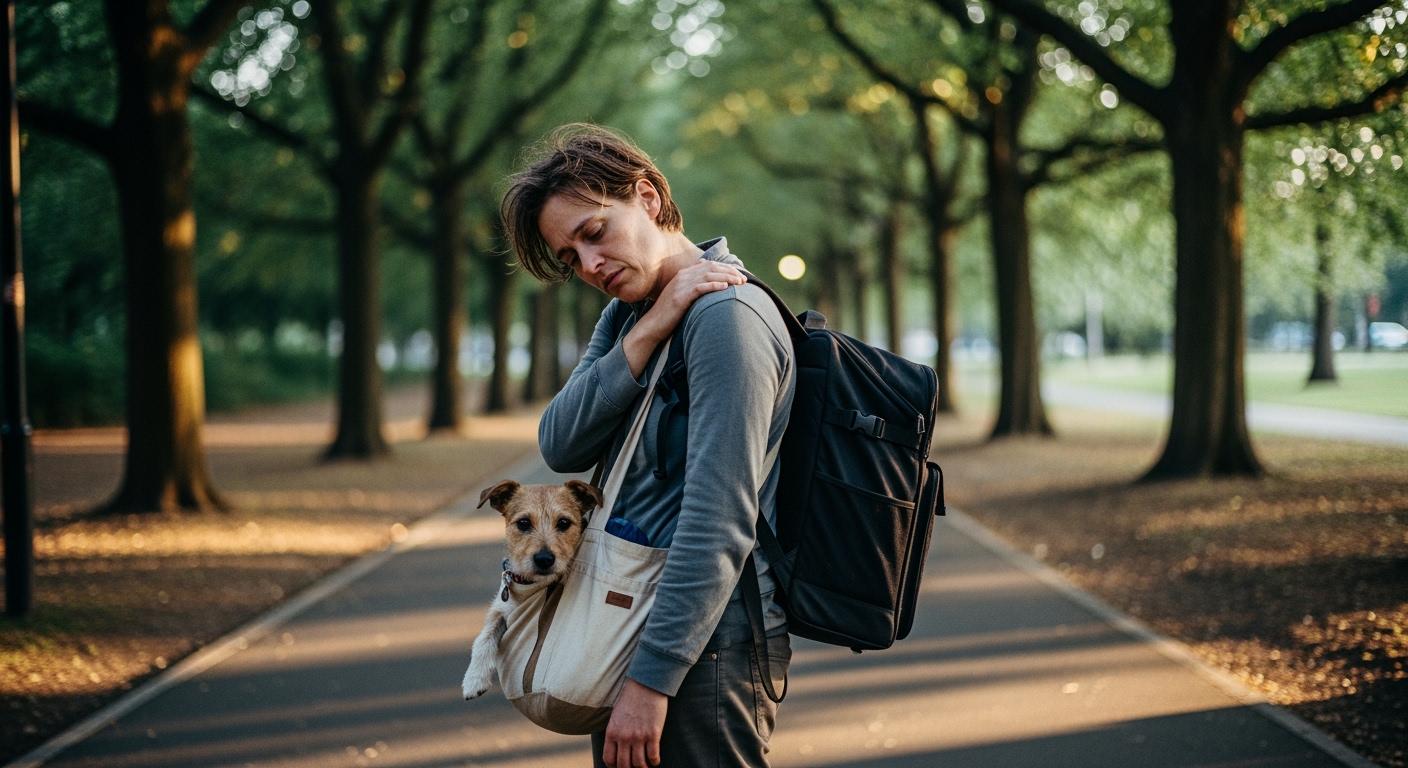
Pick up a tote carrier with a 12-pound dog inside and walk six blocks. By block four your shoulder is hiking upward to keep the strap from sliding. You switch arms. By block six both sides ache. That is not a strap padding problem. It is a load path problem — and it is the central difference in the dog tote carrier vs backpack carrier comparison.
A tote hangs the entire weight from a single point on one shoulder. A backpack carrier routes the same weight through two shoulder straps and often a waist belt, then transfers it into a structured frame or panel that keeps the dog’s mass close to your spine. The result is not just less fatigue. It is a different class of stability — for your shoulders, your stride, and the dog inside the carrier. This article traces that difference through how each carrier type handles weight, shifting, heat, and terrain, so you can match the design to the walk you actually take.
How the Load Path Differs Between a Tote and a Backpack Carrier
Every carrier is a suspension system. The question is where the load terminates and what that does to the person carrying it.
In a tote carrier, the strap anchors at one or two points along the bag’s rim. The dog sits at the bottom of a soft-walled compartment. When you walk, each step generates a small downward oscillation. That oscillation travels from the dog’s mass through the bag floor, up the fabric walls, into the strap anchor points, and finally into a single clavicle and trapezius. The shoulder becomes a fulcrum with a 10-to-15-pound mass swinging at the end of a 12-to-18-inch lever arm. Your body counters by recruiting the opposite-side obliques and spinal erectors to stay upright. After 10 or 15 minutes, those muscles fatigue. You lean. The strap drifts. The dog shifts in response to the new angle. The cycle compounds.
A backpack carrier changes the termination points. The load splits across two shoulder straps that run over the trapezius and pectoral girdle on both sides. A chest strap prevents the shoulder straps from drifting laterally. A waist belt — present on backpack carriers designed for urban carrying and longer outings — transfers a portion of the dog’s weight directly to the iliac crest, bypassing the spine and shoulders entirely. The dog’s mass sits inside a structured compartment that holds its shape, so the load does not swing independently of your torso. The center of mass stays within a few inches of your spine, where your body’s postural muscles are built to manage it.
In practice: After a 15-minute walk with each carrier type, stand still and check whether your shoulders are level. If one sits noticeably higher than the other, the carrier has been recruiting asymmetrical muscle compensation — and your walk was harder than it needed to be.
When the Load Path Gap Widens
The difference is modest on a flat, straight sidewalk with a calm dog. It widens sharply under three conditions.
First, stairs. Climbing shifts your center of mass forward and up. A single-shoulder tote forces you to counter-rotate your torso to keep the load from swinging outward on each step. A dual-shoulder backpack carrier keeps the dog’s weight aligned with your spine’s forward lean, so you climb without that side-to-side twist. For carriers used on routes with stairs, hills, or extended walks, this alignment difference compounds with every step.
Second, uneven ground. Gravel, grass, cobblestones — any surface that introduces lateral instability forces your body to make micro-corrections. A tote carrier adds a secondary pendulum that moves out of phase with your own balance adjustments. Two instability sources fighting each other. A backpack carrier couples the dog’s mass to your torso so both move as one unit.
Third, dog movement. If the dog stands up, turns around, or shifts weight inside the carrier — and most dogs do at least once per outing — the tote’s single-point suspension transmits every shift as a torque around the shoulder joint. The backpack’s multi-point harness distributes the same shift across more contact area, muting the effect.
What the Floor and Side Walls Do When Your Dog Shifts
Most carrier comparisons focus on straps first. But strap design matters far less than what happens at the bottom of the bag.
A tote carrier typically has a soft or semi-rigid bottom insert with fabric side walls. When a dog settles inside, its weight concentrates on the insert. Over time — sometimes within a single walk — the fabric surrounding the insert stretches or the insert itself flexes. The bottom bows downward. The dog slides toward the lowest point, which is usually the center or rear corner. The dog’s spine curves to match the new shape. That curvature triggers an instinctive squirm. The squirm produces another shift. The handler feels the weight distribution change and tightens their grip or adjusts their posture. The walk degrades from there.
This is not about padding. It is about whether the carrier floor resists deformation under dynamic load. A structured backpack carrier uses a rigid or semi-rigid base panel that spans the full footprint of the compartment. The side walls are reinforced — typically with foam backing, plastic sheeting, or tensioned fabric panels — so they do not collapse inward when the dog leans against them. The engineering goal is the same one that governs hiking backpacks for humans: keep the load’s shape constant so the carrier’s contact points against your body do not shift mid-stride.
For a carrier that will cover longer walks with an active dog, a floor that flexes is the first thing that fails. Strap padding cannot compensate for a base that lets the dog slide into a corner.
In practice: After a walk, unzip the carrier and look at where the dog’s body left an impression on the floor panel. If the impression is centered and even, the base held its shape. If it is deeper at one edge or corner, the floor deformed and the dog spent the walk fighting gravity.
Why Side-Wall Rigidity Matters More Than It Seems
Side walls do two things that soft-sided carriers cannot. First, they create a defined volume that the dog cannot collapse by leaning. If a dog presses against a soft fabric wall, that wall gives way. The dog’s mass shifts outward. The carrier’s center of gravity moves away from your spine. Your body leans to compensate. The sequence is slow — it might take 10 minutes — but it is relentless.
Second, rigid side walls prevent the carrier from narrowing at the top when weight pulls downward. In a tote, the handles or strap anchors attach near the top edge. When loaded, the fabric between the anchor points goes into tension, pulling the opening narrower. The dog feels the walls closing in and may try to stand or paw at the opening. A backpack carrier with structured sides maintains its opening dimensions under load because the reinforcement resists the inward pull.
| Design Difference | Why It Matters | Main Limitation |
|---|---|---|
| Rigid base panel vs. flexible insert | Keeps the dog level; prevents spinal curvature from sagging | Adds weight; less packable for storage |
| Reinforced side walls vs. soft fabric | Maintains interior volume under load; prevents top narrowing | Reduces the carrier’s ability to compress flat when empty |
| Multi-point suspension vs. single-shoulder strap | Splits load across both shoulders and hips; reduces postural fatigue | Takes longer to put on and take off |
Where Body Position, Airflow, and Heat Separate the Two Designs

A dog’s body position inside a carrier is not a comfort preference. It is a structural variable that affects breathing, spinal loading, and heat regulation.
Tote carriers hold the dog in a seated or upright position. The spine is vertical, the hind legs bear partial weight against the floor, and the chest cavity is somewhat compressed by the dog’s own posture. For short trips this is rarely a problem. But over 20 or 30 minutes, vertical positioning can restrict diaphragmatic breathing — especially in brachycephalic breeds whose airways are already narrower. The dog pants harder, generates more internal heat, and becomes restless.
Backpack carriers designed for small dogs typically position the dog horizontally — lying on its sternum with legs tucked or extended forward. This is the dog’s natural resting posture. The spine is neutral. The ribcage can expand fully for breathing. The dog’s weight distributes across a larger surface area, reducing pressure points. From a manufacturing standpoint, achieving this horizontal position requires a carrier whose base length matches the dog’s sternum-to-rump measurement, not just its standing height. A carrier that is too short forces the dog into a curled position that defeats the horizontal advantage. Sizing a backpack carrier correctly means measuring the dog lying down, not standing up — a step most sizing guides skip.
Where Mesh Panels Actually Need to Sit
Ventilation is often reduced to “has mesh panels.” But mesh placement determines whether those panels function or become decorative.
A mesh panel works by allowing convective air exchange — warm air exits, cooler air enters. For that exchange to happen, the panel must sit where the dog’s body does not press against it. A side-mounted mesh panel with a dog leaning against it blocks airflow entirely. The fabric becomes a vapor barrier regardless of how breathable the material is on a spec sheet.
Effective airflow design places mesh on at least two non-adjacent surfaces — top and front, or top and one side opposite the dog’s typical lean direction. When air can enter one opening and exit another, a pressure differential drives airflow even without wind. This is why a tote carrier’s open top, despite seeming more breathable, often traps heat: warm air rises and exits the top, but if there is no lower intake, no replacement air enters. The dog sits in a pocket of exhaled, humid air. A backpack carrier with mesh on the top and front panels creates a passive chimney — warm air exits the top, cooler air enters the front, and flow continues as long as the temperature gradient persists.
In practice: After a warm-weather walk, unzip the carrier and place your hand against the interior fabric where the dog’s back or side was resting. If that fabric feels damp, the ventilation design is not moving enough air — regardless of how many mesh panels are listed in the product description.
The comparison between tote, sling, and backpack carriers is relevant here because each carrier type places the dog in a different position, which directly affects which ventilation surfaces remain unobstructed by the dog’s body.
When a Tote, Backpack, or Sling Carrier Is the Right Tool
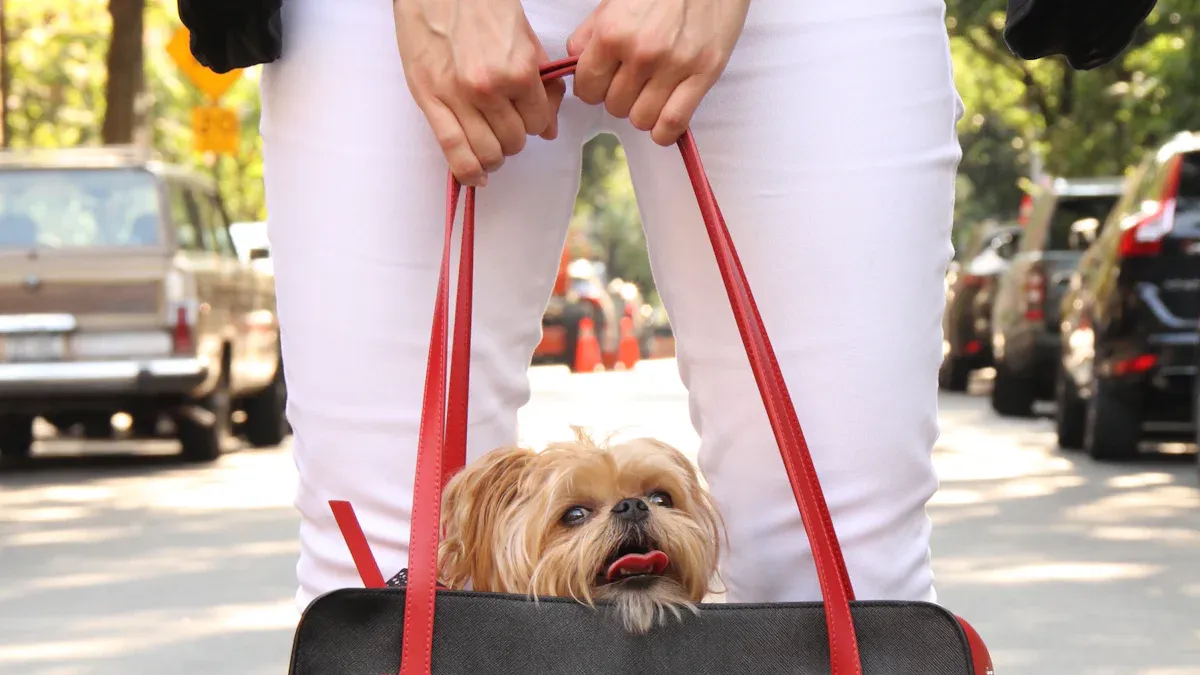
No single carrier design wins every outing. The right choice depends on duration, terrain, dog temperament, and how much postural work you are willing to do as the handler.
Tote Carrier: Short, Calm, Quick-Access
A tote carrier excels when the walk is under 10 minutes, the dog stays still, and you need to get the dog in and out fast. The open top and minimal strapping mean zero setup time. For a vet visit, a quick trip into a store, or carrying a sedate dog from the car to a café patio, the tote’s simplicity is its design advantage. The tradeoff is unambiguous: you accept single-shoulder loading and a soft floor in exchange for instant access. That tradeoff holds up for about 10 to 12 minutes of walking. After that, the fatigue curve steepens and the dog’s stability degrades.
Backpack Carrier: Longer Walks, Stairs, Heat, Uneven Ground
A backpack carrier becomes the better tool when any of these variables increases: duration beyond 15 minutes, elevation change, ambient temperature above 75°F, or a dog that shifts position mid-walk. The dual-shoulder harness, structured base, and multi-surface ventilation are not comfort features — they are failure preventions. Each one addresses a specific way that tote carriers degrade under extended load. A backpack carrier with a rigid base panel and ventilated side panels trades the tote’s instant access for sustained stability. The setup takes 30 seconds longer. The walk can go 45 minutes longer.
Sling/Crossbody Carrier: Ultra-Short, Close-Body Carry
A sling carrier shares the tote’s single-shoulder load path but wraps the dog tighter against the body, reducing the lever-arm effect slightly. It is useful for dogs under 8 pounds on outings under 5 minutes — the kind of carry where strapping into a full backpack would take longer than the walk itself. Beyond that, the shoulder fatigue pattern is the same as a tote.
| Carrier Type | Where It Works | Where It Falls Short |
|---|---|---|
| Tote | Sub-10-minute errands, calm dogs, quick in-and-out access | Any walk over 12 minutes; stairs; dogs that shift or stand |
| Backpack | 15+ minute walks, stairs, uneven ground, warm weather, active dogs | Ultra-short trips where setup time outweighs walk time |
| Sling | Sub-5-minute carries, dogs under 8 lb, close-body preference | Any outing long enough to fatigue one shoulder |
Disclaimer: These duration estimates assume a smooth-coated dog under 15 pounds on level ground at moderate temperature. Double-coated breeds generate more internal heat and may reach discomfort thresholds sooner, especially in backpack carriers with limited side ventilation. Dogs with barrel chests or very deep keels — particularly French Bulldogs, Pugs, and Boston Terriers — may not fit the horizontal resting position that backpack carriers are patterned for. In those cases, check whether the carrier’s base length accommodates the dog’s full sternum-to-rump measurement while lying flat. If it does not, the horizontal-position advantage described here does not apply, and a carrier that allows the dog to sit upright with proper spinal support may be the safer choice.
FAQ
Why does a backpack carrier cause less shoulder fatigue than a tote?
Because of where the load terminates. A tote concentrates the dog’s entire weight through a single strap onto one shoulder joint. A backpack splits the same load across two shoulders and — when a waist belt is present — redirects a portion directly to the hip structure. The biomechanical difference is not subtle: a single-shoulder load forces continuous asymmetrical muscle recruitment just to stay upright. A dual-shoulder load lets your postural muscles work the way they are built to work.
Does a structured base actually matter for short walks?
For walks under 10 minutes with a dog that stays still, a structured base matters less. The dog will not be inside long enough for the floor to deform significantly, and minor sagging will not produce enough spinal curvature to cause restlessness. The base becomes load-bearing when duration, dog weight, or dog movement increases — any one of those three variables pushes a soft floor past its functional limit.
How do I check whether a carrier’s ventilation actually works?
Take a 15-minute walk in temperatures above 70°F. Immediately after, unzip the carrier and feel the interior fabric against the dog’s back. Dry and cool to the touch means airflow reached that surface. Damp or warm means it did not — regardless of how many mesh panels the carrier has. The test tells you whether the panel placement works with the dog’s body position, not against it.
Can a tote carrier be modified to improve stability?
A crossbody strap that runs diagonally across the torso can reduce the shoulder-drift problem somewhat, and a rigid insert placed under the existing floor pad can improve base support. But neither modification changes the fundamental load path: the weight still terminates at a single shoulder. The stability ceiling is set by the suspension architecture, not the accessories.
What is the most overlooked factor when comparing carrier types?
Dog body position inside the carrier. A horizontal resting position — which a properly sized backpack carrier allows — keeps the spine neutral and the airway open. A vertical seated position, which most totes enforce, can compress the diaphragm and restrict breathing over time. This difference affects the dog’s comfort more than strap padding or pocket count, but it is rarely discussed because it requires measuring the dog lying down, a step most sizing advice omits.






