
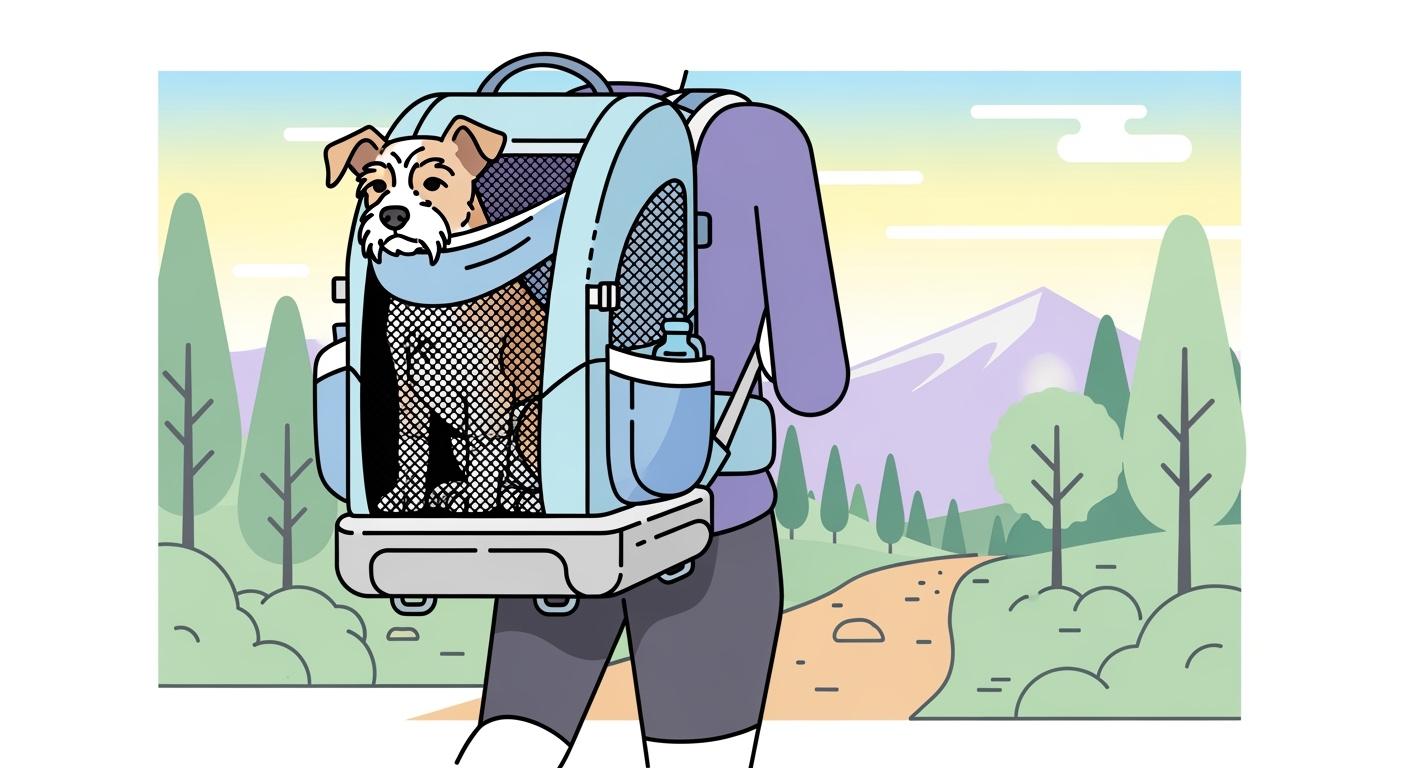
Most small-dog hiking carriers feel fine for the first mile. The problems show up later. A base panel that looked flat in the living room starts to bow under sustained weight. Mesh that felt breathable at the trailhead traps heat once the dog has been inside for twenty minutes. And a carrier that seemed stable during a quick fit check begins shifting as the owner navigates uneven ground.
These are not random failures. They follow directly from specific design decisions — how the base panel is reinforced, where the mesh is placed, and whether the interior structure resists lateral movement or just contains it. A dog backpack carrier for small dog hiking that handles distance well addresses each of these at the structural level, not with thicker padding or larger dimensions.
The Two Design Problems That Show Up After Mile Three
Sagging Base Becomes a Structural Problem Over Distance
A soft base does not announce itself right away. The dog settles in, the owner adjusts the straps, and for the first half-mile everything holds. But fabric stretches. Foam compresses. The panel that started flat develops a dip, and the dog’s weight follows that dip.
Once the base begins to bow, the dog’s hips tilt and the spine curls to compensate. Short-legged breeds and long-bodied dogs — Dachshunds, Corgis, small senior dogs — have less margin for this kind of postural distortion. They cannot brace against the carrier walls the way a larger dog might. Instead they slump farther into the sag, which deepens the dip, which worsens the slump. The loop feeds itself.
This is not a comfort problem alone. Sustained spinal flexion under load can strain the intervertebral muscles and, in dogs predisposed to disc issues, create conditions those dogs were never built to handle inside a moving backpack. The design variable that breaks this cycle is base rigidity — and not just any stiffness, but stiffness concentrated at the center of the load-bearing panel.
| Failure Signal | Likely Carrier Design Cause | Better Design Direction |
|---|---|---|
| Dog slumps or slides forward | Soft, unsupported base panel that bows under weight | Reinforced, rigid base platform |
| Dog curls or twists sideways | Unstable interior with no lateral structure | Structured inner compartment with defined walls |
| Dog cannot settle, keeps readjusting | Uneven weight distribution across the base | Flat, level load platform with even support |
Airflow Shortfalls Compound With Heat and Time
Ventilation looks adequate on a showroom floor. But inside a carrier, the dog is a 101-degree heat source wrapped in fur. On a 70-degree day, the interior temperature of a poorly vented carrier can climb 15 to 20 degrees above ambient within thirty minutes. Mesh panels on one or two sides are not enough — heat rises and pools, and if the top and back panels are solid fabric, that heat has nowhere to go.
Dogs cool themselves primarily through panting and, to a lesser extent, through vasodilation in the ears and paws. Both mechanisms depend on moving air. Stagnant air inside a carrier saturates with humidity from the dog’s breath, which reduces evaporative cooling efficiency. The dog pants harder, produces more moisture, and the cycle accelerates. Brachycephalic breeds enter this spiral faster because their airway geometry already limits heat exchange.
The design fix is not simply “more mesh.” It is mesh placed to create a cross-ventilation path — low intake on one side, high exhaust on the opposite side — so that the dog’s own thermal plume drives airflow rather than blocking it.
- Mesh on only the front panel leaves heat trapped at the top and back.
- Mesh on all sides but without offset placement creates turbulence, not directional flow.
- A low-to-high cross-ventilation path uses convection — warm air rises and exits the high vent, pulling cooler air in through the low vent.
Unstable Load Strains the Owner’s Shoulders
When the dog shifts inside an unstructured carrier, the center of mass moves. The owner compensates by tensing the shoulder on the heavier side, then the opposite shoulder, then leaning slightly forward. Over three miles of mixed terrain, this micro-adjustment cycle adds up. A carrier with a sagging base and loose interior produces more shifts per mile than one with a rigid platform and defined interior walls. The straps can be thickly padded and still fail to help if the load they carry is wandering inside the pack.
Reinforced Base Architecture — Why a Firm Platform Changes Everything
How a Rigid Base Changes the Load Path
The base of a hiking carrier does two jobs that are easy to conflate. It holds the dog’s weight. And it resists deformation under that weight. A base that does the first job but not the second creates a stability problem that padding cannot solve.
Here is the causal chain: when the center of the base panel deflects downward under the dog’s mass, the fabric perimeter that connects the base to the carrier walls goes slack at the lowest point and taut at the edges. The dog’s contact patch — the area where body weight actually presses into the panel — shrinks to the deepest part of the sag. With a smaller contact patch, the same weight produces higher pressure on a smaller area, which accelerates foam compression, which deepens the sag. Each step the owner takes introduces a vertical oscillation. The dog’s hips translate that vertical bounce into a slight lateral rock, and without a flat surface to push against, the dog’s core muscles must stabilize against the motion instead of resting.
After two miles of this, a small dog has performed the equivalent of several hundred micro-corrections. That is when the slumping begins in earnest — not because the dog is tired, but because the platform it is sitting on stopped being a platform.
A reinforced base interrupts this chain at the first link. A rigid insert — typically a stiff plastic or composite panel sewn into or slid beneath the base fabric — distributes the dog’s weight across its full surface area. The contact patch stays large. The foam compresses evenly rather than locally. And the vertical oscillation from the owner’s stride transmits as a uniform lift-and-settle rather than a rocking tilt. The dog’s core muscles can relax because the surface beneath them is not moving independently.
Tip: Set the empty carrier on a table and press down on the center of the base with approximately your dog’s weight. A base that deflects more than a half-inch under that pressure will not hold posture steady across miles of uneven trail. This check catches the most common design shortfall before the dog ever enters the carrier.
Interior Structure Keeps the Dog From Becoming a Shifting Load
A rigid base solves the vertical problem. It does not solve the lateral one. If the interior compartment is a single unstructured cavity, the dog can still slide side to side when the owner tilts on uneven trail sections. This matters because a small dog’s body is light enough that even modest lateral forces — stepping across a slope, rounding a switchback — can push it against the carrier wall.
Interior structure takes a few forms. A defined compartment with semi-rigid side panels limits the dog’s range of lateral movement. Internal tether points let the owner clip the dog’s harness to a fixed anchor, which prevents the dog from turning around or leaning out. Both features serve the same function: they keep the dog’s center of mass aligned with the carrier’s load-bearing axis, which in turn keeps the weight balanced across both of the owner’s shoulders. When the load stays centered, backpacking with a dog carrier becomes sustainable over real distance rather than something you tolerate for twenty minutes.
Ventilation Design — When Mesh Count Matters Less Than Mesh Placement
Why Cross-Ventilation Beats More Mesh Panels
Adding mesh panels to every side of a carrier sounds like the obvious fix for heat buildup. But panel count is a weaker predictor of cooling performance than panel arrangement. Two well-placed mesh panels — one low on the front face, one high on the rear — can move more air than four panels all positioned at the same height. The reason is convection. The dog’s body warms the air inside the carrier. That warm air rises. If the highest vent is on the side at mid-height, the warmest air pools above it and never escapes. If the highest vent is at the top of the rear panel, warm air exits there, creating negative pressure that draws cooler outside air in through the lower front vent.
This does not require powered fans or exotic materials. It requires the vent layout to respect the direction heat naturally travels. A carrier designed with offset vent positioning uses the dog’s own body heat to drive the airflow cycle, turning a passive design into an active cooling system.
| Design Difference | Why It Matters | Where It Falls Short |
|---|---|---|
| Mesh on front and top only | Lets heat rise and exit directly above the dog | Side winds cannot create cross-flow; still air = no cooling |
| Mesh on all four sides at same height | Looks well-vented; works in a stiff breeze | No vertical convection path; hot air pools above vent line on calm days |
| Offset low-front / high-rear mesh | Creates a convection-driven airflow loop using the dog’s body heat | Performance drops if either vent is blocked by the owner’s back or jacket |
Observing Ventilation Performance in the Field
A carrier’s ventilation claims are easy to check. After fifteen minutes of carrying on a warm day — not hot, just warm — unzip the side panel and feel the back of the dog’s neck and the area between the shoulder blades. If those spots are damp and the day is not humid enough to explain it, the carrier is trapping moisture rather than venting it. A well-vented carrier moves enough air across the dog’s body to evaporate light perspiration before it accumulates.
A second check: after the same fifteen-minute window, put your hand flat against the inside of the top panel. If the fabric feels noticeably warmer than the outside air, heat is pooling at the highest point — a sign that the highest vent is positioned too low or is undersized for the volume of air the dog is heating.
These two observations — dampness at the neck and warmth at the top panel — catch the most common ventilation failures. Neither requires special equipment. Both tell you more than a spec sheet ever will.
When a Well-Designed Carrier Still Is Not the Right Choice
A carrier with a rigid base, offset ventilation, and a structured interior solves the three main failure modes that show up on longer hikes. But no carrier design covers every dog and every trail.
Dogs with severe anxiety or confinement distress may panic regardless of how well the interior is structured. A small dog that has never been carried in an enclosed space needs gradual acclimation — short sessions at home with the carrier open, then brief carries around the block, then longer outings. Skipping these steps turns a well-designed carrier into a source of stress, and a stressed dog in a backpack is a safety risk for both dog and owner.
Terrain also sets limits. Scrambling sections that require the owner to use both hands, stream crossings where a slip could submerge the carrier, and trails with sustained grades above 15 percent all introduce forces that exceed what any backpack carrier is designed to manage. On these sections, the dog is safer walking on its own or being carried in a different setup entirely.
The right design dramatically expands the range of hikes a small dog can join. It does not make every hike safe.
Disclaimer: The fit and ventilation checks described here assume a smooth-coated or short-haired small dog in moderate outdoor temperatures. Double-coated breeds retain heat differently and may show subtler overheating signals — dampness at the neck may not appear until internal temperature is already elevated. For these dogs, supplement the dampness check with a behavioral check: if the dog stops looking around and fixes its gaze straight ahead without moving, it may be heat-stressed even if the coat feels dry. Dogs with brachycephalic airway syndrome, cardiac conditions, or known spinal issues need veterinary clearance before any carrier-based hiking, regardless of how well the carrier is designed.
FAQ
How do you check whether a carrier base is firm enough before buying?
Press down on the center of the unloaded base with roughly your dog’s weight. If the panel deflects more than a half-inch, it will sag further under sustained load and trail motion. Some carriers let you remove and reinforce the base insert — if the base is a sleeve with a removable stiffener, swapping in a thicker panel is a low-cost fix for an otherwise well-built carrier. For a small-dog-specific carrier, base rigidity is disproportionately important because a light dog has less mass to press the panel flat, so any curvature in the base becomes the shape the dog must conform to.
Do all small dogs need the same level of base support?
No. A six-pound Chihuahua with short legs and a compact torso distributes weight differently than a twelve-pound Dachshund with an elongated spine. Long-backed breeds need a flatter, more rigid base because any sag amplifies spinal flexion. Short-legged breeds need base support that extends to the edges so the dog’s legs do not slip into gaps between the base panel and the carrier wall. A carrier built with a full-coverage rigid insert addresses both body types; a carrier with a smaller insert or foam-only base does not.
How can you tell if ventilation is adequate for your dog?
The two-field-check method works for most dogs: after 15 minutes of carrying, feel the back of the neck for dampness and the inside of the top panel for trapped heat. If the neck is damp on a non-humid day, or the top panel is noticeably warmer than outside air, the vent arrangement is insufficient for that dog in those conditions. A carrier with low-front and high-rear mesh typically resolves both issues by creating a convection path that does not depend on outside wind.
Can a carrier that works for city errands handle a three-hour hike?
Rarely. Carriers designed for short carries prioritize compactness, quick access, and a low profile. Hiking carriers prioritize sustained load stability, cross-ventilation, and structured interiors. The design trade-offs run in opposite directions. A compact upright carrier with minimal mesh works fine for a twenty-minute coffee run. On a three-hour trail, the same carrier produces the base sag, heat buildup, and load shift problems described above. Using a carrier outside its design range is the single most common reason a hike gets cut short.






