
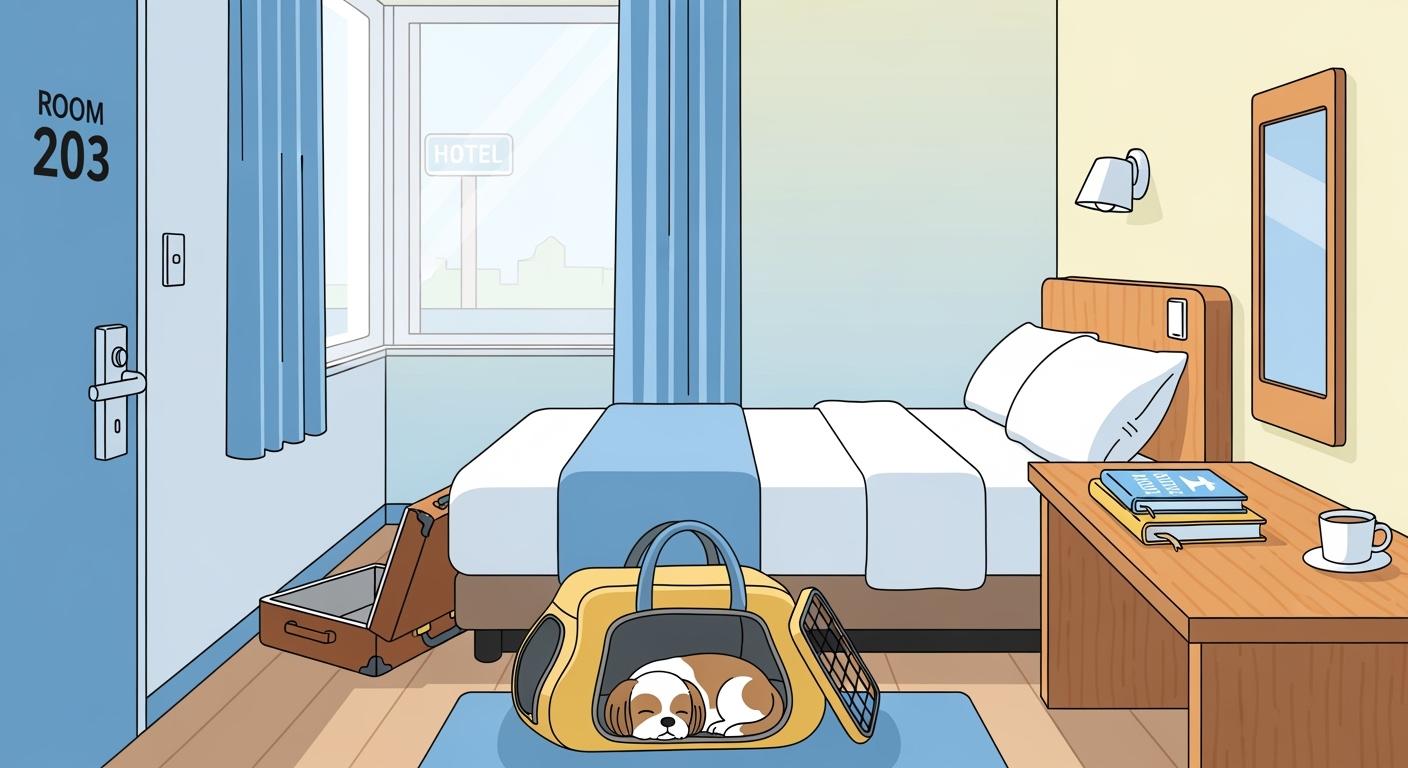
Walk into a hotel room with a carrier that has a thin fabric base and hard frame corners, and the trouble starts before you unzip it. Damp paws leave marks on the carpet. The frame scrapes the nightstand when you set it down. And a carrier that does not fold sits in the middle of the floor all night — a tripping hazard in the dark. A hotel room amplifies every design weakness a carrier bag has. The same features that go unnoticed at home become problems the moment you check in.
Three design decisions determine whether a dog carrier bag for hotel travel makes the stay easier or turns it into a damage report. The base either seals or leaks. The structure either absorbs noise or broadcasts it. And the frame either folds flat or eats the floor. This article walks through why those three details matter more inside a hotel room than anywhere else.
Why Most Carriers Turn a Hotel Room into a Problem
A base that absorbs instead of repels
The bottom panel of a carrier is the only barrier between whatever is inside and the hotel floor beneath it. Thin fabric bases — typically a single layer of uncoated polyester or cotton-blend canvas — pull moisture in through capillary action. Water, urine, or condensation from a water bowl spreads across the fabric surface and seeps through to the carpet or hardwood below. The carrier becomes a wick, not a container.
That is why the first walk-through check matters. After your dog has been inside for 20 minutes, lift the carrier and run your hand across the floor underneath. Dampness or a cool spot means the base has already transferred moisture. Stains that reach hotel carpet padding are not surface-cleaned — they often require a section replacement, and the charge lands on your bill.
Designs that fail at this level share a common flaw: a single-layer bottom that was never intended to block liquid. It works fine as a dry-weather tote slung over a shoulder on a short walk through a city. It fails in a hotel room where a dog spends hours inside.
Hard edges that broadcast noise
Hotel hallways and rooms are acoustically hard spaces — minimal soft furnishings, bare walls, uncarpeted corridors. Sound carries. A rigid-frame carrier with exposed plastic corners or metal hinge hardware turns every movement into a sharp report. When you shift the carrier at 11 p.m., the scrape of a hard edge against a wall or doorframe travels through the building.
Zippers add a second layer of noise. Coarse-tooth zippers with stamped metal sliders rattle when the dog shifts inside. A restless dog in a carrier with noisy hardware can keep you — and the guests in the next room — awake.
The quieter alternative is not simply “soft” — it is a structural tradeoff where the panel material itself damps vibration instead of transmitting it. Foam-backed polyester panels absorb the high-frequency noise that hard plastic frames reflect. The difference is audible the first time you set the carrier down on a hard floor.
Bulk that cannot disappear
A standard hotel room offers roughly 25 to 30 square feet of unobstructed floor space between the bed, desk, and dresser. A non-folding carrier with a fixed 24-by-16-inch footprint consumes over 2.5 square feet of that — nearly 10 percent of usable floor area. That is before luggage, a dog bed, and a food station.
When the carrier does not fold, it dictates the room layout. You walk around it. You trip over it in the dark. It becomes a permanent obstacle. Many common carrier bag mistakes trace back to mismatched expectations about where and how the carrier will actually be used — a carrier that worked in a living room becomes a liability in a 200-square-foot hotel room.
| Hotel-use failure | Design cause | Why it matters | Where it works instead |
|---|---|---|---|
| Floor stains under carrier | Single-layer uncoated fabric base | Moisture wicks through to carpet padding; replacement-level damage | Dry indoor floors, short stays |
| Noise complaints or disturbance | Rigid frame corners, coarse-tooth zippers | Hard surfaces reflect and amplify impact noise through walls | Outdoor use where noise is irrelevant |
| Lost floor space, tripping | Fixed-frame, non-folding structure | Consumes ~10% of usable hotel floor area; cannot be stored | Permanent home setups |
What a Leak-Resistant Base Actually Needs to Do
Liquid moves through fabric along two paths: directly through pores in the weave, and laterally along individual threads via capillary action. A single-layer woven polyester panel offers both paths. Water hits the surface, fills the gaps between yarns, and spreads outward before soaking downward. The result is a wet spot larger than the original spill, with some liquid already through to the other side.
A leak-resistant base interrupts both paths. The inner surface layer — typically a thermoplastic polyurethane (TPU) coating or a laminated waterproof membrane — closes the direct pores. The coating also blocks lateral wicking: liquid beads on the surface instead of traveling along the threads. What reaches the hotel carpet is zero, provided the seams hold.
This is why a wipeable surface is not a convenience feature. It is the visual confirmation that the barrier layer is intact and working. After an accident, run a dry paper towel across the base interior. If it comes away completely dry except where liquid pooled, the seal is continuous. If you find damp streaks along seam lines, the barrier has a breach — and the carrier is no longer hotel-safe.
Tip: Before a trip, pour two tablespoons of water into the empty carrier base and wait 10 minutes. Wipe it out and check the underside. Any moisture transfer means the base coating has degraded and the carrier should not be placed on hotel carpet.
Seams and zippers as failure points
The base coating only works if the seams are sealed. A carrier can have a TPU-lined bottom and still leak through the stitching holes where the base panel joins the side walls. Each needle puncture during sewing creates a channel through the coating. Water under pressure — from a dog stepping into a small puddle inside the carrier — follows those channels outward.
The fix at the manufacturing level is seam taping or welded-seam construction, where a waterproof tape is heat-bonded over every stitched seam on the interior. This adds a production step and material cost, which is why lower-cost carriers skip it. The result is a carrier that looks leak-resistant but is not. A proper fit and material checklist catches these gaps before a trip, but many travelers only discover the problem when they see the stain.
Zippers create a separate channel. Even with a sealed base, a zipper that does not close fully — or one without a fabric welt covering the teeth from inside — leaves a gap where liquid can escape if the carrier tips. Smooth, close-tooth zippers with an interior fabric guard strip reduce this risk. They are also quieter, which matters when a dog shifts position at 2 a.m.
Soft-Sided and Foldable — When Structure Matters More Than Ruggedness
Panel construction and noise transmission
A rigid plastic panel and a foam-backed polyester panel react to impact differently at the physics level. When a hard plastic corner strikes a wall or floor, the collision impulse is short and sharp — the plastic does not deform, so nearly all the kinetic energy converts to sound pressure in a single millisecond spike. That spike travels through hotel drywall and wakes the neighbor.
A foam-backed soft-sided panel deforms on impact. The foam compresses, stretching the collision impulse over a longer time window — 5 to 10 milliseconds instead of 1. The peak sound pressure drops by an order of magnitude. Same bump, same force, but the noise profile is fundamentally different. This is not about “soft equals quiet” as a rule of thumb — it is about impulse broadening as a physical mechanism.
The test is simple: set the empty carrier on a hard floor and push it sideways one foot with your hand. A rigid frame produces a clear scrape or clatter. A foam-backed panel produces a muffled thump. That difference is what hotel neighbors hear — or do not hear.
Fold-flat geometry and usable room space
A carrier that folds flat does more than save packing space. It changes the carrier from a permanent room fixture into something you deploy only when needed. During the day, it slides under the bed. At night, it comes out. The room stays navigable.
The mechanical requirement is straightforward: the side panels must hinge inward without permanent deformation, and the base must remain rigid enough to support the dog when unfolded. This is achieved with a combination of flexible panel hinges — often a strip of unreinforced fabric at the fold line — and a stiff base insert, typically a removable rigid board or high-density foam panel that doubles as the structural floor. A foldable pet carrier built this way collapses to under 3 inches thick and regains its shape when the base board is reinserted.
Carriers that achieve this without sacrificing stability tend to use a bathtub-style floor design — a rigid perimeter edge that holds the base insert in place and prevents the walls from caving inward under the dog’s weight. The bathtub edge also contains small spills, adding a secondary leak barrier. Without it, a soft-sided carrier can pancake when the dog leans against a side wall.
| Material | What it does in a carrier panel | Main limitation |
|---|---|---|
| Polyester Oxford with foam backing | Damps impact noise, holds shape under lateral pressure, cleans with a wipe | Heavier than unbacked fabric; dries slower if soaked |
| Nylon ripstop (unbacked) | Lightweight, resists tearing, packs very flat | Transmits noise readily; no impact damping |
| Neoprene-faced panels | Excellent vibration absorption, soft against furniture | Premium cost; can retain odor if not aired |
| Rigid plastic frame (ABS/PP) | Maximum crush resistance, holds precise shape | Loud on impact; bulky; cannot fold |
Breathable mesh panels serve a dual role in hotel use. They provide ventilation — important for breeds prone to overheating in enclosed spaces — and they reduce condensation buildup inside the carrier. A carrier with mesh on at least three sides allows cross-ventilation. Without it, body heat and exhaled moisture from the dog raise the internal humidity, which can accelerate odor development in the fabric lining. Carriers designed for commuting and weekend trips often prioritize multi-panel mesh for exactly this reason — the carrier needs to stay habitable for hours at a time, not just for a 15-minute errand.
When This Carrier Type Is Not the Right Pick
A leak-resistant, soft-sided, foldable carrier solves specific hotel-travel problems. It is not the best choice for every scenario.
If the dog is a determined chewer, soft-sided panels and mesh windows are vulnerable. A dog that chews through fabric in 30 minutes needs a hard-sided crate, not a soft carrier — even at the cost of noise and bulk. The design tradeoffs that make a carrier hotel-friendly also make it less resistant to sustained chewing.
If the trip involves airline cargo holds rather than hotel rooms, the requirements flip. Cargo-grade carriers prioritize crush resistance and rigid locking mechanisms — features that directly conflict with foldability and low-noise panel construction. Fit and sizing checks for backpack-style carriers follow a different set of rules than what a hotel room demands.
If the dog is over roughly 40 pounds, the bathtub-floor structural approach has limits. The rigid base insert bears the dog’s full weight, and a larger dog can flex the board enough to collapse the side walls inward. Above that weight threshold, a semi-rigid frame with a folding mechanism becomes the better compromise — though it adds weight and some noise.
Disclaimer: The leak-resistance checks described here assume a smooth-coated dog whose paws and body do not carry excessive water into the carrier. Double-coated breeds or dogs that drool heavily may introduce more moisture than the base coating can contain before it beads and rolls off — in those conditions, hand-check the floor under the carrier more frequently, and consider a secondary absorbent mat inside the carrier that is changed every few hours during the stay.
Disclaimer: Fold-flat soft-sided carriers rely on zipper integrity for containment. If the dog is an escape artist who has previously worked zippers open from the inside, a soft-sided design is the wrong tool regardless of how well it performs on noise, leak resistance, and storability. The quietest carrier in the hotel means nothing if the dog is not inside it.
FAQ
How is a hotel-specific carrier different from a general travel carrier?
A general travel carrier is designed for transport — it prioritizes portability and crash safety. A hotel-use carrier adds three constraints: the base must be leak-resistant because it sits on carpet for hours, the structure must be quiet because walls are thin, and the frame must fold because floor space is scarce. Most general carriers handle one or two of these. Few handle all three.
Can a carrier with a removable fleece pad be leak-resistant?
The fleece pad itself is absorbent — it will soak up liquid. What matters is whether the base panel underneath the pad is sealed. Remove the pad and inspect the base material directly. If the base is the same fabric as the side walls with no coating or lamination, the pad is the only barrier — and once saturated, it transfers liquid through. A true leak-resistant design has a coated or laminated base that functions independently of the removable pad.
What is the single best pre-trip test for hotel readiness?
Set up the carrier on a light-colored towel at home. Pour two tablespoons of water into the center of the base. Wait 10 minutes. Wipe the interior dry, then lift the carrier and check the towel. Any moisture on the towel means the base is not sealed. No moisture — and the carrier passes the hotel-floor test.
Does a soft-sided carrier provide enough stability for an anxious dog?
It depends on the dog’s anxiety response. A dog that trembles or shifts position frequently benefits from the foam-backed panels, which absorb movement without broadcasting noise. A dog that lunges or throws body weight against the walls can collapse a soft-sided carrier. In that case, a semi-rigid folding crate is the safer middle ground — it trades some quietness for structural integrity.
How long can a dog safely stay in a hotel carrier?
Ventilation is the limiting factor, not space. A carrier with mesh on three or four sides and a room-temperature hotel environment allows multi-hour stays, assuming the dog has been exercised and relieved beforehand. Without adequate cross-ventilation, internal humidity climbs and the dog can overheat — particularly in breeds with shortened airways. Check the dog every two hours; if the carrier interior feels warmer than the room or the mesh panels show condensation, ventilation is insufficient.






