
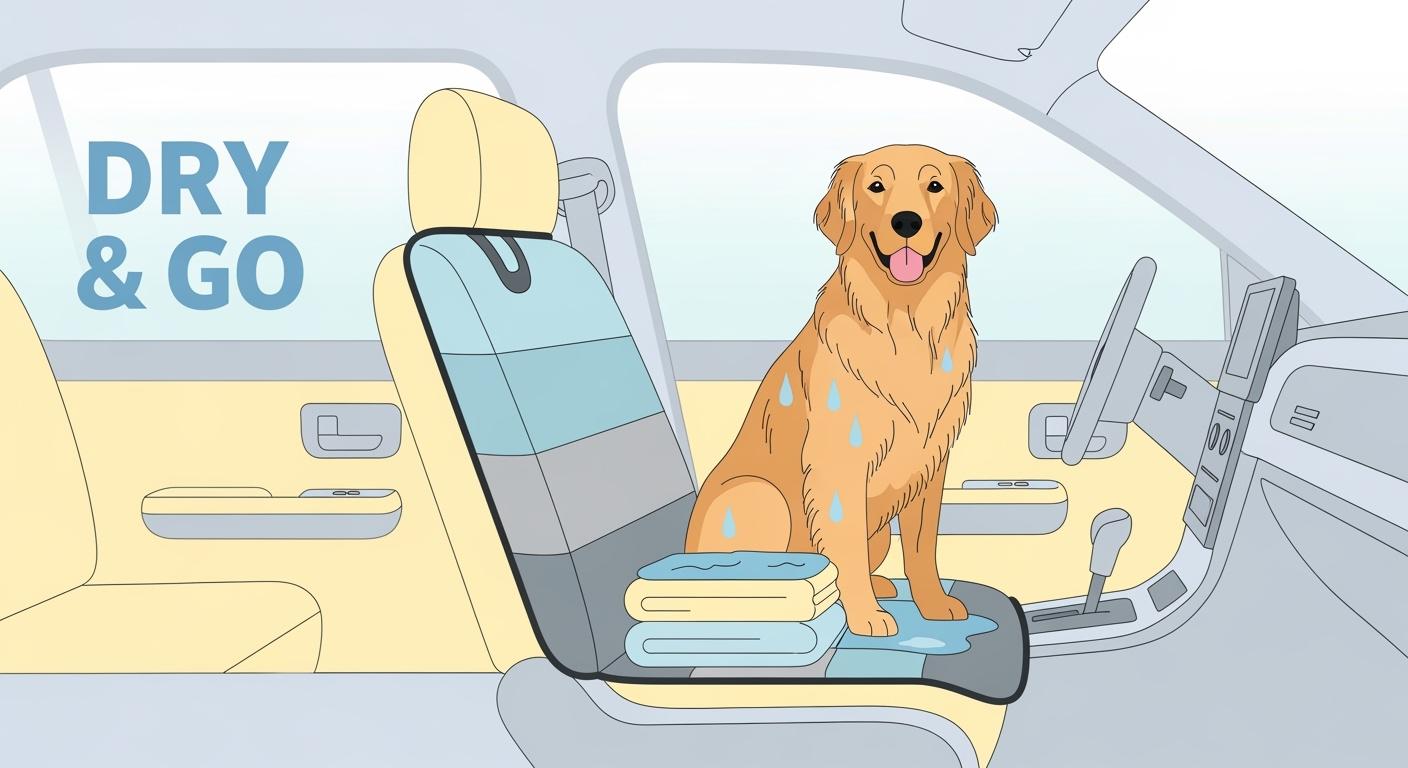
A wet dog climbs into the back seat and shakes off. You toss a towel over the cover, thinking that solves it. But water from the fur and the towel presses through the surface into the padding underneath. The cover looks dry on top while moisture sits trapped in the middle layer. A few trips later, the car smells. The problem is not that the cover got wet — it is that the cover held onto the water instead of letting it go.
Not every car seat cover fails this way. The difference comes down to three design choices: whether the top layer resists water penetration, whether the backing actually seals, and whether the padding absorbs or sheds moisture. A cover built around those three layers as a system dries fast and resists odor. One with a weak link in any layer traps moisture and smells within days.
Why Wet Dogs Make Some Covers Smell — and Others Do Not
The Moisture Path Through Cover Layers
Water does not sit still on a dog car seat cover. A wet dog shifts position, lies down, presses weight into the fabric. That weight drives moisture downward. If the top layer has an open weave or uses absorbent material, water passes through almost immediately. If the padding beneath is quilted cotton or closed-cell foam — materials chosen for softness, not drying speed — the water stays there. Body heat from the dog warms the trapped moisture, turning the padding into a slow incubator for bacteria.
The causal chain is straightforward. Water enters the top layer → padding holds it → the backing, if permeable, lets it reach the seat. Even if the backing blocks the seat itself, the padding stays damp. On the next trip, more water joins what is already there. The cover never fully dries between uses.
Seams make this worse. Stitch lines pierce every layer. Each needle hole is a capillary path — water wicks along the thread and into the padding from the sides, not just from the top. A cover with quilted stitching has dozens of these paths across its surface.
In practice: After a wet-dog trip, press a dry paper towel firmly into the cover for 10 seconds. Moisture on the towel means the top layer let water through and the padding is holding it. A dry towel with visible water beads still on the surface means the top layer did its job — wipe and go.
Why Odor Builds Up Over Repeated Wet Trips
Odor is not caused by water alone. It is caused by bacteria feeding on organic matter — skin oils, saliva, and dirt from the dog’s coat — in a warm, wet environment. Slow-drying padding extends the window during which bacteria multiply. A cover that dries in 30 minutes under airflow gives bacteria little time. One that stays damp for hours gives them a full growth cycle.
The fabric type also matters. Natural fibers and some synthetic foams bind odor molecules at a molecular level, holding them even after the material dries. Washing removes surface contaminants but often cannot extract what has bonded into the foam cells. That is why some covers smell again shortly after being washed — the odor was never fully removed.
Three Layers That Determine How a Cover Handles Moisture
Top Layer: Water Resistance vs. Absorption
The top layer is the first decision point. A tightly woven synthetic — Oxford cloth, high-denier polyester — forces water to bead on the surface rather than penetrating. The weave density matters more than any coating. Coatings wear off with washing and abrasion. Tight weaves can persist through dozens of wash cycles because the barrier is structural, not chemical.
Compare that to a quilted cotton or soft fleece top layer. Those materials are chosen for tactile comfort — they feel nicer to the hand on a retail shelf. But they wick water instantly. Once the surface is wet, the padding beneath has already started absorbing. A hammock-style cover with a dense synthetic top layer leaves water visible on the surface where you can wipe it away.
Tip: After extended use, even a tightly woven top layer can lose water repellency as dirt clogs the weave. A gear reproofing spray restores the surface tension without adding a coating that peels.
Backing and Padding: Blocking vs. Holding Water
The backing is the seat’s last line of defense. A waterproof backing uses a continuous film barrier — typically TPU or a laminated membrane — that water cannot pass through in liquid form. Water-resistant backing, by contrast, only slows penetration. The distinction becomes critical when a 60-pound wet dog lies on the cover for an hour-long drive. Sustained pressure pushes water through a water-resistant backing that would have held up against a quick spill.
The padding between the top layer and backing determines drying speed. Non-absorbent padding — open-cell structured foam or synthetic batting that does not hold water — dries from both sides once the surface moisture is wiped away. Absorbent padding acts like a sponge. It pulls water in and releases it slowly, keeping the interior damp long after the surface feels dry.
| Design Feature | How It Handles Moisture | Where It Falls Short |
|---|---|---|
| Tightly woven synthetic top layer | Water beads on surface; structural weave resists penetration even after washing | Less soft to the touch; may feel slick to dogs that scramble during entry |
| TPU or membrane waterproof backing | Blocks liquid water under sustained pressure from a dog’s weight | Traps body heat if not paired with breathable padding; can feel warmer in summer |
| Non-absorbent open-cell padding | Dries from both sides; does not hold water or odor molecules in cell structure | Thinner feel than quilted padding; less cushioning for dogs that prefer a soft surface |
Removable Construction and Drying Access
A fixed cover — one that does not detach from its straps and anchors — cannot be removed for machine washing or hung to dry. Moisture trapped in the seams and padding has no way out except slow evaporation through the surface. A removable design lets you separate the cover body from its mounting hardware so the entire fabric panel can air out or go through a wash cycle.
Drying a cover fully between uses prevents the moisture buildup that leads to odor. Hang the cover over a door or drying rack so airflow reaches both sides. Laying it flat on a surface traps moisture against the backing and slows drying — exactly the condition the cover was designed to prevent on the car seat itself.
Note: Check the car seat surface under the cover after a wet-dog drive. Run your hand across the seat fabric. Dry = the backing held. Damp or cool to the touch = water got through. This check takes 5 seconds and tells you whether the cover’s waterproofing is still intact.
Why a Secure Fit Matters More When the Dog Is Wet
A loose cover creates problems that a dry dog might not reveal. When the cover shifts under a wet dog, water gets pushed into folds and gathers at the edges. A cover that fits flat and stays anchored keeps the surface smooth so water beads rather than pools. The difference is not just about neatness — pooled water creates a path past the backing at the edges, where the waterproof layer often ends.
The anchor system does the work here. Headrest straps hold the top edge against the seat back. Seat anchors — small cylindrical plugs pushed into the gap between the seat back and bottom cushion — prevent the cover from sliding forward when the dog jumps in or shifts during a turn. Without seat anchors, the cover rides forward and bunches under the dog, creating folds that trap moisture.
The non-slip backing is a separate mechanism. It uses a high-friction rubberized surface on the underside of the cover to grip the car seat. When a wet dog shakes off — a motion that generates lateral force — the non-slip backing resists the sideways slide. The same principles that keep a booster seat from tipping apply here: multiple anchor points plus surface friction create stability that any single attachment method cannot match.
A shifting cover also compromises the dog’s footing. Wet paws on a sliding surface increase anxiety during the drive. The dog tenses, shifts more, and pushes more water into the cover. A stable surface reduces that cycle.
Tip: After installing the cover, grab the front edge and pull forward with moderate force. If the cover moves more than an inch before the anchors catch, adjust the strap tension or reposition the seat anchors. This check catches loosening before a wet trip exposes it.
When a Waterproof Hammock Cover Is Not the Right Choice
Waterproof hammock-style covers work best for back-seat use with one or two dogs where the primary concern is moisture and dirt containment. The hammock design bridges the gap between the front and rear seats, creating a sling that also blocks a dog from climbing into the front. That design adds protection — but it also adds constraints.
Hammock covers limit passenger access. If you regularly carry people in the back seat alongside the dog, removing and reinstalling the hammock takes time. A bench-style cover leaves the seat usable for passengers while still protecting the seating surface from moisture. The trade-off is side protection — a bench cover does not block the footwell gap, so water and hair can still reach the floor.
Hammock covers also assume a standard bench seat. In vehicles with contoured or deeply bolstered rear seats, the flat hammock surface may not sit flush against the seat back, leaving air gaps where a dog’s weight can stretch the fabric and create stress points at the straps. In split-folding rear seats, the center gap between the seat sections can let water through if the cover does not have a reinforced center panel that bridges the split.
Disclaimer: If your dog has a double coat — huskies, malamutes, shepherds — the dense undercoat holds far more water than a smooth-coated breed and releases it slowly as the dog lies on the cover. Even a well-designed waterproof cover may need a mid-trip surface wipe on long drives with these breeds. The water volume simply exceeds what surface tension can hold in bead form. A second dry towel laid under the dog for the first 15 minutes of the drive gives the cover’s surface time to shed the initial water load before sustained pressure sets in.
FAQ
Can a dog car seat cover handle a dog that is fully soaked after swimming?
Yes, if the cover uses a water-resistant top layer and a sealed waterproof backing. The top layer keeps most water on the surface where you can wipe it. The backing stops what gets through from reaching the seat. A fully soaked dog brings more water volume than a rain-damp dog — wipe the surface after the first few minutes of the drive to clear pooled water before the dog’s weight presses it into the seams.
Why does a cover sometimes smell even after washing?
Odor molecules can bond into absorbent padding at a molecular level. Surface washing removes contaminants from the fabric face but often leaves what has penetrated into foam cells. Non-absorbent padding avoids this by never giving odor molecules a place to bond in the first place. If your cover smells after washing, the padding type — not the wash method — is the root cause.
How often should the cover be fully removed and dried?
After any trip where the dog was wet enough to leave the cover surface damp to the touch. Remove the cover, hang it so air reaches both sides, and let it dry completely before reinstalling. Leaving it on the seat traps moisture against the backing and creates the same damp environment the waterproof layer was designed to prevent.
Does the non-slip backing lose grip over time?
Rubberized non-slip backing can lose grip if dirt, hair, or oils build up on the contact surface. Wiping the underside with a damp cloth every few weeks restores the friction surface. If the backing peels or cracks — usually from prolonged heat exposure in parked cars — the cover should be replaced because a compromised backing can trap moisture in the peeling layers against the seat.






