
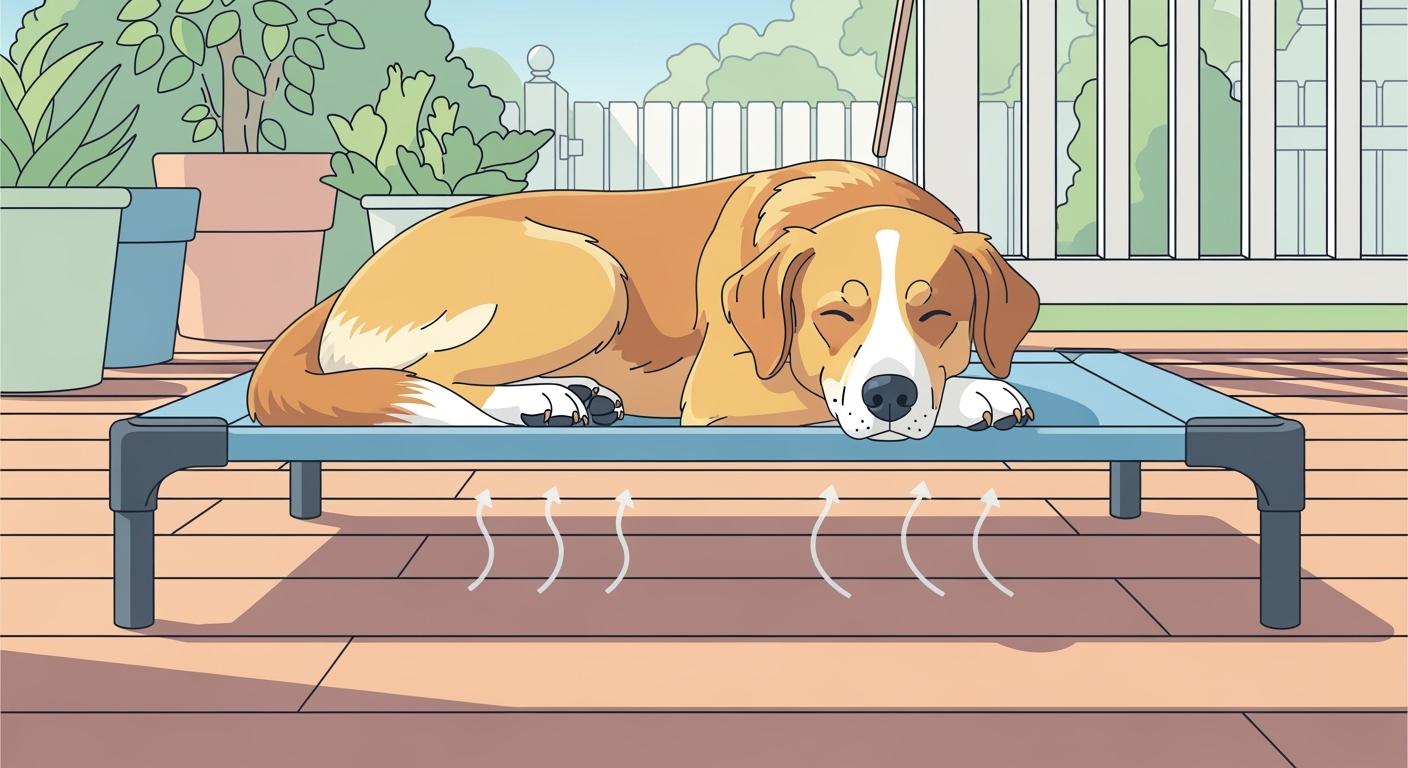
A deck in full sun stores heat. By mid-afternoon the boards can climb past 130°F even when the air is only 85°F. Drop a flat dog bed on that surface and the bed becomes part of the problem. The deck does not care what sits on it — it transfers heat into anything in contact. A raised bed changes the physics entirely. Instead of conducting heat upward through padding, it creates an air gap that lets moving air carry heat away before it ever reaches the dog.
Why a Flat Bed Turns a Hot Deck Into a Heat Trap
Sun-Heated Decks Create a Direct Conduction Path
Heat moves from a hotter object to a cooler one. A sun-baked deck at 130°F will transfer thermal energy into a dog bed — and then into the dog — through direct conduction. There is no air gap to interrupt the path. Deck, bed fabric, padding, dog: one thermal chain.
Body weight makes it worse. When a dog lies down, the fabric and fill compress. Whatever millimeter of air might have existed between the deck and the bedding collapses. The bed is no longer a barrier. It is a bridge. Even a two-inch foam pad with a 130-degree underside will heat through — foam slows conduction but does not stop it.
The observable signal is straightforward. After your dog has been lying on a flat bed for 15 minutes on a warm deck, slide your hand under their chest. If the fabric feels warmer than the surrounding air, the bed is storing heat, not shedding it. A bed that accumulates heat is one that has lost the cooling battle.
Thick Padding and Waterproof Layers Make Heat Release Harder
Padding thickness does not solve the conduction problem. Closed-cell foam and memory foam trap heat because their structure lacks open channels for air movement. Heat penetrates from below, body heat enters from above, and the foam holds both. The dog lies in a pocket of warmth that intensifies the longer they stay.
Waterproof covers add a second barrier that works against cooling. A non-breathable membrane stops moisture from reaching the fill — that is its job. But it also stops body heat and deck heat from escaping. Moisture vapor from the dog’s underside condenses against the cover, and the whole surface turns clammy. A cover that blocks water in one direction also blocks heat in both.
| Bed Feature | Cooling Performance | Heat Release | Drying Speed |
|---|---|---|---|
| Thick foam, no airflow | Low | Slow | Slow |
| Waterproof, non-breathable | Low | Slow | Slow |
| Raised mesh, airflow | High | Fast | Fast |
Note: The difference between a bed that stays cool and one that traps heat is not about how much padding it has. It is about whether heat has a path to leave.
How a Raised Frame and Breathable Mesh Reverse the Problem
Elevation Swaps Conduction for Convection
Lift the sleeping surface six to eight inches off the deck and the heat-transfer mechanism changes. The deck still radiates warmth upward, but moving air carries it away before it saturates the bed. Conduction — direct contact between surfaces — is replaced by convection, where air itself becomes the cooling medium.
Here is the physical chain that makes it work. The deck heats the air directly above it. That air becomes less dense and rises. Cooler air from the sides moves in to replace it. This cycle — natural convection — runs as long as a temperature difference exists between the deck and the surrounding air. A raised bed places the sleeping surface above the warmest layer of this convection current. By the time air reaches the mesh, it has already mixed with cooler ambient air.
The mesh fabric completes the design. Open-weave polyester or Textilene has low thermal mass — it cannot store enough heat energy to become a secondary heat source the way foam does. When a dog lies on it, body heat radiates downward through the open weave. Rising air carries that heat off. The cycle resets in seconds. A steel-frame elevated dog bed built around this principle relies on the frame for structure and the mesh for thermal performance — each material does one job well.
In practice: The cooling cycle depends on frame height, mesh openness, and fabric tension working together. If any one of these three is compromised — a frame that sits too low, a weave that is too dense, or fabric that has stretched and sagged — the cooling effect drops sharply, even if the bed looks intact.
Mesh Tension Preserves the Air Gap
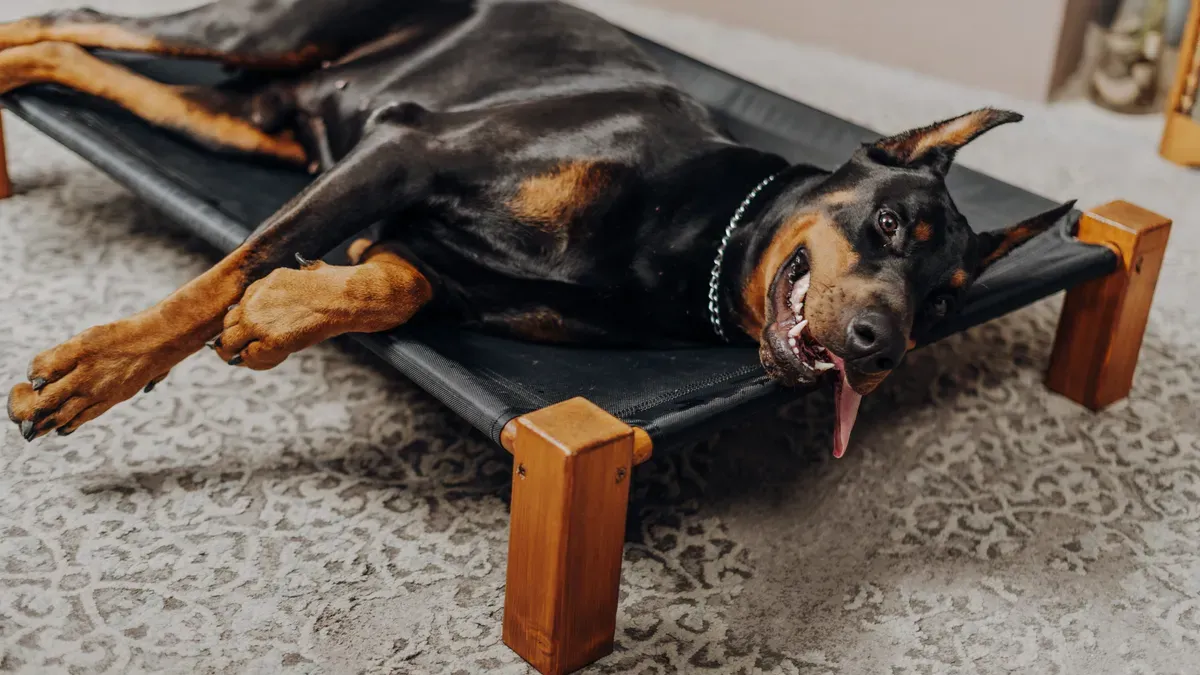
Mesh tension is the structural detail that determines whether the air gap holds. A tightly tensioned panel acts as a tensioned membrane, distributing body weight outward to the frame rails. This prevents sagging. Sag is the enemy of cooling — if the fabric dips into the warmer air zone near the deck, the effective air gap shrinks and the convection cycle weakens.
Frame height and fabric tension are not independent choices. A taller frame tolerates some sag and still keeps the dog above the warmest air layer. A lower frame needs higher tension to maintain the same clearance. The design trade-off is real: a tall, lightly tensioned bed is easier to assemble but bulkier to store; a low, high-tension bed packs smaller but needs stronger frame joints and more careful fabric spec. Getting the right balance of these factors is what separates an outdoor elevated bed that actually performs from one that looks right in a photo but goes unused.
| Fabric Type | Airflow | Cooling Effect | Heat Retention |
|---|---|---|---|
| Open-weave mesh | High | Strong | Low |
| Dense nylon | Low | Weak | High |
| Waterproof, non-breathable | Low | Weak | High |
The observable check for mesh cooling performance is simple. After your dog has been on a raised mesh bed for 20 minutes on a hot deck, place your palm flat on the mesh where the dog was just lying. The surface should feel close to ambient air temperature. If it feels noticeably warm, one of three things is happening: the mesh is too dense to pass heat, the frame sits too low for the convection current to clear, or the fabric has lost tension and is sagging into the warm zone.
Faster Drying Is a Side Benefit of the Same Design
An elevated bed with open-weave fabric dries in minutes because air touches both sides. Moisture on the surface evaporates into the same airflow that carries heat away. A flat bed with foam fill can take hours — water trapped in the core has no exit path. For a deck bed that gets hosed down, rained on, or splashed by a wet dog, this difference means the bed is ready again quickly. The design that solves the heat problem also solves the moisture problem, because both rely on the same mechanism: air moving freely where flat beds block it.
Tip: If a raised bed stays damp hours after getting wet, the mesh weave is too tight or the frame is blocking airflow along the edges. The entire perimeter should be open to moving air.
| Feature | Raised Airflow Bed | Traditional Flat Bed |
|---|---|---|
| Drying Speed | Fast | Slow |
| Ease of Cleaning | Easy | Hard |
| Mold/Mildew Risk | Low | High |
| Odor Control | Good | Poor |
| Cooling Support | Strong | Weak |
Where the Design Excels — and Where It Falls Short
A raised airflow bed is not the universal answer. It solves a specific problem under specific conditions, and outside those conditions the same design features that make it effective can work against it.
The design performs best on hot decks in direct sun, in humid climates where evaporative cooling is slow and dogs depend on convection, and with active dogs that cycle between rest and play — the bed resets between uses. It also works well in backyard setups where the bed stays outside full-time and needs to survive rain, dry fast, and stay clean without daily attention. For a dog that spends hours lounging on a sun-exposed deck, the raised bed is the right tool for the job.
Cold weather exposes the design’s main limitation. The same air gap that pulls heat away in summer does the same thing in winter. On a cold deck, a dog on a raised mesh bed loses body heat from below with zero insulation underneath. For year-round outdoor use, the bed needs an insulating pad placed on top when temperatures drop — otherwise the dog is essentially sleeping on a heat sink.
Some dogs simply will not use an elevated surface. Small breeds, older dogs with joint stiffness, or dogs that prefer enclosed den-like resting spots may avoid a raised cot entirely. Frame height is an access barrier for short-legged dogs — a six-inch step-up is trivial for a Labrador but a serious climb for a Dachshund. This is not a design flaw in the bed; it is a mismatch between the bed’s physical format and a specific dog’s needs.
Frame stability on uneven deck surfaces is another practical consideration. Decks with warped boards or wide gaps between planks can make a four-leg frame wobble. A bed that rocks when the dog steps onto it will not get used. Checking that all four feet make firm, even contact with the deck before introducing the dog avoids the trust problem before it starts. Understanding the sizing and fit dimensions of an outdoor elevated cot also prevents the common mistake of buying a frame that is technically large enough but too narrow for the dog to stretch out comfortably — a dog that cannot settle will not cool down.
Disclaimer: The surface temperature checks described in this article assume a smooth-coated or short-haired dog. Double-coated breeds — Huskies, Malamutes, German Shepherds — have a dense undercoat that insulates in both directions, which means a hand-check of the mesh may not reflect what the dog actually experiences. For double-coated dogs, watch for behavioral signals: if the dog repeatedly chooses the bare deck over the raised bed on a hot day, the bed is likely not providing a meaningful cooling advantage under those conditions. Similarly, dogs with chest shapes that fall far outside breed norms may distribute weight unevenly across the mesh, creating localized sag that collapses the air gap in spots even when the overall bed appears level.
FAQ
Can shade fix the heat problem on a flat dog bed?
Shade slows the deck from heating up but does not reverse heat that is already stored. Wood, concrete, and composite decking hold heat for hours after the sun moves. A flat bed in shade still sits directly on a warm surface with no air gap to interrupt conduction. The bed surface may feel less hot to the touch, but body heat still accumulates in the padding with no path to escape. A raised frame addresses both sources of heat — deck heat and body heat — at the same time.
Do raised airflow beds work for all dog sizes?
Raised beds are available across a wide size range, from small breeds to giant breeds. What varies by size is not whether the cooling mechanism works but how much the mesh sags under weight. A 15-pound dog on a properly tensioned small bed creates negligible sag. A 120-pound dog on a large bed needs a frame and mesh spec matched to that load — too much sag and the air gap collapses in the center, killing the cooling cycle where it matters most.
How do I keep a raised outdoor bed clean?
The open frame design lets you sweep or rinse underneath without moving the bed. Mesh and PVC-coated fabric wipe clean with water and dry within minutes. Many raised beds also have removable covers that can go through a washing machine. The key advantage over a flat bed is that moisture, dirt, and debris do not accumulate in foam layers that take hours to dry.
What if my dog refuses to use a raised bed?
Some dogs need time to trust an elevated surface, particularly if they have only known cushioned or floor-level bedding. Placing a familiar blanket or mat on top for the first few uses can bridge the gap. But if a dog consistently avoids the bed after a reasonable introduction period, the issue is usually frame height, instability, or the feel of the mesh underfoot — not temperature. A bed that the dog will not lie on provides zero cooling, regardless of how well its airflow design works on paper.






