
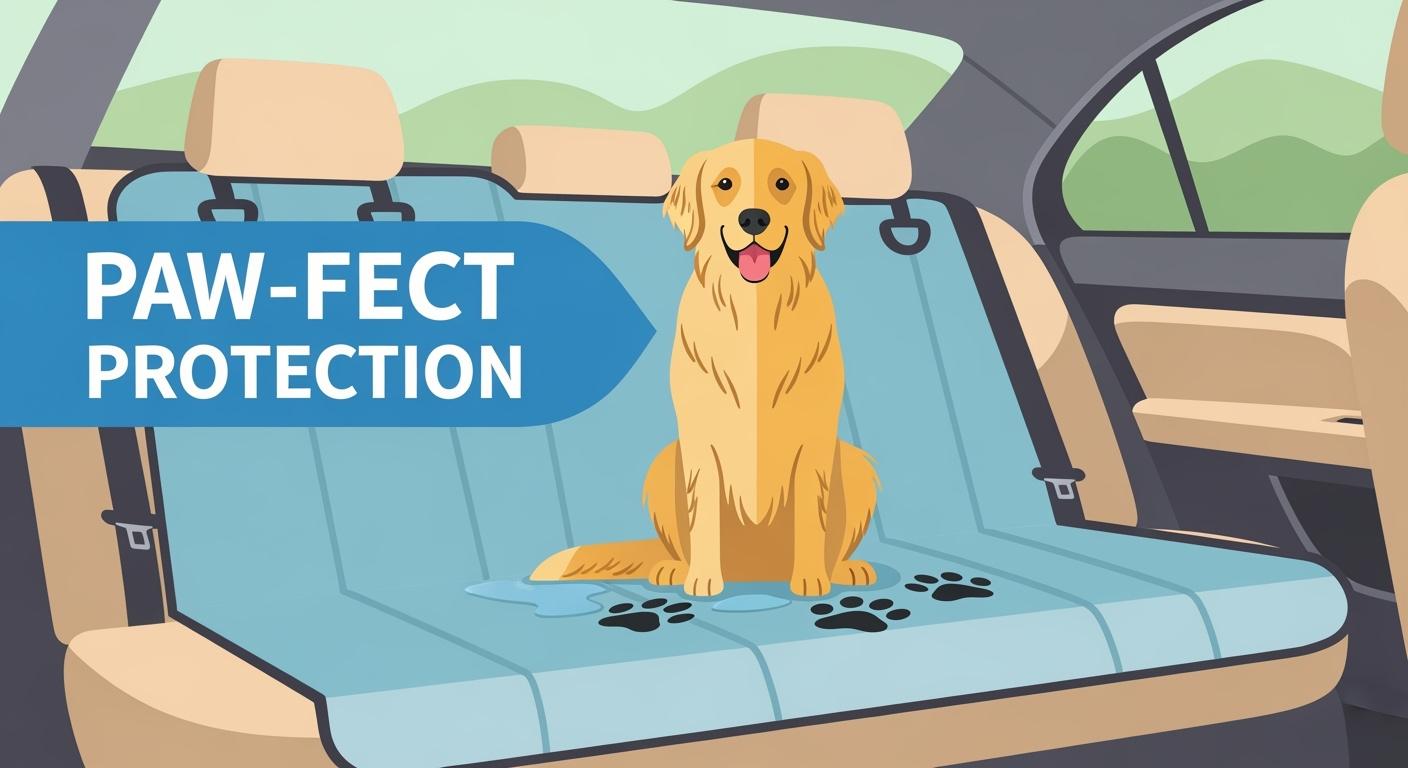
A waterproof dog rear car seat cover keeps moisture off the upholstery. That part works. But keeping a dog steady on top of that waterproof layer is a separate problem — one most covers handle poorly. After a rainy walk, wet paws meet a smooth coated surface and the result is predictable: sliding, bracing, a dog that never quite settles. The design question is not whether the cover blocks water. It is whether the top surface gives paws something to hold onto when it is wet.
Why Smooth Waterproof Surfaces Defeat Paw Grip
When a dog’s paw presses down on a textured surface — fabric, carpet, even rough concrete — the pad deforms slightly into the microscopic peaks and valleys. That mechanical interlock is grip. A smooth waterproof coating eliminates it. No valleys, no interlock.
Now add water. A thin film forms between the paw pad and the coating. It acts as a lubricant. The paw still contacts the surface, but the friction coefficient drops sharply. The dog’s weight pushes down. Lateral forces — from turns, stops, or shifting position — meet almost no resistance. That is why a dog can be standing perfectly still one moment and scrabbling sideways the next.
This is the core disconnect in most waterproof dog car seat covers: the feature that protects the seat is the same feature that defeats the dog’s footing. A rear seat cover built with a waterproof membrane blocks liquid completely. But if the manufacturer stops there — membrane applied, surface left smooth — the cover passes the waterproof test and fails the stability test.
In practice: run your palm across the cover surface after a drive with a damp dog. If it feels slick under your hand, your dog’s paws are experiencing the same film effect — just with less surface area and more weight behind it.
How Material Production Choices Shape Surface Grip
A laminated TPU or PVC membrane blocks water effectively in both directions. That decision is about material selection. But the surface finish — matte versus gloss, embossed versus flat — is a separate manufacturing decision. A gloss finish releases from the mold cleaner and looks sharper on the shelf. An embossed finish requires a textured mold surface, picks up more dust during production, and adds a process step. The extra step is what separates a cover that only protects the seat from one that also keeps the dog stable.
From a production standpoint, this is a deliberate tradeoff between manufacturing efficiency and functional performance. The smooth release is cheaper and faster. The textured release costs more per unit but delivers grip that the smooth surface cannot match once moisture enters the equation.
Texture Is the Grip Variable Most Covers Overlook
The difference between a dog bracing through every turn and lying down calmly often comes down to surface texture. Not padding thickness. Not anchor count. Texture. A cover that prioritizes surface grip can keep a restless dog steadier than a heavily padded cover with a slick top layer, because the dog trusts the surface under its paws.
Three surface approaches show up in rear seat covers, and they perform very differently under wet conditions.
| Surface Type | Grip When Wet | Main Limitation |
|---|---|---|
| Flat Oxford coating | Poor — water film forms instantly | Easy to wipe but useless for stability when damp |
| Embossed or heat-pressed pattern | Moderate — ridges create intermittent contact | Debris packs into the pattern over time, reducing depth |
| Silicone-dot or rubberized grid overlay | Good — dots create high-friction contact zones under each pad | Dots can wear down with aggressive scrubbing over repeated washes |
The physics is straightforward. A paw pad under load needs at least one of two things: mechanical interlock from texture, or a high coefficient of friction from a rubberized material. Flat waterproof Oxford fabric provides neither. An embossed pattern provides the first. Silicone dots provide the second. A cover that layers both — a textured substrate with high-friction overlay points — performs best when paws are wet and the vehicle is moving.
Tip: before installing, press your palm into the cover surface and slide it sideways. Wet your palm and repeat. If the difference is dramatic — easy dry, near-zero resistance wet — the surface relies on dry friction alone. Wet paws will struggle.
The Stability System — Anchors, Tension, and Controlled Padding
Top-surface texture keeps the dog from sliding on the cover. The cover also needs to stay put on the seat. These are two separate grip problems requiring two separate solutions. A cover perfectly anchored to the upholstery can still have a top surface slick enough to send the dog sliding.
Non-Slip Backing Solves a Different Problem
Non-slip backing — typically rubberized mesh or silicone nubs on the underside — prevents the cover from migrating across the upholstery. This matters because a shifting cover amplifies every other stability problem. When the cover bunches, the dog’s footing changes unpredictably. Even a textured surface loses effectiveness because the dog is compensating for movement underneath. But non-slip backing addresses cover-to-seat friction, not paw-to-cover friction. Both grip planes must work independently.
Anchor Tension and Why Installation Order Matters
The anchor system — seat anchors pushed into the crease between backrest and bench, plus adjustable headrest straps — creates tension across the cover surface. That tension keeps the cover flat. A flat cover gives the dog a predictable surface. A loose cover develops ripples and folds that create tripping points and concentrate wear.
Installation order matters more than most buyers realize. Tighten the straps first, then push the anchors into the seat crease. The tension locks the cover flat before the anchors fix its position. Reversing the order — anchors first, then tightening — pulls the cover out of position and creates slack that accumulates with every drive. This principle applies across car travel gear where strap tension and anchor placement work together to hold a surface stable under a moving dog.
Tip: after a 10-minute drive, check whether the cover has shifted more than an inch from its original position at the edges. Edge drift is the first sign that anchor tension is insufficient. Drift becomes bunching, and bunching signals a surface the dog cannot trust.
How Padding Thickness Changes What the Dog Feels
Thick, plush padding feels comfortable to a human hand pressing down in a showroom. For a dog in a moving vehicle, it creates instability. Soft padding compresses unevenly under the dog’s weight, forming a depression that cups the body. The paw’s contact area with the textured surface shrinks as the padding wraps upward around it, and the dog loses the ability to splay and grip.
Controlled padding — thinner, denser, with less compression travel — keeps the dog closer to the structural layer beneath. The textured top surface stays flatter under load. Covers with hard bottom panels take this logic further: a rigid substrate spreads the dog’s weight across the entire bench area, prevents localized sinking, and keeps the surface geometrically stable regardless of where the dog sits. This matters most for larger breeds, where weight-driven compression is deeper and the stability penalty of soft padding is proportionally worse.
When the Design Reaches Its Limits
Textured waterproof covers work best under a specific set of conditions: the dog fits the bench seat, the cover matches the vehicle seat dimensions with full anchor engagement, and the wetness comes from paws and coat rather than a dog lying in standing water.
Conditions where grip degrades: double-coated breeds that hold significant water in their undercoat release moisture continuously as they settle, eventually overwhelming the texture’s ability to shed the water film. Dogs that pace or circle repeatedly generate concentrated shear forces that no texture pattern can fully resist. And covers installed on deeply contoured seats may never achieve full surface tension regardless of anchor design.
Disclaimer: The grip observations in this article assume a short-coated or medium-coated dog making normal contact with the cover surface. Double-coated breeds — huskies, malamutes, shepherds — may carry enough water in their undercoat to saturate the texture pattern, reducing grip even on well-designed surfaces. For these breeds, pairing a textured cover with a quick-dry microfiber towel across the seating area on especially wet days can help maintain traction during the drive.
Cleaning Maintains the Grip Equation
Dirt, shed fur, and dried mud fill in the texture pattern over time. A textured surface packed with debris behaves like a flat surface — the mechanical interlock disappears. Regular cleaning restores the texture depth that grip depends on, but technique matters. Vacuum before washing to prevent fur from matting into the pattern during the wash cycle. Air dry rather than machine dry; high heat can glaze the surface of some waterproof membranes, permanently reducing texture depth. Between washes, a stiff brush restores some grip by breaking up packed debris in the surface pattern.
FAQ
Does a waterproof cover guarantee my dog will not slide?
No. Waterproofing and grip are independent design attributes. A cover can be fully waterproof and nearly frictionless when wet. The surface texture determines grip, not the waterproof membrane underneath. The two functions require separate design decisions during production.
What is the difference between a hammock-style and bench-style cover for grip consistency?
A hammock cover suspends the surface between the front and rear headrests, which adds tension but also introduces sway as the car moves. A bench cover sits directly on the seat and transmits less independent movement to the dog. For grip consistency, bench covers usually perform better because the surface does not swing independently of the seat.
How often should the cover be cleaned to maintain grip?
Vacuum weekly if the dog rides frequently. Wash when the texture pattern becomes visibly packed with dirt or fur — typically every two to four weeks for a daily-riding dog. Between washes, a stiff brush can restore some texture depth by breaking up debris in the pattern.
Can I improve grip on a smooth cover I already own?
If the cover has a smooth top surface, placing a rubberized mat or textured towel on top creates a temporary high-friction layer. This is a workaround — the add-on layer can shift independently of the cover. But it is effective for occasional wet-weather use on covers that perform acceptably when dry.






