
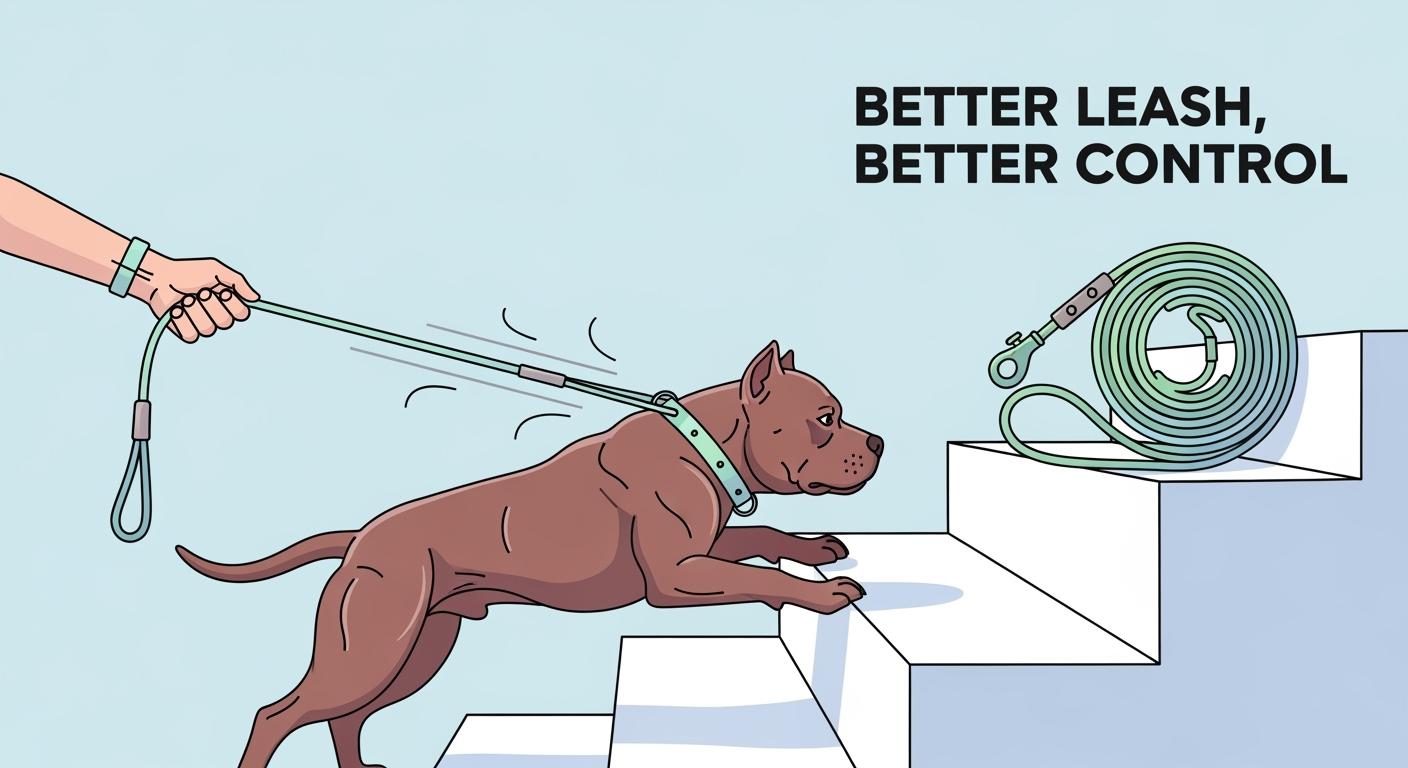
A leash for large dogs that pull does one job that separates safe walks from close calls: it transmits force from the dog to your hand with as little delay as possible. Most leash failures on stairs and slopes trace back to a single design choice — elastic sections that absorb energy by stretching. On flat sidewalks, the half-second lag is an inconvenience. On a flight of stairs, it is the window in which a 70-pound dog builds enough momentum to pull you off balance.
The leash designs that hold up in these conditions share three traits: low-stretch webbing that resists elongation under load, a fixed length that keeps the dog within a predictable control radius, and hardware that does not twist, snag, or release under sudden force. Everything else — reflective stitching, color, accessory loops — is secondary to what happens between the clip and the handle when a large dog lunges forward on an incline.
How Stretch Turns a Slope Into a Risk Multiplier
When a large dog pulls on flat ground, the handler braces against horizontal force only. Add a downhill slope and gravity contributes roughly the dog’s body weight as an additional forward vector. The force at the leash clip is no longer just the dog’s pulling effort — it is pulling effort plus gravitational acceleration. A bungee or elastic section in the leash stores this combined force as mechanical deformation: the webbing stretches before it transmits tension to your hand.
That mechanism turns a manageable pull into a dangerous one. The stretch buys the dog time. In the half-second or so between the lunge starting and tension reaching your hand, the dog takes one to two additional strides. Each stride increases momentum. By the time you feel the pull, the dog is moving faster than when the lunge began. The leash has not absorbed the force — it has deferred it, and the force that eventually arrives is larger than what entered the system.
Low-stretch webbing works differently. Materials like tightly woven nylon or polyester with minimal elongation rates transmit force near-instantaneously from clip to handle. Under a 70-pound dog’s pulling load, a quality low-stretch leash elongates less than two percent of its total length. Tension at the clip end reaches your hand with almost no lag. You feel the pull when it starts, not after it has built up speed. The gap between instant feedback and delayed response is often the difference between bracing for a stair step and stumbling.
In practice: Walk your current leash downhill for 10 minutes. If you noticed any gap between the moment the dog surged and the moment tension reached your hand, the leash material is adding a reaction delay. That delay is invisible on flat ground but measurable on a slope.
What Slack Does That Stretch Does Not
Slack creates a different but overlapping problem. A leash with extra length lets the dog move several feet before tension builds at all. By the time the leash goes taut, the dog has covered ground — and on stairs, covering ground means descending or ascending multiple steps without any restraint signal. Stretch delays your reaction to a pull. Slack eliminates the connection entirely until the dog reaches the end of the line.
Both conditions produce the same outcome: the handler reacts late, the dog is already moving fast, and the corrective input has to overcome more momentum than it would have a second earlier. A fixed-length low-stretch leash removes both variables. There is no elastic buffer and no surplus length. The control loop between dog and handler stays closed, which is the mechanical basis for why reducing system slack and stretch improves control margins on uneven terrain.
What Separates a Control Leash from a Standard Leash
Webbing That Transmits Instead of Absorbing
The defining material choice is elongation rate. Standard nylon webbing stretches roughly 15 to 30 percent under heavy load depending on weave density. A bungee section stretches far more — often 50 percent or beyond. Low-stretch polyester or dense-weave nylon keeps elongation under 5 percent at typical large-dog pulling forces. The difference shows up most clearly when the dog lunges from a standstill: in a bungee leash, the handler feels a gradual ramp-up of tension. In a low-stretch leash, the force profile is immediate and linear — what happens at the clip is what you feel in your hand.
This is not universally better. It is specifically better when the handler needs to make fast corrections — on stairs, near traffic, on narrow trails. A leash with elastic absorption can reduce peak forces during steady-state running where sudden stops are rare, but in stairwells and on slopes the priority shifts from comfort to response speed.
Fixed Length and Why Four to Six Feet Works
A leash longer than six feet gives a large dog room to accelerate before the handler feels tension. On stairs, that acceleration distance translates directly into steps taken without restraint. Four to six feet keeps the dog close enough that a lunge registers immediately but long enough that normal walking is not constrained. This range is not arbitrary — it balances the dog’s stride length against the handler’s reaction window. A six-foot leash with a large breed gives roughly one stride of warning before the dog reaches full extension. A four-foot leash cuts that to less than a stride.
Tip: The right fixed length depends on handler height and dog shoulder height. A taller handler paired with a shorter dog can work with six feet comfortably. A shorter handler with a tall, strong breed often benefits from four feet — the shorter radius reduces the leverage the dog can generate before tension kicks in.
Handle Shape and Grip Surface
A round-rope handle concentrates the dog’s pulling force into a narrow line across the palm. Under repeated loading — which is what a pulling dog delivers — that narrow pressure line causes hand fatigue within minutes. A wide, flat grip distributes the same force across a larger surface area. Neoprene padding stays grippy when wet. Untreated nylon turns slick with sweat or rain. A handle that requires re-gripping every few minutes works against you when your other hand is already occupied with a railing or a second leash.
In practice: After a 20-minute walk, check whether the leash handle has shifted position in your palm or twisted. A handle that migrates during use is failing to resist rotational force — you have been micro-adjusting it the entire walk. That is grip energy spent on equipment management rather than dog control.
Hardware That Does Not Become the Failure Point
Leash failure rarely happens in the middle of the webbing. It happens at the clip, the swivel, or the handle attachment — the joints where force concentrates. A swivel that does not rotate smoothly under load transfers rotational stress into the webbing, which twists and shortens its effective length. A clip with a weak spring can release under side-loading, which is exactly the force direction produced when a dog pulls at an angle on stairs.
Metal hardware — particularly zinc-alloy or stainless steel clips with locking gates — resists deformation under repeated shock loading better than plastic. Plastic clips develop hairline fractures at the gate pivot that are invisible until failure. Metal clips tend to bend or deform visibly before they break, which gives a useful inspection window. Checking hardware before each walk catches these warning signs early.
When Low-Stretch Leashes Are Not the Answer
A low-stretch fixed-length leash performs best when pulling is driven by forward excitement — the dog wants to get somewhere faster than the handler is walking. In that scenario, instant feedback and a short control radius work together: the dog feels the tension immediately and the handler can redirect before momentum builds. This control loop depends on the handler being able to process and respond to force feedback, which is why leash design and handler technique cannot be fully separated.
But the design has clear limits. If the dog lunges unpredictably in multiple directions — a reactive dog that bolts sideways at passing dogs or bicycles — a fixed low-stretch leash transmits every shock load directly to both dog and handler. There is no absorption mechanism. The dog’s neck or chest takes the full impulse, and the handler’s shoulder and wrist take the same. In these cases, a leash with controlled energy absorption — not a free-stretching bungee but a damped elastic section that elongates progressively — can reduce peak forces without completely disconnecting the control loop.
A low-stretch leash also assumes the handler can physically manage the dog’s pulling force. For a 90-pound strong-pulling breed paired with a handler who weighs 120 pounds, even instant feedback may not be enough — the force imbalance exists regardless of how quickly it is transmitted. In that pairing, a no-pull harness that redirects the dog’s forward momentum into a turn may be a necessary complement.
Disclaimer: The control benefits described here assume a dog whose pulling is driven by forward excitement or drive, not by fear or reactivity. A reactive dog that lunges sideways at passing triggers experiences force vectors that a fixed-length low-stretch leash cannot redirect — it transmits the full shock load to both dog and handler. If the dog’s chest shape falls outside the breed norms that standard harness patterns are built for — particularly dogs with a barrel chest or very deep keel — the fit checks referenced here may not catch every pressure point. Hand-checking after walks is a more reliable method than visual inspection alone for those builds.
FAQ
Does a low-stretch leash hurt the dog when it pulls?
Low-stretch webbing does not increase the total force the dog experiences — it changes when that force is felt. A bungee leash delays the same force; it does not eliminate it. The key variable is not stretch versus no-stretch, but whether the attachment point distributes force across enough surface area. A low-stretch leash clipped to a flat collar concentrates pulling force onto a narrow band around the neck. The same leash clipped to a padded chest harness spreads it across the chest and shoulders.
What length works for a tall handler with a large dog?
Handler height changes the geometry. A six-foot-tall handler walking a 26-inch-shoulder-height dog on a four-foot leash will find the dog consistently underfoot — the vertical distance plus the short horizontal radius leaves almost no buffer. Six feet gives more stride separation. A shorter handler benefits from four feet because the dog’s shoulder is closer to the handler’s center of mass, and the shorter radius means the dog reaches full extension sooner, generating less pulling leverage before tension arrives.
Can a low-stretch leash be used with a no-pull harness?
Yes, and the combination often works better than either tool alone. A front-clip harness redirects the dog’s forward momentum into a turn when tension hits. A low-stretch leash ensures the tension arrives immediately, so the redirection happens before the dog is moving at full speed. The two designs complement each other: the harness changes the force direction, and the leash eliminates the delay in the signal that triggers that change.






