
The heaviest part of a spiked harness is rarely the spikes. It is the panel system underneath them. On a 60-pound dog, an extra 3mm of foam and a couple of oversize buckles may go unnoticed. On a 12-pound dog, those same details press into a chest that has less surface area than your open hand. A spiked harness for small dogs fails not because the spikes hurt — properly designed spikes sit on outer panels and never contact skin. It fails because bulk that would be trivial on a large dog becomes a pressure point, a rub zone, or a movement restriction on a body built with tighter clearance between shoulders, chest, and forelegs.
The design question is not whether spikes deter predators. Positioned along the back and outer sides, they create a visible and physical barrier that makes a small dog a harder target. The question is whether the harness carrying those spikes respects the anatomy it wraps around — and whether it stays stable during the stride cycle that small dogs repeat more times per minute than large dogs, which is where walking control starts with how the harness tracks the body rather than how tight the straps are.
When Extra Protection Starts to Rub
Most spiked harness problems show up in the first ten minutes. Not in dramatic failures — the dog does not yelp or freeze. The signals are quieter: a half-step shorter on one side, a slight drift left on a straight walk, or a stop to scratch at a shoulder the harness is not even touching directly. These are referred-pressure signals. A stiff panel edge sitting near the shoulder blade does not need to dig in to cause a problem. It restricts the blade’s forward glide by a few millimeters, and the dog compensates by shortening stride on that side, which shifts weight to the other foreleg, which changes how the chest panel sits, which pulls the opposite strap incrementally tighter. That is the chain. One edge, one compromised stride, and within ten minutes the harness has walked itself into an asymmetric load that concentrates pressure along a single strap line.
Small dogs amplify every link in that chain. The distance from shoulder point to elbow is shorter, so a strap sitting 2mm too high covers a larger proportion of the available clearance. The space behind the front leg is tighter, giving a thick panel less room before it bunches into soft tissue. And because small dogs take more strides per minute at walking speed, the same 15-minute walk generates more friction cycles across every contact surface. A harness that stays centered on a medium-to-large dog through a 30-minute walk can drift off-axis on a small dog in half that time.
Observable check: after a 10-minute walk on flat ground, run your finger under each strap edge. Dampness concentrated along one edge rather than spread evenly across the inner panel surface means the strap is bearing load unevenly — a sign the panel is too stiff or the edge binding is creating a pressure ridge rather than distributing force across its full width.
Why Spike Bulk Matters More on Small Dogs
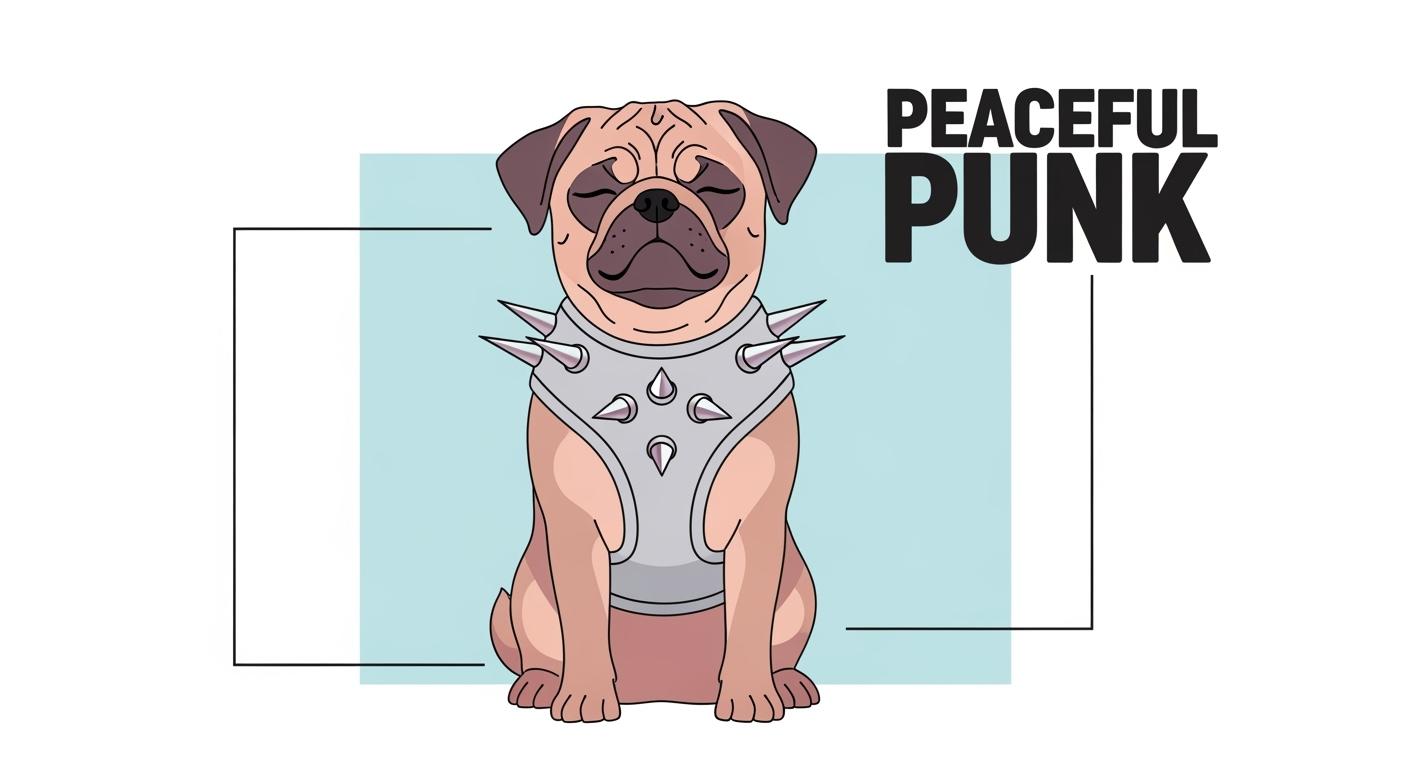
The core design tension is straightforward: protection adds material, material adds bulk, and bulk on a small dog hits anatomical constraints that do not scale down linearly. A harness panel 6mm thick on a Labrador covers roughly 3% of the available clearance between chest and foreleg at rest. That same 6mm panel on a Chihuahua or small terrier can cover 12 to 15%. But the proportional gap is only half the problem. The other half is that panels do not compress uniformly under load — edges resist compression more than centers, so the effective thickness at the panel perimeter is higher than the nominal thickness measured at the middle. On a small dog, that edge-thickness differential eats into clearance faster than the overall panel thickness would predict.
This is where outer-zone spike placement matters structurally. Spikes positioned on the back and outer side panels keep added bulk away from three high-movement zones: the throat, the armpit fold, and the shoulder blade’s forward glide path. When a spike or its stiff mounting base sits inside one of these zones, it acts as a pivot point — the harness rotates around it microscopically with each step, converting forward motion into a slight twisting force that walks the chest panel off-center. Over a 20-minute walk, a chest panel that started centered over the sternum can drift 10 to 15mm to one side. At that point the harness is no longer loading symmetrically, and the dog begins compensating with uneven stride. The same spike that deters a predator at minute zero has, by minute twenty, become a leverage point working against the harness’s own stability.
The material under the spikes matters as much as the placement. A flexible substrate — thin closed-cell foam or layered mesh — lets the spike base move with the dog’s body. A rigid substrate transmits every stride impulse into the spike base, turning a passive deterrent feature into a small lever. This distinction is invisible in product photos. It shows up after the first walk, in how the harness sits when the dog stops moving. It is also why sizing a spiked harness correctly involves more than matching girth measurements — the panel architecture has to match the dog’s stride mechanics, and materials that flex with movement rather than resisting it change how that architecture performs on a short-coupled body.
What Spiked Harness Design Protects Without Rubbing

Three design features separate a spiked harness that protects from one that rubs. The first is low-bulk panel construction. Panels built from layered mesh or thin closed-cell foam distribute spike mounting force across a wider area without adding the edge thickness that creates pressure ridges. Smooth edge binding — where the panel perimeter is wrapped and stitched flat rather than left as a cut edge — eliminates the sharp transition zone where most rubbing begins. The binding does not just cover the edge. It distributes the tension that would otherwise concentrate at the panel perimeter into the stitching line, which sits a few millimeters inward from the edge itself. The dog’s skin never contacts a raw material edge.
The second is hardware weight and placement. Small dogs feel buckle weight disproportionately because a buckle sits higher relative to their center of mass. A metal D-ring that goes unnoticed on a large-dog chest strap becomes a small pendulum on a small dog, swinging with each stride and tapping against the sternum. Lightweight acetal or coated alloy hardware reduces this effect. Stable adjustment points — separate straps for neck, chest, and belly — let each zone be set independently, so tightening the chest girth does not pull the neck strap into the throat. A harness that fits a small dog well is not a scaled-down large-dog pattern; the adjustment points need to be repositioned for a shorter back, a proportionally deeper chest relative to body length, and less distance between the neck base and the shoulder point.
The third is outer-zone spike placement. Spikes mounted only on dorsal and lateral panels stay clear of the throat, the armpit fold, and the shoulder blade’s forward travel path. This preserves deterrent function — a predator approaching from above or behind still encounters the spikes — while leaving stride mechanics untouched. When a harness design prioritizes spike placement on non-contact zones, the dog experiences the harness as a protective shell rather than a restrictive cage, and the materials underneath the armor layer determine whether that shell breathes or traps heat during extended outdoor use.
| Design Feature | What It Solves | Failure Signal | Where It Works Best |
|---|---|---|---|
| Low-bulk panels with smooth edge binding | Prevents pressure ridges at panel perimeters | Redness or dampness concentrated along strap edges after 10 minutes | Short-coupled breeds with tight shoulder-to-elbow clearance |
| Lightweight hardware with independent adjustment points | Eliminates pendulum effect and throat pull during stride | Hardware tapping sternum; neck strap tightening when chest is adjusted | Dogs under 20 pounds where buckle weight is a higher proportion of body mass |
| Outer-zone spike placement | Keeps deterrent spikes off flex points and pivot zones | Stride asymmetry; chest panel drifting off-center during walks | Active dogs in wildlife areas where predator approach comes from above or behind |
Observable check: after fitting the harness, have the dog shake off as if wet. Watch the harness position before and after. If any panel shifts more than the width of your index finger from its starting point, either a strap needs re-tensioning or the panel material is too rigid to track the dog’s body through rapid movement. A harness that cannot survive a shake without drifting will not hold position through a 20-minute walk.
When a Spiked Harness Is Not the Right Choice
A spiked harness solves one specific problem: giving a small dog a visible and physical deterrent against predators during outdoor walks. It is not an all-day harness. The spikes, even when well-placed, add surface texture that can catch on furniture, crate bars, or car upholstery. Remove the harness when the dog is indoors or unattended.
Some small-dog builds are harder to fit regardless of adjustment range. Dogs with very short legs and a proportionally deep chest — a shape common in certain terrier and dwarf breeds — have limited vertical clearance between the chest floor and the throat. A harness panel that carries spike mounting hardware may simply be too tall for this body type, leaving no strap path that clears both the throat and the armpit simultaneously. Dogs with sensitive or thin coats may show rub marks from edge binding that a thicker-coated dog would not. If after two independent fit adjustments the dog still shortens stride on one side or develops redness along a strap line within ten minutes, the panel architecture is likely wrong for that specific build — not defective, just incompatible. In these cases, a lightweight harness built for small-dog proportions without the added armor layer may provide a better match for the dog’s movement profile.
Disclaimer: The fit checks described here assume a smooth-coated or short-coated dog where skin contact and hair flattening are visible without parting the coat. Double-coated and long-haired breeds may develop rub marks under the surface coat that are not visually obvious — hand-checking along strap paths after each use is the more reliable method. Dogs with barrel chests or very deep keels may fall outside the proportional envelope this harness type is patterned for; the standard two-finger and visual checks may not catch every pressure point on these builds.
FAQ
Does a spiked harness hurt a small dog during normal movement?
Not if the spikes are mounted on outer panels only. The spikes should sit along the back and outer sides, away from the throat, armpit, and shoulder zone. If you can feel a spike base pressing through the inner lining with your hand, the panel is too thin or the mounting position is wrong — the inner surface should feel smooth and uniform regardless of what is attached to the outside.
How long can a small dog wear a spiked harness?
For the duration of an outdoor walk or monitored outdoor activity. It is protective gear, not everyday wear. Remove it once the dog is back indoors or resting. The spike texture, even when well-placed, adds surface friction that is unnecessary and potentially uncomfortable during sedentary time.
What is the earliest sign that a spiked harness does not fit?
Stride asymmetry. Before any redness, scratching, or hair flattening appears, the dog will take a slightly shorter step on one side or drift consistently to one side on a straight walk. These are the first indicators that a strap or panel edge is interfering with shoulder movement. Check for them within the first five minutes of a walk, before the dog has time to compensate in ways that mask the original restriction.






