
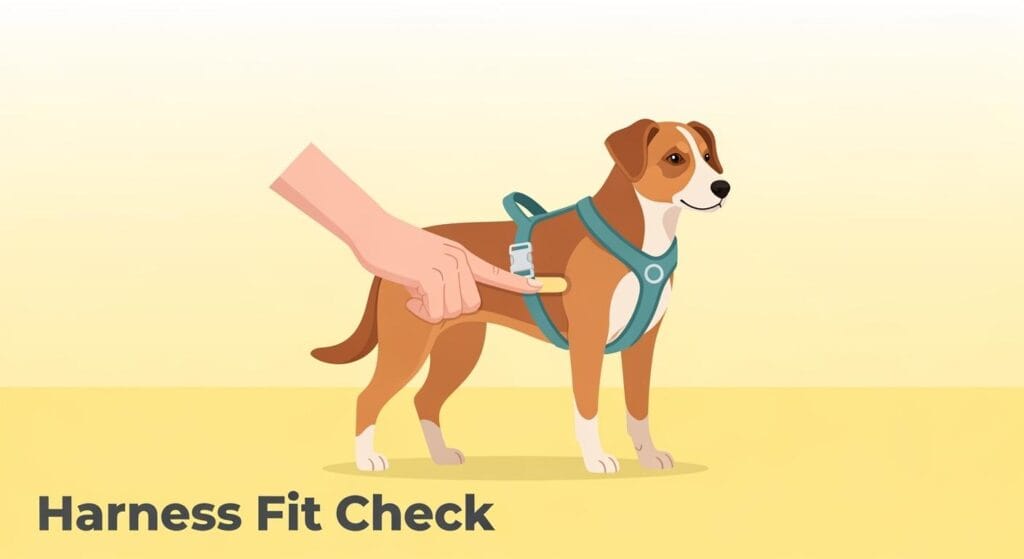
If you are wondering how tight should a dog harness be, the short answer is simple: snug enough to stay centered, loose enough that your dog can walk, turn, sit, and breathe without strain. The two-finger rule is a good starting point, but the real test happens when your dog moves. A harness that looks fine while standing still can still rub behind the legs, creep into the throat, or twist when leash tension builds.
The safest fit usually feels secure without looking cinched down. You should be able to slide two fingers under the straps with light resistance, and the harness should stay stable through a short walk. If it shifts, pinches, or leaves marks after a few minutes, it needs adjustment even if the straps technically pass the finger test.
Key Takeaways
- Use the two-finger rule as a starting check, not the whole fitting decision.
- A well-fitted harness stays centered on the chest and does not block the shoulders or ride into the armpits.
- Always judge fit after movement, because rubbing, twisting, and escape gaps usually show up on the walk, not before it.
What the Right Fit Actually Feels Like
A good harness fit is about balance. Too loose, and the harness slides, rotates, or opens escape space at the neck and shoulders. Too tight, and it can crowd the front legs, press upward toward the throat, or make your dog shorten stride. For most dogs, the right answer to how tight should a dog harness be is “secure, but not restrictive.”
Use the two-finger rule as a first check
Start by sliding one or two fingers under each main strap. You should feel contact, but not compression. If you have to force your fingers in, the harness is too tight. If the strap floats away from the body or the harness swings side to side, it is too loose.
That said, the two-finger rule is only a starting point. Deep-chested dogs, narrow-waisted dogs, short-legged dogs, and dogs with heavy coats can all make the same harness behave differently. If you are still sorting out the base measurements, measuring a dog for a harness gives you a cleaner starting point than tightening by eye alone.
Tip: Check every strap, not just one spot. A harness can feel fine at the ribs and still be too high at the throat or too close behind the front legs.
How to fit and adjust the harness
Use a simple fitting sequence so you do not end up chasing one crooked strap with another:
- Put the harness on while your dog is standing naturally.
- Center the chest piece on the sternum instead of letting it drift toward one shoulder.
- Adjust the neck area so it sits clear of the throat.
- Tighten the girth strap behind the front legs until it feels snug, not compressive.
- Match the left and right sides so the harness does not twist under leash pressure.
- Run the two-finger check under each main strap.
- Walk your dog forward, turn once or twice, then ask for a sit.
- Recheck the armpits, chest, and throat after a short walk.
If the harness style itself is confusing, putting on a dog harness without common fitting mistakes can help you confirm panel placement before you keep adjusting the straps.
What a good fit looks like compared with a bad one
| Fit | What You See | How the Dog Moves | What to Watch |
|---|---|---|---|
| Good fit | Harness stays centered and lies flat | Normal stride, easy turns, relaxed posture | No rubbing, no deep marks, no drifting |
| Too loose | Harness shifts, twists, or gaps open near the neck | Dog may back out, brace, or feel unstable | High escape risk and uneven pressure |
| Too tight | Straps press into the coat or pull upward | Shortened stride, hesitation, scratching, stiffness | Rubbing, throat pressure, and hot spots |
A stable fit should still look stable after the first block, not just the first few seconds. If it drifts early, the problem is usually placement, sizing, or harness shape rather than a lack of tightening.
Check the Pressure Points Before You Leave
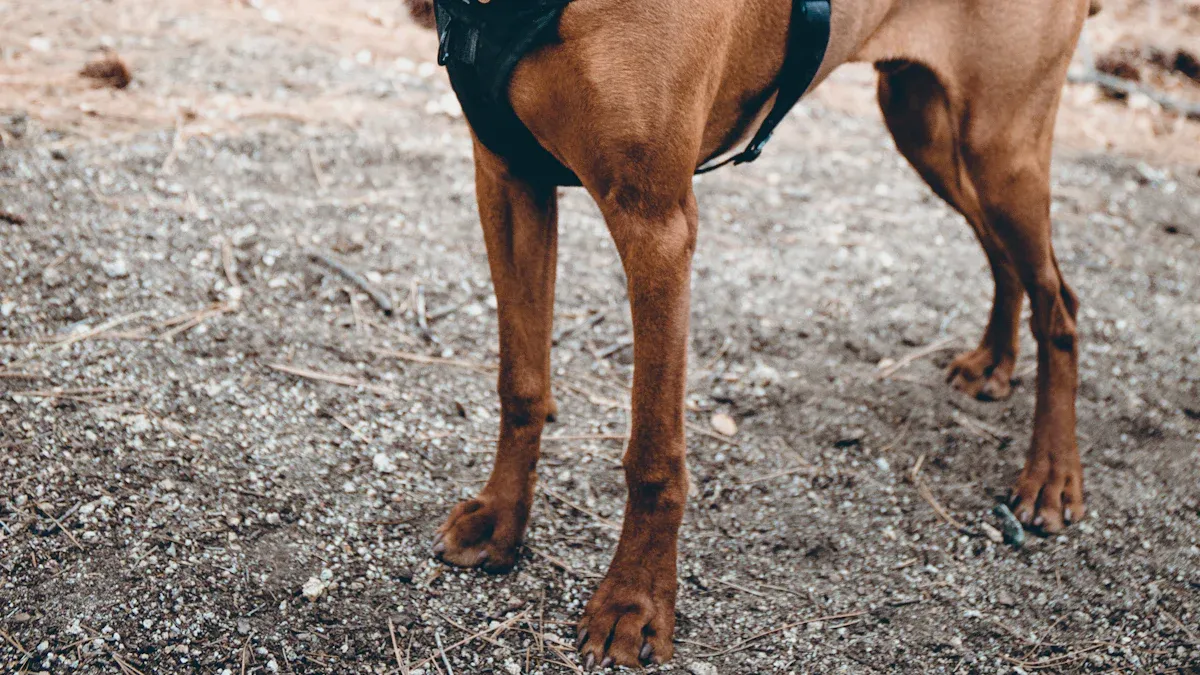
Harnesses usually spread leash pressure across the chest more than collars do, but a poor fit can still create pressure points. The areas that matter most are the throat, the armpits, the shoulders, and the center of the chest. Those spots tell you quickly whether the harness is secure for real movement or only looks secure at rest.
The four areas worth checking every time
- Throat: The front section should sit on the upper chest, not rise into the soft area of the neck when the leash tightens.
- Armpits: The girth strap should stay clear enough that it does not rub the skin behind the front legs through a full stride.
- Shoulders: Straps should not cut across the shoulder joint or make the front legs move in shorter steps.
- Chest: The center panel should stay on the sternum instead of twisting sideways.
If your dog falls between shapes more than sizes, comparing the strap layout against everyday harness fit and sizing checks is usually more useful than tightening the current harness harder. Different body builds often need a different front opening, chest panel length, or adjustment range.
| Pressure Point | Looks Right | Warning Sign | First Fix |
|---|---|---|---|
| Throat | Front stays low on the chest | Coughing, gagging, or upward pull at the neck | Lower and recenter the front section |
| Armpits | Strap clears the skin during movement | Redness, hair thinning, repeated scratching | Reposition or loosen the girth area slightly |
| Shoulders | Front legs extend naturally | Short steps, stiff turns, reluctance to move | Shift the harness away from the shoulder line |
| Chest | Panel stays centered on the sternum | Twisting or drifting to one side | Equalize both side straps |
Signs the harness is blocking comfort or motion
Watch your dog, not just the hardware. The first few minutes usually tell you more than the product label ever will.
- Short or uneven front steps
- Stopping often or resisting forward movement
- Scratching at the harness mid-walk
- Redness, flattened fur, or warm spots after removal
- Noisy breathing, coughing, or gagging
- Harness drift toward one shoulder under normal leash tension
If rubbing is already starting, the problem rarely fixes itself on the next walk. The patterns described in preventing harness chafing on active walks are especially useful when moisture, repetitive movement, or underarm contact make irritation worse over time.
When you are still comparing layouts, the broader range of dog harness styles can make it easier to see whether the issue is the adjustment or the design itself.
Warning Signs That Mean the Fit Is Wrong
The most important harness failures are easy to miss if you only check fit indoors. A harness may feel secure in the house and still fail once the dog pulls forward, turns sharply, backs up, or gets excited. That is why how tight should a dog harness be is really a movement question, not a standing-still question.
Early red flags after the first few minutes
- Harness twisting off the center of the chest
- Gaping at the neck when your dog backs up
- Rubbing behind the front legs after a short walk
- Frozen or shortened stride
- Deep impressions in the coat after removal
- Repeated shaking off, pawing, or refusal to continue
One of the biggest fitting mistakes is assuming tighter always means safer. In practice, over-tightening can create just as many problems as a loose fit because it trades escape risk for friction, restricted motion, or throat pressure.
What to do when you notice a problem
- Stop the walk and look at where the harness has moved, not just where it started.
- Run the two-finger check again under the neck and girth areas.
- Recenter the chest panel before you tighten anything else.
- Adjust both sides evenly instead of cranking down one strap.
- Inspect the skin and coat after the walk for rub points or hot spots.
- If the fit looks acceptable but control still feels sloppy under tension, review the overall harness and leash setup because leash length and clip position can change how the harness behaves outside.
Note: Stop using the harness and ask your veterinarian for guidance if your dog shows coughing, repeated gagging, limping, skin injury, or clear pain even after refitting.
When to refit or replace the harness
Even a harness that fit well last month may not fit well now. Recheck sooner than you think when your dog’s body or coat changes, and replace the harness when wear starts affecting security.
- Weight gain or loss changes how snug the straps sit
- Growth changes the chest, neck, or shoulder proportions
- Seasonal coat changes make the harness suddenly tighter or looser
- Stretched webbing no longer holds the same adjustment
- Frayed stitching, cracked buckles, or slipping sliders reduce safety
A properly fitted harness should feel almost unremarkable on the dog. It stays in place, spreads pressure sensibly, and lets your dog move normally. If you keep seeing drift, rubbing, or escape gaps, the answer is usually a better fit or a better harness shape, not more force on the straps.
- Check fit before every walk, but judge it after movement.
- Use the two-finger rule as a baseline, then confirm chest position, shoulder freedom, and armpit clearance.
- Refit or replace the harness as soon as you see rubbing, twisting, hardware wear, or repeated escape space.
FAQ
How often should you check your dog’s harness fit?
Check it before every walk and recheck after any weight change, coat change, or new rubbing pattern.
Can a harness still be too loose if two fingers fit under the straps?
Yes, because a harness can pass the finger test and still twist, drift, or open escape gaps once your dog moves.
What if your dog seems to hate the harness?
If your dog freezes, scratches, or avoids walking, pause and reassess fit first, then consider whether the harness shape is the wrong match for your dog’s body.






