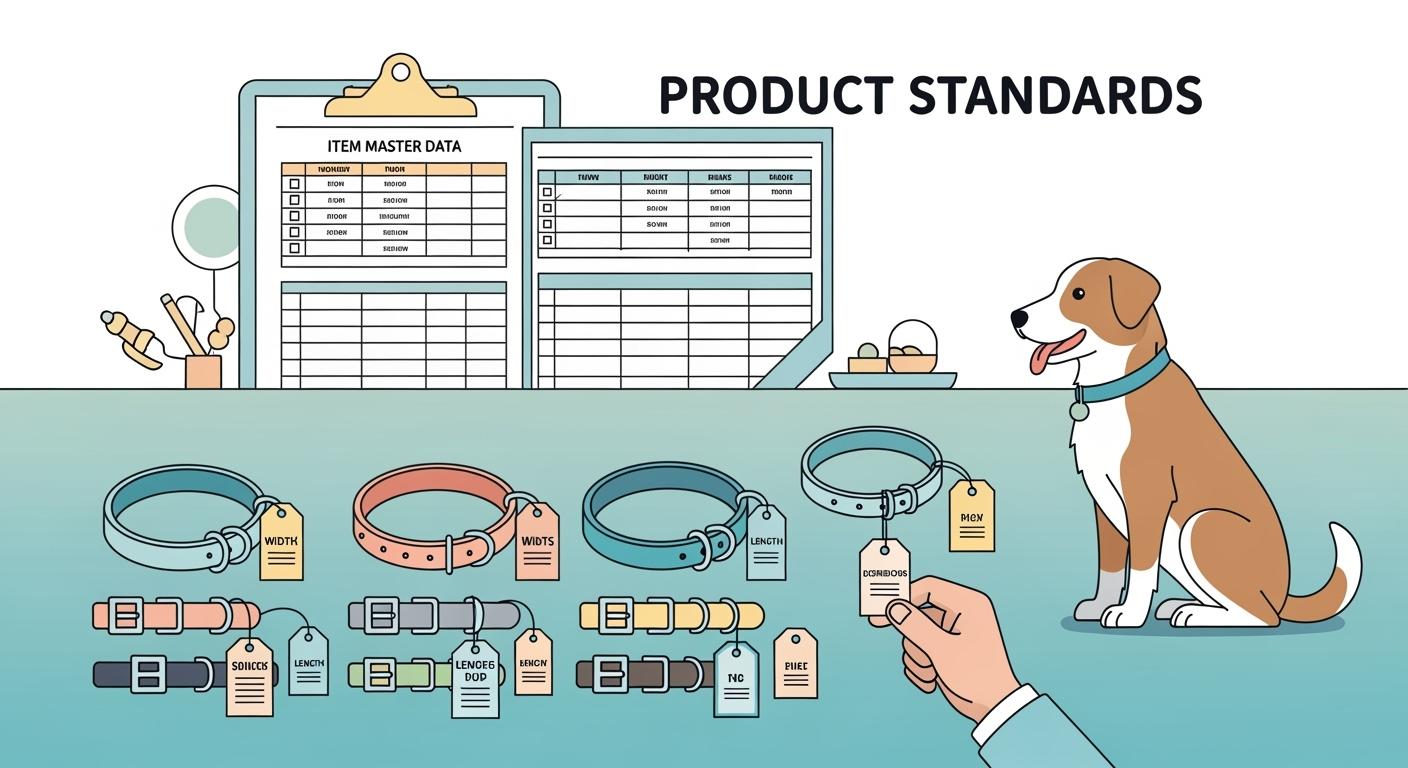
If you are cleaning up collar records or comparing multiple collar variants, the fastest way to create confusion is to rely on vague labels instead of measurable details. Terms like small, medium, heavy-duty, or standard can help at a glance, but they do not tell you the exact strap width, fit range, or buckle style that separates one collar record from another.
A better approach is to anchor every record to the same core fields, then add a small group of supporting fields only when they truly help you distinguish one option from the next. If you are reviewing a wider set of pet harnesses and leashes, that same principle helps keep collar data easier to compare across different product families.
Where collar records usually go wrong
Most collar data problems start in one of four places: the width is recorded inconsistently, the fit range is taken from the wrong part of the collar, the buckle description changes from one record to another, or too many minor details are treated like separate products. The result is harder comparison, duplicate-looking records, and avoidable fit confusion.
- Width is taken from a padded edge or decorative section instead of the actual strap at the neck.
- Fit range is copied from total strap length instead of the smallest and largest usable inside measurement.
- Buckle names shift between similar but inconsistent terms, making filters unreliable.
- Color or packaging differences are treated like new base products when the core collar construction has not changed.
Before adding more fields, make sure the core ones are stable first. A clean collar record should let someone answer three questions quickly: how wide is the strap, what neck range does it fit, and what closure system does it use?
The three fields that should anchor every collar record
These three fields do most of the work. If they are unclear, the rest of the record rarely fixes the problem.
| Field | What to record | Common mistake | Why it matters |
|---|---|---|---|
| Collar width | The strap width at the narrowest section that sits on the neck | Including padding, trim, or decorative outer pieces | Keeps size comparison consistent across variants |
| Neck range | The smallest and largest inside fit setting | Using total strap length or outside length | Shows the real usable fit range |
| Buckle type | A controlled label for the main closure system | Using mixed free-text terms for similar hardware | Makes filtering and comparison easier |
Record width the same way every time
Width should describe the strap section that actually contacts the neck. That means measuring the narrowest true strap section rather than the broadest visible part of the finished collar. If one record uses the padded outer width and another uses the inner webbing width, the numbers look tidy but the comparison stops being useful.
Use the real fit range, not the full strap length
The collar length range should describe the smallest and largest neck setting the collar can actually fit. This is the inside fit range, not the total strap length laid flat. That distinction matters because two collars with similar overall strap length can still have very different usable fit ranges once the buckle, fold-back, and adjustment system are taken into account.
Keep buckle labels controlled and boring
Buckle data works best when it is consistent rather than creative. If one record says side-release, another says quick clip, and another says plastic snap buckle, the records may describe almost the same closure but behave like separate types in a filter or export. Pick one approved label per hardware type and keep using it.
- Plastic side-release buckle
- Metal pin buckle
- Metal roller buckle
- Limited-slip or martingale hardware
- Quick-release buckle, only if it is clearly distinct in your system
The supporting fields that keep variants clean
Once the three anchor fields are correct, add only the supporting fields that help separate meaningful variants. This is where many collar records become bloated. The goal is not to capture every possible note in the main title. The goal is to make one collar easy to distinguish from another when the core build changes.
| Supporting field | Use it when | Do not let it replace |
|---|---|---|
| Strap material | The body material changes the product build | Width or fit range |
| Hardware material | The ring or buckle construction changes | Buckle type |
| Adjustment method | Variants tighten in different ways | Measured neck range |
| Color or pattern | The base build stays the same but appearance changes | Parent product identity |
| D-ring position or finish | The hardware layout or finish is relevant to comparison | The main closure description |
A simple rule helps here: if the change affects fit, hardware behavior, or construction, treat it as a stronger differentiator. If the change is only color or pattern, it usually belongs at the variant level instead of becoming a brand-new base record.
This also matters for special-purpose collars. For example, visibility-focused versions should not be grouped loosely under the same assumptions as ordinary everyday collars if the reflective elements are a meaningful buying difference. In that case, a separate comparison rule is more useful, and this reflective dog collars guide gives a clearer way to think about fit, visibility expectations, and material tradeoffs.
A quick QA pass before the record goes live
Before a collar record is finalized, run one short review pass that checks the measurable fields against the physical sample or the most reliable supplier spec. This is where a lot of duplicate-looking collar records can be caught before they spread into multiple exports, listings, or comparison sheets.
- Confirm width at the true neck-contact strap section.
- Confirm the smallest and largest usable inside fit setting.
- Confirm the approved buckle label matches the actual closure hardware.
- Check whether strap material and hardware material are recorded in a consistent format.
- Make sure a color or pattern change has not accidentally been treated as a new parent product.
- Compare nearby records to catch duplicate width + neck range + buckle combinations.
If the collar family sits inside a broader walking setup, it also helps to review whether the naming logic stays understandable alongside related restraint products. That is usually easier when you compare it against the site’s wider walking and control solutions structure instead of judging the collar in isolation.
A good QA pass should make the record easier to scan, not heavier. If a field does not help distinguish fit, construction, or hardware, it probably does not belong in the main record logic.
FAQ
What is the best way to measure dog collar width?
Measure the actual strap section that sits on the neck, using the narrowest true strap width rather than padded edges, decorative trim, or widened outer layers.
Should neck range come from the total strap length?
No. Use the smallest and largest inside fit settings. Total strap length can make the collar sound larger than the real usable fit range.
When should a collar become a new parent product instead of a variant?
If the core build changes, such as strap material, closure type, or major hardware construction, it usually deserves a new parent record. If the difference is only color or pattern, it is usually a variant.
Is color important enough to keep in the main collar title?
Only if color is one of the primary ways the variants are organized in your system. In many cases, color works better as a supporting variant field than as part of the core product identity.
What is the fastest way to catch duplicate collar records?
Compare nearby records using the same three anchor fields first: width, usable neck range, and buckle type. If those match and the supporting construction details also match, you may be looking at a duplicate or an unnecessary split.