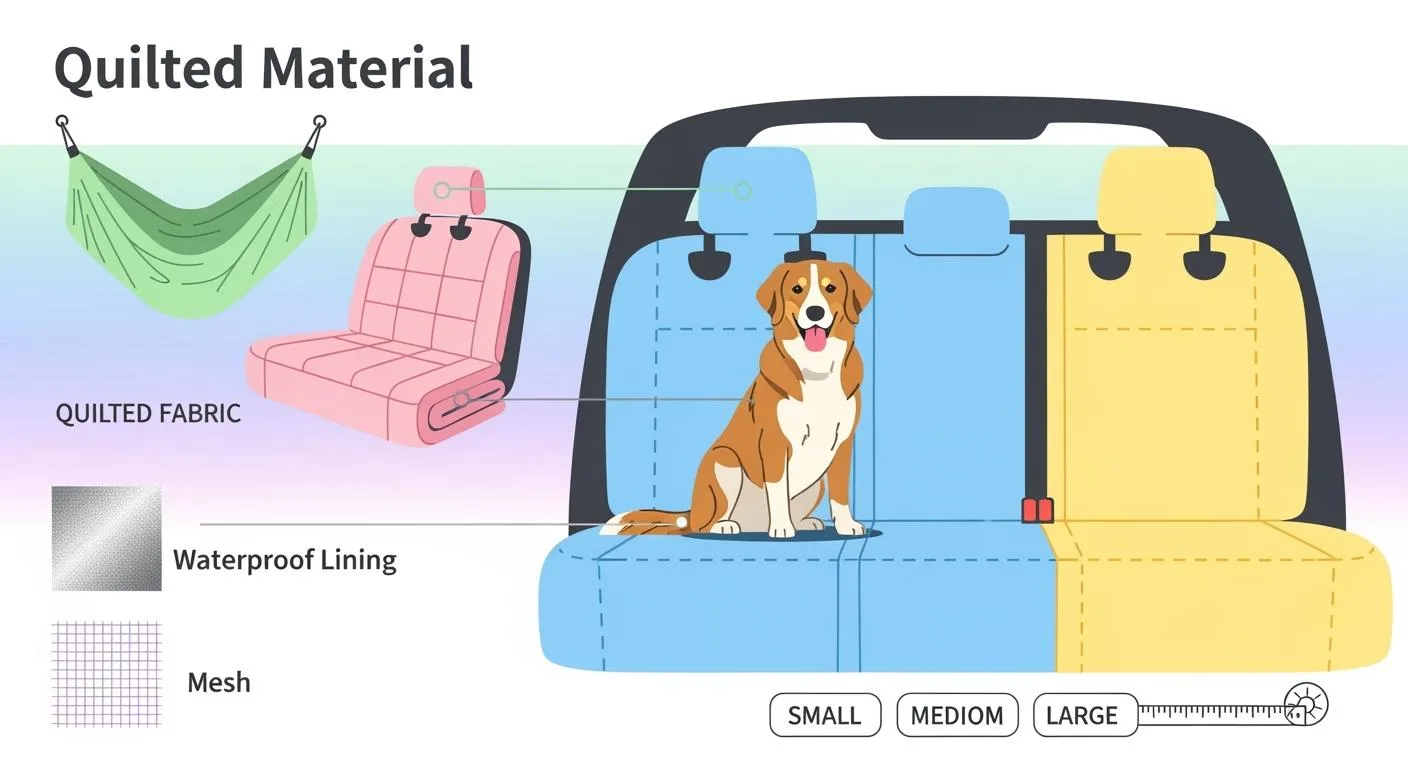
A dog back seat cover is meant to keep the rear seat cleaner, drier, and easier to use with a dog. The product starts to fail when it slides under the dog, leaves the door-side seat edges exposed, blocks seat belt buckles, traps water against the upholstery, or becomes hard to clean after muddy trips.
The right cover is not just the one that looks wide enough in a product photo. It has to match the vehicle layout, the dog’s movement, the cleaning routine, and the way the rear seat is actually used. A bench cover, hammock cover, split-seat cover, and cargo liner can all work well, but each one fails in different ways when the structure, material, or size is wrong.
This guide focuses on the product details that decide whether dog back seat covers stay useful in real car use: coverage, grip, buckle access, waterproof layers, stitching, seat shape, and cleaning behavior after repeated use.
| Common failure | Why it happens | Better product direction |
|---|---|---|
| The cover slides or bunches | The backing has poor grip, the anchors are weak, or the straps cannot hold tension. | Use non-slip backing, seat anchors, adjustable headrest straps, and a flatter panel shape. |
| Seat edges stay exposed | The cover is too narrow or has no side flaps for door-side protection. | Choose wider coverage, side wings, or a hammock structure for dogs that lean or climb sideways. |
| Buckles become hard to reach | The buckle openings are missing, too small, or poorly aligned with the seat layout. | Use reinforced buckle openings and check split-seat compatibility before use. |
| Water still reaches the seat | The top fabric repels water, but the seams, backing, or edge areas leak. | Use layered waterproof construction, sealed or reinforced seam zones, and raised edge protection where needed. |
| The cover feels unstable for the dog | The surface is slick, the cover moves under paw pressure, or the footwell area sags. | Prioritize grip, stable anchoring, and hammock support that does not collapse under movement. |
Choose the cover type by how the rear seat is actually used
Dog back seat covers are often described as simple seat protectors, but the type matters. The wrong type can make the product look protective while still leaving daily-use problems unsolved.
Bench covers
A bench cover works well when the dog rides on the rear seat and the main goal is seat-surface protection. It is usually easier to install and remove than a hammock. The weakness is side coverage. If the dog climbs in from the door, leans against the edge, or moves between window and middle seat, a flat bench cover can leave the side bolsters and door-side seat edges exposed.
Hammock covers
A hammock cover connects the rear headrests to the front headrests. It protects more of the rear area and can reduce the chance that the dog falls into the footwell. It is better for active dogs, muddy trips, and dogs that shift position during travel. The failure point is compatibility. Some vehicles have headrest shapes, center consoles, seat belt receivers, or rear-seat layouts that make the hammock hard to tension correctly.
Split-seat covers
A split-seat cover is useful when the rear seat must be shared by a passenger and a dog, or when part of the seat needs to fold down. The product should not force the user to remove the whole cover just to access a buckle, fold one side of the seat, or use a child seat zone. The weak point is exposed gaps. A split design needs careful panel overlap and buckle alignment.
Cargo liners
A cargo liner is better for SUVs, muddy outdoor trips, and dogs that ride in the rear cargo area. It should match the cargo floor shape, protect the side edge where the dog jumps in, and stay flat instead of curling. A cargo liner fails when it is too light, too slippery, or too small for the vehicle’s rear storage area.
| Cover type | Works better for | Most common failure | What to check |
|---|---|---|---|
| Bench cover | Simple rear-seat protection | Door-side edges stay exposed | Width, edge flap, anchor position, buckle openings |
| Hammock cover | Active dogs and fuller rear-seat coverage | Loose front panel or poor headrest fit | Headrest straps, footwell support, side panels, buckle access |
| Split-seat cover | Shared passenger and pet use | Gaps around the split line | Panel overlap, zipper or split design, buckle alignment |
| Cargo liner | SUV cargo areas and muddy outdoor use | Curling, sliding, or weak side coverage | Cargo width, length, raised edges, backing grip |
| Flat rear seat mat | Short trips and quick protection | Limited coverage and more movement | Seat depth, surface grip, anchor stability |
Material choice affects slipping, leaking, heat, and cleaning
Material should be judged by how it behaves after paws, claws, mud, water, hair, and cleaning. A thin surface can look waterproof at first but still leak through seams or lose shape after washing. A heavy surface can resist scratches but feel stiff, noisy, or slow to dry.
Multi-layer waterproof covers usually perform better than a single thin layer because the top fabric, inner barrier, padding, and backing can each solve a different problem. The surface handles dirt and claw contact, the waterproof layer reduces liquid transfer, the padding adds comfort, and the backing helps the cover stay in place.
| Material or layer | What it helps with | Failure risk | Better use case |
|---|---|---|---|
| Oxford or polyester fabric | Daily abrasion, hair, dirt, and basic water resistance | Can feel thin if the fabric weight is too low | Everyday rear-seat covers and bench covers |
| TPU or PVC waterproof layer | Liquid protection from wet paws, spills, and accidents | Can crack, peel, or feel stiff if poorly laminated | Wet-weather use, muddy trips, and easy-clean designs |
| Quilted padding | Comfort, surface structure, and a more stable feel | Can hold moisture or dry slowly if not designed well | Daily travel where comfort matters as much as protection |
| Non-slip backing | Seat stability and reduced bunching | Low-quality backing can wear down or lose grip | Active dogs, leather seats, and smoother upholstery |
| Mesh or breathable panels | Airflow and visibility in some hammock designs | Less liquid protection and more seam exposure | Warmer climates or rides where airflow is important |
The best material is not always the thickest one. The better direction is a balanced structure: durable top fabric, real waterproof protection, stable backing, reinforced stress points, and a surface that can be cleaned without trapping moisture or hair.
Sizing decides whether the cover protects the real contact zones
A dog back seat cover can fail even when the label says it is universal. Rear seats vary by width, depth, headrest spacing, buckle location, split-fold layout, and side bolster shape. Dogs also use the rear seat differently. Some stay in the center. Some stand at the window. Some jump in from the side and scrape the seat edge every time.
Before choosing a cover direction, the important question is not only “Does it cover the seat?” It is “Does it protect the areas the dog actually touches?”
| Measurement or fit point | Why it matters | Fail sign |
|---|---|---|
| Rear bench width | Controls whether the cover reaches the door-side edges. | Bolsters or side seat edges stay uncovered. |
| Seat depth | Controls whether the cover lies flat from backrest to front edge. | The front edge curls, bunches, or slides into the footwell. |
| Headrest spacing | Controls whether straps can hold a hammock or bench cover correctly. | The top panel sags or pulls unevenly. |
| Buckle receiver position | Controls seat belt and restraint access. | Openings do not line up or buckle access is blocked. |
| Split-fold layout | Controls whether passengers and cargo functions can still be used. | The cover must be removed to fold one side of the seat. |
| Dog movement pattern | Controls where reinforcement and coverage matter most. | The dog stands on uncovered edges or slips on the surface. |
For medium and large dogs, edge coverage and anchoring matter more than a simple length-and-width match. A cover that is slightly larger but poorly anchored can still slide. A cover that fits the center of the seat but ignores buckles and side edges can still fail in real use.
Construction details that keep the cover useful after repeated trips
The difference between a short-term seat protector and a reliable dog back seat cover is usually in the construction details. These details decide how the cover handles entry, exit, movement, cleaning, and repeated installation.
| Construction detail | What it prevents | Better design direction |
|---|---|---|
| Seat anchors | Sliding when the dog enters, exits, or turns around | Use firm anchor points that push into the seat gap without tearing the fabric. |
| Adjustable headrest straps | Sagging and poor front-to-back tension | Use straps with enough adjustment range for different headrest heights. |
| Reinforced buckle openings | Blocked buckles and fraying around cutouts | Use aligned openings with stitched or reinforced edges. |
| Side flaps or wings | Scratches and dirt on seat edges | Extend coverage to the door-side zones where dogs climb in. |
| Double stitching | Seam failure at high-pull areas | Reinforce strap points, edge seams, and buckle openings. |
| Washable cover structure | Odor, hair buildup, and slow cleanup | Use materials that wipe clean and keep shape after washing. |
Cleaning should not require a full reinstall after every short ride. A good cover can handle wiping, shaking off dirt, and occasional deeper washing without losing grip, curling at the corners, or weakening the seams.
Pass-fail checklist for dog back seat covers
Use this checklist to judge whether the product direction is likely to work in real rear-seat use.
| Checkpoint | Pass sign | Fail sign | Better direction |
|---|---|---|---|
| Cover stability | Stays flat after the dog enters and turns | Slides, folds, or bunches | Improve anchors, backing grip, and panel tension. |
| Side coverage | Protects the seat edges and door-side zones | Edges stay exposed | Use wider panels, side flaps, or hammock coverage. |
| Buckle access | Buckles and restraint points remain usable | Slots are blocked or misaligned | Add reinforced, correctly placed openings. |
| Water protection | Moisture stays on the cover surface or within protected layers | Seams, edges, or backing leak | Use layered waterproof construction and stronger seam zones. |
| Dog footing | The dog can sit, stand, and shift without slipping | Surface feels slick or unstable | Improve surface texture and backing grip. |
| Cleaning behavior | Hair, dirt, and water are easy to remove | Cover traps odor, dries slowly, or loses shape | Choose easy-clean fabrics and washable construction. |
A strong dog back seat cover is not defined by one feature alone. It works because the type, coverage, anchoring, waterproof layer, buckle access, and cleaning behavior all match the way the rear seat is used.
FAQ
Which dog back seat cover type is best for active dogs?
A hammock cover is often better for active dogs because it protects more of the rear-seat area and helps reduce footwell gaps. It still needs stable headrest straps, buckle access, and side coverage to work well.
Why does a dog seat cover slide even when it fits the seat?
Sliding usually comes from weak backing grip, loose anchors, poor strap tension, or a smooth seat surface. Fit size matters, but anchoring and backing decide whether the cover stays flat after movement.
Is a waterproof dog back seat cover always better?
Waterproof protection is useful, but it should not be the only check. The cover also needs good grip, reinforced seams, buckle openings, and easy cleaning. A waterproof surface can still fail if seams or edges leak.
What should be checked before choosing a split-seat cover?
Check whether the cover allows part of the rear seat to fold, whether buckles remain reachable, and whether the split area leaves open gaps. A split design is only helpful when it protects the seat while keeping the layout usable.
Can a dog back seat cover replace a safety restraint?
No. A seat cover protects the seat and can improve stability, but it is not a crash restraint. Seat belt openings and buckle access should remain usable so a proper dog restraint can be used separately.