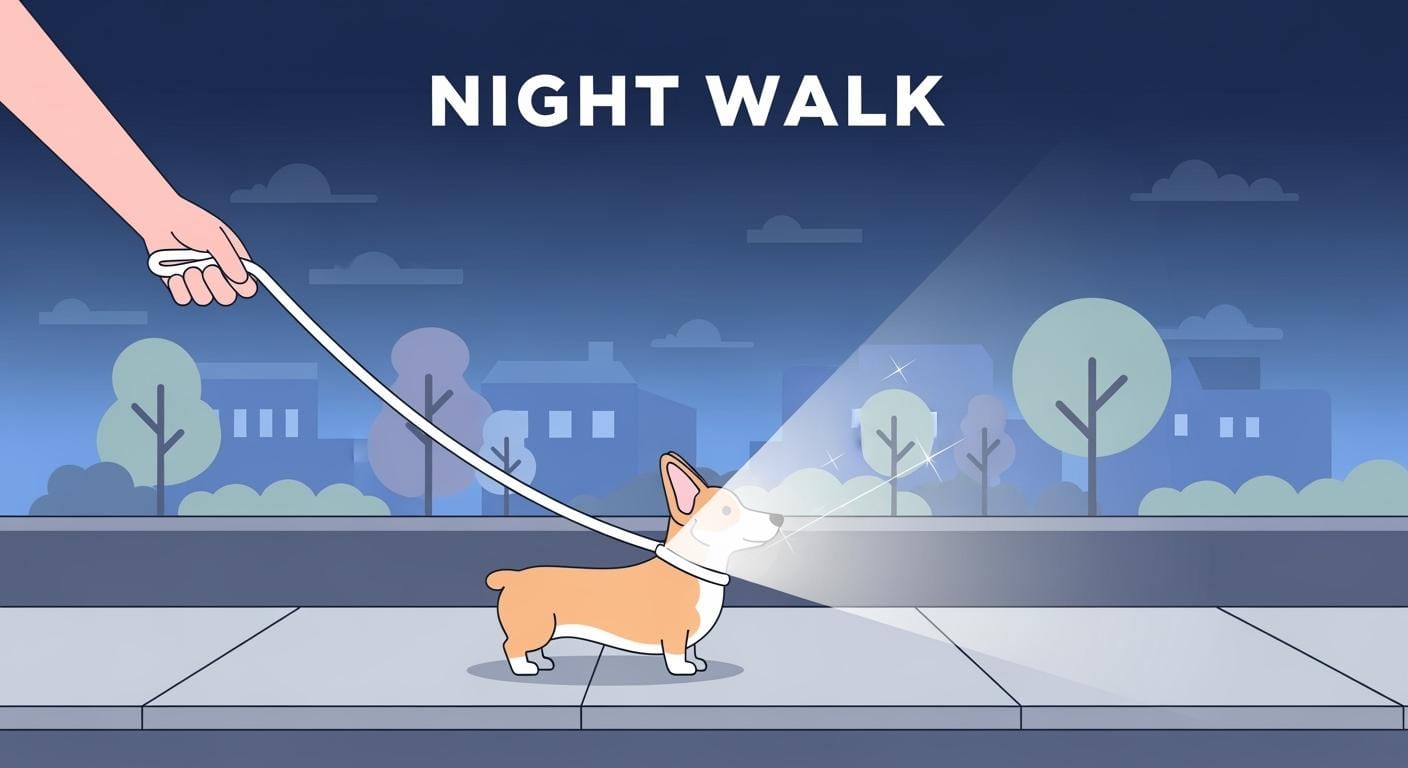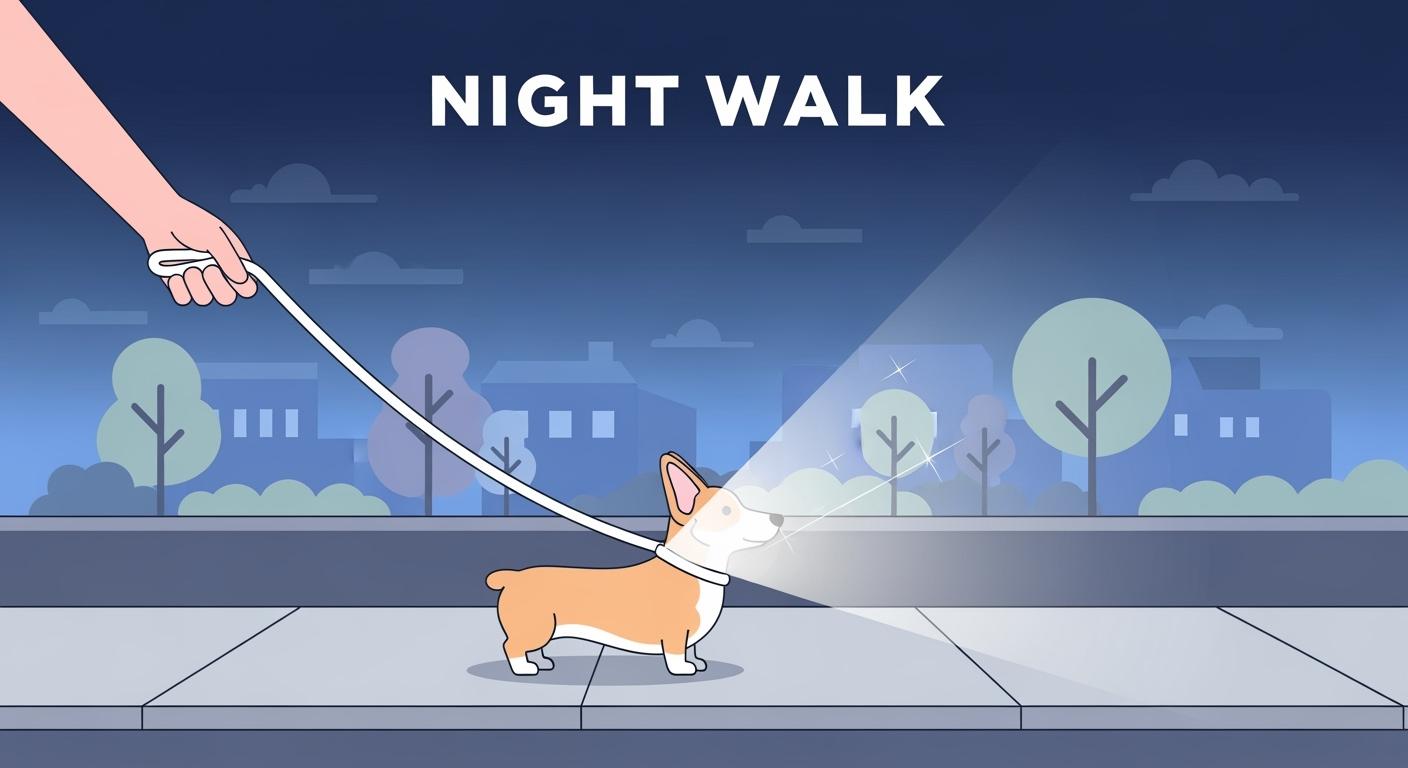
A small dog walks low to the ground. Car headlights hit the pavement first, then sweep upward at a shallow angle. A reflective leash for a small dog at night has to catch that low-angle light and return it to the driver’s eyes — fast. If the reflective surface is too narrow or facing the wrong direction when the beam arrives, the leash stays invisible. It does not matter how bright the strip looked under a flashlight at home. What matters is surface width, orientation, and whether the material holds its shape through the walk.
The leash is the thinnest, most-moved piece of reflective gear on a dog. Unlike a vest or a harness panel that stays draped over the body, a leash swings, twists, kinks, and drags. On a small dog, these movements are quicker and the leash sits closer to the ground. Understanding why some reflective designs hold up under those conditions — and which ones fail — starts with how the light actually works.
Why Narrow Reflective Strips Go Dark on a Small Dog at Night
Retroreflection Depends on Surface Area, Not Just Material
Reflective leash materials use glass beads or microprismatic elements that return light in a tight cone back toward the source. That is the physics: light enters, refracts through a bead, hits a reflective backing, and exits roughly parallel to the entry angle. But the return cone is narrow — typically 0.5 to 2 degrees of spread. If the reflective surface is a thin strip, only a fraction of the available headlight beam actually hits the retroreflective elements at the right angle. The rest scatters or misses entirely.
A narrow strip — say a quarter-inch sew-on binding — catches light only when the leash is perfectly perpendicular to the beam. On a small dog walking along a road, the leash rarely holds that angle for more than a step. The dog’s body is close to the ground, so the headlight-to-leash angle is shallow. At 30 feet of distance, a driver’s low beams hit a small-dog leash from roughly 3 to 5 degrees above horizontal. A thin strip presents a tiny target at that angle. A wider panel — an inch or more — increases the surface area catching the beam at any given moment. It also tolerates more angular deviation before the return cone misses the driver’s eyes.
Tip: Retroreflective brightness is a product of surface area multiplied by angular tolerance. Wider panels buy you both — more glass beads in play and more forgiveness when the leash is not dead-perpendicular to the light source.
Small Dogs Put the Leash at the Worst Height for Headlights
Leash height matters. A reflective leash clipped to a large dog sits 18 to 24 inches off the ground — closer to the center of a passenger car’s headlight beam. A small dog holds the leash at 6 to 10 inches. At that height, the leash sits at the bottom edge of the beam pattern, where intensity drops off. The reflective surface has less light energy to work with from the start. That makes surface area even more critical. Expanding from a thin strip to a wide panel is not a cosmetic upgrade. It compensates for the physics of beam falloff at low height.
This same height problem affects how the leash looks from the side. When a reflective leash is the primary visibility marker on a dog at night, the driver needs to see it from multiple approach angles — head-on, side-on, and everything between. A strip that faces only one direction leaves the dog invisible from cross-streets and driveways.
How Leash Twist and Kink Hide Reflective Surfaces
Small Dogs Move Faster, and the Leash Pays for It
A small dog changes direction in less than a body length. A Chihuahua can pivot and dart sideways faster than a handler can adjust leash tension. Each quick turn twists the leash. If the reflective treatment is stiff — a thick PVC coating, a rigid woven-in strip — the leash kinks instead of flattening back out. A kink points the reflective surface at the ground. The driver’s headlights hit the non-reflective back of the kink. The dog disappears.
This is the design problem at the core of choosing a leash that matches small-dog movement patterns. A leash that works for a Labrador walking a straight line can fail for a Pomeranian that zigzags. The difference is not durability or overall brightness. It is how the reflective material responds to repeated twisting and untwisting over the course of a 20-minute walk.
| Design Difference | Why It Matters | Main Limitation |
|---|---|---|
| Flexible reflective fabric panel | Flattens after twist, keeps beads facing outward | May wrinkle with heavy use; needs smooth attachment edges |
| Stiff reflective coating or tape | Looks bright when new and flat | Kinks permanently; once creased, stays pointed at the ground |
| Reflective stitching only | Lightweight, no added bulk | Too narrow to return enough light at low angles; decorative, not functional |
What to Check After a Walk
Walk the dog for 10 minutes on a routine route — turns, stops, sniffs, the usual. Then hold the leash up under a single light source and rotate it slowly through 360 degrees. If the reflective surface stays bright through most of that rotation, the material is flexible enough to maintain orientation. If it goes dark at specific angles or stays dim because of permanent creases, the material is too stiff for a small dog’s movement patterns. That fails fast.
In practice: The walk test catches what flashlight-at-the-store misses. A reflective leash that has not been walked looks bright on a shelf. The same leash after 10 minutes of a small dog’s twists may have three or four dead zones where the surface points the wrong way.
Clip Weight and Leash Drape Shape the Reflection Geometry
A heavy metal clip on a small-dog leash pulls the attachment end downward. That changes the angle of the reflective material near the clip — tilting it toward the pavement. A reflective bungee leash built with lightweight hardware reduces downward pull at the dog end, which keeps the reflective panel flatter and more likely to face oncoming light. The effect is small but cumulative. Over a 30-minute walk through a neighborhood with cross-traffic, a leash that stays flat and facing forward catches headlights at every intersection. A leash that droops at the clip end misses those opportunities one after another.
Where Reflective Leashes Work Best — and Where Visibility Drops
Conditions That Favor Reflective Visibility
Reflective materials return light to its source. That means they work best when there is a strong, active light source and the viewer is close to that source. A driver with headlights on a straight road is the ideal case. The beam and the driver’s eyes are within a few feet of each other vertically, so the retroreflective cone sends light back where it needs to go. Streetlights help too, but less — the light source and the viewer’s eyes are farther apart, so the return cone may miss.
Leashes with reflective panels on both sides — dorsal and ventral — maintain visibility during frequent direction changes typical of casual neighborhood walks. Single-sided reflective treatments go dark every time the leash flips over, which on a restless small dog happens constantly.
| Condition | What Works | What Fails |
|---|---|---|
| Straight road, car approaching | Wide panel perpendicular to beam | Thin strip at shallow angle |
| Cross-street or driveway | Double-sided or wraparound reflective | Single-side reflective facing away |
| Fog, mist, drizzle | High-contrast non-reflective backup color | Reflective-only design — beads scatter in moisture |
| No active light source | Nothing reflective works; active lighting needed | Any passive reflective — there is no light to return |
Disclaimer: This visibility assessment assumes typical suburban street lighting and standard passenger-vehicle headlights. On unlit rural roads or trails with no active light sources, no passive reflective leash provides visibility — it depends entirely on an external beam hitting it at the right angle. Small dogs with very dark coats also reduce the contrast that makes reflective panels stand out against the background; a bright non-reflective secondary color on the leash helps fill that gap.
The Handle End Needs Its Own Visibility Strategy
A leash that is visible along its length but has an invisible handle creates a second problem: the handler cannot locate the grip quickly if the leash is dropped or needs a fast two-hand redirect. Handles that match the leash body color disappear against dark clothing, grass, or pavement. High-contrast handle material — or a reflective treatment on the handle itself — turns the grip into a target the handler can find by looking down, not by feeling around.
| Handle Design | When It Works | Where It Falls Short |
|---|---|---|
| High-contrast color separate from leash body | Spot it in peripheral vision; fastest grab | Color alone does nothing without ambient light |
| Reflective stitching or panel on handle | Shines under headlights if leash is dropped roadside | Small surface area; less effective at distance |
| Handle same color as leash body | Clean look, no downside in daylight | Invisible at night — handler locates by touch only |
The walk from a parked car to a trailhead or across a parking lot puts both dog and handler in mixed traffic. A walking setup designed for real-world nighttime control treats handle visibility and leash-body visibility as one system, not two separate features. If the leash shines but the handle disappears, the handler is one dropped grip away from losing control at the worst possible moment.
Design Features That Keep a Leash Visible After Dark
Panel Width and Placement Beat Stitch-Only Designs
Reflective stitching — a common feature on budget leashes — puts a single thread line of retroreflective material along the edge of the webbing. That thread is roughly 0.5 mm wide. At 30 feet, it is effectively invisible regardless of how bright the glass beads are. A reflective panel one inch wide delivers roughly 50 times the surface area. The physics is not subjective: more beads in the beam path means more light returned to the driver’s eyes. Placement on both faces of the leash — top and bottom — doubles the odds that at least one panel faces the light source at any moment.
Flexible Materials Prevent Permanent Dead Zones
Stiff reflective tapes and coatings crease. Once creased, they create permanent dark angles — sections of the leash that never face forward again, no matter how the handler adjusts tension. Flexible woven-in reflective fabrics and soft TPU-based treatments recover from bends. They may wrinkle but they do not crease. After a walk, a flexible leash looks used. A stiff one looks folded. The difference at night: a used-looking leash still returns light across most of its surface; a folded one has blank spots where the kinks point the beads away from traffic.
The same walk-and-check test described earlier catches this. After a walk, pull the leash flat and check for dark crease lines under a flashlight. More than two permanent dark creases means the reflective material is too rigid for the dog’s movement intensity. This is especially relevant for fixed-length leashes used daily on the same side of the body, which develop repetitive wear patterns in the same spots.
Disclaimer: The crease test works for coated and taped reflective treatments. Woven-in reflective yarns may fray rather than crease — check for broken or dulled fibers at the edge of the panel instead. For flat-coated breeds like French Bulldogs or Boston Terriers, the leash may also rub against the dog’s wider body, adding abrasion to the crease problem.
Edge Binding and Hardware Placement Do Not Block the Panel
Some leash designs sandwich the reflective panel between thick edge bindings or place D-rings and accessory loops directly over the reflective surface. Each obstruction blocks a portion of the panel from the light source. The blocked zone may only be a half-inch wide, but on a leash that is already narrow, losing a half-inch of reflective coverage to hardware placement cuts effective surface area by a meaningful fraction. Designs that place hardware away from the reflective zone — or use edge binding that sits beside, not over, the panel — preserve the full reflective width.
| Design Difference | Why It Matters | Where It Works | Where It Falls Short |
|---|---|---|---|
| Wide woven-in reflective panel, both faces | Maximum surface area; survives twisting | Suburban streets, mixed traffic, active small dogs | Adds slight stiffness; heavier than uncoated nylon |
| Soft TPU reflective coating on nylon webbing | Flexible, resists creasing, lighter weight | Small dogs under 15 lb where leash weight matters | Coating can wear off at friction points over time |
| Reflective stitching only | Minimal cost, no change to leash feel | Daytime use with occasional dusk overlap | Insufficient surface area for real nighttime visibility |
| Removable reflective sleeve over standard leash | Adds visibility to an existing leash | Occasional night use, travel | Sleeve can slide, rotate, or bunch up during walks |
A reflective leash for a small dog at night is not a visibility guarantee. It is a system of design choices — panel width, material flexibility, handle contrast, hardware placement — that together determine whether a driver sees the dog or sees nothing. The leash that looked bright on the product page earns its real rating on a dark street after 20 minutes of walking, when the reflective surface has been twisted, kinked, dragged, and clipped at every angle a small dog can produce. What stays visible then is what was designed to stay visible — not what was bright when perfectly flat and new.
FAQ
How does a reflective leash help at night differently from a reflective collar or harness?
A reflective leash moves independently of the dog’s body. A collar or harness panel stays relatively stable on the dog, while the leash swings, twists, and changes angle constantly. The leash covers a larger spatial zone — the line between handler and dog — which means it can catch headlights from more approach angles than body-mounted gear. But it also has less consistent orientation, which is why panel width and double-sided reflective coverage matter more on a leash than on a harness.
Can fog or rain make a reflective leash stop working?
Moisture scatters light. Water droplets on the reflective surface can redirect incoming headlight beams away from the glass beads, reducing the light that reaches the retroreflective backing. Heavy fog also fills the air between the light source and the leash with scattering particles, weakening the beam before it arrives. In these conditions, a bright non-reflective backup color — orange, yellow, or high-visibility green — provides a fallback that passive reflection cannot.
What width of reflective panel makes a real difference for a small dog?
A panel roughly one inch wide or wider provides enough surface area to catch low-angle headlight beams at typical road distances. Strips narrower than half an inch — common in reflective-stitching-only designs — return too little light at small-dog leash height to register as a visible marker beyond 15 to 20 feet. The width matters more than the total reflective surface area distributed in thin lines.
Does leash length change how visible it is at night?
Longer leashes put more reflective material in the beam path, but they also create more slack, which increases twisting and kinking. A 6-foot leash with a flexible wide panel stays visible across more of its length than a 4-foot leash with a stiff narrow strip. Length amplifies whatever the reflective design is already doing — it makes good visibility better and bad design worse.