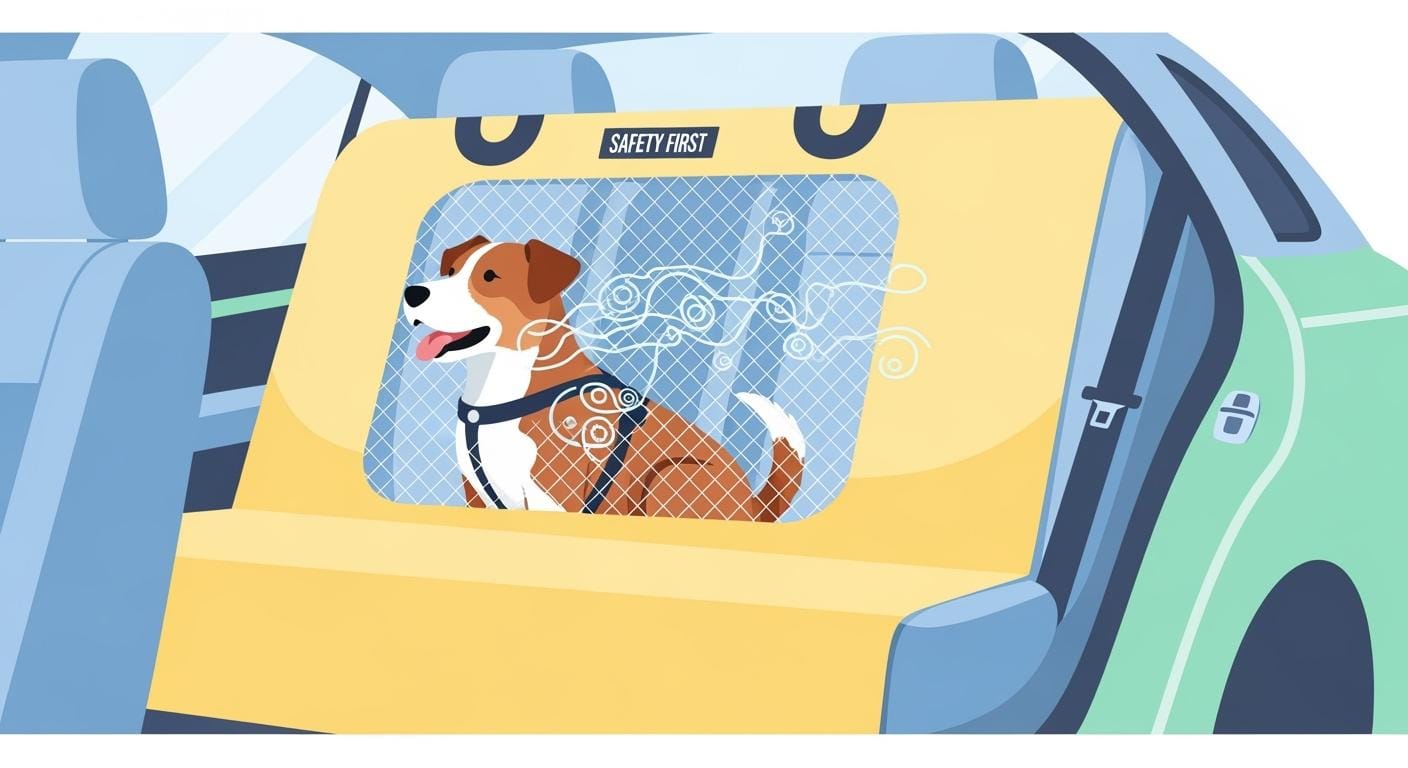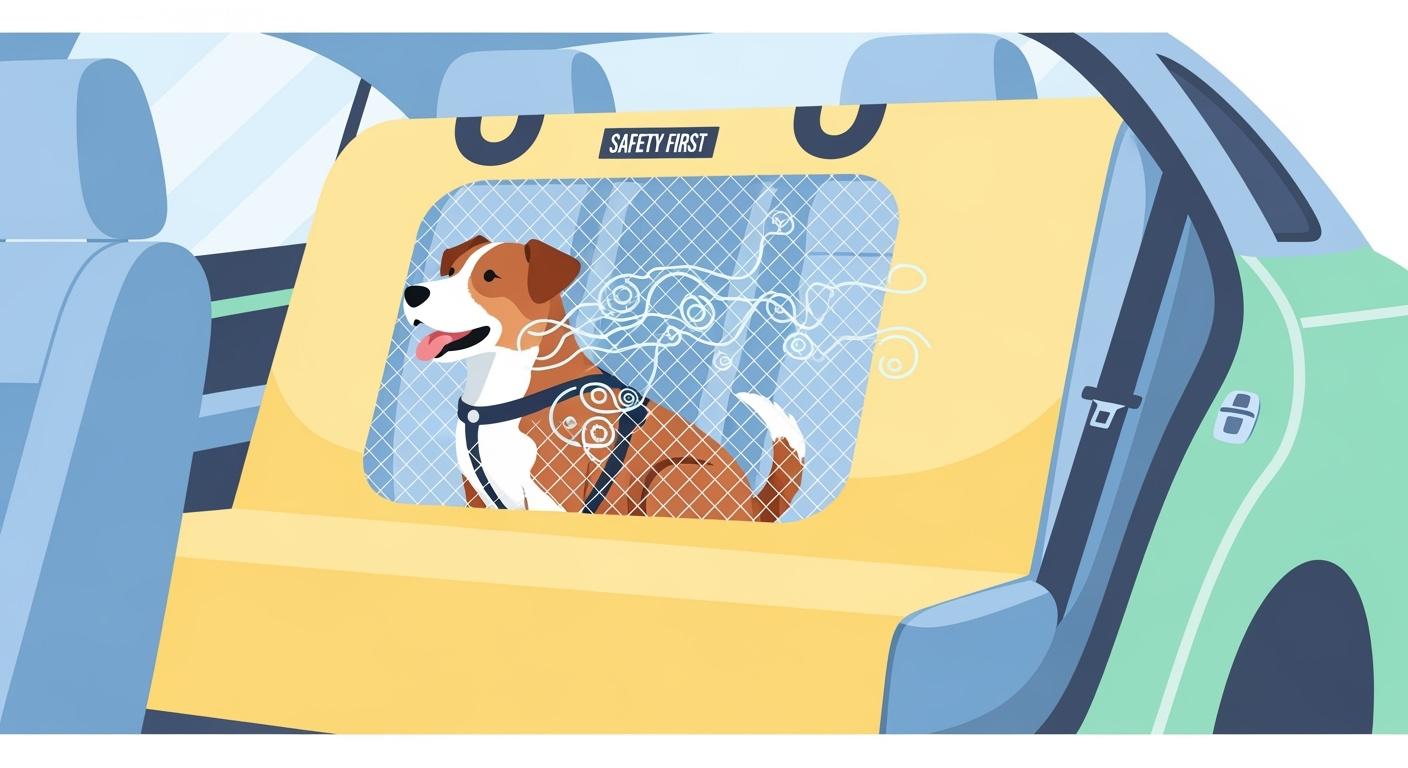
A hammock-style dog car seat cover keeps mud and fur off the upholstery. That part works. But stretch that same cover from the front headrests to the rear headrests, and it also forms a near-vertical fabric wall between the front cabin and the back seat. Air from the dash vents hits that wall and curls back forward. Your dog sits behind it, in still air that gets warmer with every mile. A dog car seat cover with a mesh window for airflow is not just a cover with a hole — it is a ventilation path. Whether it actually delivers airflow depends on where that mesh sits, how it is reinforced, and whether the rest of the cover stays anchored when the dog moves.
When a Full-Coverage Dog Car Seat Cover Traps Heat Instead of Protecting the Seat
The Hammock Design’s Hidden Trade-Off
A waterproof hammock-style cover solves one problem cleanly: it catches mud, fur, drool, and claw scratches before they reach the seat. The fabric stretches across the bench, clips to the front and rear headrests, and forms a tub that contains messes. High side panels add door protection. On wet-hike days or after a swim, a hammock cover with the right fabric and tension keeps the seat dry and the door panels clean.
But the same full-height coverage that blocks dirt also blocks air. Front cabin vents push air forward and down — not straight back. Without a low-resistance opening, that air cannot break through the fabric barrier. The rear seat zone stratifies: warm, still air pools at dog level while cooler air stays in the front. On a 90-minute drive with the AC running, the temperature difference between the front cabin and the rear footwell can be enough to make a dog pant and shift restlessly.
This is the core design tension in any full-coverage dog car seat cover: more fabric means more protection but less passive ventilation. A mesh window, placed correctly, resolves the tension — but placement makes all the difference.
Signs the Cover Is Blocking More Than It Should
After a drive, reach back and hold your palm at your dog’s head level in the back seat. If the air feels still or noticeably warmer than the air at your own shoulder in the front, the cover is blocking the ventilation path. A second sign: the dog shifts position every few minutes, trying to find air. Short-muzzled breeds show this faster — they rely more on ambient air for thermoregulation and less on evaporative cooling from panting alone.
| What you notice on a drive | What the cover design is doing | Design fix that changes it |
|---|---|---|
| Rear seat air feels still or warm at dog level | Full fabric wall blocks front-to-rear airflow path | Center mesh window at dog’s seated head height |
| Dog keeps craning to see forward, vocalizing | High panels block line of sight to passengers | Mesh window positioned for visibility as well as air |
| Cover shifts, bunches, or slides off one side | Seat anchors are loose or the backing has no grip | Non-slip backing plus seat anchors tucked deep into the crevice |
| Door panels still get paw prints and drool | Side flaps are too short to catch lateral mess | Partial side protection extending past the door card |
Where Mesh Windows in a Dog Car Seat Cover Deliver Real Airflow — and Where They Come Up Short
Why Mesh Placement, Not Just Mesh Presence, Controls Airflow
A mesh panel sewn too low — near the seat bottom — sits below the airflow path. Front vents blow across the dash and center console; air that reaches the rear seat travels at roughly chest-to-head height for a medium-sized dog sitting upright. A mesh panel placed there creates a low-resistance opening in the fabric wall. Air bleeds through. The pressure difference between the front cabin (slightly positive from the blower) and the rear zone (neutral or slightly negative) does the rest. No fan needed. No extra vent. Just a path.
Place that same mesh panel too high, near the headliner, and most of the airflow misses the dog entirely. Place it too low and it ventilates the footwell — where the dog is not. The mesh has to sit where the dog’s head actually is during the ride. For a Labrador lying across the bench, that means lower. For a Border Collie sitting upright, that means higher. A single fixed-position mesh window cannot suit every posture, but a centered, generously sized panel at mid-to-upper-backrest height covers the most common positions.
Reinforced Edges Keep the Mesh From Becoming a Weak Point
The mesh panel is both the cover’s most valuable feature and its most likely failure point. Open-weave fabric concentrates stress at the seam where it meets the denser waterproof body fabric. Every time the dog leans against the mesh, the seam takes a lateral load — and open-weave material has no bias stretch to distribute it. The force lands on individual threads at the stitch line.
A reinforced edge — double-folded binding, bar-tack stitching at the corners, and a seam allowance wide enough to carry lateral tension — prevents those threads from pulling one by one. Without it, the mesh sags within a few months of regular use, then tears. A cover that runs cooler fabric through the body while reinforcing the mesh opening gains durability without losing the ventilation benefit.
To check whether your cover’s mesh is adequately reinforced: after a month of use, run a fingertip along the seam where the mesh meets the body fabric. If the stitching has pulled away from the fabric edge by more than roughly 2 mm anywhere along the seam, thread failure is starting — the mesh panel will sag soon.
Too Much Mesh Destroys the Cover’s Primary Job
More mesh is not more better. A mesh opening that spans half the cover area trades protection for ventilation — and protection is why the cover is there. A large, unreinforced mesh panel buckles under a dog’s shifting weight. Spills, drool, and loose fur pass through openings the cover was supposed to block. The seat underneath gets wet. That fails the core task.
The right ratio: mesh occupies the center third of the cover’s backrest area — enough for a clear ventilation window and an unobstructed sightline to the front cabin — while the seat base, sides, and lower third of the backrest stay solid and waterproof. Mesh is not the cover. Mesh is a window cut into a cover that still does its job everywhere else.
What a Better Mesh-Window Cover Balances: Airflow, Anchoring, and Seat Protection
A Waterproof Base Layer That the Mesh Doesn’t Weaken
The mesh window solves ventilation. Everything beneath it must still solve containment. A waterproof seat base matters because the cover’s job does not stop when the dog is cool — it stops when the seat underneath is still dry after three hours of wet dog. Multi-layered fabric with a dedicated waterproof barrier layer stops moisture migration that single-layer coated fabrics eventually allow at seam perforations. The base needs a waterproof barrier that holds up through repeated cleaning cycles — not just a DWR coating that washes off.
Seat Anchors and Non-Slip Backing Determine Whether the Mesh Still Aligns After 20 Minutes
A mesh window only ventilates if it stays where it was placed. A cover that slides forward or bunches toward the center console pulls the mesh out of alignment with the airflow path. The dog ends up behind solid fabric again — the mesh is now angled toward the window or the opposite seat.
The mechanism that prevents this: seat anchors tucked deep into the seat crevice, plus a non-slip backing — rubberized dots or a silicone grid pattern — that resists lateral shear. When the dog shifts weight during a corner or a brake, the backing grips the seat surface and the anchors prevent the cover from walking forward. A cover that lies flat and stays put under cornering loads keeps the mesh where it belongs: at the dog’s head, aligned with the airflow.
Disclaimer: The airflow checks described here assume a standard sedan or SUV cabin layout with front-to-rear ventilation. In vehicles where rear AC vents are positioned high on the B-pillar or roof, a mesh window may add less benefit — those vents already deliver air directly to the dog’s zone. For brachycephalic breeds that pant rather than rely on passive airflow for cooling, a mesh window alone may be insufficient on hot days; pair it with direct vent airflow and frequent water breaks.
Side Flaps That Protect Without Sealing the Dog In
Full-height side panels that cover the entire door card trap the dog in a fabric box — good for containment, bad for comfort if the dog feels cut off. Partial side flaps — roughly two-thirds the height of the door card — catch lateral paw swipes and drool while leaving the upper door area open. The dog gets a partial outside view. The door material stays clean where paws actually reach it.
A cover built with a waterproof base, reinforced mesh, and partial side flaps weighs the trade-offs correctly: protection where contact happens, ventilation where it is needed, and visibility where it calms the dog.
| Design difference | Why it matters for airflow and protection | Where it falls short |
|---|---|---|
| Center mesh at head height | Creates a direct path for front cabin air to reach the dog’s breathing zone; doubles as a sightline to passengers | Fixed-position mesh may not align for dogs that always lie flat across the bench |
| Reinforced mesh edges with bar-tack stitching | Prevents the seam from pulling apart under lateral load when the dog leans against the panel | Adds manufacturing steps; cheaper covers skip this and the mesh sags within months |
| Waterproof barrier layer in seat base | Stops liquid migration through the fabric, even after repeated cleaning cycles | Multi-layer construction adds weight and cost versus single-layer coated fabric |
| Non-slip backing with deep seat anchors | Keeps the mesh aligned with the airflow path by preventing forward creep during braking and cornering | Effective only when anchors are installed correctly — loose anchors negate the backing’s grip |
| Partial side flaps (roughly two-thirds door height) | Catches paw-level mess while leaving upper sightlines open; reduces the “boxed in” feeling | Tall dogs that press against the upper door may still leave marks above the flap line |
When a Mesh-Window Cover Is Not the Right Design Choice
A dog car seat cover with a mesh window solves a specific problem: a full-coverage hammock blocking airflow and visibility in a vehicle without dedicated rear vents. If your vehicle already has strong rear-seat air vents positioned at or above seat level, the mesh adds less — the rear vents are already doing what the mesh window would do. The cover’s job in that vehicle is pure protection; a solid hammock without a mesh window works fine.
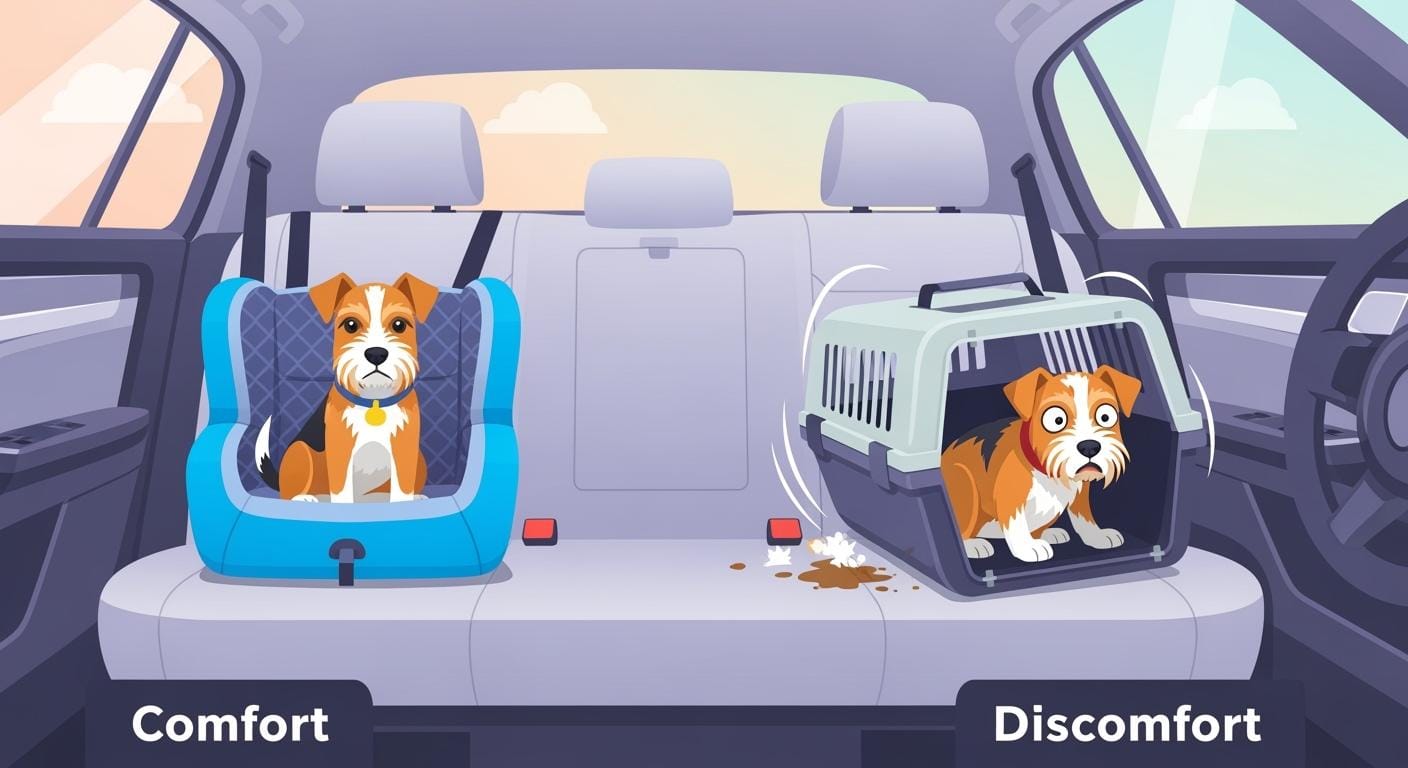
Mesh windows also do less for dogs that ride in a secured carrier or booster seat rather than directly on the rear bench — those enclosures have their own ventilation and sightline design, and the cover’s mesh is irrelevant to them. Booster seats with their own structure and sightlines solve visibility differently than a mesh panel in a hammock cover, and the two designs do not compound.
For dogs with heavy shedding paired with a habit of pressing against the backrest, even a reinforced mesh panel collects fur in its weave faster than a solid panel does. The mesh still ventilates, but it needs more frequent cleaning to stay open. If cleaning the mesh every few trips is not feasible, a solid cover with the rear windows cracked may be the more practical choice — less elegant, but less maintenance.
FAQ
Where should the mesh window sit on a dog car seat cover?
The mesh panel should sit at roughly mid-to-upper backrest height — where the dog’s head is during the ride. Too low and it ventilates the footwell. Too high and the airflow passes above the dog. A centered panel placed where front cabin air naturally travels toward the rear seat gives the most consistent ventilation across different dog postures.
Does more mesh area mean better airflow?
Not past a point. A mesh panel that covers more than roughly the center third of the backrest weakens the cover’s containment function — spills and fur pass through, and the seat underneath gets wet. What matters is whether the opening sits in the airflow path, not how large it is. A smaller, well-placed mesh window outperforms a larger, poorly placed one.
Why does the mesh on my cover sag or pull away from the edges?
Open-weave mesh concentrates stress at the seam where it meets the denser body fabric. Without reinforced edges — double-folded binding and bar-tack stitching at the corners — lateral tension from the dog leaning against the panel pulls individual threads loose. The mesh sags, then tears. Reinforced edges prevent thread-by-thread failure by distributing the load across the binding.
Can a mesh window cover keep the seat waterproof?
Yes, if the mesh is limited to the backrest area and the seat base uses a dedicated waterproof barrier layer — not just a surface coating. The mesh should occupy the upper-center portion of the cover while the seat base, lower backrest, and sides remain solid, waterproof fabric. The mesh ventilates; everything else contains.
Why does my cover still slide even with anchors installed?
Anchors that are not pushed deep into the seat crevice cannot resist forward creep during braking. The cover walks forward, pulling the mesh out of alignment with the airflow path. Non-slip backing helps but cannot compensate for loose anchors — the two must work together. After installing, pull the cover firmly toward the rear of the seat; if it moves more than an inch, re-seat the anchors deeper before loading the dog.