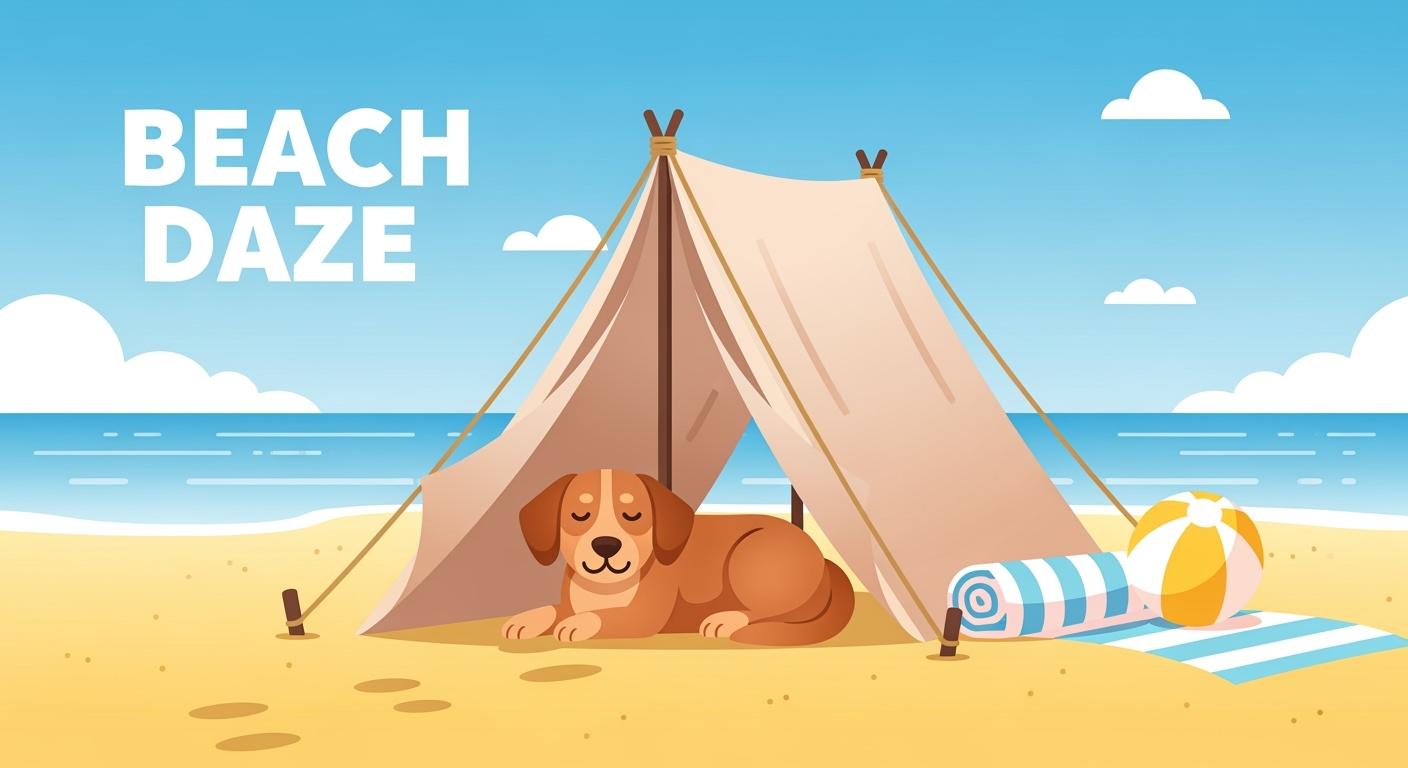
A dog tent for beach shade faces two problems that a backyard tent never does. Loose sand offers almost no grip for standard stakes. And without airflow, shade quickly becomes an oven. Both failures share a root cause: most tents are designed for grass and campgrounds, not for the physics of sand and radiant heat.
A tent on the beach takes force from three directions at once — wind pressing against the fabric, the dog’s weight shifting inside, and sand grains flowing around whatever anchor was pushed into the ground. When any one of those forces overcomes the anchor’s hold, the whole structure shifts. The question is not whether a tent provides shade. It is whether the shade stays where the dog is.
Why Standard Tent Anchors Fail on Loose Sand
How Sand Defeats Standard Stakes
A standard metal peg holds in soil because compacted earth pushes back against the stake shaft along its entire length. Slide that same peg into dry beach sand and the mechanics reverse. Sand grains are round and loosely packed — they flow around the stake rather than gripping it. The holding force drops to near zero the moment any upward or lateral load is applied.
When wind catches a tent panel, the force travels through the guy line to the stake. In soil, the stake resists because displacing it would require compacting the earth around it. In sand, the grains simply rearrange. The stake extracts with almost no resistance — often within seconds of the first gust. That is the cascade: wind load → guy line tension → stake uplift → sand grain flow → anchor failure. A dog moving inside the tent accelerates every step of it.
You can verify this before the trip. Push a standard tent stake into damp sand at the beach, pull it laterally with about 15 pounds of force — roughly the tug of a medium-sized dog shifting position. If the stake moves more than an inch, it will not survive a 20 mph gust with a dog inside.
Wind, Frame Flex, and the Waterbed Effect
Wind direction matters as much as wind speed. A tent facing into the wind catches air like a sail — the fabric balloons, the windward anchors take the full load, and the frame twists along its diagonal. When the wind shifts, the load transfers to a different corner. Lightweight frames flex under these shifting loads, and flexing loosens whatever grip the anchors still have.
Dog movement adds a second, less obvious force. When a dog shifts weight inside the tent, the floor fabric pulls on the frame at a single point. That point load transfers diagonally across the structure — the opposite corner lifts, the anchor on that corner unweights, and if it was already loose in sand, it pulls free. This is the waterbed effect: pressure at one corner lifts the opposite side. A frame that is rigid enough to resist this torsion keeps all four anchors loaded, which is what keeps the tent planted.
Uneven Sand and Anchor Geometry
Beach sand rarely sits flat. Slopes, dips, and soft pockets change how each anchor is loaded. On a slope, the downhill anchors carry more weight; the uphill ones carry less and pull out first. A tent set up on packed wet sand near the water may hold for an hour, then loosen as the sand dries and the grains lose cohesion.
Different surfaces demand different anchor strategies. The table below shows how surface type changes what holds:
| Surface Type | Stake Hold | Frame Stability | Shade Reliability |
|---|---|---|---|
| Flat, packed wet sand | Moderate | High | Consistent |
| Sloped dry sand | Low | Low | Shifts with sun |
| Soft, loose dry sand | Near zero | Medium | Unreliable |
How Poor Ventilation Turns Shade Into a Heat Trap
Why Shade Without Airflow Becomes an Oven
Shade blocks direct sunlight, but it does not remove heat. A tent with closed sides traps the dog’s body heat and the radiant heat absorbed by the fabric itself. Within 15 to 20 minutes on a sunny beach day, the interior temperature can rise 10 to 15 degrees above the outside air. The tent becomes a solar collector with a dog inside it.
The mechanism is straightforward. Sunlight strikes the tent fabric, which absorbs shortwave radiation and re-emits it as longwave infrared. That infrared heats the air inside the tent. If the panels are closed, the warm air has nowhere to go. The dog adds more heat through respiration and body surface radiation. Without an exit path, the interior temperature climbs steadily. Mesh panels break this loop by creating a pressure differential — wind enters the windward mesh, warm air exits the leeward side. The flow carries heat out rather than letting it accumulate.
A quick field check: after the tent has been in the sun for 10 minutes, place your hand against the inside of the roof panel. If it feels warmer than the outside air, the fabric is radiating heat downward. Then check for air movement at the side mesh — if you feel nothing, cross-ventilation is not working and the dog is sitting in a heat trap.
Fabric Color and the Radiation Problem
Fabric color changes how a tent handles solar radiation. The difference is not cosmetic — it directly affects the temperature inside.
Light-colored fabrics reflect a larger fraction of incoming solar energy. The fabric itself stays cooler, which means less infrared re-radiation onto the dog. But lighter weaves can allow more visible light to pass through, which brightens the shaded area and can make it feel less protective. Dark fabrics absorb more energy, block more visible light, and create a dimmer shade — but the fabric surface heats up significantly and radiates that stored heat downward into the occupied space.
The table below breaks down the trade-off:
| Fabric Color | Solar Reflection | Heat Absorption | Fabric Surface Temp | Shade Brightness |
|---|---|---|---|---|
| Light (white, beige) | High | Low | Cooler to touch | Brighter |
| Dark (blue, black) | Low | High | Hotter to touch | Dimmer |
The best result comes from a light-colored shell with a tight weave — high reflectivity with low light transmission — paired with large mesh panels on opposite sides. The fabric bounces solar energy away, and the mesh vents whatever heat does accumulate. No single material property solves the problem alone.
Design Features That Control Beach Conditions
Anchor Systems That Work in Sand
The anchor is the single point of failure for any beach tent. Standard stakes fail in sand because their holding force depends on soil compaction — something sand does not provide. Three anchor types solve this through different mechanisms.
Screw-in anchors use helical flights to engage sand through compression rather than friction. Each flight traps a column of sand above it — to extract the anchor, that entire column must be displaced. Deadman anchors work on a different principle: buried horizontally at a 45-degree angle, they convert upward pull into soil pressure against a broad surface. Anchor bags filled with sand rely on pure mass — a filled bag weighing 25 to 35 pounds resists movement through weight alone, and the bag’s fabric conforms to the sand surface for added friction.
| Anchor Type | Hold Mechanism | Setup Effort | Main Limitation |
|---|---|---|---|
| Standard stake | Soil friction | Low | Near-zero hold in dry sand |
| Screw-in anchor | Helical sand compression | Moderate | Needs minimum sand depth |
| Deadman anchor | Buried surface area | High | Requires digging and reburying |
| Anchor bag | Mass + surface friction | Low | Heavy to carry; needs refilling |
Tip: Anchor bags double as carry weight on the walk to the beach. Empty them for transport, fill them with sand on site. The weight you need is already under your feet.
Frame Design and Torsional Stability
A tent frame takes two kinds of load: compression from above and torsion from the side. Compression — the weight of the fabric and any wind pressing down — most frames handle adequately. Torsion is what breaks them. When wind hits one corner or the dog leans against one side, the frame twists along its diagonal axis. A frame with flexible joints absorbs that twist by deforming, but deformation unweights the opposite anchor. The tent walks itself loose.
Rigid corner joints and a hub-style top connection resist torsion better than flexible pole sleeves. The difference shows up in how the tent behaves during gusts: a torsion-resistant frame transfers wind load evenly to all four anchors, while a flexible frame channels it to the windward side only. Even anchor distribution keeps every anchor loaded — the condition that prevents pull-out.
Ventilation Layout and Panel Materials
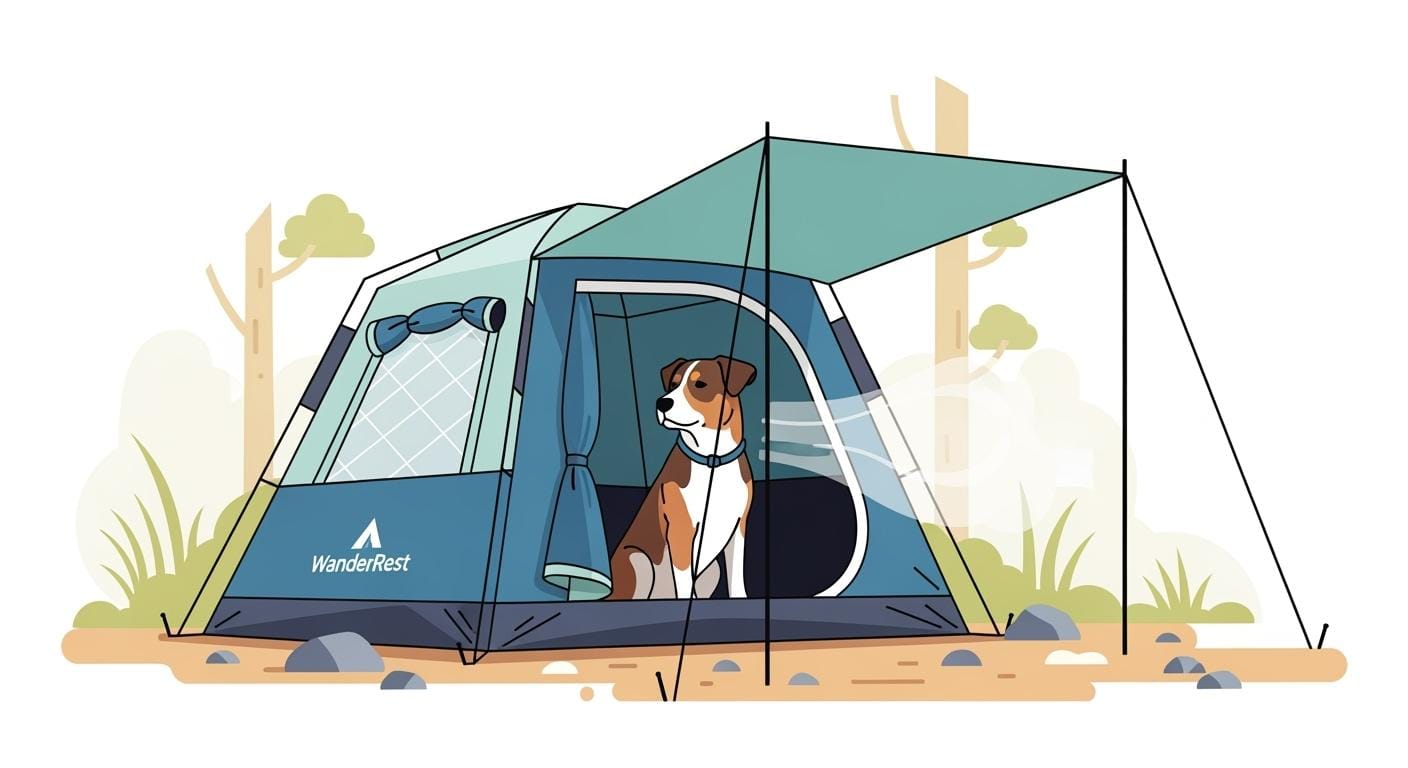
Ventilation is not about having mesh somewhere on the tent. It is about the pressure differential between the windward and leeward sides. Mesh on one side alone creates almost no airflow — the air inside reaches equilibrium pressure and stops moving. Mesh on opposite sides creates a path: wind enters the high-pressure side, flows across the interior, and exits the low-pressure side. That continuous flow is what carries heat out.
The panel material matters for more than durability. Polyester panels offer UV protection but limited stretch, so they hold their shape in wind. Nylon is lighter and more tear-resistant but can sag when wet. Oxford weaves add water resistance — useful if the tent sits near the tide line. Lycra or spandex-blend mesh panels stretch without tearing and recover their shape after the dog leans against them. The table below summarizes material properties:
| Material | Key Property | Where It Works Best |
|---|---|---|
| Polyester | UV resistance, shape retention | Roof and top panels |
| Nylon | Lightweight, tear-resistant | Side panels |
| Oxford weave | Water resistance, durability | Floor and lower panels |
| Lycra/spandex mesh | Stretch recovery, breathability | Ventilation panels |
Shade Area and Sun Angle
The shaded footprint of a tent is not fixed. It moves with the sun. Early morning and late afternoon sunlight strikes at a low angle, casting a long, narrow shadow that shifts rapidly. Midday sun is more vertical, producing a shorter, wider shadow that stays relatively stable for an hour or two. A tent with a wide floor gives the dog room to follow the shade as it moves.
Adjustable side flaps or awnings help block low-angle sun that slips under the roof line. Without them, the shaded area shrinks to a thin strip by mid-afternoon, and the dog ends up in direct sun without realizing it.
| Time of Day | Sun Angle | Shade Footprint | Adjustment Needed |
|---|---|---|---|
| Morning (8–10 am) | Low, from the east | Long, narrow | Angle tent to block side sun |
| Midday (11 am–2 pm) | High, overhead | Short, wide | Minimal — best coverage window |
| Afternoon (3–5 pm) | Low, from the west | Long, narrow | Reposition or add side flaps |
When a Beach Tent Is Not the Right Tool
A tent provides temporary shade and some wind shelter. It does not cool the air. It does not protect against extreme heat — on a 95-degree day with no breeze, even the best-ventilated tent will not keep a dog comfortable for long. For extended beach days, a tent is one piece of a larger heat-management plan that includes water, cooling mats, and timed shade breaks.
An open-sided canopy sometimes works better than a full tent — more airflow, less trapped heat, and fewer anchor points to manage. The trade-off is less wind protection and no bug screening. The right choice depends on whether the main risk at your beach is heat or wind.
Disclaimer: The fit checks and anchor tests described here assume a typical sandy beach with moderate wind. If your dog is a brachycephalic breed — bulldog, pug, boxer — heat stress can set in faster than these ventilation benchmarks account for. Shorten shade sessions by half and watch for respiratory effort, not just panting. For double-coated breeds, rub-checking for pressure points may require hand-feeling rather than visual inspection, since thick fur masks skin-level contact marks.
FAQ
Can a dog tent keep a dog cool on the beach?
A tent blocks direct sun, which slows heat gain. Whether it keeps the dog cool depends on airflow. Mesh panels on opposite sides create cross-ventilation — wind enters one side, warm air exits the other. Without that flow, the tent interior heats up regardless of how much shade the roof casts. No tent replaces the need for water, shade breaks, and monitoring.
Do standard tent stakes work in beach sand?
They do not. Standard stakes rely on soil compaction for grip. Dry sand has almost no compaction — the grains flow around the stake shaft and offer minimal resistance. Pull a standard stake laterally with modest force and it slides out. Screw-in anchors, deadman anchors buried at an angle, and sand-filled anchor bags all provide better hold because they engage sand through different mechanisms than simple friction.
Should a beach dog tent be fully enclosed or open?
Open ventilation on at least two opposite sides is essential for any beach tent. Fully enclosed designs trap radiant heat from the sun and the dog’s body heat — the interior can climb 10 to 15 degrees above outside air within 20 minutes. The ideal layout pairs a solid roof (for direct sun blockage) with large mesh side panels on opposing walls.
How do you keep the shaded area usable as the sun moves?
The shaded footprint shifts with sun angle throughout the day. Morning and afternoon sun produces a long, narrow shadow that moves quickly. A wide floor gives the dog room to follow the shade. Adjustable side flaps or awnings block low-angle sunlight that slips under the roofline. Repositioning the tent every 60 to 90 minutes keeps the dog in the shadow as the sun arcs overhead.