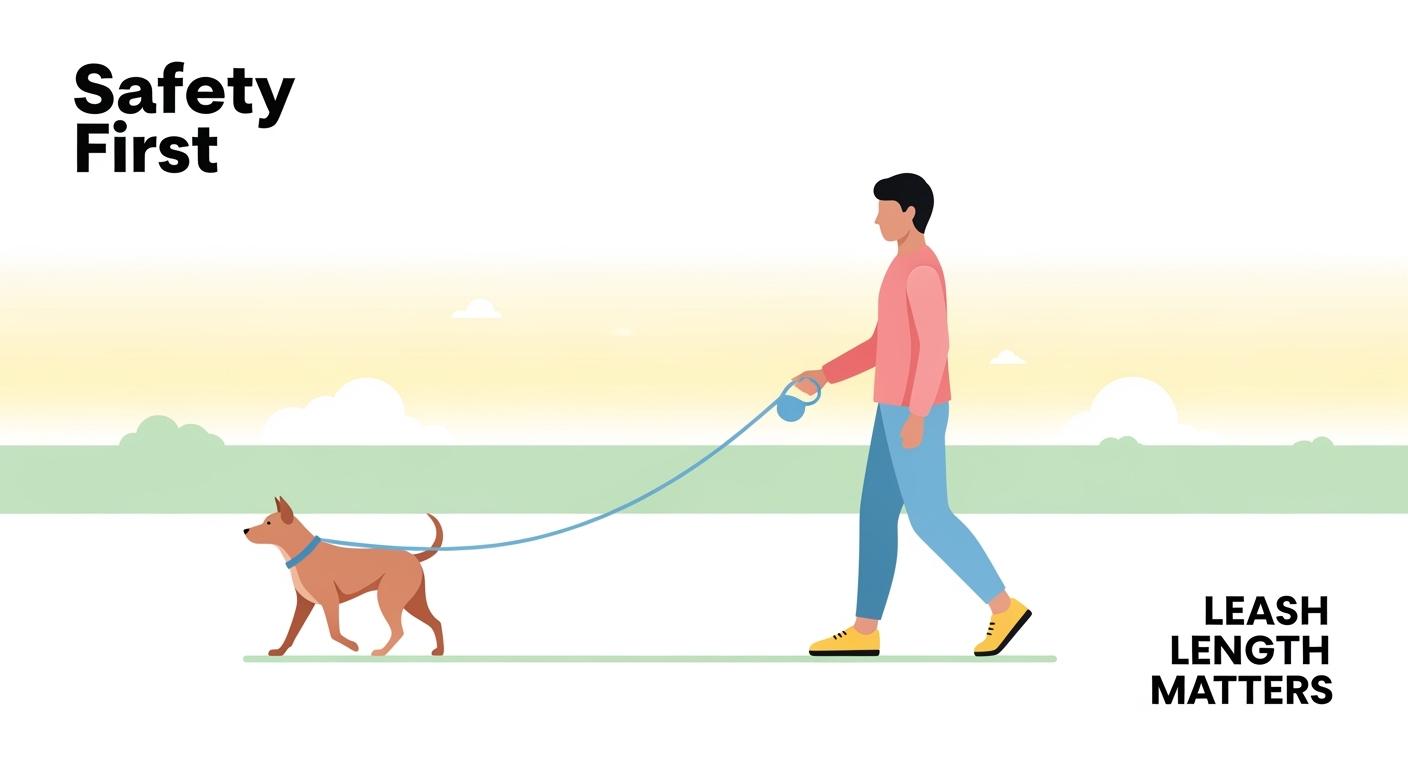
A leash that drifts longer mid-walk does not announce itself. The slider moves a quarter-inch per stop-start cycle. Over ten minutes, that becomes six inches of unintended length. The dog is farther out than you expect. In traffic, that distance matters.
This is not a training problem. It is a hardware problem — one rooted in how the slider contacts the webbing, how the material surface responds to repeated tension, and whether the tail end stays managed or becomes a slack reservoir. Fix those three things and the drift stops.
The Warning Sign — A Leash That Grows Longer During Stop-Start Walks
How slider creep shows up in real movement
When a dog changes pace, the leash experiences a tension spike. That spike travels up the webbing and hits the slider at an angle determined by the buckle orientation and the dog’s position relative to the handler. If the slider’s contact surface is smooth — polished nylon against polished nylon — the webbing slides through it. A fraction of an inch per spike. Over a dozen stop-start cycles, those fractions add up.
The mechanism is straightforward. A smooth slider relies entirely on surface friction between two low-friction materials. Under straight-line static load, that friction may hold. But walking is not static. Each time the dog lunges, stops, or changes direction, the load vector shifts off-axis. The webbing enters the slider at a slight angle, reducing the contact patch area. Less contact area means less friction. The webbing slips. The leash grows longer. The handler does not notice until the dog is already out of position.
Fixed-length leashes do not have this failure mode — there is no adjuster to creep — but they trade away versatility. Among adjustable and fixed-length designs, the difference in real-world control often comes down to whether the adjustment hardware stays put after the first ten minutes of walking. Retractable leashes magnify the problem: a lock mechanism that slips under sudden load can release up to 26 feet of cord before the handler reacts.
In practice: Mark the webbing with a piece of tape right at the slider exit point before a walk. After ten minutes of normal movement — stops, starts, pace changes, one or two tight passes — check whether the tape has migrated relative to the slider. More than half an inch of drift means the hardware is not holding under real walking loads.
Why Adjustable Length Slips Under Real Movement
Slider grip physics: smooth versus toothed contact
The difference between a slider that holds and one that creeps is not brand. It is geometry. A smooth tri-glide presents a flat, uninterrupted surface to the webbing. Friction comes from surface roughness alone. When nylon webbing runs through a nylon slider at a shallow entry angle, the effective coefficient of friction can drop below what is needed to resist a 30-pound dog’s intermittent pull.
A toothed slider changes the force pathway. Each tooth creates a localized high-pressure contact point that presses into the webbing’s weave structure. Instead of relying on distributed surface friction, the teeth mechanically engage the fibers. The force that would have produced sliding motion dissipates at each tooth-webbing interface as microscopic deformation and heat. In production terms, this is easier to execute consistently with POM (polyoxymethylene) than with nylon — POM holds sharper tooth profiles through molding and wears more gradually, so grip degradation follows a predictable curve rather than a sudden failure.
Webbing texture matters in parallel. Smooth, tightly-woven webbing presents fewer surface features for teeth to bite into. A slightly coarser weave — still comfortable in the hand — gives the slider more mechanical purchase. The interaction is two-sided: a toothed slider on smooth webbing still outperforms a smooth slider on textured webbing, but the combination of toothed hardware and a matte-finish weave creates the most slip-resistant system. How material and width choices affect daily handling goes beyond comfort — they directly determine whether the set length survives a full walk.
Buckle angle and repeated load cycling
A buckle that sits at an off-axis angle relative to the webbing path introduces a rotational moment every time tension is applied. The webbing twists slightly as it passes through. That twist reduces the effective contact width inside the slider, concentrating the load on one edge. Over hundreds of cycles, this edge-loading polishes a narrow track into the webbing surface — the same spot the slider is supposed to grip. A polished track has lower friction than the surrounding material. The slider now has less to hold onto than when the leash was new.
Good hardware keeps the webbing path straight through the adjuster regardless of the buckle angle above or below it. This is partly a design choice — where the D-ring or O-ring is placed relative to the slider — and partly a material choice. Stiffer webbing resists twisting better than soft, pliable webbing, which means it enters the slider at a more consistent angle across a wider range of pulling directions. The trade-off: stiffer webbing feels less supple in the hand. For walking setups where the leash attaches to a harness, this stiffness also affects how much harness rotation reaches the leash — a stiffer leash transmits less twist, which keeps the slider angle more consistent across different dog positions.
| Design Feature | Material | Why It Resists Slip |
|---|---|---|
| Wide-mouth slide with anti-slip stripe | POM | Increases contact patch area; stripe adds a high-friction zone that interrupts smooth sliding |
| Toothed adjustable slide | POM | Teeth mechanically engage webbing fibers rather than relying on surface friction alone |
| Webbing adjust slide with toothed back | POM | Reverse-side teeth prevent the webbing from backing out under reverse-load conditions |
| Tri-glide with tooth protrusions | Nylon | Protrusions create discrete grip points; nylon flexes enough to avoid cutting fibers under peak load |
What Keeps Control Distance Stable
Hardware that holds: what to check before the walk
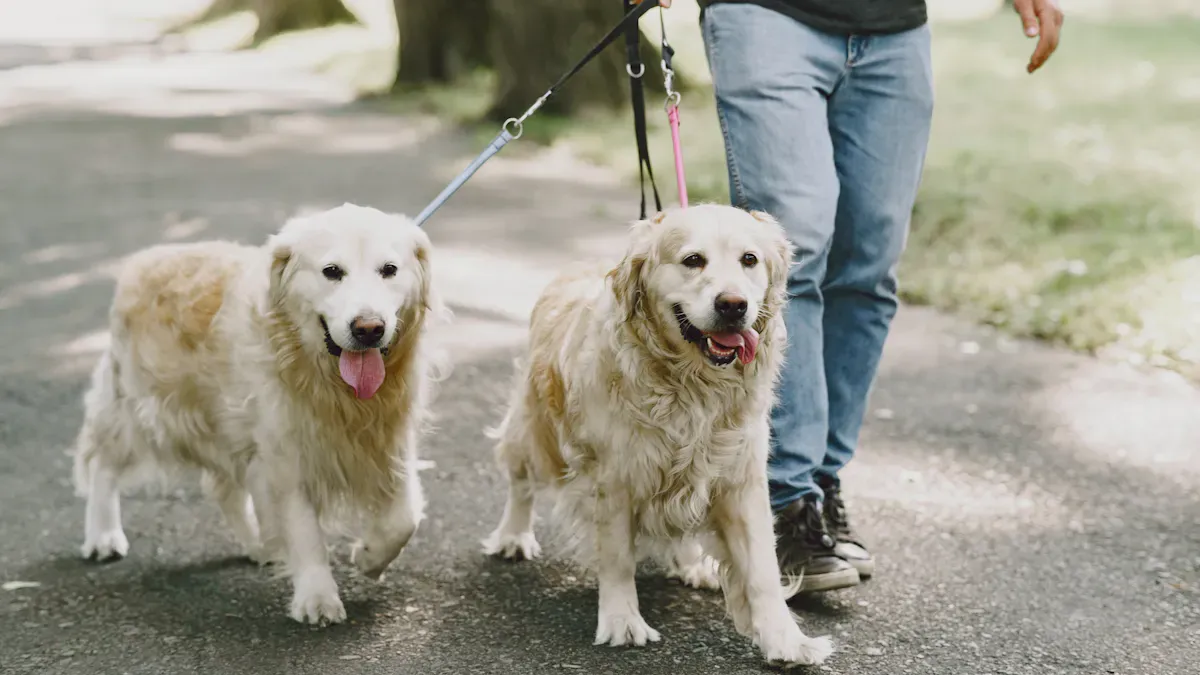
Three hardware elements determine whether a leash holds its set length. The first is the adjuster itself — a toothed tri-glide or cam-lock buckle that bites into the webbing rather than riding on it. The second is the carabiner or clip at the harness end. A swivel clip prevents the leash from winding up as the dog circles or changes direction; that winding, if transmitted back to the slider, pulls webbing through at an uneven angle. The third is the handle layout. A double-handle design with a close-control grip near the clip gives the handler a fixed-length zone that functions independently of the adjustable section — even if the slider does creep, the close-control handle remains at a known distance.
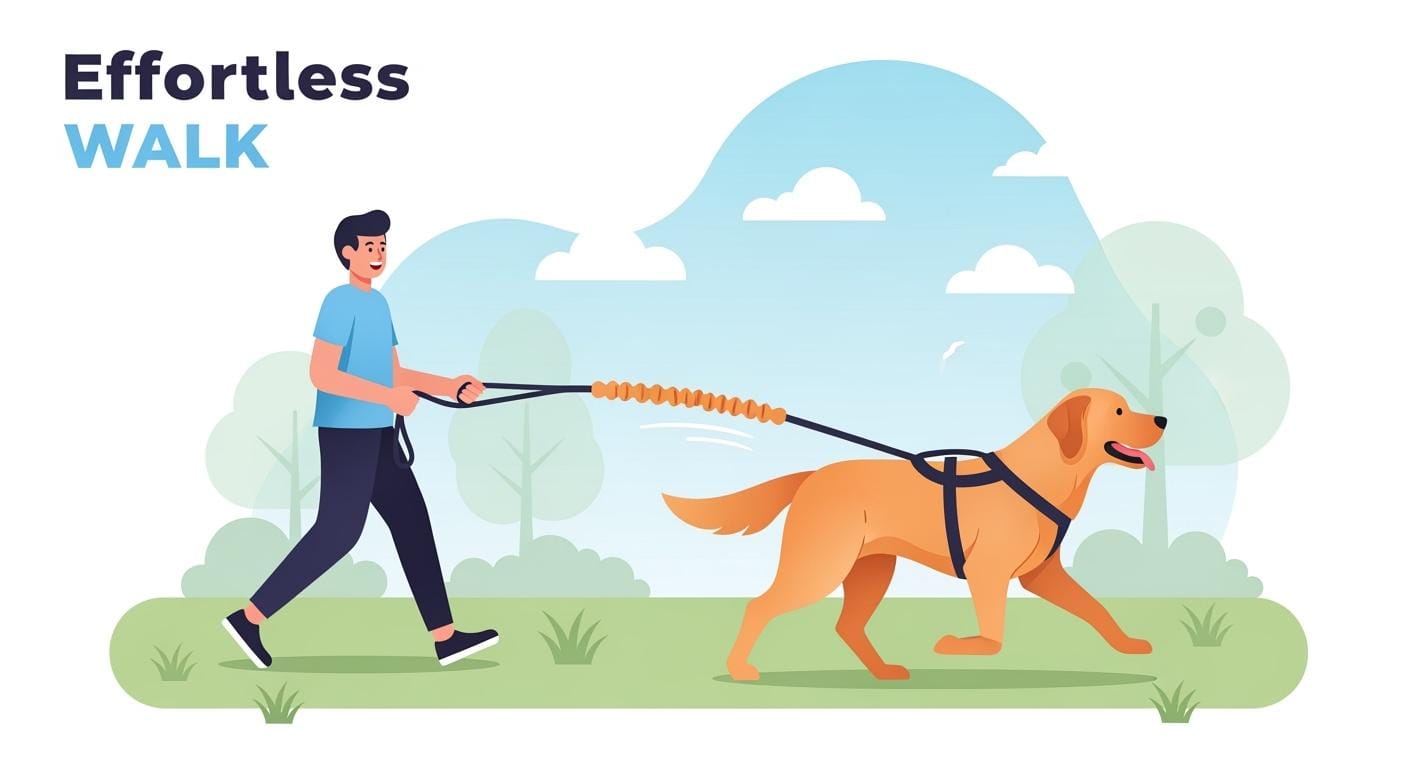
Shock-absorbing bungee sections complicate this picture. A bungee that stretches more than a few inches under typical walking tension creates two problems. First, the stretch itself is a form of length instability — the handler’s control distance varies continuously with load. Second, bungee recoil can yank webbing through the slider in the opposite direction from pull-creep, creating bidirectional wear on the adjuster. A bungee leash with toothed adjustment hardware limits stretch to a short, controlled zone while keeping the main length stable — the bungee absorbs shock, but the slider keeps the baseline distance.
Webbing surface and tail management
Run your thumb along the inner surface of the webbing where it passes through the slider after a walk. A polished, glossy feel means the weave has burnished smooth from micro-slippage — the surface can no longer generate enough friction to assist the hardware. A matte, slightly textured surface that still feels uniform indicates the weave is maintaining micro-resistance. This is a check you can do in ten seconds at the end of any walk.
Tail management is the overlooked half of the problem. A loose tail hanging from the adjuster adds weight on the exit side of the slider. Under movement, that weight bounces, applying oscillating tension that walks the webbing through the adjuster — even when the dog is not pulling. A simple elastic tail keeper or stitched loop arrests this mechanism. It costs almost nothing in materials and prevents a failure mode that no amount of slider grip can fix, because the force is coming from the wrong side of the adjuster. Spotting wear patterns at stress points before they become failures includes checking whether the keeper itself is stretching out — a loose keeper is no keeper at all.
Fixed-length zones and close-control handles
A close-control handle positioned 12–18 inches from the clip creates a fixed-length zone that bypasses the adjuster entirely. Grab it, and the dog is at a known distance regardless of what the slider has done. This is not a convenience feature. It is a safety redundancy — a second control point that does not rely on the same hardware as the primary length setting.
In walking control setups where predictable distance matters — crossing streets, passing other dogs, navigating doorways — this redundancy means the handler never needs to look down and re-adjust mid-stride. A 4-foot fixed-length leash provides the same predictability but at the cost of versatility. A 6-foot adjustable with a close-control handle and a toothed slider gives both: fixed-length precision when needed, longer reach when conditions allow.
| Walking Situation | Slider Holds? | Tail Managed? | Control Distance | Outcome |
|---|---|---|---|---|
| Crowded sidewalk | Yes | Yes | Stable | Predictable control |
| Hiking on mixed terrain | No | No | Drifts longer | Loss of close control on descents |
| Park entrance | Yes | No | Mostly stable | Tail catches on brush; minor drift |
| Dog park / event space | No | No | Drifts unpredictably | Cannot shorten quickly enough |
| Training session | Yes | Yes | Stable | Consistent feedback loop |
When the Design Holds — and When It Falls Short
Toothed hardware and textured webbing perform best under the conditions that most commonly cause drift: intermittent tension from pace changes, off-axis pulling from a dog working side to side, and the low-amplitude vibration of a trotting dog transmitted through the leash. These are everyday walking conditions, not edge cases.
The design reaches its limits when the webbing is wet. Water acts as a lubricant between slider and webbing, reducing the mechanical engagement of teeth by allowing fibers to slide within the weave rather than locking against protrusions. Nylon webbing absorbs water and swells slightly, which can either increase grip (if the swelling tightens the slider clearance) or decrease it (if the water film overrides the texture). The direction depends on the specific weave density and slider tolerance. There is no universal answer — only the observation that a leash that holds dry may drift wet, and the tape-mark test described earlier catches both conditions.
A close-control handle solves the symptom — it gives the handler a fixed reference point — but does not solve the drift mechanism itself. For handlers who rely primarily on the adjustable length rather than the close-control grip, hardware quality and webbing texture remain the gatekeepers of stable control distance.
Disclaimer: The tape-mark drift test assumes a standard flat-webbing leash with a tri-glide or ladder-lock adjuster. Leashes with tubular webbing, rubberized grip strips, or cam-lock buckles may show different drift patterns — a surface mark may not capture creep if the hardware grips unevenly across the webbing width. For bungee-core leashes, apparent length change can also come from elastic recovery failure rather than slider slip. Isolate stretch from hardware drift before concluding the adjuster is at fault.
Häufig gestellte Fragen
How do you check if a leash is drifting longer during a walk?
Place a piece of tape at the webbing exit point of the slider before starting. Walk normally for ten minutes with natural stops and turns. If the tape has migrated more than half an inch from the slider, the hardware is not holding under real load.
Why does webbing texture matter more than thickness for slip resistance?
Thickness adds tensile strength. But slip resistance comes from surface interaction — how the weave presents contact points to the slider teeth. A thin, coarsely-woven webbing can resist slip better than a thick, glassy-smooth one because the teeth have more structure to engage.
Does a wet leash always slip more?
Not always. Water can act as a lubricant and reduce grip, but if the webbing swells enough to tighten clearance inside the slider, friction can actually increase. The direction depends on weave density and slider tolerance. The tape-mark test catches either outcome.